Creature Lore of Oman's Wildest Stories
Oman does not have a single nationally famous cryptid comparable with Scotland’s Loch Ness Monster or North America’s Bigfoot. Its mystery-creature tradition is older, more scattered and harder to separate from folklore.
Page outline Jump by section
Introduction
That distinction matters. Oman’s surviving oral traditions are not field reports of undiscovered species, while most modern “monster” images lack the dates, witnesses and physical evidence needed for serious zoological investigation. Yet the country is unusually well suited to strange-animal stories. Its deep seas hold whales, whale sharks and unfamiliar pelagic creatures; its deserts and mountains shelter elusive leopards, hyenas, wolves and caracals; and Dhofar’s caves, mist and seasonal greenery provide a dramatic setting for tales in which the natural and supernatural meet.[academia.edu]academia.eduPDF) An Ethnographic Discussion of Fairy Tales and Folktales from Southern OmanAcademia(PDF) An Ethnographic Discussion of Fairy Tales and Folktales from Southern Oman…
Why Oman has no single defining cryptid
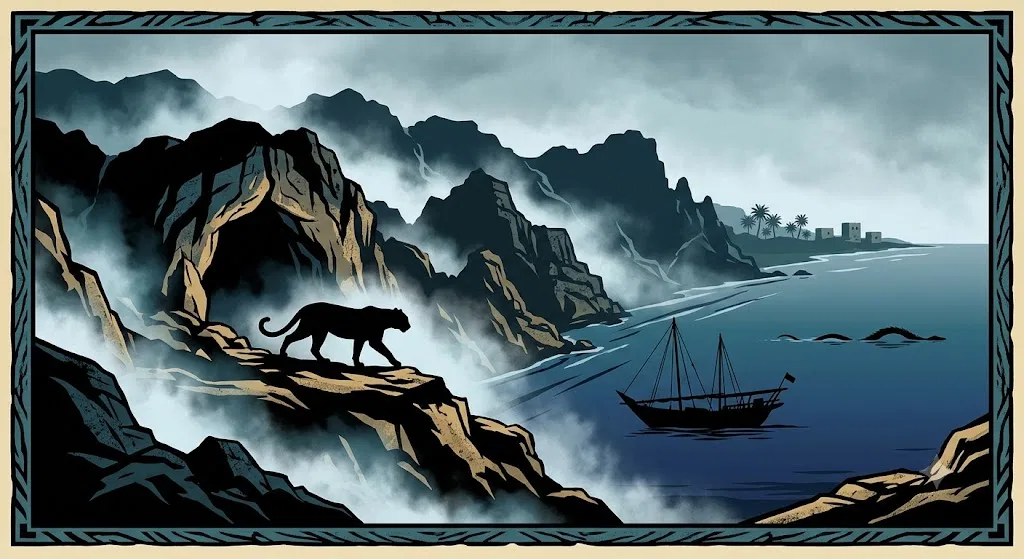
The most honest answer to “What is Oman’s cryptid?” is that there is no well-documented national candidate. Searches of zoological research, conservation records, Omani wildlife reporting and published folklore reveal no long-running series of sightings centred on one unknown animal. Instead, stories are local and varied: a frightening creature in a mountain tale, an animal-shaped supernatural encounter, a puzzling marine photograph or a rare predator unexpectedly appearing near a settlement.
This fragmented pattern partly reflects how folklore was preserved. Much of southern Oman’s traditional storytelling was oral, and systematic recording came comparatively late. Research on tales collected in Dhofar during the 1970s notes that they were recorded in local, previously unwritten languages during a period of rapid modernisation. The material includes animal fables, wonder tales and stories involving supernatural beings, but it was not originally organised as a catalogue of named monsters.[Academia]academia.eduPDF) An Ethnographic Discussion of Fairy Tales and Folktales from Southern OmanAcademia(PDF) An Ethnographic Discussion of Fairy Tales and Folktales from Southern Oman…
Published scholarship also warns against stripping these stories from their social setting. Animals in Dhofari tales often reflect animals that people actually knew: wolves, leopards, hyenas, foxes, vultures, ravens, ibex and cattle. They function as tricksters, threats, rivals and moral examples. In one documented fable, a travelling group includes a wolf, leopard, hyena, vulture, raven and fox—an assembly drawn from the region’s ecological memory rather than an invented bestiary.[Academia]academia.eduPDF) An Ethnographic Discussion of Fairy Tales and Folktales from Southern OmanAcademia(PDF) An Ethnographic Discussion of Fairy Tales and Folktales from Southern Oman…
That makes Oman’s creature lore different from modern cryptozoology. A cryptozoological claim usually asks whether an unknown flesh-and-blood animal exists. An Omani folktale may instead use a familiar animal, an impossible event and a recognisable landscape to teach caution, endurance or cleverness. The creature’s cultural truth does not depend on its zoological reality.
Dhofar’s animals, caves and supernatural encounters
Southern Oman provides the richest setting for mystery-beast traditions. Dhofar differs sharply from much of the Arabian Peninsula: its seasonal monsoon supports greener mountains, cattle herding and wildlife associated with rugged uplands. Recorded tales contain caves, grazing grounds, isolated paths and animals such as leopards and hyenas. These are not decorative details; researchers use them as “physical markers” showing that the stories grew from a specifically Dhofari environment.[Academia]academia.eduPDF) An Ethnographic Discussion of Fairy Tales and Folktales from Southern OmanAcademia(PDF) An Ethnographic Discussion of Fairy Tales and Folktales from Southern Oman…
Some tales cross the boundary between animal story and supernatural narrative. Academic study of Dhofari folklore identifies several stories involving supernatural beings and notes that local tellers could regard such accounts as descriptions of reality rather than as simple fairy tales. In wider Arabian tradition, these beings may appear in human or animal form, but treating every such story as a cryptid sighting would be misleading. They belong primarily to religious belief and folklore, not to claims about an undiscovered species.[Academia]academia.eduPDF) An Ethnographic Discussion of Fairy Tales and Folktales from Southern OmanAcademia(PDF) An Ethnographic Discussion of Fairy Tales and Folktales from Southern Oman…
Omani literature has continued to reuse this older imaginative world. A 2024 study describes oral myth and legend as a long-standing influence on Omani writers, particularly through stories transmitted by mothers and grandmothers. Modern novels may transform inherited beings and motifs into literary symbols, so a creature that appears in contemporary fiction should not automatically be read as evidence of a continuing eyewitness tradition.[PAS Journals]journals.pan.plPAS Journals
The useful distinction is therefore:
- Folklore creature: part of an inherited tale, moral lesson or supernatural worldview.
- Witness claim: an account presented as something actually seen at a stated place and time.
- Media mystery: a photograph or video circulated without enough context to verify it.
- Known animal: a rare, distant or badly observed species mistaken for something unknown.
Most Omani material belongs to the first and fourth categories. Firmly documented examples of the second are scarce.
The Strait of Hormuz sea-serpent photograph
The closest thing to an internationally circulated Omani cryptid case is a photograph said to have been taken in 1936 in or near the Strait of Hormuz. It is commonly attributed to a man named Laurent Pelletier and described online as showing a thick, serpentine form at the surface. Later retellings say the photographer compared it to a large snake digesting prey.[Reddit]reddit.comthis photo was taken in 1936 by laurent pelletier24, 2023 — This photo was taken in 1936 by Laurent Pelletier. Who described the creature photographed as being “like a boa d…
The case is intriguing but evidentially weak. The surviving story is mainly repeated on cryptozoology forums and social-media pages, not in a readily verifiable contemporary newspaper report, scientific archive or original photographic collection. Important details remain unclear: the exact location, the identity and background of the photographer, whether the image is an original print, what camera and lens were used, how long the object was observed and whether anyone else saw it.
Even its connection to Oman requires care. The Strait of Hormuz lies between Oman and Iran, and an imprecise “Hormuz” location does not establish that the object was in Omani territorial waters or that the story formed part of Omani popular tradition. Its modern afterlife is chiefly international and internet-based. It is better described as a sea-serpent photograph associated with the waters beside Oman than as “Oman’s sea monster”.
Several ordinary explanations remain available. A line of dolphins or whales surfacing in sequence can produce the illusion of a single humped body. A whale’s back, fluke or disturbed wake can appear elongated in a still image. Floating debris, fishing gear and a large ray or shark seen at an awkward angle are also plausible. Natural-history specialists have long noted that historical sea monsters were frequently inspired by whales, sharks, large fish, squid and decomposing carcasses.[Natural History Museum]nhm.ac.ukOpen source on nhm.ac.uk.
Nothing in the Pelletier case demonstrates an unknown animal. Its value lies instead in showing how a poorly documented photograph can acquire a stable cryptid identity decades later. The lack of an accessible primary record has not stopped the story spreading; it has made the image easier to reinterpret.

Real animals that can look monstrous
Oman’s fauna supplies more convincing explanations for mystery sightings than an undiscovered giant beast. The country supports several large or elusive species that most residents and visitors will never see clearly in the wild.
Arabian leopard. This critically endangered big cat survives in the mountains of southern Oman. It is secretive, mainly active when people are less likely to observe it and associated with steep, broken terrain. A brief night sighting, indistinct trail-camera image or glimpse of a long-tailed animal on a ridge can easily grow in the retelling.[PMC]pmc.ncbi.nlm.nih.govThe mountains areWild fauna in Oman: Current situation and perspectives, with…by M Giangaspero · 2025 · Cited by 2 — The Environment Authority was r…
Striped hyena, Arabian wolf and caracal. All are recognised members of Oman’s fauna. The hyena’s sloping back and mane can appear oddly proportioned; the caracal’s long legs and black ear tufts give it an unfamiliar silhouette; and wolves may be mistaken for unusually large dogs. Oman’s Environment Authority lists these animals among the country’s protected or regulated native wildlife, confirming that reports of strange predators need not involve phantom species.[cloud.gbif.org]cloud.gbif.orgOpen source on gbif.org.
Whale sharks. These enormous, spotted fish occur in Omani waters, with research focused on Musandam and the Daymaniyat Islands. A whale shark moving just beneath the surface can be perceived as a vast dark body, particularly from a small boat. Scientific photo-identification studies have recorded hundreds of individual whale sharks across the Arabian Gulf and northern Gulf of Oman region.[Marine Megafauna Foundation]marinemegafauna.orgOpen source on marinemegafauna.org.
Whales and dolphins. At least 20 cetacean species have been recorded in Oman’s waters, including four great whales. Groups surfacing in sequence can create the classic “many-humped serpent” effect, while a distant whale seen head-on or partly obscured may seem unlike any familiar animal. Oman is especially important for the endangered Arabian Sea humpback whale population.[ESO]eso.org.omWhale and Dolphin Research and ConservationThere are over 80 species of cetaceans in the world, 20 of them live in Oman's water, inclu…
Large marine animals also wash ashore in incomplete or decomposed condition. Skin loss, collapsed tissue and missing fins can make a whale or shark carcass look reptilian. Without examination by marine biologists, such remains often become “monster” photographs before a mundane identification catches up.
Where mystery reports are most likely to cluster
Although Oman lacks a recognised cryptid hotspot, its geography suggests several areas where unusual-animal reports are most likely to arise.
Dhofar’s mountains and escarpments combine caves, seasonal fog, isolated grazing areas and surviving large carnivores. They are also the strongest documented centre of local animal folklore. The overlap of real predators and inherited storytelling makes Dhofar the country’s most important region for interpreting beast legends.[Academia]academia.eduPDF) An Ethnographic Discussion of Fairy Tales and Folktales from Southern OmanAcademia(PDF) An Ethnographic Discussion of Fairy Tales and Folktales from Southern Oman…
Musandam and the Strait of Hormuz offer steep coastal cliffs, deep channels, heavy maritime traffic and sightings of whales, dolphins and whale sharks. Distance, glare and rough water make size and shape difficult to judge. The disputed 1936 serpent photograph has added a thin layer of cryptid mythology to an already dramatic seascape.[forums.forteana.org]forums.forteana.orgThe Pelletier Sea Serpent Photo (1936; Strait Of Hormuz)9 Oct 2020 — The lost sea serpent photograph of 1936… The Pelletier Sea Serpen…
The Arabian Sea coast and Hallaniyat Islands support diverse cetaceans, including deep-diving species that are unfamiliar even to many experienced sailors. Scientific surveys around southern Oman have recorded humpback whales, beaked whales and smaller deep-water cetaceans. A rare surfacing animal may therefore be genuinely unusual without being scientifically unknown.[archive.iwc.int]archive.iwc.intOpen source on iwc.int.
Interior deserts and gravel plains produce a different kind of uncertainty. Long viewing distances, heat shimmer and nocturnal activity can distort the appearance of gazelles, foxes, wolves, hyenas and feral animals. Reports from these areas require basic information—tracks, scale, direction of movement and repeated observation—before an exotic explanation becomes necessary.

Hoaxes, viral images and missing evidence
Modern Omani mystery-animal stories increasingly circulate through social media, where a dramatic image may be detached from its original location. Posts labelled “found in Oman” or “seen near Muscat” are often reposted without the photographer’s name, date or unedited footage. Some use images from other countries; others show known deep-sea animals, unusual octopuses or decomposed carcasses.
A credible anomalous-animal case should provide more than a striking picture. The most useful evidence would include an original file with metadata, a precise location, multiple independent witnesses, several photographs from different angles, scale references, tracks or biological material, and examination by a relevant zoologist. Oman’s active whale, shark and terrestrial-wildlife research means that a genuinely unknown large animal should eventually leave repeatable evidence in surveys, strandings, camera traps, fishing records or genetic samples.
The current record does not meet that threshold. The country’s best-known “sea serpent” is poorly sourced, while its strongest creature traditions are clearly embedded in folklore and literature. Reports of strange cats, dogs or marine shapes are more economically explained by Oman’s known but rarely seen wildlife.
How the legend has changed
Oman’s mystery-creature tradition has moved through three broad stages. First came local oral storytelling, in which animals, supernatural beings and familiar landscapes carried moral and cultural meaning. Second came twentieth-century collection and publication, when researchers and writers recorded tales that had previously circulated mainly by speech. Third came the internet era, in which isolated photographs and wildlife clips were relabelled as cryptid material for a global audience.[Academia]academia.eduPDF) An Ethnographic Discussion of Fairy Tales and Folktales from Southern OmanAcademia(PDF) An Ethnographic Discussion of Fairy Tales and Folktales from Southern Oman…
This shift changes the creatures themselves. A leopard in an older Dhofari tale may be a dangerous but recognisable part of the mountain world. A shadowy cat in a modern video becomes a “mystery beast”. A disputed photograph near Hormuz becomes a named sea-serpent case despite having little demonstrable connection to Omani folklore. The internet favours a single monster with a memorable label; Oman’s older traditions are more local, varied and resistant to that format.
The result is a country with rich creature lore but a thin conventional cryptid record. Oman’s strangest animal stories are most rewarding when read at the meeting point of ecology and folklore: real leopards behind mountain fears, real whales behind serpentine shapes, and inherited tales reshaped by modern media. The mystery remains, but it is less about proving a hidden species than understanding how unfamiliar animals, difficult landscapes and storytelling turn brief encounters into enduring monsters.
Amazon book picks
Further Reading
Books and field guides related to What Creatures Haunt Oman's Wildest Stories?. Use these as the next step if you want deeper reading beyond the article.
Field Guide To Bigfoot, Yeti, & Other Mystery Primates Worldwide
Provides global context for evaluating cryptid traditions like those discussed in Oman.
The Mythical Creatures Bible
Introduces creature traditions comparable to those found in Oman.
eBay marketplace picks
Marketplace Samples
Live-tested eBay searches with available results related to this page.
Endnotes
1.
Source: academia.edu
Title: (PDF) An Ethnographic Discussion of Fairy Tales and Folktales from Southern Oman
Link:https://www.academia.edu/78422166/An_Ethnographic_Discussion_of_Fairy_Tales_and_Folktales_from_Southern_Oman
Source snippet
Academia(PDF) An Ethnographic Discussion of Fairy Tales and Folktales from Southern Oman...
2.
Source: pmc.ncbi.nlm.nih.gov
Title: The mountains are
Link:https://pmc.ncbi.nlm.nih.gov/articles/PMC11910281/
Source snippet
Wild fauna in Oman: Current situation and perspectives, with...by M Giangaspero · 2025 · Cited by 2 — The Environment Authority was r...
3.
Source: eso.org.om
Link:https://eso.org.om/whales-and-dolphins/
Source snippet
Whale and Dolphin Research and ConservationThere are over 80 species of cetaceans in the world, 20 of them live in Oman's water, inclu...
4.
Source: journals.pan.pl
Title: PAS Journals
Link:https://journals.pan.pl/Content/133686/PDF-MASTER/ROrient%2077%20z.%202-24%203Al-Saadi.pdf
5.
Source: reddit.com
Title: this photo was taken in 1936 by laurent pelletier
Link:https://www.reddit.com/r/Cryptozoology/comments/12xu963/this_photo_was_taken_in_1936_by_laurent_pelletier/
Source snippet
24, 2023 — This photo was taken in 1936 by Laurent Pelletier. Who described the creature photographed as being “like a boa d...
Published: April 24, 2023
6.
Source: forums.forteana.org
Link:https://forums.forteana.org/index.php?threads%2Fthe-pelletier-sea-serpent-photo-1936-strait-of-hormuz.67820%2F=
Source snippet
The Pelletier Sea Serpent Photo (1936; Strait Of Hormuz)9 Oct 2020 — The lost sea serpent photograph of 1936... The Pelletier Sea Serpen...
7.
Source: cloud.gbif.org
Link:https://cloud.gbif.org/asia/resource?r=mammals_of_oman&request_locale=en&v=1.0
8.
Source: pmc.ncbi.nlm.nih.gov
Link:https://pmc.ncbi.nlm.nih.gov/articles/PMC4928964/
9.
Source: archive.iwc.int
Link:https://archive.iwc.int/pages/download.php?direct=1&ext=pdf&k=&noattach=true&ref=11895
10.
Source: academia.edu
Link:https://www.academia.edu/Documents/in/Mythical_Creatures
11.
Source: forums.forteana.org
Link:https://forums.forteana.org/index.php?threads%2Fthe-pelletier-sea-serpent-photo-1936-strait-of-hormuz.67820%2Fpage-2=
12.
Source: forums.forteana.org
Link:https://forums.forteana.org/index.php?tags%2Fpelletier%2F=
13.
Source: forums.forteana.org
Link:https://forums.forteana.org/index.php?tags%2Fhormuz%2F=
14.
Source: forums.forteana.org
Link:https://forums.forteana.org/index.php?forums%2Fcryptozoology-water-monsters.39%2Fpage-2=
15.
Source: forums.forteana.org
Link:https://forums.forteana.org/index.php?tags%2Fsea-monsters%2F=
16.
Source: reddit.com
Link:https://www.reddit.com/r/Cryptozoology/comments/1agau3s/according_to_bernard_heuvelmans_in_the_wake_of/
17.
Source: youtube.com
Title: Under Siege: A Mother Leopard’s Brutal Battle to Protect Her Cubs
Link:https://www.youtube.com/watch?v=ngA7lY0P76c
Source snippet
Witness - Saving the Leopard...
18.
Source: youtube.com
Link:https://www.youtube.com/watch?v=lA2yIaY4w4I
Source snippet
Biosphere Expeditions: Arabian leopard conservation, Oman...
19.
Source: nhm.ac.uk
Link:https://www.nhm.ac.uk/discover/sea-monsters-inspiration-serpents-mermaids-the-kraken.html
20.
Source: Wikipedia
Title: Sea monster
Link:https://en.wikipedia.org/wiki/Sea_monster
21.
Source: ea.gov.om
Link:https://www.ea.gov.om/en/authority-services/service-catalogue/service-catalogue/permit-to-possess-certain-species-of-oman-wild-animals-bred-in-captivity/
22.
Source: marinemegafauna.org
Link:https://marinemegafauna.org/whale-sharks/oman-research-project
23.
Source: Wikipedia
Title: Sea serpent
Link:https://en.wikipedia.org/wiki/Sea_serpent
Additional References
24.
Source: newlinesmag.com
Title: middle east myths and monsters reveal our humanity
Link:https://newlinesmag.com/essays/middle-east-myths-and-monsters-reveal-our-humanity/
Source snippet
New Lines MagazineMiddle East Myths and Monsters Reveal Our Humanity31 Oct 2022 — Though jinn, ghouls and other creatures from folklore s...
25.
Source: researchgate.net
Link:https://www.researchgate.net/publication/304644902_Population_Structure_Abundance_and_Movement_of_Whale_Sharks_in_the_Arabian_Gulf_and_the_Gulf_of_Oman
26.
Source: researchgate.net
Link:https://www.researchgate.net/publication/396099816_Gender_Representation_in_Omani_Folktales_An_Analysis_Through_Kristeva%27s_Symbolic_and_Semiotic_Framework
27.
Source: facebook.com
Link:https://www.facebook.com/OmanPocketGuide/posts/arabian-oryx-omans-national-animal-source-oman-observeroman-travel-myoman-travel/5102147133189523/
28.
Source: facebook.com
Link:https://www.facebook.com/CinematicUniverse.hoanh/posts/enigmatic-human-lobster-hybrid-unearthed-in-arabian-seaomans-ancient-sea-secret-/776761881587067/
29.
Source: facebook.com
Link:https://www.facebook.com/muscatdailyonline/posts/following-reports-of-an-arabian-caracal-in-al-maysar-village-the-environment-aut/1548955470564155/
30.
Source: instagram.com
Link:https://www.instagram.com/p/DXQ49UNjG2n/
31.
Source: facebook.com
Link:https://www.facebook.com/thearabianstories/posts/heres-todays-top5-stories-from-oman-and-around-the-world-summed-up-for-you/1107927374685129/
32.
Source: facebook.com
Link:https://www.facebook.com/groups/378371256226063/posts/1247944665935380/
33.
Source: ebsco.com
Link:https://www.ebsco.com/research-starters/religion-and-philosophy/legendary-creatures
Topic Tree
Follow this branch
Related pages 192
- Antigua Cryptids
- Maldives Monsters
- Malta Monsters
- Qatar Monsters
- Argentina Monsters
- +187 more in sidebar