Where Do Portugal's Monster Stories Come From?
Portugal has no single modern cryptid to rival the Loch Ness Monster or Bigfoot. Its mystery-creature tradition is older, more scattered and more closely woven into folklore, maritime history and living festivals.
Page outline Jump by section
Introduction
That distinction matters. Portugal offers abundant monster folklore but comparatively little well-documented evidence of a persistent, unidentified animal. Most cases belong clearly to legend, ritual or literature; others may reflect fleeting encounters with rare wildlife. The result is not an empty cryptid map, but a country where the most revealing question is often not What unknown species lives here? but How did real landscapes and animals become monsters in memory?
Why Portugal has no national cryptid
Portugals mystery-animal stories do not usually form the familiar modern pattern of repeated sightings, blurry photographs and organised searches. No Portuguese lake has produced a sustained monster industry comparable with Loch Ness, and there is no widely recognised national archive of ape-men, phantom panthers or unknown winged creatures.
Instead, several traditions overlap:
- Folklore creatures were passed through oral storytelling and recorded by ethnographers.
- Festival monsters survive as costumes, puppets and ritual opponents.
- Literary monsters represent dangerous places or historical anxieties.
- Rare real animals can appear unfamiliar enough to generate rumours or mistaken identification.
- Modern sighting claims occur occasionally but have rarely developed into long-running, independently documented cases.
This makes Portugal especially useful for understanding how the word cryptid can blur different categories. A dragon paraded through a town, a shape-shifting figure in a folktale and an unidentified animal seen beside a road are not the same kind of evidence. They may all be called monsters, but only the last is even potentially a zoological claim.
The Coca: Portugals living dragon
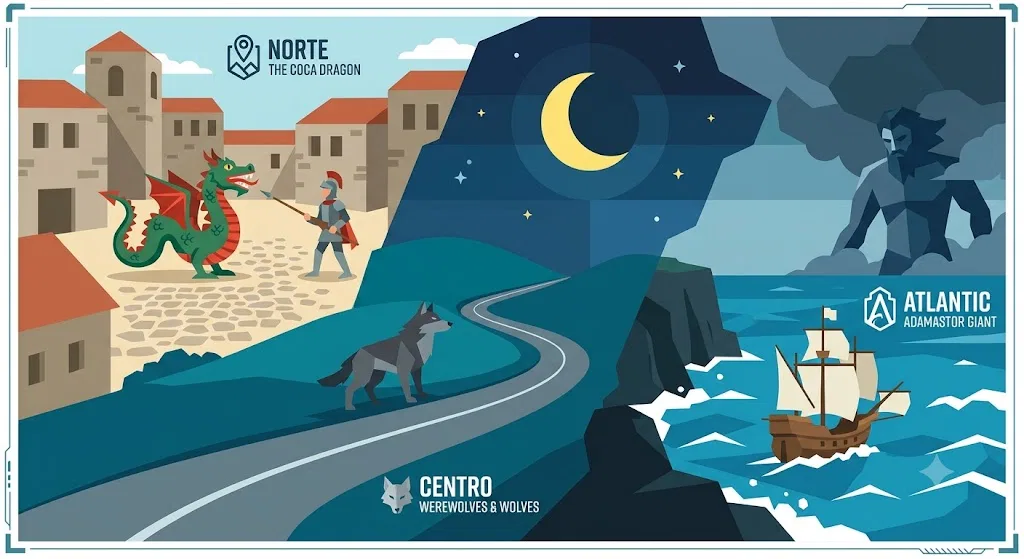
The most visible Portuguese monster is the Coca of Mono, in the far north near the Spanish border. It is a large dragon-like festival figure that fights Saint George during celebrations associated with the feast of Corpus Christi. The municipal presentation of the tradition describes the contest as a celebration of Saint Georges victory over the Coca, while Portugals cultural heritage authority formally added the Combate da Coca to the national inventory of intangible cultural heritage in May 2026.[moncaoeodragao.cm-moncao.pt]moncaoeodragao.cm-moncao.ptMono e o DragoPor esta razo, o povo de Mono celebra a vitria de S. Jorge sobre a Coca, no dia da sua maior festa, a festa do Corpo…
The creature is deliberately grotesque and hybrid rather than zoologically precise. Historical descriptions portray it processing through Mono before the mock combat, followed by shouting spectators from both Portugal and neighbouring Galicia. The ritual is old enough to have accumulated several interpretations, but the available evidence supports its identity as a ceremonial monster, not a memory of an unknown animal.[Patrimnio Cultural]patrimoniocultural.gov.ptPatrimnio Cultural Praticas sociais, rituais e eventos festivos 2Categoria: FestJuly 11, 2025… Coca de Mono. como j se disse, costume antiqussimo sair a Coca de manh a passear a sua misterio…
Its importance lies in what happens after a monster stops being feared literally. The Coca has become:
- a recognised emblem of Mono;
- the centrepiece of a public contest;
- a shared cross-border tradition;
- a cultural attraction that turns an old dragon story into an annual performance.
The creature therefore survives not through eyewitness reports but through repetition. Each performance renews the idea that the community has a monster of its own, even though everybody can see how it is constructed and operated.
The Coca also belongs to a wider European family of processional dragons defeated by saints or heroic figures. Yet its continuing association with one Portuguese town gives it a stronger local identity than many museum-bound folklore creatures. It is arguably Portugals closest equivalent to a civic cryptid mascot: not an animal awaiting discovery, but a monster whose cultural reality is beyond doubt.
Werewolves, animal transformations and night roads
Portugals werewolf tradition differs in important ways from the modern cinematic image of a human becoming a wolf under a full moon. Older Portuguese accounts describe a cursed or fated person who goes out at night, removes their clothes at a crossroads and rolls on ground where an animal has lain. The person then assumes that animals form and travels through the night running the fate. Depending on the region and version, the transformed shape might be a wolf, dog, horse, donkey or goat.[OpenEdition Books]books.openedition.orgOpen Edition Books VIIuma desgraa que pode ferir a pessoa, um destino fatal…Read more…
That variety suggests the tradition was not originally a claim about a single biological wolf-man species. It was a flexible explanation for alarming sights and sounds encountered after dark: an animal behaving strangely, a person wandering at night, hoofbeats without a visible rider or a dog appearing repeatedly along an isolated road.
Portuguese folklorists also recorded related figures. The tardo, for example, was said to appear in animal form, trouble sleepers and disorient travellers at streams, roads and crossroads. Some traditions linked it to a longer cycle of transformation that could eventually produce a werewolf.[Wikipedia]WikipediaOpen source on wikipedia.org.
These stories belong to landscapes where wolves were not imaginary. The Iberian wolf survives in northern and central Portugal, although its range has contracted and become fragmented. Portuguese conservation authorities regard it as endangered nationally and strictly protected.[ICNF]icnf.ptPrograma Alcateia 2025-2035July 16, 2025 Prembulo. O lobo-ibrico (Canis lupus signatus Cabrera, 1907) estritamente protegido em…
A real wolf glimpsed briefly at dusk can look larger, darker or more human-like than it does in daylight, especially when fear and expectation shape the encounter. Dogs, donkeys and other domestic animals moving loose at night provide further possibilities. This does not explain every folktale individually, but it helps explain why transformation legends remained persuasive: the stories were built around animals people genuinely encountered, heard and feared.
Enchanted serpents at wells, caves and ancient stones
Another major strand of Portuguese monster folklore concerns enchanted women associated with springs, wells, rivers, caves, ruins and hidden treasure. In some versions, the woman can assume the form of a serpent or appear as a partly human, partly snake-like being. These stories were recorded across Portugal and Galicia, often around old monuments or places interpreted locally as entrances to an underground realm.[Wikipedia]WikipediaEnchanted mouraEnchanted moura
The serpent form is particularly relevant to mystery-creature history because it joins three recurring ideas:
- A dangerous animal guards a place.
- A hidden human identity lies beneath its appearance.
- A treasure or release from enchantment rewards the person brave enough to approach it.
This is folklore rather than field zoology. The serpent is part guardian, part transformed person and part test of courage. Nevertheless, such traditions can influence the way later witnesses interpret ordinary animals. A large snake beside a spring is not merely a snake in a community where the location already has a story about an enchanted serpent.
Portugal has several native snake species, none of which approaches dragon-like proportions. Brief sightings, poor visibility and exaggeration can make snakes seem much larger than they are, while shed skins provide impressive but misleading clues because they stretch during removal. The folklore adds meaning after the event: a natural encounter becomes evidence that the old story still inhabits the landscape.
These legends also show why not every creature tradition should be forced into a cryptozoological category. The beings speak, guard treasure, change form and can be released by ritual actions. Their purpose is narrative and symbolic. Treating them as misremembered zoological species would remove the very features that made the stories memorable.
Adamastor and the monsters of the Atlantic
Portugals strongest monster tradition may be maritime rather than terrestrial. In The Lusiads, first printed in 1572, Cames created Adamastor, a giant who emerges from a storm cloud as the Portuguese fleet approaches the Cape of Good Hope. The figure personifies the dangerous sea, threatens shipwreck and death, and gives human form to the hazards confronting sailors attempting to round southern Africa. Literary scholarship places Adamastor within traditions of classical giants and epic monsters while emphasising his role as a figure of the unknown.[umassd.edu]ojs.lib.umassd.eduOpen source on umassd.edu.
Adamastor is not a reported animal, and the encounter was never presented as a natural-history observation. Yet he belongs in Portugals monster history because he turns sailors fears into a creature. Storms, unfamiliar currents, rocky coasts and wrecks become the actions of a hostile giant.
The character had a long afterlife in Portuguese and international literature. A monumental figure of Adamastor was installed at the Santa Catarina viewpoint in Lisbon in 1927, where the monster now overlooks the Tagus rather than the Cape he originally guarded.[Wikipedia]WikipediaOpen source on wikipedia.org.
He also provides a useful key to older sea-monster reports. Sailors often encountered animals under difficult conditions: distant whales, lines of dolphins, sharks, basking fish, floating debris and tentacled bodies at the surface. Without modern field guides, photography or rapid communication with specialists, a strange shape could remain unidentified and enter maritime storytelling.
When the monster is a giant squid
Portuguese waters have produced genuine animals capable of supporting sea-monster imagery. A scientific paper documented the first recorded giant squid specimen from the Portuguese coast after a mature male was found in 2002 near the stretch between Gal and the Melides lagoon. The specimen measured more than six metres when its extended parts were included.[ResearchGate]researchgate.netResearch Gate First recorded specimen of the giant squid Architeuthis spResearch Gate First recorded specimen of the giant squid Architeuthis sp
Further large squid have been caught off mainland Portugal and Madeira. A 2013 specimen taken near Sesimbra was reported at roughly 6.5 metres and about 50 kilograms, while a giant squid caught near Madeira in 2018 reportedly weighed more than 100 kilograms.[Wikipedia]WikipediaList of giant squid specimens and sightings (20012014List of giant squid specimens and sightings (20012014
These are not cryptids: giant squid are scientifically recognised animals. But they demonstrate how a sea-monster story can begin without fraud. A damaged, decomposing or partly submerged squid does not resemble the neat illustrations in a guidebook. Its arms may be mistaken for multiple serpents, and its size can grow further as the story is retold.
Portugals long Atlantic coastline, deep offshore waters and fishing culture therefore provide credible environmental foundations for monster tales. The mistake comes only when an unusual but known animal is promoted as proof of an undiscovered species without anatomical material, reliable images or expert examination.
Phantom cats and the return of the Iberian lynx
Portugal does not have a well-established phantom-panther tradition on the scale found in Britain, but large-cat confusion remains possible because the country is home once again to a genuine wild feline that many residents had little chance of seeing for decades.
Stable Iberian lynx populations appear to have disappeared from Portugal during the late twentieth century. Reintroduction began in 2015 in the Guadiana Valley around Mrtola, and the population has since expanded. The 2024 Iberian census recorded 2,401 animals across Spain and Portugal, including 354 in Portugal.[icnf.pt]areasprotegidas.icnf.ptOpen source on icnf.pt.
This recovery changes the interpretation of large-cat sightings. A witness who sees a long-legged feline crossing a road may correctly have seen a lynx, particularly in or near established southern territories. Distance and poor light can conceal the animals spotted coat, facial ruff and short tail. Conversely, a domestic cat seen without a scale reference can appear far larger than it really is.
The lynx does not explain descriptions of a black, long-tailed panther. Those details would point instead towards misjudged size, a large domestic cat, a dog or, in an exceptional case, an escaped exotic animal. The important point is that a responsible assessment should check recognised wildlife and captivity records before proposing an unknown breeding population.
The species return may also produce a curious reversal in folklore. During the period when lynx were effectively absent, reports could be dismissed as mistakes or memories. Now some surprising sightings may be true precisely because conservation has restored the animal.
Why the evidence remains thin
Portugals creature traditions are culturally rich but zoologically weak. The strongest recurring cases have identifiable origins in ritual, oral folklore or literature. Modern mystery-animal reports generally lack the features needed to establish an unknown species:
- repeated observations by independent witnesses;
- photographs with reliable scale and location data;
- tracks that exclude known animals;
- hair, tissue, droppings or environmental DNA;
- carcasses or bones;
- consistent behaviour and habitat;
- confirmation by wildlife authorities or zoologists.
Eyewitness testimony can still be sincere. People regularly misjudge size, speed and distance, especially at night or when an animal is visible for only seconds. Memory then becomes less exact as witnesses discuss the event, see media coverage or learn that others have reported something similar.
Hoaxes are only part of the picture. Many legends need no deliberate deception. A rare animal, an unfamiliar call, an old story and a suggestive place name can be enough to produce a monster account. Social media increases the speed of circulation, but it also makes it easier for old images, footage from other countries and computer-generated material to be detached from their origins.

What Portugals monsters really reveal
Portugals most important monsters are not failed scientific discoveries. They are ways of organising danger, place and memory.
The Coca turns a dragon battle into a living civic festival. The werewolf gives animal form to cursed wandering and nocturnal fear. Enchanted serpents guard water, ruins and imagined treasure. Adamastor transforms storms and shipwreck into a giant capable of speaking back to explorers. Giant squid, wolves and lynx show how real wildlife can keep the boundary between the familiar and the monstrous surprisingly unstable.
For readers seeking a hidden Portuguese beast, the honest conclusion is that no candidate currently has convincing evidence as an undiscovered animal. For readers interested in how monsters are made, however, Portugal offers something more varied: a chain running from ancient storytelling through maritime literature and public ritual to modern wildlife misidentification.
The countrys creature map is therefore best read in layers. At the bottom are real ecosystems and animals. Above them sit fear, memory and uncertain observation. Above those are legends that communities continue to perform, retell and adapt. The monsters may not be zoologically real, but the places, traditions and human reactions that sustain them certainly are.
Amazon book picks
Further Reading
Books and field guides related to Where Do Portugal's Monster Stories Come From?. Use these as the next step if you want deeper reading beyond the article.
The Book of Imaginary Beings
Introduces the kinds of creatures that appear throughout Portuguese monster traditions.
eBay marketplace picks
Marketplace Samples
Live-tested eBay searches with available results related to this page.


Endnotes
1.
Source: moncaoeodragao.cm-moncao.pt
Link:https://moncaoeodragao.cm-moncao.pt/
Source snippet
Mono e o DragoPor esta razo, o povo de Mono celebra a vitria de S. Jorge sobre a Coca, no dia da sua maior festa, a festa do Corpo...
2.
Source: books.openedition.org
Title: Open Edition Books VII
Link:https://books.openedition.org/etnograficapress/8605?lang=en
Source snippet
uma desgraa que pode ferir a pessoa, um destino fatal...Read more...
3.
Source: Wikipedia
Link:https://pt.wikipedia.org/wiki/Lobisomem
4.
Source: Wikipedia
Link:https://pt.wikipedia.org/wiki/Tardo
5.
Source: icnf.pt
Link:https://www.icnf.pt/api/file/doc/3f6504bbdb61bc4e
Source snippet
Programa Alcateia 2025-2035July 16, 2025 Prembulo. O lobo-ibrico (Canis lupus signatus Cabrera, 1907) estritamente protegido em...
Published: July 16, 2025
6.
Source: icnf.pt
Link:https://www.icnf.pt/api/file/doc/67c86a14f258200a
7.
Source: Wikipedia
Title: Enchanted moura
Link:https://en.wikipedia.org/wiki/Enchanted_moura
8.
Source: Wikipedia
Title: Moura encantada
Link:https://pt.wikipedia.org/wiki/Moura_encantada
9.
Source: ojs.lib.umassd.edu
Link:https://ojs.lib.umassd.edu/plcs/article/download/PLCS7_Blackmore_page255/871/3172
10.
Source: Wikipedia
Link:https://en.wikipedia.org/wiki/Adamastor
11.
Source: researchgate.net
Title: Research Gate First recorded specimen of the giant squid Architeuthis sp
Link:https://www.researchgate.net/publication/233540414_First_recorded_specimen_of_the_giant_squid_Architeuthis_sp_in_Portugal
12.
Source: researchgate.net
Link:https://www.researchgate.net/profile/Ana-Moreno-55/publication/233540414_First_recorded_specimen_of_the_giant_squid_Architeuthis_sp_in_Portugal/links/543be5940cf2d6698be347b3/First-recorded-specimen-of-the-giant-squid-Architeuthis-sp-in-Portugal.pdf
13.
Source: Wikipedia
Title: List of giant squid specimens and sightings (20012014)
Link:https://en.wikipedia.org/wiki/List_of_giant_squid_specimens_and_sightings_%282001%E2%80%932014%29
14.
Source: areasprotegidas.icnf.pt
Link:https://areasprotegidas.icnf.pt/lince/index.php/lince-iberico/reintroducao
15.
Source: icnf.pt
Link:https://www.icnf.pt/noticias/10anosdocentronacionaldereproducaodelinceiberico
16.
Source: areasprotegidas.icnf.pt
Title: estatuto conservacao
Link:https://areasprotegidas.icnf.pt/lince/index.php/lince-iberico/caracteriza-especie/estatuto-conservacao
17.
Source: sig.icnf.pt
Link:https://sig.icnf.pt/portal/home/item.html?fromSearch=true&id=f6e99cc04339442791883132c7db6197&searchFacet=card+dropdown+item+details&searchPosition=7&searchTerm=
18.
Source: icnf.pt
Link:https://www.icnf.pt/imprensa/censodelinceiberico2023
19.
Source: icnf.pt
Link:https://www.icnf.pt/api/file/doc/f5cbadb3b11c6b9b
20.
Source: icnf.pt
Link:https://www.icnf.pt/imprensa/reintroducaodolinceibericoeocomportamentodasraposas
21.
Source: geocatalogo.icnf.pt
Title: lobo distribuicao
Link:https://geocatalogo.icnf.pt/metadados/lobo_distribuicao.html
22.
Source: www3.icnf.pt
Link:https://www3.icnf.pt/imprensa/regressodolinceibericoamalcata
23.
Source: geocatalogo.icnf.pt
Link:https://geocatalogo.icnf.pt/metadados/alcateias.html
24.
Source: icnf.pt
Link:https://www.icnf.pt/api/file/doc/7056e2874281ba9b
25.
Source: geocatalogo.icnf.pt
Title: utm tipopresenca
Link:https://geocatalogo.icnf.pt/metadados/utm_tipopresenca.html
26.
Source: icnf.pt
Link:https://www.icnf.pt/api/file/doc/cd0400ef5a408119
27.
Source: icnf.pt
Link:https://www.icnf.pt/api/file/doc/9cbee89a36ff8c32
28.
Source: areasprotegidas.icnf.pt
Title: pt REINTROD UO DE LINCE-IBRICO
Link:https://areasprotegidas.icnf.pt/lince/index.php/noticias/antes-2016/item/176-reintroducao-lince-iberico-libertacao-maio
29.
Source: areasprotegidas.icnf.pt
Link:https://areasprotegidas.icnf.pt/lince/index.php/documentacao/divulgacao
30.
Source: icnf.pt
Link:https://www.icnf.pt/api/file/doc/b544bd388d2c2583
31.
Source: researchgate.net
Link:https://www.researchgate.net/publication/386201898_Licantropia_e_Lobisomens_praticas_espacos_e_cruzamentos_culturais
32.
Source: cm-moncao.pt
Title: condicionamento de transito.aspx
Link:https://cm-moncao.pt/pt/menu/900/condicionamento-de-transito.aspx
33.
Source: Wikipedia
Title: List of lake monsters
Link:https://en.wikipedia.org/wiki/List_of_lake_monsters
34.
Source: wp.ufpel.edu.br
Link:https://wp.ufpel.edu.br/ppgs/files/2014/06/dissertacao_angelita-soares-ribeiro.pdf
35.
Source: patrimoniocultural.gov.pt
Link:https://www.patrimoniocultural.gov.pt/noticias/noticias-patrimonio-imaterial/
Source snippet
Patrimnio CulturalNotcias Patrimnio ImaterialO Patrimnio Cultural, Instituto Pblico aprovou a inscrio do Combate da Coca, de Mon...
36.
Source: patrimoniocultural.gov.pt
Title: Patrimnio Cultural Praticas sociais, rituais e eventos festivos 2
Link:https://www.patrimoniocultural.gov.pt/wp-content/uploads/2026/03/INPCI_CombateCoca_AnexoI_AperfeicoamentoJul25.pdf
Source snippet
Categoria: FestJuly 11, 2025... Coca de Mono. como j se disse, costume antiqussimo sair a Coca de manh a passear a sua misterio...
Published: July 11, 2025
37.
Source: patrimoniocultural.gov.pt
Link:https://www.patrimoniocultural.gov.pt/wp-content/uploads/2026/03/INPCI_CombateCoca_AnexoII_AperfeicoamentoJul25.pdf
Source snippet
Patrimnio CulturalFicha de Inventrio (Anexo II)Combate da Coca em Mono, existe j alguns apontamentos histricos e levantamento de. P...
38.
Source: researchspace.ukzn.ac.za
Link:https://researchspace.ukzn.ac.za/bitstreams/adddbc32-9960-44fc-8baa-2b6b803806ed/download
39.
Source: jstor.org
Link:https://www.jstor.org/stable/2928486
40.
Source: patrimoniocultural.gov.pt
Link:https://www.patrimoniocultural.gov.pt/wp-content/uploads/2025/02/Revisao-de-Inventario_Vaca-das-Cordas_Anexo-I.pdf
41.
Source: bibliotecas.patrimoniocultural.gov.pt
Title: patrimoniocultural.gov.pt Resultado da pesquisa
Link:https://bibliotecas.patrimoniocultural.gov.pt/Opac/Pages/Search/Results.aspx?Database=10171_BA_GERAL&SearchText=AUT%3D%22NEVES%2C+Leandro+Quintas%22
42.
Source: tomorrowalgarve.com
Title: Iberian lynx
Link:https://tomorrowalgarve.com/iberian-lynx-back-from-the-dead/
Additional References
43.
Source: youtube.com
Title: The Mysterious Old Woman of the White Mare Portuguese Folklore
Link:https://www.youtube.com/watch?v=oIxiLo08v-k
Source snippet
The Incredible Miracle of the Rooster of Barcelos Portuguese Folklore...
44.
Source: youtube.com
Title: The Incredible Miracle of the Rooster of Barcelos Portuguese Folklore
Link:https://www.youtube.com/watch?v=WEiE4jdDtfM
Source snippet
The Dangerous Cabra Cabriola Portuguese Folklore...
45.
Source: youtube.com
Title: The Incredible Horse of Thought Portuguese Mythology
Link:https://www.youtube.com/watch?v=cxCEpHTtP-I
Source snippet
The Fascinating She-Wolf of Portuguese Mythology - Peeira...
46.
Source: youtube.com
Title: The Dangerous Cabra Cabriola Portuguese Folklore
Link:https://www.youtube.com/watch?v=tbYzerVHMB0
Source snippet
The Incredible Horse of Thought Portuguese Mythology...
47.
Source: instagram.com
Link:https://www.instagram.com/p/DaFkxpoC5xy/
48.
Source: jstor.org
Link:https://www.jstor.org/stable/48679911
49.
Source: instagram.com
Link:https://www.instagram.com/p/DVqd1GDCMjr/
50.
Source: mythfolks.com
Link:https://www.mythfolks.com/cryptids/cadborosaurus
51.
Source: unisapressjournals.co.za
Link:https://unisapressjournals.co.za/index.php/jls/article/download/10889/6137/62638
52.
Source: facebook.com
Link:https://www.facebook.com/groups/250840638956722/posts/1460316978009076/
Topic Tree
Follow this branch
Related pages 192
- Antigua Cryptids
- Maldives Monsters
- Malta Monsters
- Qatar Monsters
- Argentina Monsters
- +187 more in sidebar