Cryptids of Libya's Desert Edge
Libya is not a country with a modern “Loch Ness monster” equivalent: there is no strong, recurring, well-documented cryptid flap centred on one lake, forest, or coastal town. Its monster tradition is older, stranger, and more literary.
Page outline Jump by section
Why Libya’s monsters are mostly ancient, not modern sightings
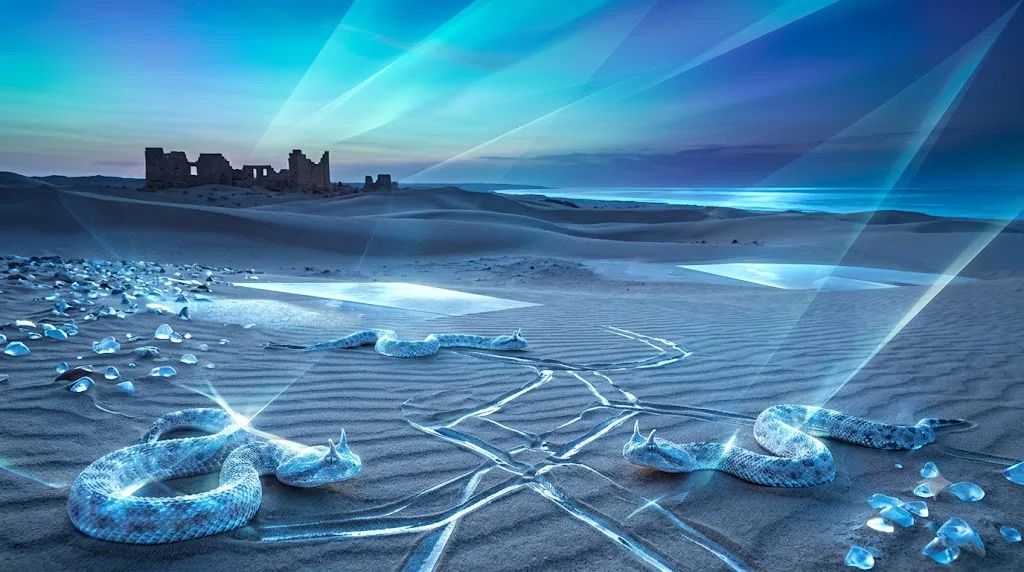
For cryptid readers, Libya can be confusing because many “Libyan” monsters come from classical geography rather than from recent local newspaper-style reports. Ancient Greek and Roman writers used “Libya” broadly for North Africa, not always for the exact borders of today’s state. That means a creature described as Libyan in an ancient source may belong to a wider imagined Saharan or North African frontier rather than to one precise modern Libyan location.
That said, Libya’s real geography explains why the association stuck. The country has a Mediterranean coast, coastal wetlands, stony plateaus, oases, and a vast arid interior; modern country-profile data still summarises the climate as Mediterranean along the coast and dry extreme desert inland, with a coastline of about 1,770 km.[World Factbook]worldfactbook.coOpen source on worldfactbook.co. In ancient storytelling, such places easily became “edge zones”: deserts where venom multiplied, coastlines where sea gods appeared, and remote mountains where unfamiliar animals could be enlarged into monsters.
The strongest reader takeaway is this: Libya’s “cryptids” are best treated as a layered tradition. Some are mythology, some are ancient natural history, some are garbled animal reports, and some are useful reminders that real Saharan wildlife has been under-recorded.
The Libyan serpent tradition: from horned snakes to the basilisk
The most persistent Libyan monster theme is the snake. Herodotus, writing in the fifth century BC, described parts of Libya as full of wild beasts and included “monstrous” serpents, venomous snakes, horned asses, dog-headed people, headless people, and wild men and women among the marvels reported there. In another passage, he listed animals of the nomadic country: gazelles, hyenas, jackals, panthers, ostriches, lizard-like “land crocodiles”, and small one-horned snakes.[Lexundria]lexundria.comHerodotus, Histories 4.191Herodotus, Histories 4.191
For a modern reader, Herodotus is not a field guide. He is reporting a mixture of inquiry, hearsay, geography, traveller lore, and Greek appetite for marvels. Yet the list is revealing because several ordinary animals sit beside fabulous ones. Hyenas, jackals, ostriches, antelopes, and large lizards are plausible North African fauna; dog-headed and headless people are not. That blend is exactly how many cryptid traditions work: a real ecological setting becomes a stage on which exaggeration, misunderstanding, and wonder can all perform.
Lucan’s first-century epic Pharsalia pushed the Libyan snake theme into full monster territory. In his account, Perseus flew over Libya carrying Medusa’s severed head, and drops of her blood soaked the hot sand, creating a catalogue of deadly serpents. Lucan’s list includes the asp, cerastes, dipsas, amphisbaena, flying iaculus, seps, and basilisk, with the basilisk portrayed as so deadly that it rules over other snakes.[Poetry in Translation]poetryintranslation.comPoetry in Translation Lucan (39–65Poetry in Translation Lucan (39–65
The sceptical reading is not that Libya secretly housed a basilisk. It is that the Sahara’s real dangers — heat, thirst, venomous animals, disorientation, and distance — were condensed into snake mythology. The desert did not merely contain snakes in these stories; it explained why snakes were lethal, uncanny, and almost supernatural.

The amphisbaena and other two-ended terrors
Among the creatures tied most clearly to the Libyan desert is the amphisbaena, the legendary serpent with a head at each end. Lucan includes it in his Libyan snake catalogue, and later writers and bestiaries helped turn it into one of Europe’s durable monster images.[Poetry in Translation]poetryintranslation.comPoetry in Translation Lucan (39–65Poetry in Translation Lucan (39–65
The amphisbaena is a good example of how a creature can move from “reported animal” to symbolic monster. A two-headed snake is biologically possible as a rare developmental abnormality, but the amphisbaena of legend is not just a snake with a defect. It becomes a desert impossibility: a creature that can move both ways, survive in hostile terrain, and embody a world where normal animal rules have broken down.
The horned snake has a more realistic root. Herodotus mentions small one-horned snakes in Libya, and North African deserts do contain horned vipers and other snakes whose appearance could easily feed such stories.[Lexundria]lexundria.comHerodotus, Histories 4.192Herodotus, Histories 4.192 Once a real “horned” snake enters oral or literary tradition, it only takes a few retellings for the horns to become lures, weapons, crowns, or signs of magical danger.
Lake Tritonis: Libya’s lost lake of gods, not a lake monster case
If Libya has anything close to a “lake mystery” in the old sources, it is Lake Tritonis. Classical writers placed this lake in ancient Libya, although its exact location remains debated and may refer to wider North African geography rather than a lake inside modern Libya’s present borders. The lake is important because it is attached to Triton, Athena, nymphs, and the Argonauts rather than to a plesiosaur-like beast or recurring modern sighting tradition.[Wikipedia]WikipediaLake TritonisLake Tritonis
In the Argonaut tradition, Triton appears when Jason and the Argonauts are stranded around the shallows of Lake Tritonis and helps them find a passage back to the sea. Theoi’s summary of the ancient material describes Triton as a fish-tailed sea god and also as the god of the large Libyan salt lake who guided the Argonauts out of the desert.[Theoi]theoi.comOpen source on theoi.com.
This matters because it prevents a common misunderstanding. Lake Tritonis is not a Libyan Nessie. It is a mythic water-place at the meeting point of desert, marsh, sea travel, and Greek colonial imagination. Its “monster” is a divine merman-like figure, not an unidentified animal reported by modern witnesses.
Gorgons, Medusa, and the desert as monster-maker
The Medusa connection gives Libya one of its most vivid monster afterlives. In classical myth, Libya becomes the land over which Perseus carries the Gorgon’s head, and where Medusa’s blood generates serpents. Lucan’s version makes the desert itself a kind of incubator: heat, sand, divine blood, and poison combine to produce a whole venomous ecology.[Poetry in Translation]poetryintranslation.comPoetry in Translation Lucan (39–65Poetry in Translation Lucan (39–65
This is not local zoology, but it is important monster history. It explains why later European bestiaries and creature catalogues repeatedly imagined North Africa as a place of lethal hybrid animals. The basilisk, the amphisbaena, the cerastes, and other snake-like beings are not independent Libyan sighting cases so much as descendants of a literary idea: Libya as the place where normal nature becomes extreme.
For a public-facing cryptid page, that distinction is useful. A folklore creature can be culturally important without being a plausible undiscovered animal. The Libyan Gorgon-serpent tradition is best read as mythic geography: a way ancient writers made desert danger memorable.
Real animals behind the legends
Libya’s real wildlife helps explain why strange animal stories could form there. Recent research has shown that even small desert carnivores can remain poorly documented. A 2025 study reported the first confirmed Libyan records of the sand cat, supported by photographs and videos, with 13 records from the south-west; it also documented new Saharan striped polecat records and stressed major knowledge gaps in Libya’s desert carnivore distribution.[ScienceDirect]sciencedirect.comOpen source on sciencedirect.com.
That is not evidence for monsters, but it is evidence for uncertainty. In a country with huge deserts, difficult field conditions, and uneven modern survey coverage, rare animals can be locally familiar, scientifically under-recorded, or surprisingly hard to verify. This is the sensible middle ground between credulity and dismissal: Libya does not need a hidden dragon for its animal record to contain surprises.
Several ordinary animals also help explain older “monster” impressions:
- Hyenas and jackals can sound eerie at night, scavenge near human settlements, and become linked with graveyard or spirit folklore.
- Large lizards and monitor-like reptiles can become “land crocodiles” in traveller descriptions.
- Horned vipers give a real-world basis for horned-serpent imagery.
- Ostriches, antelopes, and desert foxes can appear strange to outsiders encountering Saharan fauna through second-hand reports.
The point is not that every legend has one neat zoological solution. It is that Libya’s monster tradition sits in a landscape where real animals, heat, distance, fear, and storytelling all overlap.
The coast: sea-serpent potential without a strong Libyan flap
Libya’s long Mediterranean coast could, in theory, support sea-monster stories. The waters include dolphins, whales, sharks, rays, turtles, monk seals, and large fish — exactly the kinds of animals often mistaken elsewhere for sea serpents or marine monsters. A UNEP/MAP-SPA/RAC report lists bottlenose dolphin, common dolphin, striped dolphin, Risso’s dolphin, Cuvier’s beaked whale, sperm whale, and fin whale as cetaceans recorded from Libyan waters, while also noting that comprehensive studies of Libyan marine mammals are lacking.[منصة طبيعة ليبيا]wildlife.org.lyمنصة طبيعة ليبيا
The same report documents a wide range of cartilaginous fishes on the Libyan coast, including basking shark, great white shark, thresher shark, blue shark, hammerheads, guitarfish, and electric rays.[منصة طبيعة ليبيا]wildlife.org.lyمنصة طبيعة ليبيا These are not cryptids, but they matter because large marine animals are frequently the raw material of sea-serpent reports: a fin whale glimpsed at distance, a basking shark’s fin and tail, a dolphin group in rough water, or a decomposing carcass can all become a monster in poor viewing conditions.
So far, however, Libya does not appear to have a famous, repeated, named sea-serpent tradition comparable to better-known cases in northern Europe, North America, or parts of the Atlantic. The honest conclusion is modest: the ecological ingredients for misidentification exist, but the public record does not support a major Libyan sea-monster flap.
Rock art and the memory of a greener Sahara
One of Libya’s most powerful “mystery animal” contexts is not a cryptid report at all, but prehistoric rock art. UNESCO describes the Rock-Art Sites of Tadrart Acacus, in south-western Libya near the Algerian border, as containing thousands of cave paintings in different styles, dating from about 12,000 BC to AD 100, reflecting major changes in fauna, flora, and human ways of life in the Sahara.[UNESCO World Heritage Centre]whc.unesco.orgWorld Heritage Centre Rock-Art Sites of Tadrart AcacusWorld Heritage Centre Rock-Art Sites of Tadrart Acacus
The British Museum’s African rock art resource notes that Libyan rock art includes larger-than-life engravings of animals such as elephants, rhino, and an extinct buffalo-like form.[African Rock Art]africanrockart.britishmuseum.orgAfrican Rock Art LibyaAfrican Rock Art Libya For readers interested in cryptids, this is a useful reality check. Libya did once belong to a very different ecological world. Animals that would seem impossible in today’s desert were present in wetter Saharan periods, remembered in art rather than in modern sightings.
This can change how monster stories are read. Some tales of strange beasts may not preserve a literal memory of one surviving animal, but they do emerge from a region where the animal world genuinely changed dramatically. The Sahara’s past gives Libya’s creature lore a deep environmental backdrop.
What counts as evidence in Libyan mystery-beast stories?
Libya’s creature traditions fall into four broad evidence categories, and keeping them separate makes the subject much clearer.
Ancient testimony is valuable for cultural history, not proof of unknown animals. Herodotus and Lucan preserve influential monster material, but they mix observation, hearsay, myth, poetic drama, and inherited geography.[Lexundria]lexundria.comHerodotus, Histories 4.191Herodotus, Histories 4.191
Folklore and literary afterlife explain why creatures such as the basilisk and amphisbaena remain associated with Libya. These beings matter because they shaped later imagination, not because modern zoology recognises them.
Modern biodiversity records can explain why unusual sightings happen. The sand cat study is a good example: a real animal can be present in Libya while remaining scientifically under-confirmed until recent photographic evidence appears.[ScienceDirect]sciencedirect.comOpen source on sciencedirect.com.
Marine and desert misidentifications are plausible but case-dependent. Libya’s coast has large marine animals, and its desert has rare carnivores and reptiles, but a claim still needs location, date, witness detail, photographs, tracks, carcasses, or independent confirmation before it becomes more than a story.
Best sceptical explanations
The best explanations for Libya’s cryptid-like traditions are not dismissive; they are specific.
First, classical “Libya” was a symbolic frontier. Ancient writers often used remote regions as places where nature became exaggerated. This is why plausible animals and impossible beings appear side by side in the same passages.
Second, real desert animals can look uncanny. Horned vipers, hyenas, foxes, polecats, sand cats, large lizards, and nocturnal scavengers are all capable of producing strange impressions, especially at night or at distance.
Third, ecological change left a genuine memory gap. The rock art of Tadrart Acacus shows that the region’s fauna changed profoundly over thousands of years. Modern desert barrenness can make ancient animal imagery feel impossible unless readers understand the greener Sahara context.[UNESCO World Heritage Centre]whc.unesco.orgWorld Heritage Centre Rock-Art Sites of Tadrart AcacusWorld Heritage Centre Rock-Art Sites of Tadrart Acacus
Fourth, scientific under-recording can be mistaken for mystery. When a species is poorly surveyed, its rediscovery or first confirmation may sound cryptid-like. The sand cat records show how ordinary zoology can still deliver surprises in Libya.[ScienceDirect]sciencedirect.comOpen source on sciencedirect.com.
The clearest answer
Libya’s main monster tradition is not a single hidden animal, but a long-running image of the country as a place where desert, venom, ancient travel, and myth meet. The strongest examples are the Libyan serpents of classical literature, especially the amphisbaena, basilisk, cerastes, and Medusa-born snake lore; Lake Tritonis and Triton add a water-myth strand; and Saharan rock art supplies a real prehistoric animal backdrop. Modern evidence does not support a confirmed Libyan cryptid, but it does support a more interesting conclusion: Libya’s mystery-beast history is a record of how people turn difficult landscapes, rare animals, and fragmentary reports into monsters that last for centuries.
Amazon book picks
Further Reading
Books and field guides related to What Monsters Haunt Libya's Desert Edge?. Use these as the next step if you want deeper reading beyond the article.
Pliny the Elder: The Natural History Book VII (with Book VIII...
Contains many ancient accounts of exotic animals and wonders.
The Penguin Book of Classical Myths
Covers mythic traditions connected to the ancient Mediterranean world.

Monsters: A Bestiary of the Bizarre
Places Libyan monster lore in a wider mythological context.
eBay marketplace picks
Marketplace Samples
Live-tested eBay searches with available results related to this page.

Endnotes
1.
Source: lexundria.com
Title: Herodotus, Histories 4.191
Link:https://lexundria.com/hdt/4.191/mcly
2.
Source: lexundria.com
Title: Herodotus, Histories 4.192
Link:https://lexundria.com/hdt/4.192/mcly
3.
Source: sciencedirect.com
Link:https://www.sciencedirect.com/science/article/pii/S0140196325001697
4.
Source: theoi.com
Title: Legendary Creatures
Link:https://www.theoi.com/greek-mythology/fantastic-creatures.html
5.
Source: Wikipedia
Title: Lake Tritonis
Link:https://en.wikipedia.org/wiki/Lake_Tritonis
6.
Source: theoi.com
Link:https://www.theoi.com/Pontios/Triton.html
7.
Source: whc.unesco.org
Title: World Heritage Centre Rock-Art Sites of Tadrart Acacus
Link:https://whc.unesco.org/en/list/287/
8.
Source: Wikipedia
Title: List of cryptids
Link:https://en.wikipedia.org/wiki/List_of_cryptids
9.
Source: Wikipedia
Title: List of legendary creatures by type
Link:https://en.wikipedia.org/wiki/List_of_legendary_creatures_by_type
10.
Source: Wikipedia
Title: List of Greek mythological creatures
Link:https://en.wikipedia.org/wiki/List_of_Greek_mythological_creatures
11.
Source: Wikipedia
Link:https://en.wikipedia.org/wiki/Catoblepas
12.
Source: Wikipedia
Title: Gold digging ant
Link:https://en.wikipedia.org/wiki/Gold-digging_ant
13.
Source: Wikipedia
Title: List of mammals of Libya
Link:https://en.wikipedia.org/wiki/List_of_mammals_of_Libya
14.
Source: Wikipedia
Title: Wildlife of Libya
Link:https://en.wikipedia.org/wiki/Wildlife_of_Libya
15.
Source: Wikipedia
Link:https://en.wikipedia.org/wiki/Amphisbaena
16.
Source: Wikipedia
Link:https://en.wikipedia.org/wiki/Medusa
17.
Source: Wikipedia
Title: Triton (mythology)
Link:https://en.wikipedia.org/wiki/Triton_%28mythology%29
18.
Source: Wikipedia
Title: Acacus Mountains
Link:https://en.wikipedia.org/wiki/Acacus_Mountains
19.
Source: Wikipedia
Link:https://en.wikipedia.org/wiki/Libya
20.
Source: Wikipedia
Title: Geography of Libya
Link:https://en.wikipedia.org/wiki/Geography_of_Libya
21.
Source: whc.unesco.org
Link:https://whc.unesco.org/en/list/287/documents/
22.
Source: unesdoc.unesco.org
Link:https://unesdoc.unesco.org/ark%3A/48223/pf0000395411
23.
Source: theoi.com
Title: CATOBLEPA S (Katobleps)
Link:https://www.theoi.com/Thaumasios/Katoblepones.html
24.
Source: theoi.com
Title: TRITONI S
Link:https://www.theoi.com/Nymphe/NympheTritonis.html
25.
Source: unep.org
Link:https://www.unep.org/unepmap/resources/factsheets/biological-diversity
26.
Source: unep.org
Title: voice coast gender marine protection
Link:https://www.unep.org/gef/news-and-stories/blogpost/voice-coast-gender-marine-protection
27.
Source: unep.org
Link:https://www.unep.org/unepmap/who-we-are/contracting-parties/libya
28.
Source: acacus.org
Title: Rock art
Link:https://www.acacus.org/research/rock-art
29.
Source: africa.com
Link:https://africa.com/countries-of-africa/north-africa/libya
30.
Source: bestiary.ca
Link:https://bestiary.ca/prisources/pstexts964.htm
31.
Source: youtube.com
Title: Sahara: Mysteries Of The Great Sand Desert / Documentary (4K)
Link:https://www.youtube.com/watch?v=HIyaY0TQFvI
Source snippet
Cerastes...
32.
Source: youtube.com
Link:https://www.youtube.com/watch?v=LgZQkXhIIHc
Source snippet
If You See This Bizarre Mark in the Sand, Beware...
33.
Source: poetryintranslation.com
Title: Poetry in Translation Lucan (39–65)
Link:https://www.poetryintranslation.com/PITBR/Latin/PharsaliaIXmaster.php
34.
Source: worldfactbook.co
Link:https://www.worldfactbook.co/edition.php?country=libya&year=2024
35.
Source: wildlife.org.ly
Title: منصة طبيعة ليبيا
Link:https://wildlife.org.ly/moselef/2026/05/libya-conservation-of-mediterranean-marine-and-coastal-biodiversity-by-2030-and-beyond.pdf
36.
Source: africanrockart.britishmuseum.org
Title: African Rock Art Libya
Link:https://africanrockart.britishmuseum.org/country/libya/
37.
Source: mythus.fandom.com
Link:https://mythus.fandom.com/wiki/Amphisbaena
38.
Source: cryptidz.fandom.com
Link:https://cryptidz.fandom.com/wiki/Amphisbaena
39.
Source: mythus.fandom.com
Link:https://mythus.fandom.com/wiki/Triton
40.
Source: youtube.com
Link:https://www.youtube.com/watch?v=i93LwbsXncM
41.
Source: geofactbook.com
Link:https://geofactbook.com/countries/libya
42.
Source: geofactbook.com
Link:https://geofactbook.com/countries/libya/coastline
43.
Source: ebsco.com
Link:https://www.ebsco.com/research-starters/geography-and-cartography/libya
44.
Source: kids.nationalgeographic.com
Link:https://kids.nationalgeographic.com/geography/countries/article/libya
45.
Source: worldfactbookarchive.org
Title: Climate — Libya
Link:https://worldfactbookarchive.org/archive/field/LY/Climate
46.
Source: worldfactbookarchive.org
Link:https://worldfactbookarchive.org/archive/2023/LY
47.
Source: openfactbook.org
Link:https://openfactbook.org/countries/libya/
48.
Source: abookofcreatures.com
Link:https://abookofcreatures.com/category/libya/
49.
Source: worldfactbook.co
Link:https://www.worldfactbook.co/country.php?slug=libya
50.
Source: climateknowledgeportal.worldbank.org
Link:https://climateknowledgeportal.worldbank.org/country/libya
51.
Source: briefworld.net
Link:https://briefworld.net/e/libya
52.
Source: wildlife.org.ly
Link:https://wildlife.org.ly/en/animal-cards/
53.
Source: dailynaturedive.com
Link:https://www.dailynaturedive.com/countries/country-libya
Additional References
54.
Source: youtube.com
Title: 25 Most LEGENDARY Creatures From Greek Mythology
Link:https://www.youtube.com/watch?v=2ViJHWSzGbk
Source snippet
Sahara: Mysteries Of The Great Sand Desert / Documentary (4K)...
55.
Source: researchgate.net
Link:https://www.researchgate.net/publication/374022066_ATLAS_of_Tadrart_Acacus_rock_art_A_UNESCO_World_Heritage_site_in_southwestern_Libya
56.
Source: academia.edu
Link:https://www.academia.edu/2067705/The_Earliest_Rock_Paintings_of_the_Central_Sahara_Approaching_Interpretation
57.
Source: researchgate.net
Link:https://www.researchgate.net/publication/321278667_Imaginary_Zoology_Mysterious_Fauna_in_the_Reports_of_Ancient_Travelers_and_Chroniclers
58.
Source: researchgate.net
Link:https://www.researchgate.net/publication/343999903_Wild_mammals_in_northwestern_Libya_and_the_role_of_rain_and_temperature_in_its_geographical_distribution
59.
Source: gettyimages.com
Link:https://www.gettyimages.com/photos/tadrart-acacus-rock-art
60.
Source: facebook.com
Link:https://www.facebook.com/LibyatheVision/posts/ajdabia-the-libyan-wildlife-society-has-strongly-condemned-the-killing-of-a-stri/1477292541078538/
61.
Source: facebook.com
Link:https://www.facebook.com/groups/archeologyandcivilizations/posts/25531824596484390/
62.
Source: facebook.com
Link:https://www.facebook.com/groups/1519103878311682/posts/3542575942631122/
63.
Source: loebclassics.com
Link:https://www.loebclassics.com/view/aristotle-history_animals/1965/pb_LCL439.203.xml?print=&readMode=recto
Topic Tree
Follow this branch
Related pages 192
- Antigua Cryptids
- Maldives Monsters
- Malta Monsters
- Qatar Monsters
- Argentina Monsters
- +187 more in sidebar