Cryptids of Nicaragua's Lakes and Forests
Nicaragua does not have a single, well-documented equivalent of Scotland’s Loch Ness Monster or North America’s Bigfoot.
Page outline Jump by section
Introduction
The strongest “monster” story is also the least supernatural. Bull sharks really do enter Lake Nicaragua through the San Juan River, although they were once treated as an isolated freshwater species. Other traditions sit much further along the spectrum from zoology to folklore. The ape-like sisimite belongs mainly to a wider Central American tradition rather than a securely documented Nicaraguan sighting history, while the witch-monkey is explicitly a supernatural figure. Chupacabra reports arrived through a fast-moving regional media legend rather than evidence of an unknown native predator. Nicaragua’s cryptid history is therefore best understood not as a catalogue of undiscovered animals, but as an overlap between extraordinary wildlife, dangerous landscapes, inherited folklore and stories that grow as they travel.
Is there a monster in Lake Nicaragua?
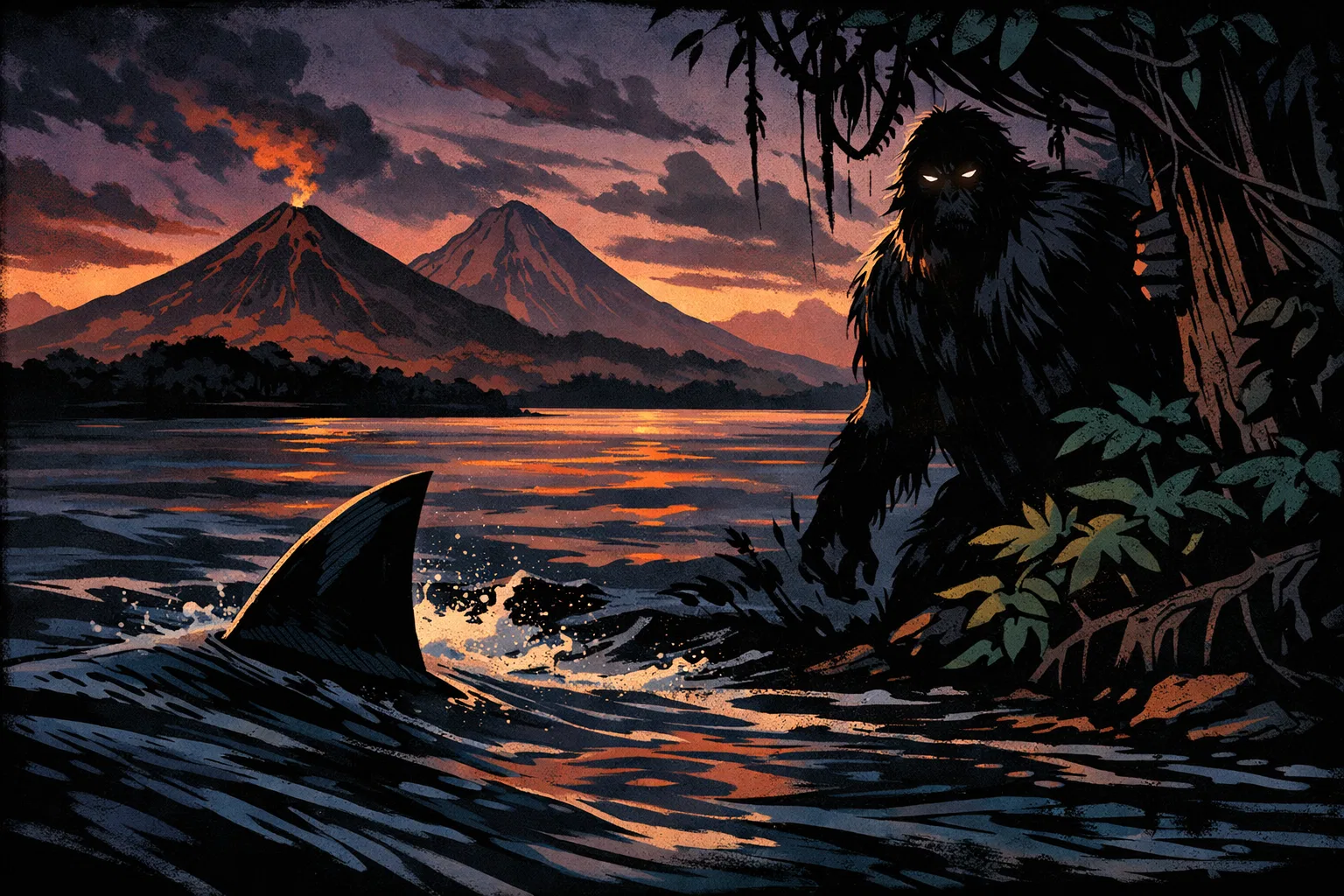
Lake Nicaragua, also called Lake Cocibolca, is the natural centre of the country’s monster lore. It is Central America’s largest lake, covering roughly 8,000 square kilometres, with volcanic islands, broad horizons and a river connection to the Caribbean. It is precisely the sort of place in which distant wakes, large fish and uncertain silhouettes can become stories.
Yet the lake’s most famous supposed anomaly needs no imaginary monster. Bull sharks live, or historically lived, within the Lake Nicaragua–San Juan River system. Early researchers debated whether these animals represented a unique freshwater species, sometimes called the Lake Nicaragua shark. Comparative studies eventually showed that they were ordinary bull sharks, a species unusually capable of tolerating both salt and fresh water.[bio-nica.info]bio-nica.infoLos Cocos: upper end of Lake Nicaragua, San Carlos: head of the…Read more…
The older explanation held that the sharks had become trapped when geological changes separated the lake from the Pacific. Tagging overturned that idea. Sharks marked in the Caribbean were recovered in the lake, while lake-tagged animals were later found towards the coast. The evidence demonstrated that the sharks travelled through the San Juan River rather than surviving as an ancient, isolated population.[DigitalCommons]digitalcommons.unl.eduMovement of Bull Sharks, Carcharhinus Leucas, Between…by TB Thorson · 1976 · Cited by 141 — In 1969, three sharks that h…
This discovery helps explain why Lake Nicaragua acquired such a powerful reputation. A traveller hearing that sharks inhabited a freshwater lake might reasonably imagine a prehistoric survivor or hidden lake beast. In reality, the animal is known to science; the extraordinary part is its migration and physiology.
Reports often embellish the journey by saying that sharks “jump the rapids like salmon”. The underlying point—that they can negotiate the river system—is well supported, but the salmon-like image should not be treated as a precise description of routine behaviour. The San Juan is a long, difficult waterway, and historic research found sharks most abundant in its lower reaches and progressively less common towards the lake.[DigitalCommons]digitalcommons.unl.eduThe Status of the Lake Nicaragua Shark: An Updated Appraisalby TB Thorson · 1976 · Cited by 46 — The Lake Nicaragua- Rio Sa…
The lake also historically supported largetooth sawfish, enormous ray relatives whose toothed snouts look almost designed for monster stories. Sawfish populations have collapsed across much of the world because their rostra become entangled easily in fishing gear. Research from Nicaragua recorded serious exploitation during the twentieth century, and modern conservation assessments classify sawfishes among the world’s most threatened groups of marine fishes.[springer.com]link.springer.comOpen source on springer.com.
A large sawfish seen briefly at the surface could appear far stranger than a shark. Its long body, dorsal fins and projecting saw might be interpreted as several separate shapes, particularly in waves or poor light. Tarpon—large, reflective fish capable of rolling or leaping—add another source of dramatic surface activity. The lake therefore contains, or once contained, enough remarkable real animals to create monster-like observations without requiring an unknown species.
Why Nicaragua never developed a single famous lake beast
Many countries with large lakes eventually acquire a named, standardised monster: a creature with a familiar appearance, repeated sighting locations and a recognisable media identity. Nicaragua’s lake tradition has not crystallised in quite that way.
One reason is that the real sharks already occupy the story’s ecological niche. Instead of asking whether an unknown predator inhabits the water, local and foreign accounts can point to an authenticated large predator. The revelation that the sharks migrate did not make them less remarkable; it merely moved the mystery from cryptozoology into biology.
Another factor is the changing abundance of conspicuous animals. Bull sharks and sawfish suffered from intensive fishing, including a twentieth-century commercial shark fishery in the lake system. Contemporary accounts describe lake sharks as much less frequently encountered than during the period when researchers could tag substantial numbers.[springer.com]link.springer.comOpen source on springer.com.
This creates an unusual reversal of the classic lake-monster pattern. Elsewhere, repeated but inconclusive sightings encourage claims that an unknown animal remains hidden. In Nicaragua, there is strong historical evidence for remarkable animals, but their present scarcity makes the lake seem less visibly monstrous than it once was.
Ometepe and Zapatera islands nevertheless provide fertile settings for local legends. Ometepe’s twin volcanoes rise directly from the lake, while Zapatera combines volcanic terrain with extensive archaeological remains. Stories about the landscape often explain islands and volcanoes through transformed bodies, tragic lovers or sacred geography rather than through reports of a zoological creature. A widely repeated Ometepe origin story, for example, connects the island’s shape and volcanoes with doomed lovers whose bodies formed features of the lake.[Wikipedia]WikipediaLago CocibolcaLago Cocibolca
Such narratives belong to folklore rather than cryptozoological evidence, but they matter because they show how the lake is imagined: not as empty scenery, but as a living landscape whose unusual forms invite explanation.
The hairy creature at the forest’s edge
The sisimite is a large, shaggy, human-like being said to inhabit mountains, caves and deep forest. Common descriptions give it ape-like features, great strength and feet that face backwards, making its tracks misleading. Some versions say it abducts women or punishes people who wander carelessly into the wilderness.
This tradition is strongest and best documented in Honduras, Belize and Guatemala. Nicaragua appears on broader lists of countries where related stories circulate, but readily available evidence for a distinct, continuous Nicaraguan sighting tradition is thin. It is therefore misleading to advertise the sisimite simply as “Nicaragua’s Bigfoot”. It is better treated as a regional forest being whose story crosses modern national borders.[wikipedia.org]WikipediaOpen source on wikipedia.org.
The backwards feet are an important clue to the creature’s folkloric function. They are less like an anatomical claim than a storytelling device: a human entering the forest cannot trust the trail. Similar reversed-foot motifs occur in traditions far beyond Central America, often marking beings that belong to dangerous or morally inverted places.
Nicaragua’s geography makes the story understandable. The eastern part of the country contains extensive rainforest, river systems and sparsely populated territories. Real large mammals include jaguars, pumas and Baird’s tapirs, while several monkey species inhabit the canopy. Howler monkeys are particularly effective monster-makers because their deep calls can travel through forest and sound vastly larger than the animal producing them. Nicaragua also supports spider and capuchin monkeys, whose upright postures and rapid movements may look surprisingly human when glimpsed through vegetation.[biodb.com]biodb.comOpen source on biodb.com.
None is a convincing match for a giant bipedal ape. Central America has no recognised native great ape, and no physical evidence—bones, hair with an unknown genetic profile, clear photographs or a specimen—establishes one. The most economical explanation is that sisimite stories combine inherited supernatural motifs with distorted encounters involving monkeys, bears remembered from stories elsewhere, large cats, people in poor visibility and the normal dangers of getting lost.
The creature nevertheless remains valuable as folklore. It personifies the point beyond which cultivated land gives way to wilderness. In that role, proof of an unknown primate is almost beside the point.
The witch-monkey and Nicaragua’s shape-changing beasts
A more distinctly Nicaraguan creature tradition concerns the witch-monkey: a person, usually described as a witch, who transforms at night into a large, powerful monkey-like animal. Accounts vary from place to place, but the being is commonly said to run over roofs, leap between trees, disturb households or pursue solitary travellers.[puebloantiguo.com]puebloantiguo.comOpen source on puebloantiguo.com.
This is not a cryptid claim in the narrow zoological sense. The story does not usually suggest an undiscovered breeding population of unknown primates. Its central idea is transformation. The creature is frightening because it is both human and animal, and because a familiar neighbour may secretly become something dangerous after dark.
The legend may still absorb real sensory experiences. Monkeys moving on roofs or in trees can create loud impacts; domestic animals can scramble across corrugated metal; branches strike buildings in wind; and a witness awakened suddenly may see only a hunched silhouette. Folklore then supplies an identity for the noise.
The witch-monkey also overlaps with broader Central American traditions of animal transformation and deceptive female apparitions. These stories should not all be collapsed into one creature. Some are moral tales about forbidden behaviour, some are supernatural warnings for travellers, and others are family or community narratives attached to a particular alleged witch. Their shared feature is not biological description but unstable identity: the human-looking figure becomes an animal, or the attractive stranger reveals a monstrous form.
For a cryptid history, that distinction is crucial. A witness saying “I saw a large monkey” presents a possible animal-identification problem. A story saying “a witch turned into a monkey” belongs primarily to supernatural folklore, even when it contains vivid eyewitness language.
How the chupacabra reached Nicaragua
The chupacabra is Nicaragua’s clearest example of an imported modern monster legend. The story emerged in Puerto Rico in 1995 after reports of livestock deaths supposedly involving puncture wounds and missing blood. Within a short period, newspapers and television carried similar claims across Latin America, including Central America. Nicaragua became part of the creature’s expanding territory even though the legend did not originate there.[iu.edu]scholarworks.iu.eduOpen source on iu.edu.
Descriptions changed as the story moved. Early Puerto Rican witnesses often described a bipedal, spiny-backed creature with a vaguely reptilian or science-fiction appearance. Later reports, especially from Mexico and the United States, increasingly identified hairless, dog-like animals. These two forms are so different that treating them as a stable zoological description is difficult.
Several ordinary processes can make a livestock death look mysterious. Predators often bite the throat because it is an efficient place to restrain prey. Dogs may kill several animals without eating them, particularly when confined livestock repeatedly trigger a chase response. Blood usually remains within a carcass or pools underneath it rather than producing a dramatic stain. Scavengers and insects target eyes, mouths and other soft tissues, while drying and decomposition can make torn skin resemble a clean cut.[Wikipedia]WikipediaOpen source on wikipedia.org.
Dog-like “chupacabra bodies” are commonly coyotes, foxes or domestic dogs affected by severe mange or another skin condition. Mange causes hair loss, thickened skin and an emaciated appearance, turning a familiar animal into something that may look unknown at a distance.[National Geographic]nationalgeographic.com101028 chupacabra evolution halloween science monsters chupacabras picture101028 chupacabra evolution halloween science monsters chupacabras picture
Nicaragua has coyotes, domestic and feral dogs, large cats and smaller wild carnivores capable of attacking poultry or young livestock. A responsible investigation would examine tracks, tooth spacing, feeding pattern, internal blood loss, disease and scavenging before considering an unknown predator. Without veterinary reports or preserved physical material, claims that an animal was “drained of blood” remain testimony rather than a demonstrated cause of death.
The chupacabra’s importance is therefore cultural rather than zoological. It shows how quickly a creature can become internationally recognisable when television, newspapers and later the internet give scattered animal deaths a shared name. Once that name exists, later incidents are interpreted through it.
Could real wildlife explain other monster reports?
Nicaragua is unusually well supplied with animals capable of producing startling encounters. The country spans Pacific dry forest, volcanic highlands, enormous freshwater systems, Caribbean wetlands and dense eastern rainforest. Familiarity matters: an animal that is ordinary to a biologist can appear monstrous to someone who sees it briefly, at night or outside its expected habitat.
Several species are particularly relevant:
- Howler monkeys produce deep, carrying vocalisations that can suggest a much larger animal hidden in the forest.
- Spider monkeys have long limbs and can momentarily look human-shaped when upright or crossing gaps in the canopy.
- Tapirs are heavy, mostly nocturnal mammals with unusual profiles. A partial view can be difficult to interpret.
- Jaguars and pumas may generate phantom-cat stories where only tracks, livestock injuries or a fleeting shape are observed.
- Jaguarundis, ocelots and margays vary greatly in silhouette and can be mistaken for unfamiliar cats.
- Manatees, large fish, crocodilians, tarpon and drifting logs can account for humps, wakes or broad shapes reported in rivers and lagoons. Nicaragua’s recognised fauna includes monkeys, tapirs, several wild-cat species and aquatic mammals across these habitats.[biodb.com]biodb.comOpen source on biodb.com.
Misidentification does not mean that witnesses are dishonest. Human perception is reconstructive: distance, fear, expectation and poor light influence what a person believes they saw. A short glimpse may preserve the most dramatic features while losing useful details such as scale, gait and surrounding landmarks.
Hoaxes and media exaggeration add another layer, but they should not be assumed automatically. Most mystery-animal stories probably arise from sincere interpretation rather than deliberate deception. The difficulty begins when a vivid account is repeated without its original uncertainty, or when a regional tradition is retrospectively attached to Nicaragua despite little evidence of local circulation.

Where the evidence is strongest—and weakest
Nicaragua’s creature traditions fall into four broad levels of evidence.
Confirmed unusual animals: Lake Nicaragua’s bull sharks are fully zoological, supported by specimens, comparative anatomy and tagging. Sawfish were also genuine inhabitants of the lake-river system. The old mystery concerned their identity and route, not whether the animals existed.[unl.edu]digitalcommons.unl.eduMovement of Bull Sharks, Carcharhinus Leucas, Between…by TB Thorson · 1976 · Cited by 141 — In 1969, three sharks that h…
Plausible wildlife encounters: Reports of large cats, strange cries, oversized fish or unfamiliar forest shapes may concern known animals seen under poor conditions. These cases remain unresolved individually unless tracks, photographs or carcasses allow identification.
Folkloric beings: The witch-monkey and related shape-changing figures are embedded in supernatural storytelling. Their meaning lies in fear, morality and community memory rather than a testable claim about an unknown species.
Travelling media legends: The chupacabra reached Nicaragua as part of a continent-wide wave. The creature’s changing appearance, absence of diagnostic physical evidence and close association with ordinary predation, decomposition and diseased canids make an unknown blood-drinking species unnecessary.
The sisimite sits between the final two categories. It is an old regional forest being that modern cryptid culture has repackaged as a Central American Bigfoot. The folklore is genuine, but the zoological interpretation is modern and poorly supported.
Why the stories endure
Nicaragua’s monster lore is inseparable from its landscapes. A freshwater lake with sharks already seems to violate the expected order of nature. Twin volcanoes rising from an island invite origin myths. Dense forests conceal large mammals and distort sound. Rivers connect inland settlements to the Caribbean and carry animals far beyond the places where observers expect to see them.
Modern tourism strengthens some of these associations. Ometepe is promoted through its volcanic scenery, archaeological remains and unusual wildlife, including the famous lake sharks, even though visitors are now far more likely to encounter howler monkeys than a shark. Contemporary travel writing continues to present the island as a meeting place of dramatic geology, Indigenous heritage and extraordinary nature.[El País]elpais.comOpen source on elpais.com.
The risk is that folklore becomes flattened into generic “cryptid content”. A Honduran forest giant may be labelled Nicaraguan; a supernatural witch story may be rewritten as an ape sighting; and the genuine history of Lake Nicaragua’s sharks may acquire invented monster encounters. Keeping the categories separate makes the stories richer rather than less exciting.
Nicaragua’s most compelling mystery-animal history is ultimately about the unstable boundary between the unbelievable and the merely unexpected. The lake shark sounded mythical but proved real. The supposed endemic species proved mistaken, while the animal’s extraordinary migration proved true. Hairy giants and blood-drinking predators remain unsupported, yet they reveal how people interpret wilderness, livestock deaths and frightening nocturnal encounters. In Nicaragua, the lesson is not that every monster has an ordinary explanation. It is that the real natural history can be stranger—and better documented—than the monster story built around it.
Amazon book picks
Further Reading
Books and field guides related to What Monsters Haunt Nicaragua's Lakes and Forests?. Use these as the next step if you want deeper reading beyond the article.
Latin American Folktales
Provides Central American and Latin American storytelling context.
The Mythology Book
Helps readers place Nicaraguan legends within wider myth traditions.
The World of Lore: Monstrous Creatures
Explores how monster traditions spread and evolve.
eBay marketplace picks
Marketplace Samples
Live-tested eBay searches with available results related to this page.

Endnotes
1.
Source: bio-nica.info
Link:https://www.bio-nica.info/biblioteca/Thorson1966FreshwaterShark.pdf
Source snippet
Los Cocos: upper end of Lake Nicaragua, San Carlos: head of the...Read more...
2.
Source: jstor.org
Link:https://www.jstor.org/stable/1441058
Source snippet
Los Cocos: upper end of Lake Nicaragua, San Carlos: head of the Rio San Juan.Read more...
3.
Source: link.springer.com
Link:https://link.springer.com/article/10.1007/BF00002497
4.
Source: Wikipedia
Title: Lago Cocibolca
Link:https://es.wikipedia.org/wiki/Lago_Cocibolca
5.
Source: Wikipedia
Link:https://en.wikipedia.org/wiki/Sisimito
6.
Source: folktalesamerica.com
Title: el sisimite itacayo the mountain giant of honduras
Link:https://folktalesamerica.com/el-sisimite-itacayo-the-mountain-giant-of-honduras/
7.
Source: biodb.com
Link:https://biodb.com/region/nicaragua/
8.
Source: Wikipedia
Link:https://en.wikipedia.org/wiki/Fauna_of_Nicaragua
9.
Source: puebloantiguo.com
Link:https://puebloantiguo.com/leyenda-la-bruja-mona-nicaragua-2/
10.
Source: Wikipedia
Link:https://en.wikipedia.org/wiki/Chupacabra
11.
Source: Wikipedia
Title: Cattle mutilation
Link:https://en.wikipedia.org/wiki/Cattle_mutilation
12.
Source: ni.bio.br
Link:https://www.ni.bio.br/1982-0224-2025-0034/
13.
Source: Wikipedia
Title: Bull shark
Link:https://en.wikipedia.org/wiki/Bull_shark
14.
Source: Wikipedia
Title: Animal attacks in Latin America
Link:https://en.wikipedia.org/wiki/Animal_attacks_in_Latin_America
15.
Source: portals.iucn.org
Link:https://portals.iucn.org/library/sites/library/files/documents/2024-024-En_part_2.pdf
16.
Source: youtube.com
Link:https://www.youtube.com/watch?v=jJNGldoyrUE
Source snippet
The Devil's Snare | The Vampire Vine of Nicaragua...
17.
Source: digitalcommons.unl.edu
Link:https://digitalcommons.unl.edu/cgi/viewcontent.cgi?article=1037&context=ichthynicar
Source snippet
Movement of Bull Sharks, Carcharhinus Leucas, Between...by TB Thorson · 1976 · Cited by 141 — In 1969, three sharks that h...
18.
Source: digitalcommons.unl.edu
Link:https://digitalcommons.unl.edu/cgi/viewcontent.cgi?article=1040&context=ichthynicar
Source snippet
The Status of the Lake Nicaragua Shark: An Updated Appraisalby TB Thorson · 1976 · Cited by 46 — The Lake Nicaragua- Rio Sa...
19.
Source: digitalcommons.unl.edu
Link:https://digitalcommons.unl.edu/ichthynicar/38/
Source snippet
DigitalCommons"Movement of Bull Sharks, Carcharhinus Leucas, Between...by TB Thorson · 1976 · Cited by 141 — Movement of Bull Sharks, Ca...
20.
Source: iucnssg.org
Link:https://www.iucnssg.org/sawfish-strategy.html
21.
Source: elpais.com
Link:https://elpais.com/elviajero/2025-05-18/asi-es-ometepe-la-isla-de-los-volcanes-gemelos-que-emergen-de-un-lago-en-nicaragua.html
22.
Source: ranchosantana.com
Link:https://ranchosantana.com/blog/national-parks-nicaragua/
23.
Source: scholarworks.iu.edu
Link:https://scholarworks.iu.edu/journals/index.php/jfrr/article/view/39300
24.
Source: nationalgeographic.com
Title: 101028 chupacabra evolution halloween science monsters chupacabras picture
Link:https://www.nationalgeographic.com/culture/article/101028-chupacabra-evolution-halloween-science-monsters-chupacabras-picture
25.
Source: servitourstravel.com
Title: nicaraguas biodiversity
Link:https://servitourstravel.com/en/nicaraguas-biodiversity/
26.
Source: facebook.com
Link:https://www.facebook.com/groups/91335002341/posts/10156575962347342/
27.
Source: facebook.com
Link:https://www.facebook.com/groups/669979166452016/posts/9582457901870720/
28.
Source: edgeofexistence.org
Link:https://www.edgeofexistence.org/species/largetooth-sawfish/
29.
Source: iucnredlist.org
Link:https://www.iucnredlist.org/species/pdf/249881355
30.
Source: ranchosantana.com
Title: sharks of lake nicaragua
Link:https://ranchosantana.com/blog/sharks-of-lake-nicaragua/
31.
Source: es.scribd.com
Link:https://es.scribd.com/document/926113823/LEGENDS
32.
Source: pack-lightly.com
Link:https://pack-lightly.com/nicaragua/animals/
Additional References
33.
Source: pmc.ncbi.nlm.nih.gov
Title: PMCFirst Confirmed Record of a Bull Shark in Lake Gatun
Link:https://pmc.ncbi.nlm.nih.gov/articles/PMC12928108/
Source snippet
by GA Castellanos‐Galindo · 2026 — After establishing that Bull Sharks can navigate the ~200 km of the San Juan River from the Caribbe...
34.
Source: youtube.com
Title: The Devil’s Snare | The Vampire Vine of Nicaragua
Link:https://www.youtube.com/watch?v=Ai1c94w97s8
Source snippet
The Horrifying Killings of El Chupacabra • Mystery Files...
35.
Source: youtube.com
Title: Shark Facts: 11 facts about Bull Sharks
Link:https://www.youtube.com/watch?v=P8bAFx8vdV4
Source snippet
Exploring the Museum of Myths and Legends of León, Nicaragua | La 21...
36.
Source: facebook.com
Link:https://www.facebook.com/CorozalDaily/posts/the-legendary-sisimitebelize-yucatec-maya-sisimite-native-to-the-world-of-the-ma/2911652189051137/
37.
Source: facebook.com
Link:https://www.facebook.com/laprensanicaragua/posts/alguna-vez-se-pens%C3%B3-que-los-tiburones-del-cocibolca-eran-%C3%BAnicos-en-el-mundo-esto/10156204377889790/
38.
Source: facebook.com
Link:https://www.facebook.com/sonicgang/posts/chupacabra-the-blood-sucking-monster-urbanlegends-curiouspanti/757490973281080/
39.
Source: skepticalinquirer.org
Link:https://skepticalinquirer.org/2025/04/chupacabra-revisited-dueling-origin-stories-of-the-hispanic-vampire/
40.
Source: instagram.com
Link:https://www.instagram.com/p/DadS5islVG1/
41.
Source: facebook.com
Link:https://www.facebook.com/mictlanthegame/posts/conocido-err%C3%B3neamente-por-algunos-como-el-pie-grande-mexicano-el-sisimite-o-itac/325568559268482/
42.
Source: facebook.com
Link:https://www.facebook.com/ViaCordoba.com.ar/posts/el-clip-de-video-donde-habr%C3%ADan-capturado-a-este-ser-es-tendencia-la-leyenda-del-/1105519981619641/
Topic Tree
Follow this branch
Related pages 192
- Antigua Cryptids
- Maldives Monsters
- Malta Monsters
- Qatar Monsters
- Argentina Monsters
- +187 more in sidebar