Within Venezuela Cryptids
Are Venezuela's Forest Beings Really Hidden Animals?
Stories such as the reported owhuama become distorted when spiritual guardians and moral traditions are treated as simple zoological sightings.
On this page
- The reported owhuama and its uncertain record
- Mapinguari comparisons and lost ground sloth claims
- How forest stories encode place, danger and conduct
Page outline Jump by section
Introduction
When readers look for Venezuelan cryptids, they often expect a checklist of hidden animals: giant snakes, unknown apes or surviving prehistoric beasts. Southern Venezuela’s Amazonian traditions do not always fit that pattern. Many forest beings described by Indigenous communities occupy a different category altogether. They may appear as animals, people, spirits, guardians or shape-shifting presences depending on the story being told. Treating them as straightforward zoological sightings can flatten traditions that were never intended as wildlife reports in the first place.

This is especially true of stories linked to the owhuama, a little-known being associated with the Venezuelan Amazon near the Brazil border. In cryptozoological literature it is often presented as a local version of the mapinguari, but the closer one looks, the more complicated the picture becomes. The story sits at the crossroads of folklore, environmental knowledge, memory, morality and speculation about unknown animals. Understanding that complexity tells us more about Venezuela’s forest traditions than simply asking whether a creature exists.[fandom.com]cryptidarchives.fandom.comCryptid Archives Owhuama | Encyclopaedia of CryptozoologyCryptid ArchivesOwhuama | Encyclopaedia of Cryptozoology - FandomThe owhuama is a cryptid reported from the Venezuelan Amazon, considered…
Are Venezuela’s Forest Beings Really Hidden Animals?
One of the most common misunderstandings in cryptid writing is the assumption that every mysterious forest creature is meant to be a flesh-and-blood species awaiting scientific discovery. Across Amazonia, including the Venezuelan Amazon, stories often serve several purposes at once. A being may explain dangers in a landscape, enforce social rules, mark sacred places or express relationships between people and the forest.
The Venezuelan state of Amazonas contains a remarkable diversity of Indigenous cultures, languages and traditions. Forest narratives emerge from this cultural landscape rather than from a single unified mythology. As a result, stories about strange beings can shift dramatically between communities and even between tellers.[Wikipedia]WikipediaAmazonas (Venezuelan stateAmazonas (Venezuelan state
This matters because many modern cryptid summaries remove the cultural context and leave only a supposed animal description. Once that happens, a guardian spirit or moral figure can begin to look like a zoological mystery. The result is often a creature that seems more concrete and animal-like than it originally was.

The Reported Owhuama and Its Uncertain Record
The owhuama is among the least documented creatures associated with the Venezuelan Amazon. Most modern references describe it as a large, sloth-like forest being reported from the Venezuelan-Brazilian borderlands and sometimes specifically linked to Yanomami territory. In cryptozoological catalogues it is frequently described as Venezuela’s equivalent of the better-known Brazilian mapinguari.[Cryptid Archives]cryptidarchives.fandom.comCryptid Archives Owhuama | Encyclopaedia of CryptozoologyCryptid ArchivesOwhuama | Encyclopaedia of Cryptozoology - FandomThe owhuama is a cryptid reported from the Venezuelan Amazon, considered…
The problem is that the documentary trail is extremely thin. Much of what appears online today ultimately derives from a small number of secondary cryptozoological sources repeating one another. Detailed historical records, contemporary witness reports and extensive ethnographic descriptions are difficult to locate.
That uncertainty is revealing in itself. The owhuama is often presented as though it were a clearly defined creature with fixed characteristics, yet the surviving references suggest a more fluid tradition. In some retellings it resembles a giant ground sloth. In others it functions more like a powerful forest being whose significance extends beyond physical appearance. The limited evidence makes it difficult to determine where folklore ends and later cryptozoological interpretation begins.[Cryptid Archives]cryptidarchives.fandom.comCryptid Archives Owhuama | Encyclopaedia of CryptozoologyCryptid ArchivesOwhuama | Encyclopaedia of Cryptozoology - FandomThe owhuama is a cryptid reported from the Venezuelan Amazon, considered…
Rather than proving the existence of a hidden animal, the sparse record shows how easily local traditions can be reshaped when they enter global monster literature.
Mapinguari Comparisons and Lost Ground Sloth Claims
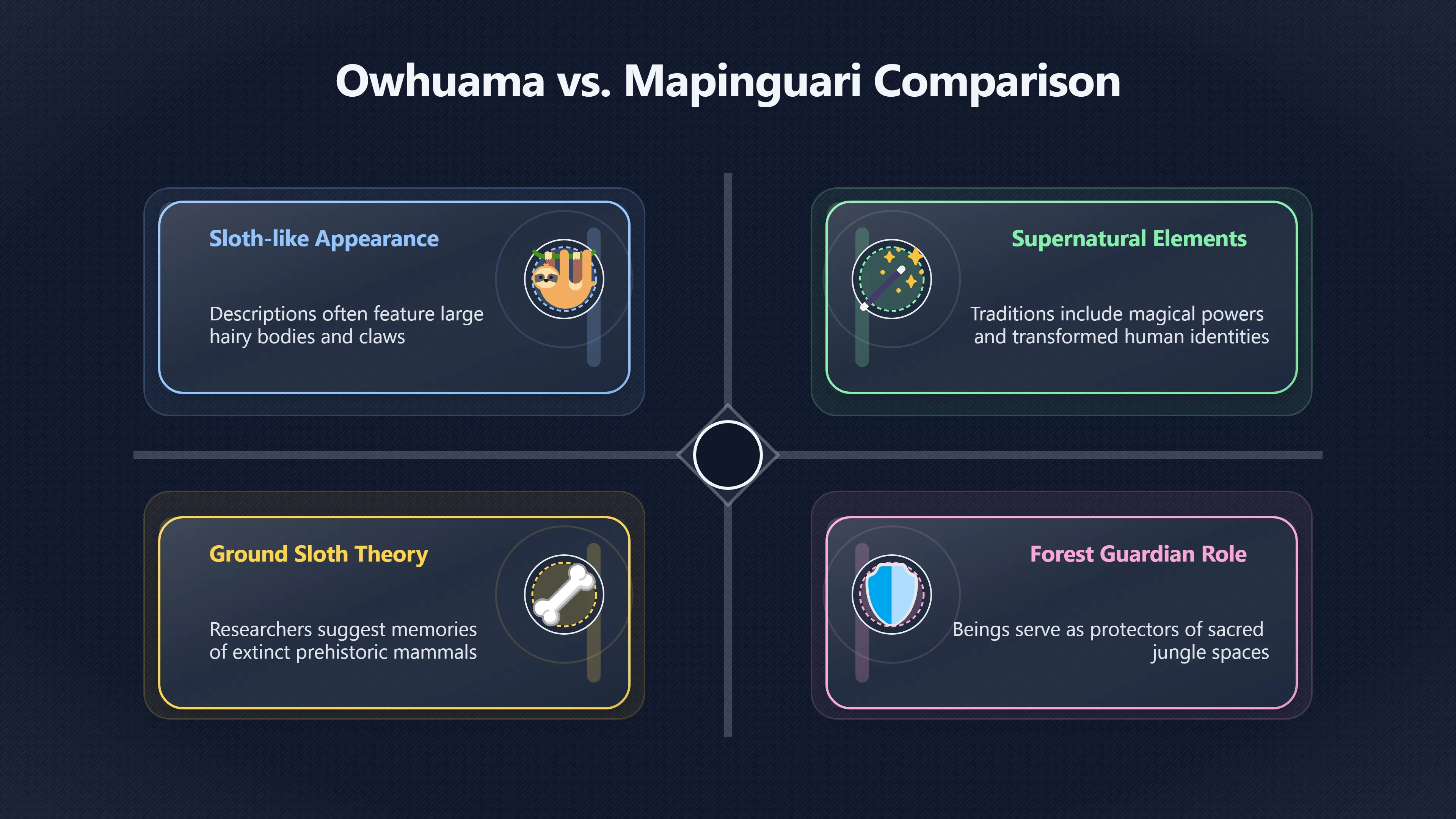
The owhuama is usually discussed alongside the mapinguari, one of Amazonia’s most famous legendary creatures. Reports collected in Brazil describe a large hairy being associated with a terrible smell, immense strength and unusual anatomical features. Depending on the version, it may be a forest guardian, a transformed human, a supernatural monster or a giant animal.[Wikipedia]WikipediaOpen source on wikipedia.org.
During the late twentieth century, some researchers proposed a dramatic explanation: perhaps stories of the mapinguari preserved memories of giant ground sloths, relatives of the extinct mammals that once lived across South America. Ornithologist David Oren became the most prominent advocate of this idea after collecting numerous reports from Amazonian regions.[Wikipedia]WikipediaOpen source on wikipedia.org.
The hypothesis attracted attention because some details seemed suggestive:
- Descriptions of large claws resembled known ground sloth anatomy.
- Stories sometimes portrayed the creature as primarily plant-eating.
- Folklore occasionally emphasised thick, resistant skin.
- Ground sloths genuinely existed in South America until the end of the Ice Age.[Wikipedia]WikipediaOpen source on wikipedia.org.
Yet the difficulties are substantial. Many mapinguari traditions include clearly supernatural elements such as magical powers, transformed humans, impossible anatomy or guardian functions that do not resemble zoological reports. Mainstream palaeontologists also note the absence of convincing modern physical evidence for surviving giant ground sloths. The youngest mainland fossils remain thousands of years old.[Wikipedia]WikipediaOpen source on wikipedia.org.
For that reason, the ground-sloth theory remains an intriguing speculation rather than an accepted explanation. The comparison is useful not because it proves a hidden animal exists, but because it shows how folklore, palaeontology and cryptozoology can become intertwined.

How Forest Stories Encode Place, Danger and Conduct
The most productive way to understand Amazonian forest beings may be to stop treating them exclusively as mystery animals.
Across many Indigenous traditions of Amazonia, the forest is not viewed as an empty wilderness populated only by wildlife. It is a living social landscape filled with relationships, obligations and powerful non-human presences. Stories about unusual beings help communicate how people should behave within that environment.[Wikipedia]WikipediaAmazonian KichwasAmazonian Kichwas
Several recurring themes appear in forest-being traditions across the wider Amazon region:
Respect for boundaries. Dangerous places, hunting grounds and spiritually significant locations are often associated with powerful beings.
Warnings about conduct. Tales may discourage reckless travel, greed, disrespect toward animals or violations of community rules.
Environmental memory. Stories preserve practical knowledge about landscapes, hazards and survival in remote forests.
Human-animal ambiguity. Many beings blur the distinction between people and animals, reflecting a worldview different from modern Western ideas of nature.[Wikipedia]WikipediaAmazonian KichwasAmazonian Kichwas
Seen through this lens, the owhuama becomes more interesting than a simple cryptid. Whether or not any original account referred to an unusual animal, the creature belongs to a broader Amazonian tradition in which the forest is populated by agents that cannot easily be reduced to biological categories.
Why Cryptid Checklists Often Miss the Point
Modern cryptid catalogues work best when dealing with claims about allegedly unknown animals. They are less effective when applied to traditions in which a being may simultaneously be an animal, a spirit, an ancestor, a guardian and a moral lesson.
The owhuama illustrates this problem. In many retellings it is reduced to a single line in a monster index: a giant sloth-like creature from Venezuela. Yet that summary strips away the cultural setting that gave the story meaning. The result is a creature that appears to belong alongside lake monsters and ape-men even though its roots may lie in a very different way of understanding the forest.
For readers exploring Venezuela’s mystery-animal traditions, Amazonian forest beings offer an important reminder. Not every strange creature story is really about discovering an undiscovered species. Sometimes the more revealing question is why people remembered the being at all, what role it played in the landscape and how its meaning changed when it was translated into the language of cryptozoology.[fandom.com]cryptidarchives.fandom.comCryptid Archives Owhuama | Encyclopaedia of CryptozoologyCryptid ArchivesOwhuama | Encyclopaedia of Cryptozoology - FandomThe owhuama is a cryptid reported from the Venezuelan Amazon, considered…
Amazon book picks
Further Reading
Books and field guides related to Are Venezuela's Forest Beings Really Hidden Animals?. Use these as the next step if you want deeper reading beyond the article.
The Lost World of the Kalahari
Provides broader context for interpreting traditional stories outside zoology.
eBay marketplace picks
Marketplace Samples
Live-tested eBay searches with available results related to this page.


Endnotes
1.
Source: Wikipedia
Link:https://en.wikipedia.org/wiki/Yanomami
Source snippet
YanomamiThe Yanomami, also spelled Yąnomamö or Yanomama, are a group of approximately 35,000 Indigenous people who live in some 200–250 v...
2.
Source: Wikipedia
Title: Amazonas (Venezuelan state)
Link:https://en.wikipedia.org/wiki/Amazonas_%28Venezuelan_state%29
3.
Source: Wikipedia
Link:https://en.wikipedia.org/wiki/Mapinguari
4.
Source: Wikipedia
Title: Amazonian Kichwas
Link:https://en.wikipedia.org/wiki/Amazonian_Kichwas
5.
Source: Wikipedia
Link:https://en.wikipedia.org/wiki/Curupira
6.
Source: cryptidarchives.fandom.com
Title: Cryptid Archives Owhuama | Encyclopaedia of Cryptozoology
Link:https://cryptidarchives.fandom.com/wiki/Owhuama
Source snippet
Cryptid ArchivesOwhuama | Encyclopaedia of Cryptozoology - FandomThe owhuama is a cryptid reported from the Venezuelan Amazon, considered...
7.
Source: thecryptidatlas.com
Title: mapinguari south america bigfoot cryptid sloth or rainforest guard
Link:https://thecryptidatlas.com/mapinguari-south-america-bigfoot-cryptid-sloth-or-rainforest-guard/
Source snippet
Cryptids Across the AtlasSouth America Bigfoot, Cryptid Sloth, or Rainforest Guard?22 Sept 2022 — Across the Brazilian and Venezuelan Ama...
8.
Source: cryptidarchives.fandom.com
Title: Cryptid Archives Mapinguari
Link:https://cryptidarchives.fandom.com/wiki/Mapinguari
Source snippet
Cryptid ArchivesMapinguari - Encyclopaedia of Cryptozoology - FandomThe mapinguari (see etymology below) or mapinguary is a cryptid repor...
9.
Source: cryptidz.fandom.com
Link:https://cryptidz.fandom.com/wiki/Mapinguari
Additional References
10.
Source: amazonaid.org
Link:https://amazonaid.org/yanomami-indigenous-people-amazon/
Source snippet
Amazon AidYanomami: Indigenous People of the AmazonThe Yanomami people live in the forested mountains of northern Brazil and southern Ven...
11.
Source: scribd.com
Link:https://www.scribd.com/document/885199173/David-Oren-Did-Ground-Sloths-Survive-to-Recent-Times-in-the-Amazon-Region
Source snippet
Mapinguari: Folklore or Ground Sloth? | PDFThe document discusses the legend of the 'mapinguari,' a creature described by native Am...
12.
Source: youtube.com
Title: THE CURUPIRA: Brazil’s Most Terrifying Forest Guardian | True Amazon Legend
Link:https://www.youtube.com/watch?v=ZgS0Px4NvoM
Source snippet
Mapinguari Amazon cryptid folklore Mapinguari | A Family-Friendly Song Inspired by Amazon Folklore Cryptid Chorus...
13.
Source: youtube.com
Title: Mapinguari: South America Bigfoot, Cryptid Sloth, or Rainforest Guard?
Link:https://www.youtube.com/watch?v=2X7tlzcHBVg
Source snippet
AMAZONIAN LEGEND: Mapinguari | AMARUMAYU Community...
14.
Source: reddit.com
Link:https://www.reddit.com/r/Cryptozoology/comments/1hecvbo/can_anyone_here_tell_me_what_different_versions/
15.
Source: scribd.com
Link:https://www.scribd.com/document/562001747/Boricubos-LATAM-Monsters
16.
Source: facebook.com
Link:https://www.facebook.com/marcus.pope.9/posts/the-yanomami-also-spelled-y%C4%85nomam%C3%B6-or-yanomama-are-a-group-of-approximately-3500/9581619918554625/
17.
Source: facebook.com
Link:https://www.facebook.com/groups/487648871307669/posts/32018940974418381/
18.
Source: reddit.com
Link:https://www.reddit.com/r/Cryptozoology/comments/1b3asvt/the_owhuama_is_a_ground_sloth_cryptid_from_the/
19.
Source: instagram.com
Link:https://www.instagram.com/p/DHq4-qbsqvD/
Topic Tree