Where Benin's Monsters Are Mostly Sacred
Benin does not have a globally famous “lake monster” or headline cryptid in the Loch Ness sense.
Page outline Jump by section
Introduction
For readers looking for Benin’s “cryptids”, the strongest answer is therefore not one monster but a pattern: snakes, crocodiles, leopards, water beings, and masked guardians carry the mystery. The evidence for these traditions is much stronger as folklore, religion, tourism, ethnography, and conservation context than as zoological proof of unknown species.
The python is Benin’s clearest mystery-beast symbol
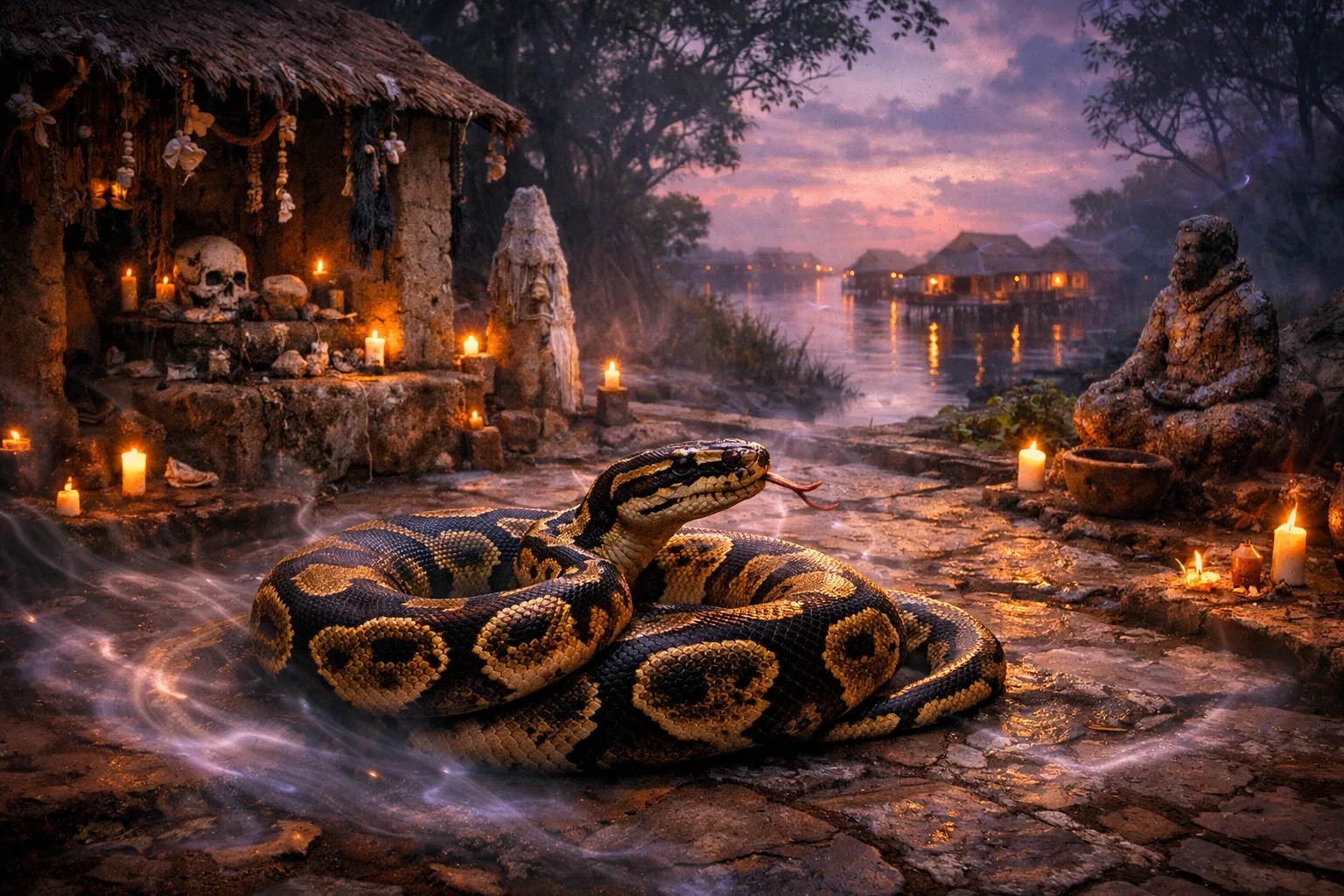
The closest thing Benin has to a nationally recognisable creature legend is the sacred python of Ouidah. The Temple of the Pythons is one of the country’s best-known Vodun sites, and Benin’s own tourism material describes it as a place where sacred pythons are venerated in a city famous for living religious traditions. The same account links the temple’s origin story to a conflict in 1717, when a defeated king of Ouidah was said to have taken refuge in a forest while fleeing enemy warriors.[benintourisme.net]benintourisme.netThe Temple of the PythonsThe Temple of the Pythons
This is not a cryptid in the strict sense. The snakes are real animals, not unknown beasts. Reports and travel accounts describe royal pythons or similar non-venomous snakes kept at the temple, handled by priests and shown to visitors. Reuters, reporting from Ouidah during Pope Benedict XVI’s 2011 visit, described a small stone house inside the complex containing large and baby pythons, with a priest placing several around his neck and arms.[Reuters]reuters.comPope visits cathedral in African voodoo cityPope visits cathedral in African voodoo city
What makes the python important for a mystery-animal page is the way the animal’s ordinary body carries extraordinary meaning. Atlas Obscura describes the snakes as a major totem for Vodun followers in West and Central Africa, while Benin’s tourism authority presents the temple as a symbol of the sacredness of the animal. These accounts agree on the main point: the python is not merely a zoo-like attraction. It is a religiously charged animal whose presence makes the line between wildlife, spirit, protection, and local identity feel unusually thin.[Atlas Obscura]atlasobscura.comAtlas Obscura The Temple of Pythons in OuidahAtlas Obscura The Temple of Pythons in Ouidah
For a sceptical reader, the explanation is straightforward: there is no need to posit an unknown serpent species. The mystery lies in cultural status, not zoology. Benin has living snake species, and recent ethnozoological work on reptiles in Benin discusses local knowledge of pythons including the ball python, African rock python, and Calabar burrowing python. The same kind of real reptile can be a biological species, a household fear, a protected sacred animal, a tourist encounter, and a story-bearing being, depending on context.[techagro.org]techagro.orgOpen source on techagro.org.
Where creature stories cluster: Ouidah, Ganvié, lakes, forests, and parks
Benin’s creature lore is strongly tied to place. Ouidah is the obvious centre for python traditions and modern Vodun tourism. Reuters reported in 2025 that Benin’s Vodun Days festival in Ouidah is used to challenge stereotypes about Vodun, with ceremonies, concerts, exhibitions, tourists, worshippers, and figures such as the “guardians of the night” in elaborate straw costumes.[Reuters]reuters.comOpen source on reuters.com.
Ganvié, the stilt settlement on Lake Nokoué, gives Benin another creature-rich setting. The settlement is widely presented as a refuge founded by the Tofinu people during the era of slave raiding. Condé Nast Traveler describes Ganvié as Africa’s largest town on stilts and explains that the lake became a haven because religious beliefs prevented Fon pursuers from fighting there. The result is not a monster flap but a landscape where water, protection, fear, and survival are central to the founding story.[Condé Nast Traveler]cntraveler.comOpen source on cntraveler.com.
Some travel accounts add a more explicitly legendary animal element: a leader turning into or being aided by a crocodile or bird while guiding people to safety. Such versions should be treated carefully, because they are often retold in tourist literature rather than documented as fixed ancient texts. Still, they fit the wider pattern: in Benin, powerful animals often mark the place where history becomes myth.
The country’s northern protected areas provide a different kind of mystery-beast backdrop. Pendjari National Park is part of the W-Arly-Pendjari complex, which African Parks describes as the largest remaining intact ecosystem in West Africa and a refuge for elephants, West African lions, cheetahs, leopards, hippos, antelope, buffalo, and other large mammals.[African Parks]africanparks.orgOpen source on africanparks.org. Real predators and large animals make misidentification plausible: a rare leopard seen at dusk, a hippo surfacing in poor light, or a crocodile moving through reeds can easily acquire a larger-than-life afterlife in local retelling.

Crocodiles, water spirits, and the power of the lake
Benin’s waters are more important to its mystery-animal traditions than any single alleged monster. Lake Nokoué, Ganvié, coastal lagoons, mangroves, and river systems create exactly the kind of environment where crocodile stories, water-spirit ideas, and ambiguous sightings can thrive.
Ganvié is useful because it shows how a creature can be legendary without being a cryptid. The basic historical frame is clear enough: people fled danger and built a life on the lake. The creature layer changes from telling to telling. Some versions stress sacred water and protective deities; others introduce a crocodile or bird-like transformation. What matters is not whether a giant crocodile literally carried people to safety. The story makes crocodiles and water part of the memory of survival.
Benin’s broader coastal and wetland ecology also helps explain why watery creatures remain plausible in imagination. Le Monde reported in 2024 on Benin’s mangroves, noting sacred spaces protected by Vodun-associated rules and describing reptiles including puff adders, forest cobras, pythons, and possibly returning crocodiles in the Togbin area near Cotonou. The article also noted that many villages have sacred spaces, sometimes a natural island, tree, spring, or forest patch, and that these places can act as biodiversity refuges.[Le Monde.fr]lemonde.frLe Monde.fr Benin's voodoo deities take care of precious mangrovesLe Monde.fr Benin's voodoo deities take care of precious mangroves
This is where folklore and ecology overlap. A protected mangrove channel can become a place where animals are less disturbed. A sacred grove can preserve habitat. A lake associated with danger or taboo can reduce human intrusion. In such settings, real animals are more likely to survive, and stories about hidden, guarded, or forbidden creatures become easier to believe.
Mami Wata and serpent imagery: spirit, not specimen
West African water-spirit traditions are often pulled into cryptid discussions because they feature mermaid-like beings, serpents, underwater realms, and dangerous beauty. In Benin’s case, Mami Wata and related water-spirit imagery are best understood as religious and artistic traditions, not reports of an unknown aquatic animal.
The National Museum of Scotland describes Mami Wata as an African spiritual tradition centred on a pantheon of water spirits, with influence spread by trading routes across a broad region from Senegal to Zambia. It is especially associated in that article with south-eastern Nigeria, but its wider West African circulation makes it relevant to Benin’s coastal religious world.[National Museums Scotland]nms.ac.ukOpen source on nms.ac.uk.
Scholar Henry John Drewal’s work on Mami Wata emphasises the importance of snakes in the iconography: snakes are ancient symbols of African water spirits and often accompany Mami Wata, who may be shown as a snake charmer.[UW Staff]staff.washington.eduUW Staff Mami WataUW Staff Mami Wata That matters for Benin because serpent reverence is already highly visible in Ouidah. A visitor may encounter pythons as living sacred animals, snake imagery in shrines, and water-spirit ideas in the same broad cultural landscape.
For a cryptid-minded reader, the distinction is important. Mami Wata is not a “mermaid sighting file” in the modern monster-hunter sense. The tradition belongs to religion, art, healing, danger, wealth, beauty, water, and moral obligation. Its creatures are meaningful because they are spiritually charged, not because they are zoological candidates awaiting capture.
The “monster” that is really a guardian: Zangbeto
Another Beninese figure that sometimes looks monster-like to outsiders is Zangbeto, often described as a night guardian or “guardian of the night” in Vodun-associated performance. The form can be startling: a tall, spinning raffia body that appears animated, sometimes with no visible human performer. Reuters’ 2025 report on Vodun Days referred to “guardians of the night” wearing elaborate dyed straw costumes as one of the festival highlights.[Reuters]reuters.comOpen source on reuters.com.
Zangbeto is not an animal claim, but it belongs on a Benin mystery-creature page because it shows how easily ritual performance can be misread as a monster tradition. A masked guardian in motion, seen at night or in a festival crowd, can seem like a creature. Yet its meaning is social and religious: protection, order, spectacle, ancestral authority, and community identity.
The mistake to avoid is turning every non-human-looking being into a cryptid. Zangbeto belongs closer to masquerade and spiritual guardianship than to mystery zoology. Still, it helps explain why Benin’s “monster” landscape is so different from countries where the focus is a lake beast, hairy hominid, or phantom cat. Here, the uncanny often appears through ritual bodies rather than alleged unknown animals.
Real animals behind strange reports
Benin has enough real wildlife to explain many possible “mystery animal” stories without inventing new species. The country’s major protected areas include elephants, buffalo, hippos, leopards, lions, cheetahs, antelope, and large reptiles. African Parks describes Pendjari as one of the last refuges for the region’s elephants and endangered West African lions, while also listing leopard, cheetah, hippo, buffalo, hartebeest, kob, and waterbuck among its mammals.[African Parks]africanparks.orgOpen source on africanparks.org.
Several kinds of misidentification are especially plausible:
- Large cats at distance: A leopard glimpsed briefly can become a “phantom cat” story, especially outside areas where people expect to see one.
- Hippos in water: A surfacing hippo can look like a moving log, a lake creature, or a dark animal with no clear outline.
- Crocodiles in lagoons or rivers: Crocodiles already carry danger and symbolic force, making them easy to enlarge in retelling.
- Pythons and other snakes: A large African rock python can become a giant-serpent story, particularly where snakes also have sacred meaning.
- Masked ritual figures: A Zangbeto or other masquerade seen without context can be mistaken by outsiders for a creature tradition.
The strongest sceptical explanation for Benin’s thin cryptid record is not that the country lacks strange stories. It is that many of its strange animal-like traditions are already explained by known wildlife, Vodun practice, sacred ecology, and historical memory. The “unknown animal” category is simply less useful here than the categories of sacred animal, spirit being, protective masquerade, and misidentified wildlife.
Why Benin has folklore rather than a famous cryptid
Benin’s creature traditions have not become famous in global cryptozoology for several reasons. First, many are embedded in Vodun, which outsiders have often misunderstood or sensationalised. Modern reporting on Vodun Days stresses that the festival is partly about challenging stereotypes and presenting Vodun as a living religion rather than a horror-movie caricature.[Reuters]reuters.comOpen source on reuters.com.
Second, the main creatures are not unknown. Pythons, crocodiles, leopards, hippos, and elephants exist. Their mystery comes from relationship: taboo, reverence, danger, protection, royal symbolism, or sacred space. That makes Benin less suited to the usual cryptid question, “Does this animal exist?”, and better suited to the deeper question, “Why does this animal matter so much here?”
Third, Benin’s sacred landscapes complicate the usual split between belief and environment. Research on African traditional religions and forest cover uses Benin as a key case, arguing that religious beliefs placing forests within a sacred sphere can influence conservation outcomes.[arXiv]arxiv.orgarXiv Sacred Ecology: The Environmental Impact of African Traditional ReligionsarXiv Sacred Ecology: The Environmental Impact of African Traditional Religions Le Monde’s reporting on mangroves makes the same point in a more concrete way: sacred prohibitions can help protect habitats where reptiles, birds, fish, and mammals live.[Le Monde.fr]lemonde.frLe Monde.fr Benin's voodoo deities take care of precious mangrovesLe Monde.fr Benin's voodoo deities take care of precious mangroves
That means a Beninese creature story may preserve ecological knowledge as much as supernatural fear. A python may be protected because it is sacred. A grove may survive because it is spiritually guarded. A lake may become a refuge because enemies will not enter it. In such cases, folklore is not a decorative extra added to nature; it changes how people treat the living landscape.
How to read Benin’s creature lore fairly
The fairest way to read Benin’s mystery-animal traditions is to keep four categories separate.
Living sacred animals are real species given religious or symbolic status. The pythons of Ouidah are the clearest example: real snakes, publicly visible, but surrounded by Vodun meaning and local tradition.[benintourisme.net]benintourisme.netThe Temple of the PythonsThe Temple of the Pythons
Legendary animals in origin stories appear in accounts such as Ganvié’s water-protection traditions. These stories may feature crocodiles, birds, water powers, or transformation, but their main job is to explain survival, refuge, and identity rather than to document an unknown species.[Condé Nast Traveler]cntraveler.comOpen source on cntraveler.com.
Spirit beings and ritual figures include water-spirit imagery and Zangbeto-like guardians. They may look creaturely, but they belong primarily to religion, art, performance, and social life.[UW Staff]staff.washington.eduUW Staff Mami WataUW Staff Mami Wata
Misidentified or rare wildlife covers the ordinary zoological explanations: large snakes, crocodiles, hippos, leopards, and other animals seen briefly, at night, in water, or outside expected settings. Benin’s protected areas and wetlands make these explanations plausible without draining the stories of interest.[African Parks]africanparks.orgOpen source on africanparks.org.
This approach keeps the strangeness intact without pretending that Benin has a hidden dinosaur, lake serpent, or ape-man tradition supported by strong evidence. Its creature lore is subtler than that. Benin’s monsters are often guardians, ancestors, sacred animals, water powers, or misunderstood wildlife — and that makes the country’s mystery-beast tradition less like a monster hunt and more like a map of how animals, spirits, places, and memory live together.
Amazon book picks
Further Reading
Books and field guides related to Where Benin's Monsters Are Mostly Sacred. Use these as the next step if you want deeper reading beyond the article.
Mami Wata
Directly relates to water spirits, serpents, and sacred creature imagery in Benin.
African Myths of Origin
Provides regional folklore context for sacred animals and legendary beings.

The Penguin Book of Dragons
Explores how cultures transform animals into powerful legendary symbols.
eBay marketplace picks
Marketplace Samples
Live-tested eBay searches with available results related to this page.



Endnotes
1.
Source: benintourisme.net
Title: The Temple of the Pythons
Link:https://www.benintourisme.net/en/news/pythons-benin
2.
Source: reuters.com
Link:https://www.reuters.com/world/africa/benin-festival-seeks-dispel-voodoo-stereotypes-2025-01-14/
3.
Source: reuters.com
Title: Pope visits cathedral in African voodoo city
Link:https://www.reuters.com/article/world/pope-visits-cathedral-in-african-voodoo-city-idUSJOE7AI00E/
4.
Source: techagro.org
Link:https://techagro.org/index.php/MJAS/article/view/1053
5.
Source: arxiv.org
Title: arXiv Sacred Ecology: The Environmental Impact of African Traditional Religions
Link:https://arxiv.org/abs/2401.13673
6.
Source: reuters.com
Title: benin cult priests charged over anti voodoo prayer deaths id USKBN15W1SG
Link:https://www.reuters.com/article/world/benin-cult-priests-charged-over-anti-voodoo-prayer-deaths-idUSKBN15W1SG/
7.
Source: cntraveler.com
Link:https://www.cntraveler.com/stories/2014-06-23/ganvie-benin-maphead
8.
Source: atlasobscura.com
Title: Atlas Obscura The Temple of Pythons in Ouidah
Link:https://www.atlasobscura.com/places/the-temple-of-pythons-ouidah-benin
9.
Source: africanparks.org
Link:https://www.africanparks.org/the-parks/pendjari/biodiversity-conservation
10.
Source: africanparks.org
Link:https://www.africanparks.org/the-parks/pendjari
11.
Source: lemonde.fr
Title: Le Monde.fr Benin’s voodoo deities take care of precious mangroves
Link:https://www.lemonde.fr/en/environment/article/2024/09/03/benin-s-voodoo-deities-take-care-of-precious-mangroves_6724551_114.html
12.
Source: nms.ac.uk
Link:https://www.nms.ac.uk/discover-catalogue/the-african-spiritual-tradition-of-mami-wata
13.
Source: staff.washington.edu
Title: UW Staff Mami Wata
Link:https://staff.washington.edu/ellingsn/Drewal-Mami_Wata-AfAr.2008.41.2.pdf
14.
Source: Wikipedia
Title: Mami Wata
Link:https://en.wikipedia.org/wiki/Mami_Wata
15.
Source: Wikipedia
Title: Pendjari National Park
Link:https://en.wikipedia.org/wiki/Pendjari_National_Park
16.
Source: Wikipedia
Link:https://en.wikipedia.org/wiki/Ganvie
17.
Source: atlasobscura.com
Link:https://www.atlasobscura.com/things-to-do/ouidah-benin
18.
Source: atlasobscura.com
Link:https://www.atlasobscura.com/things-to-do/benin
19.
Source: atlasobscura.com
Title: Fort of São João Baptista de Ajudá in Ouidah
Link:https://www.atlasobscura.com/places/fort-of-sao-joao-baptista-de-ajuda
20.
Source: atlasobscura.com
Link:https://www.atlasobscura.com/places?page=1099&search=asylum
21.
Source: atlasobscura.com
Title: door of no return
Link:https://www.atlasobscura.com/places/door-of-no-return
22.
Source: atlasobscura.com
Title: cotonou benin
Link:https://www.atlasobscura.com/things-to-do/cotonou-benin
23.
Source: atlasobscura.com
Link:https://www.atlasobscura.com/categories/voodoo
24.
Source: atlasobscura.com
Title: voodoo chameleon church abomey
Link:https://www.atlasobscura.com/places/voodoo-chameleon-church-abomey
25.
Source: atlasobscura.com
Title: penang snake temple
Link:https://www.atlasobscura.com/places/penang-snake-temple
26.
Source: monster.fandom.com
Link:https://monster.fandom.com/wiki/Zangbeto
27.
Source: national-parks.org
Link:https://national-parks.org/benin/pendjari-national-park/
28.
Source: africanparks.org
Link:https://www.africanparks.org/largest-collaring-initiative-concluded-protect-wildlife-pendjari-and-w-national-parks-benin
29.
Source: africanparks.org
Link:https://www.africanparks.org/sites/default/files/uploads/resources/2018-10/Pendjari%20Factsheet.pdf
30.
Source: africanparks.org
Title: biodiversity conservation
Link:https://www.africanparks.org/the-parks/w/biodiversity-conservation
31.
Source: natureconservation.pensoft.net
Link:https://natureconservation.pensoft.net/article/86352/download/pdf/757370
32.
Source: thecandytrail.com
Link:https://www.thecandytrail.com/ganvie-floating-village-benin/
33.
Source: christoph.today
Link:https://christoph.today/benin/
34.
Source: universvoyage.com
Title: Mami Wata
Link:https://universvoyage.com/en/voodoo-mami-wata-mother-of-the-waters-queen-of-the-seas-and-oceans/
35.
Source: nationsencyclopedia.com
Link:https://www.nationsencyclopedia.com/Africa/Benin-FLORA-AND-FAUNA.html
36.
Source: murderiseverywhere.blogspot.com
Title: Mami Wata
Link:https://murderiseverywhere.blogspot.com/2020/04/mami-wata-water-spirit.html
Additional References
37.
Source: instagram.com
Link:https://www.instagram.com/p/C5rIWxLIv_m/
38.
Source: academia.edu
Link:https://www.academia.edu/1950153/Imaging_otherness_in_ivory_African_portrayals_of_the_Portuguese_ca_1492
39.
Source: facebook.com
Link:https://www.facebook.com/NaijaExplorers/posts/a-brave-moment-at-the-sacred-python-temple-of-ouidah-ouidah-reels/1345387384267489/
40.
Source: facebook.com
Link:https://www.facebook.com/OGBKWolrdwide/posts/as-a-lover-of-our-beautiful-edo-art-and-culture-you-will-notice-that-these-types/722460952105913/
41.
Source: instagram.com
Link:https://www.instagram.com/reel/DKT3mzPt6Et/
42.
Source: facebook.com
Link:https://www.facebook.com/mongabay/posts/can-wildlife-conservation-succeed-in-an-active-hotspot-of-armed-conflict-in-beni/1389916813005469/
43.
Source: geotoys.com
Link:https://geotoys.com/blogs/geotoys-blog/cryptids-across-continents-global-legends-of-mystery-and-myth?srsltid=AfmBOooglNRs-zpWPCLlemAZJQ-5yw9mf8Wa4tuqrxJDN73RijdJWHFm
44.
Source: alexisduclos.com
Link:https://alexisduclos.com/index.php/ganvie-une-lagune-en-peril/
45.
Source: journeysbydesign.com
Link:https://journeysbydesign.com/destinations/benin/ganvie-2
46.
Source: facebook.com
Link:https://www.facebook.com/ohafrikans/videos/ganvi%C3%A9-benin-ganvi%C3%A9-a-distinctive-lakeside-city-in-southern-benin-on-lake-nokou%C3%A9/7192666447423614/
Topic Tree
Follow this branch
Related pages 192
- Antigua Cryptids
- Maldives Monsters
- Malta Monsters
- Qatar Monsters
- Argentina Monsters
- +187 more in sidebar