Cryptid Reports from Liberia's Rainforest Rivers
Liberia’s best-known mystery-animal story is the Gbahali, a large crocodile-like creature said to live in rainforest rivers in Lofa County, especially around the Kahai River and its tributaries.
Page outline Jump by section
Introduction
Liberia’s best-known mystery-animal story is the Gbahali, a large crocodile-like creature said to live in rainforest rivers in Lofa County, especially around the Kahai River and its tributaries. The tale is interesting because it sits in a grey zone: witnesses describe it not as a ghost or spirit, but as an ordinary, dangerous animal; sceptics point to known crocodiles, monitor lizards, exaggeration, and television-friendly “living dinosaur” framing. The available evidence is thin: there are reported interviews, local claims, and a 2017 television episode, but no verified specimen, photograph, DNA sample, or independently confirmed attack. Liberia is, however, exactly the kind of place where such a story can feel plausible: it contains major surviving tracts of Upper Guinean rainforest, real crocodile habitats, remote waterways, and wildlife that is still imperfectly documented.[blogspot.com]karlshuker.blogspot.comShuker Nature: THE GRUESOME GBAHALIShuker Nature: THE GRUESOME GBAHALI
The Gbahali: Liberia’s “terror croc” claim
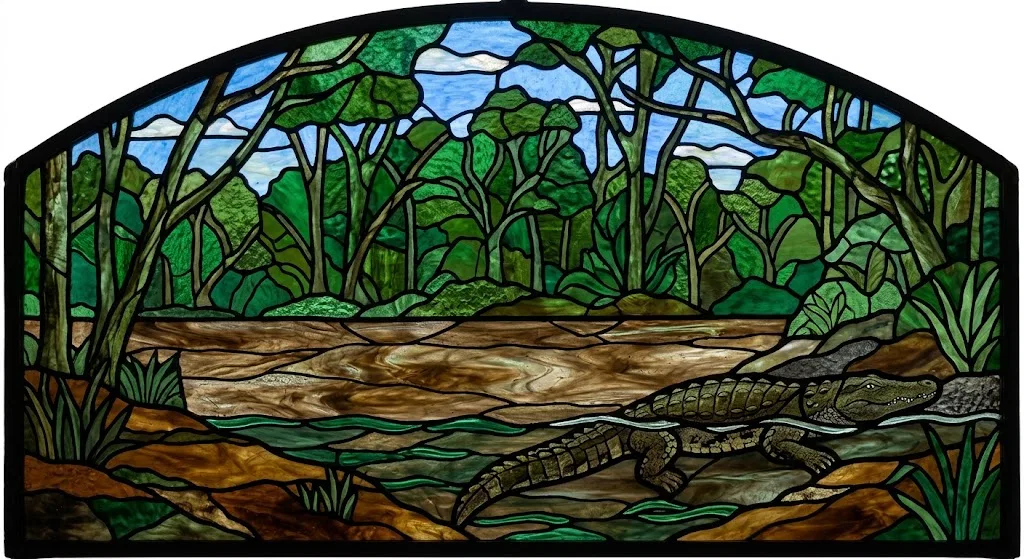
The Gbahali is usually described as a giant amphibious reptile, larger and higher-standing than an ordinary crocodile, with a lizard-like head, interlocking teeth, a powerful tail, and armoured ridges along the back. In modern cryptid writing it is often compared with prehistoric crocodile relatives, especially Postosuchus, but that comparison is more a visual hook than a serious identification. Postosuchus was a Triassic animal known from North America, not a plausible hidden survivor in a modern Liberian river system.[cryptidarchives.fandom.com]cryptidarchives.fandom.comOpen source on fandom.com.
The strongest cluster of modern claims comes from Lofa County in northern Liberia. Cryptozoological summaries and later retellings associate the creature with the Kahai River, frontier villages, fishermen and hunters, and the idea that local people avoid certain waterways because of the risk of attack. Karl Shuker’s 2024 account, based on earlier reports and the television investigation, describes witnesses around the Kahai claiming that the animal could leave the water, walk on all fours with its body raised higher than a crocodile’s, and then disappear back into the river.[karlshuker.blogspot.com]karlshuker.blogspot.comShuker Nature: THE GRUESOME GBAHALIShuker Nature: THE GRUESOME GBAHALI
The Gbahali’s public profile rose sharply through Expedition Mungo. Discovery UK’s programme page framed the case as “Living Dinosaur Of Liberia”, asking whether a huge crocodilian creature could be “more akin to a dinosaur than anything known today”. Apple TV’s listing for the 2017 episode gives a more cautious entertainment-summary version: the Gbahali might be “a case of mistaken identity” or a “super-sized species of crocodile”. That split — monster pitch on one side, misidentification on the other — captures the whole problem with the case.[Discovery UK]discoveryuk.comDiscovery UKLiving Dinosaur Of Liberia: Expedition MungoDiscovery UKLiving Dinosaur Of Liberia: Expedition Mungo

Where the reports cluster and why Lofa matters
The Gbahali is not a countrywide Liberian sea-serpent tradition or a famous lake monster. It is a northern rainforest-river story, tied most clearly to Lofa County and the Kahai River area. That matters because the setting is not a scenic tourist lake with regular boat traffic; it is a region where thick vegetation, difficult access, fishing, hunting and river crossings can produce brief, high-stress encounters with real animals.[karlshuker.blogspot.com]karlshuker.blogspot.comShuker Nature: THE GRUESOME GBAHALIShuker Nature: THE GRUESOME GBAHALI
Liberia’s broader ecological setting helps explain why a giant reptile story would take root. The country’s National Biodiversity Strategy and Action Plan describes Liberia as holding the highest remaining portion of the Upper Guinea forest massif, with substantial plant, bird, reptile and mammal diversity, while also noting major habitat loss and the need for more research. The same combination — rich habitat, incomplete monitoring, and pressure from hunting and land-use change — is ideal for both genuine wildlife surprises and durable mystery-animal rumours.[Convention on Biological Diversity]cbd.intConvention on Biological Diversity CBD Strategy and Action PlanConvention on Biological Diversity CBD Strategy and Action Plan
The southern Sapo landscape shows how much real wildlife remains in Liberia’s forests, even though it is not the main Gbahali area. Fauna & Flora describes Sapo National Park as Liberia’s largest protected area, covering 1,804 square kilometres, with key species including western chimpanzee, pygmy hippopotamus and African forest elephant. Liberia’s Sixth National Report to the Convention on Biological Diversity also identifies the Tai-Grebo-Sapo forest complex as the largest contiguous tropical rainforest area in the Upper Guinean forest ecosystem, supporting rare mammals and primates.[Fauna & Flora]fauna-flora.orgFauna & Flora Forest protection in Sapo National Park, Liberia | Fauna & FloraFauna & Flora Forest protection in Sapo National Park, Liberia | Fauna & Flora
What eyewitnesses are said to have reported
The most repeated eyewitness details are fairly consistent: the creature is said to look somewhat crocodilian, but not quite like a normal crocodile. Reported differences include a shorter or more lizard-like head, eyes set far back, a higher stance, prominent teeth and a body length sometimes estimated at around 20 feet or more. In Shuker’s summary of the Expedition Mungo material, one villager named Momo reportedly said he and his brother saw one on land near the Kahai River; another witness, Isaac from Monena, reportedly described an animal larger than a crocodile with a lizard-like mouth.[karlshuker.blogspot.com]karlshuker.blogspot.comShuker Nature: THE GRUESOME GBAHALIShuker Nature: THE GRUESOME GBAHALI
There are also attack stories. One version says a Gbahali killed three men trying to cross the Kahai on a raft at dusk. Another recounts a man being seized while crossing a shallow river after others warned him that the animal had been seen there earlier. These are dramatic claims, but they remain claims. No public record cited in the available material establishes the victims, dates, medical evidence, recovered remains, or official wildlife investigation needed to turn the stories into verified case reports.[karlshuker.blogspot.com]karlshuker.blogspot.comShuker Nature: THE GRUESOME GBAHALIShuker Nature: THE GRUESOME GBAHALI
A notable feature is that the Gbahali is often presented by informants as a flesh-and-blood animal rather than a supernatural being. That distinguishes it from many forest-spirit or water-spirit traditions. In the Gbahali material, the creature is feared because it is said to kill people, not because it is treated as a magical omen, ancestor, demon or ritual figure.[cryptidarchives.fandom.com]cryptidarchives.fandom.comOpen source on fandom.com.
Known crocodiles offer the first sceptical explanation
The most conservative explanation is that some Gbahali reports are encounters with known crocodilians, distorted by fear, poor visibility, retelling and the difficulty of judging size at water level. Liberia definitely has real crocodile habitat. Christopher P. Kofron’s survey of Liberian waterways recorded all three African crocodile species recognised in that study: Nile crocodiles in mangrove swamps and brackish river mouths, slender-snouted crocodiles in rainforest rivers, and dwarf crocodiles in small rainforest streams and stream-bank burrows. The same survey concluded that crocodiles were nowhere abundant and that populations had apparently been depleted by habitat destruction and hunting.[Cambridge University Press & Assessment]cambridge.orgOpen source on cambridge.org.
That habitat partitioning is important. If a witness in a forest river sees a long, armoured reptile at dusk, “not a crocodile” may mean “not the crocodile I expected”, rather than “unknown species”. Slender-snouted crocodiles are more associated with rainforest rivers, while dwarf crocodiles are heavily armoured, secretive and linked to small forest streams. A large crocodile in bad light can also look higher-standing when climbing a bank, bracing in shallow water, or seen at an odd angle.[Cambridge University Press & Assessment]cambridge.orgOpen source on cambridge.org.
There are problems with a simple crocodile answer, though. Witnesses specifically stress a lizard-like head, an unusually raised posture and a size sometimes beyond what would be expected for Liberia’s smaller forest crocodiles. Sceptically, those details may be exaggeration or composite memory. Cryptid-friendly readers may see them as the heart of the mystery. Either way, the known-crocodile explanation remains the first place to start because it requires no unknown animal and fits the riverine attack motif.[karlshuker.blogspot.com]karlshuker.blogspot.comShuker Nature: THE GRUESOME GBAHALIShuker Nature: THE GRUESOME GBAHALI

Monitor lizards, memory and “living dinosaur” inflation
A second plausible ingredient is the monitor lizard. West African monitor lizards can have long bodies, powerful tails, lizard-like heads and a more upright-looking gait than crocodiles. A monitor seen briefly near water could supply some features that witnesses say distinguish the Gbahali from a crocodile. The difficulty is size: monitor lizards do not account for 20- to 30-foot claims unless the witness estimate is badly inflated or the story has grown in retelling.[karlshuker.blogspot.com]karlshuker.blogspot.comOpen source on blogspot.com.
The “living dinosaur” label is the least reliable part of the modern Gbahali story. It is useful for television promotion and online monster art, but it pushes the reader toward the most exotic interpretation before the basic evidence has been established. The Discovery and Apple listings show how the case was sold to audiences: a prehistoric crocodilian creature, possibly a mistaken identity, possibly something stranger. As public-facing entertainment, that framing made the Gbahali memorable; as evidence, it adds little.[Discovery UK]discoveryuk.comDiscovery UKLiving Dinosaur Of Liberia: Expedition MungoDiscovery UKLiving Dinosaur Of Liberia: Expedition Mungo
This does not mean the witnesses are lying. Many cryptid traditions grow from sincere attempts to name frightening encounters with real animals. A fisherman or hunter does not need to mislead anyone to produce a monster report; a brief view of a large reptile, a dangerous river crossing, a missing person, and repeated village warnings can be enough. Over time, the story becomes sharper, larger and more creature-shaped.
The Kumbway and Liberia’s smaller mystery-beast fringe
The Gbahali is the main Liberian cryptid in circulation, but it is not the only alleged mystery animal attached to the country. A lesser-known claim, the Kumbway, appears in cryptozoological sources as an armour-plated, pangolin-like or reptile-adjacent creature reported from rainforest swamps in Lofa County. It has far less public material than the Gbahali and should be treated as a fringe claim within an already thin evidence field.[cryptozoonews.com]cryptozoonews.comOpen source on cryptozoonews.com.
The Kumbway is useful mainly because it shows that Lofa County has become, in cryptid circles, Liberia’s mystery-animal zone: remote forest, swamp, river, hunters’ accounts, and creatures described as dangerous but natural. That does not prove either animal exists. It does show how a single landscape can gather multiple “unknown beast” traditions when local wildlife, oral report, limited documentation and outside cryptozoological interest overlap.
Liberia also has rich animal folklore and masked-spirit traditions, but those should not be blurred carelessly into Gbahali claims. West African and Liberian stories often use animals such as spider, leopard, monkey and crocodile as moral or symbolic figures, and Poro and Sande masking traditions can represent powerful spirit forces. The Gbahali, by contrast, is usually described in modern sources as a river animal, not a ritual mask, trickster tale or forest spirit.[wordpress.com]joegbaba.wordpress.comDr. Joe Gbaba, Sr.Folktales | Dr. Joe Gbaba, SrDr. Joe Gbaba, Sr.Folktales | Dr. Joe Gbaba, Sr
What evidence would change the case?
Right now, the Gbahali rests on testimony, retellings and entertainment-media exposure. That is enough for a compelling monster page, but not enough for zoological recognition. A serious case would need at least one of the following: a clear photograph with location and date, a carcass or physical remains, environmental DNA from a repeatedly reported site, independent attack records, or repeated observations by trained wildlife researchers.
Liberia’s crocodile record shows why field evidence matters. Kofron’s work did not rely on village monster stories; it surveyed waterways and compared habitats across species. Modern conservation work in Liberia likewise uses patrols, biodiversity monitoring, camera traps and community engagement rather than anecdote alone. Fauna & Flora notes that systematic camera-trapping has been part of Sapo National Park work, and such methods are exactly the sort of tools that would be needed to test a claimed river predator.[Cambridge University Press & Assessment]cambridge.orgOpen source on cambridge.org.
The best current assessment is therefore cautious: the Gbahali is a Liberian river cryptid built around real fear, real crocodile country and repeated local testimony, but there is no strong public evidence that it represents an unknown surviving prehistoric reptile. The most likely explanations are misidentified crocodiles, unusually large known reptiles, monitor-lizard confusion, exaggerated size estimates, and stories shaped by the danger of rainforest waterways.
The cultural afterlife of Liberia’s cryptid traditions
The Gbahali persists because it answers a local and human question: what is the dangerous thing in the river? In a landscape where crocodiles are real, visibility is poor, and people fish, hunt and cross waterways for ordinary survival, a story about a giant ambush predator is not random fantasy. It turns a practical hazard into a named presence.
It also persists because Liberia is underrepresented in global monster folklore compared with places that have famous lake monsters, sea serpents or newspaper-backed big-cat flaps. The Gbahali gives the country a distinct cryptid identity: not a ghost, not a dragon in the European sense, but a feared river reptile from the rainforest frontier. That makes it easy for cryptozoology websites, television shows and creature artists to reuse.
The honest version is stranger than the inflated one. Liberia does not need a confirmed living dinosaur for the Gbahali to be worth reading about. The story is valuable because it shows how mystery-animal traditions form where local ecological knowledge, real predators, incomplete documentation and outside monster-hunting imagination meet in the same muddy river.
Amazon book picks
Further Reading
Books and field guides related to What Lurks In Liberia's Rainforest Rivers?. Use these as the next step if you want deeper reading beyond the article.
Hunting Monsters
Directly addresses alleged unknown animals and their possible explanations.
Abominable Science!
Explains how mystery-animal claims are investigated and interpreted.
The Kingdon Field Guide to African Mammals
Useful for understanding real animals that can inspire monster stories.
eBay marketplace picks
Marketplace Samples
Live-tested eBay searches with available results related to this page.

Endnotes
1.
Source: karlshuker.blogspot.com
Title: Shuker Nature: THE GRUESOME GBAHALI
Link:https://karlshuker.blogspot.com/2024/03/the-gruesome-gbahali-lurking-in-liberia.html
2.
Source: cambridge.org
Link:https://www.cambridge.org/core/journals/journal-of-tropical-ecology/article/status-and-habitats-of-the-three-african-crocodiles-in-liberia/E72D62548B369DBBE5968B18DFBDFA74
3.
Source: cryptidarchives.fandom.com
Link:https://cryptidarchives.fandom.com/wiki/Gbahali
4.
Source: karlshuker.blogspot.com
Link:https://karlshuker.blogspot.com/2024/03/
5.
Source: discoveryuk.com
Title: Discovery UKLiving Dinosaur Of Liberia: Expedition Mungo
Link:https://www.discoveryuk.com/series/living-dinosaur-of-liberia-expedition-mungo/
6.
Source: tv.apple.com
Title: TVLiving Dinosaur of Liberia
Link:https://tv.apple.com/us/episode/living-dinosaur-of-liberia/umc.cmc.6sfkphprs5ppqludlln47utzr?showId=umc.cmc.46d1455q0wkgqwzyev5u6zl8g
7.
Source: cryptozoonews.com
Link:https://www.cryptozoonews.com/kumbway/
8.
Source: cryptidarchives.fandom.com
Link:https://cryptidarchives.fandom.com/wiki/Kumbway
9.
Source: teachersinstitute.yale.edu
Title: New Haven Teachers Institute98.02.03: African Myths and What They Teach
Link:https://teachersinstitute.yale.edu/curriculum/units/1998/2/98.02.03/5
10.
Source: cryptidarchives.fandom.com
Title: Ninki nanka
Link:https://cryptidarchives.fandom.com/wiki/Ninki_nanka
11.
Source: cryptidz.fandom.com
Link:https://cryptidz.fandom.com/wiki/Gbahali
12.
Source: cambridge.org
Title: West Africa (Chapter Nine)
Link:https://www.cambridge.org/core/books/power-of-ritual-in-prehistory/west-africa/B630DD0C7F9A87171C33A03177CA6046
13.
Source: cambridge.org
Link:https://www.cambridge.org/core/journals/oryx/article/cooccurring-cryptic-species-pose-challenges-for-conservation-a-case-study-of-the-african-dwarf-crocodile-osteolaemus-spp-in-cameroon/2BB427CB396C75F6A13D2B27B585A6CC
14.
Source: bloggingwithoutmaps.blogspot.com
Title: Societies Within Society
Link:https://bloggingwithoutmaps.blogspot.com/2012/06/societies-within-society-secret.html
15.
Source: cbd.int
Title: Convention on Biological Diversity CBD Strategy and Action Plan
Link:https://www.cbd.int/doc/world/lr/lr-nbsap-v2-en.pdf
16.
Source: fauna-flora.org
Title: Fauna & Flora Forest protection in Sapo National Park, Liberia | Fauna & Flora
Link:https://www.fauna-flora.org/projects/implementing-effective-management-sapo-national-park/
17.
Source: cbd.int
Title: Convention on Biological Diversity CBD Sixth National Report
Link:https://www.cbd.int/doc/nr/nr-06/lr-nr-06-en.pdf
18.
Source: joegbaba.wordpress.com
Title: Dr. Joe Gbaba, Sr.Folktales | Dr. Joe Gbaba, Sr
Link:https://joegbaba.wordpress.com/folktales/
19.
Source: Wikipedia
Link:https://en.wikipedia.org/wiki/Poro
20.
Source: cbd.int
Link:https://www.cbd.int/doc/world/lr/lr-nbsap-01-p1-en.pdf
21.
Source: fauna-flora.org
Link:https://www.fauna-flora.org/wp-content/uploads/2021/02/FFI_CALM_Transbound_Landscape_Case_Study_FINAL_ENG.pdf
22.
Source: paperanddice.wordpress.com
Link:https://paperanddice.wordpress.com/2019/03/22/gbahali/
23.
Source: onehealthliberia.org
Title: national biodiversity strategy and action plan
Link:https://onehealthliberia.org/download/national-biodiversity-strategy-and-action-plan/
24.
Source: rainforesttrust.org
Title: the upper guinea forest
Link:https://www.rainforesttrust.org/our-impact/success-stories/the-upper-guinea-forest/
25.
Source: patricksplace.org
Link:https://patricksplace.org/folktales/
26.
Source: nationalparksassociation.org
Title: sapo national park
Link:https://nationalparksassociation.org/liberia-national-parks/sapo-national-park/
Additional References
27.
Source: youtube.com
Link:https://www.youtube.com/watch?v=zoh692qfJE0
Source snippet
Katharine's Creatures Episode 139: Gbahali...
28.
Source: fws.gov
Link:https://www.fws.gov/sites/default/files/documents/Ecological-Risk-Screening-Summary-Nile-Crocodile.pdf
29.
Source: academia.edu
Link:https://www.academia.edu/8304081/Comparative_Native_Terminology_of_Poro_Groups
30.
Source: academia.edu
Link:https://www.academia.edu/12249232/Cultural_Heritage_Assessment_of_West_Nimba_Liberia_for_Phase_2_ESIA
31.
Source: facebook.com
Link:https://www.facebook.com/congobd/posts/a-gbahali-raptosuchus-terrenus-carries-off-a-young-dingonek-hydriodon-squamatus-/1582293990565022/
32.
Source: study.com
Link:https://study.com/academy/lesson/african-mythological-creatures.html
33.
Source: ekmsliberia.info
Link:https://ekmsliberia.info/wp-content/uploads/2021/09/Biological-Diversity.pdf
34.
Source: wandering-through-time-and-place.com
Link:https://wandering-through-time-and-place.com/tag/bush-devil/
35.
Source: facebook.com
Link:https://www.facebook.com/nyantee.togba/posts/eyewitness-account-of-todays-incident-in-lofa-oretha-bundoo/3337488439748227/
36.
Source: mythlok.com
Link:https://mythlok.com/gbahali/
Topic Tree
Follow this branch
Related pages 192
- Antigua Cryptids
- Maldives Monsters
- Malta Monsters
- Qatar Monsters
- Argentina Monsters
- +187 more in sidebar