Cryptids of Equatorial Guinea's Forests
Equatorial Guinea is not a country with a crowded modern cryptid file. There is no well-attested national equivalent of Loch Ness, Bigfoot, or the Congo Basin’s heavily publicised river monsters.
Page outline Jump by section
Introduction
The best way to read Equatorial Guinea’s monster lore is therefore evidence-aware: treat the Ebigane and related forest beings as folklore, not zoological proof; treat ape-like or shadowy animal reports as likely encounters with known wildlife unless better evidence appears; and recognise that the country’s real biodiversity is strange enough without inventing dinosaurs in the undergrowth.[bristolzoo.org.uk]bristolzoo.org.ukOpen source on bristolzoo.org.uk.
The Ebigane: Equatorial Guinea’s strongest cryptid-style lead
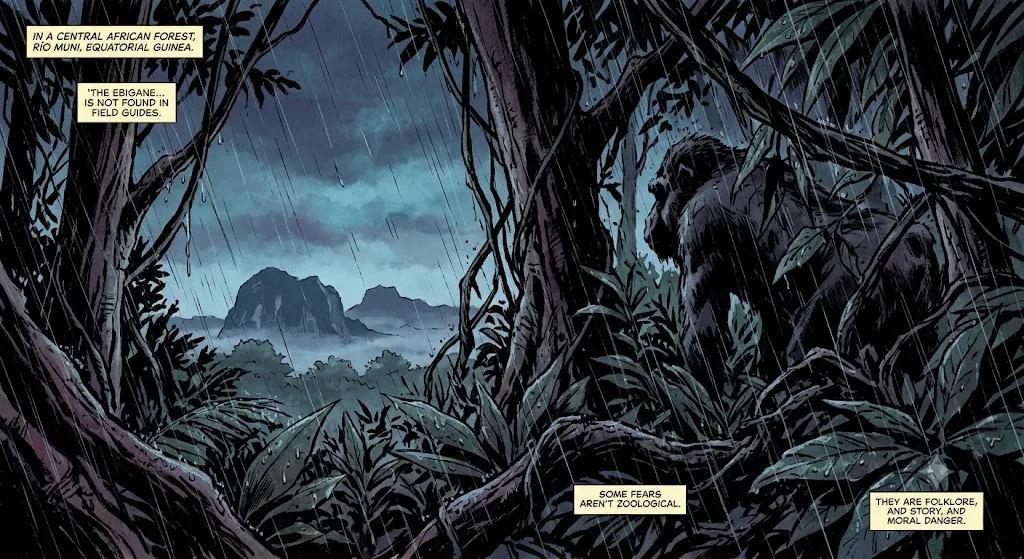
The Ebigane is the most direct match for a country-level cryptid page on Equatorial Guinea. It is described in modern creature catalogues as part of Fang folklore from Cameroon, Gabon, and Equatorial Guinea: an ambiguous being that may appear human, animal, or mixed between the two. Rather than belonging to a neat species category, it sits in the world of oral narrative, performance, and moral danger.[A Book of Creatures]abookofcreatures.comA Book of Creatures EbiganeA Book of CreaturesEbiganeNovember 16, 2020 — 16 Nov 2020 — An Ebigane, in the folklore of the Fang of Cameroon, Gabon, and Equatorial Gu…
That matters because many cryptid pages quietly change folklore into field biology. The Ebigane resists that treatment. It is not best understood as “an unknown primate” or “a surviving prehistoric animal”. Its strongest documented setting is the Fang mvet or mvett tradition: a performed epic art associated with a stringed instrument, song, memory, genealogy, ritual themes, and heroic or mythic storytelling. Sources on the mvet describe it as central to Fang cultural expression across the region, including Equatorial Guinea, and note that mvet performance can carry epic, ritual, philosophical, and historical material.[Wikipedia]WikipediaOpen source on wikipedia.org.
In cryptid terms, the Ebigane is therefore a folkloric monster, not a modern sighting flap. Its “evidence” is narrative evidence: oral tradition, repeated motifs, and later retellings. The useful question is not “has anyone caught one?” but “what kind of fear or boundary does it express?” A being that can shift between human and animal form fits a forest world where people, ancestors, spirits, hunters, and dangerous animals are not always separated as sharply as modern natural-history categories would like.
Where strange-animal stories would naturally cluster
Equatorial Guinea has two very different settings for mystery-beast traditions: the mainland region of Río Muni and the island of Bioko. Both can generate strange encounters, but for different reasons.
Río Muni places Equatorial Guinea inside the wider Central African rainforest zone, with Fang cultural links extending into neighbouring Gabon and Cameroon. That makes its creature traditions porous: a monster remembered in one country may also belong to communities, languages, and story routes that cross modern borders. The Fang are widely associated with mainland Equatorial Guinea and neighbouring Central African countries, so a Fang creature such as the Ebigane should not be forced into a purely modern national box.[Africabib]africabib.orgOpen source on africabib.org.
Bioko, by contrast, is an island stage. UNESCO describes Bioko as ecologically varied, with lowlands, mountains, microclimates, and exceptionally high rainfall in the southern Ureca region. It is also home to distinctive and threatened fauna, including drills, black colobus monkeys, duikers, and pangolins. This kind of environment can make ordinary animal encounters feel uncanny: calls carry through wet forest, animals vanish quickly into canopy or undergrowth, and unfamiliar primates can look disconcertingly human in poor light.[UNESCO]unesco.orgIsla de BiokoIsla de Bioko - Man and the Biosphere Programme (MAB)The island's fauna is equally distinctive, including highly endangered and end…
For readers looking for “hotspots”, the honest answer is that Equatorial Guinea does not have a well-documented public map of monster sightings. The stronger pattern is ecological and cultural rather than tabloid-like: mainland Fang oral tradition for the Ebigane; Bioko’s forests and sacred landscapes for island spirit lore; and forest edges, hunting routes, and night-time soundscapes for possible misidentifications.
Why real wildlife can look legendary here
Equatorial Guinea’s known animals are a major part of the explanation. Bioko alone has long been recognised for its primates. A classic survey reported ten indigenous non-human primate species on the island, with several endangered and several endemic subspecies; more recent conservation work continues to identify Bioko as a major primate-conservation hotspot.[Springer]link.springer.comOpen source on springer.com.
The drill is especially relevant to mystery-animal interpretation. It is a large, powerful, visually striking primate found in a limited range that includes Bioko. In older European contexts, unfamiliar African primates were sometimes treated as curiosities or near-human marvels before being properly classified. National Geographic has discussed a strange animal displayed in Augsburg in 1551 that biologists now think was probably a drill, based on its illustration and reported humanlike hands and feet.[National Geographic]nationalgeographic.comOpen source on nationalgeographic.com.
Other known animals also help explain why a “monster” report might arise without requiring an unknown species. Bristol Zoological Society’s conservation work in Equatorial Guinea refers to camera-trap information on forest elephants, gorillas, chimpanzees, leopards, pangolins, mandrills, and other species. Any one of these can produce dramatic partial encounters: a leopard seen at the edge of settlement, a pangolin glimpsed at night, a chimpanzee heard but not seen, or a large snake magnified by fear and darkness.[Bristol Zoo Project]bristolzoo.org.ukOpen source on bristolzoo.org.uk.
Then there are genuinely elusive animals that sound almost cryptid-like while being scientifically real. Zenkerella, a poorly known scaly-tailed squirrel from Central Africa, was described by researchers as one of the least studied living mammals; newly recovered specimens from Bioko increased the museum count from eleven to fourteen, and scientists noted that the animal had never been observed alive by them in the wild. This is not evidence for monsters, but it is a reminder that “rarely seen” and “legendary” are not the same thing.[Keck School of Medicine of USC]keck.usc.eduon the prowl for an elusive rodent called the ultimate pokemonon the prowl for an elusive rodent called the ultimate pokemon
Folklore, spirits, and animal fables are not the same as cryptid reports
Equatorial Guinea’s creature traditions sit inside broader oral cultures. Sources on Equatoguinean folklore describe Fang stories featuring animal characters, including a clever turtle figure, while other summaries of the country’s oral tradition emphasise stories, legends, proverbs, songs, dances, and rituals that transmit values and social memory.[EveryCulture]everyculture.comOpen source on everyculture.com.
This is important because animal folklore can be mistaken for cryptid testimony when removed from context. A talking animal in a fable is not a witness report. A spirit associated with a forest, mountain, stream, or ancestor is not automatically a hidden species. Fang religious and medical-worldview studies note that animals, plants, elements, and objects may be understood through relationships with ancestors or spirits; that kind of worldview gives animal imagery a social and spiritual role beyond zoology.[MDPI]mdpi.comOpen source on mdpi.com.
Bioko’s Bubi traditions add another layer. Sources on the Bubi describe traditional religious life in relation to ancestors, nature spirits, sacred places, and the island landscape. Some public-facing accounts are uneven in quality, but the broad point is supported across cultural summaries: Bioko’s island identity is not just ecological, but sacred and historical. For a cryptid reader, this means that a “forest being” from Bioko should not be flattened into a monster-hunt prompt without asking whether it belongs to ritual geography, ancestral memory, or local moral teaching.[African Tribe Names]tribeguess.comOpen source on tribeguess.com.
What about lake monsters, sea serpents, phantom cats, and dinosaurs?
This is where Equatorial Guinea is mostly a negative case. Fresh searches for Equatorial Guinea-specific lake monsters, sea serpents, and famous phantom-beast flaps produce little solid evidence. A few cryptid databases and fan pages loosely connect Central African river monsters to the wider region, but the better-known “living dinosaur” traditions are centred elsewhere in the Congo Basin, especially in accounts associated with the Republic of the Congo, the Democratic Republic of the Congo, Cameroon, and the Central African Republic.[Cryptid Archives]cryptidarchives.fandom.comCryptid Archives BadiguiCryptid Archives Badigui
That does not mean Equatorial Guinea lacks water folklore. It means the available English-language public record does not support a famous, well-developed Equatoguinean lake-monster tradition comparable to Loch Ness, Lake Tele, or mokele-mbembe stories. Bioko is coastal, and the country has rivers, mangroves, and marine environments, but search results for “Equatorial Guinea sea serpent” are dominated by irrelevant uses of the phrase rather than creature reports.[seaserpentfleet.com]seaserpentfleet.comcontact uscontact us
Phantom-cat claims are also difficult to separate from real fauna. Leopards are part of the known Central African wildlife picture, and camera-trap projects in Equatorial Guinea include leopards among documented mammals. A shadowy big cat near forest or settlement would be surprising to a witness, but not necessarily anomalous.[Bristol Zoo Project]bristolzoo.org.ukOpen source on bristolzoo.org.uk.
The same caution applies to giant frogs, snakes, or crocodile-like rumours. The region contains impressive real reptiles and amphibians, and neighbouring Cameroon and Equatorial Guinea are associated with the real goliath frog’s range in popular cryptid databases. But the goliath frog is not a hidden monster; it is a known species whose size and habitat have made it a magnet for “world’s largest” fascination.[Cryptid Wiki]cryptidz.fandom.comCryptid Wiki Goliath FrogCryptid Wiki Goliath Frog
Why Equatorial Guinea produces fewer famous cryptid stories than its neighbours
Equatorial Guinea’s thin cryptid profile is not proof that people there lack monster traditions. It reflects language, archive visibility, colonial history, publishing patterns, and the way global cryptozoology has tended to spotlight certain countries over others. English-language cryptid culture has repeatedly favoured exportable stories: lake monsters with named bodies of water, “ape-men” with repeat sightings, and dinosaur-like beasts that fit adventure-expedition narratives. Equatorial Guinea’s better-supported material is more local, oral, and performance-based.[MDPI]mdpi.comOpen source on mdpi.com.
There is also a practical archive problem. A story carried through Fang mvet performance, Bubi ritual memory, or local family narration may not appear in searchable newspapers or English-language books. When it does appear online, it may be summarised in creature catalogues without the full oral-performance setting. That is why the Ebigane is visible enough to name, but not easy to document as a modern sighting tradition.[A Book of Creatures]abookofcreatures.comA Book of Creatures EbiganeA Book of CreaturesEbiganeNovember 16, 2020 — 16 Nov 2020 — An Ebigane, in the folklore of the Fang of Cameroon, Gabon, and Equatorial Gu…
Modern conservation evidence also changes the mood of the mystery. In some countries, cryptid tourism thrives by promising that something unknown may be waiting in the forest. In Equatorial Guinea, the more urgent story is that known animals are under pressure. Studies of Bioko describe hunting pressure, illegal hunting in protected areas, and severe concern for primates, including critically endangered Pennant’s red colobus.[Frontiers]frontiersin.orgFrontiersAccessibility to Protected Areas Increases Primate Hunting…by D Branch · 2022 · Cited by 10 — Bioko Island, Equatorial Guinea…
The most plausible explanations for Equatoguinean monster claims
A fair reading of Equatorial Guinea’s mystery-beast material leaves several explanations on the table, depending on the story.
Folklore and performance explain the Ebigane best. Its place in Fang epic tradition makes it a narrative being before it is anything else. That does not make it “fake” in a cultural sense; it means its truth belongs to story, identity, warning, and imagination rather than camera traps or specimen drawers.[A Book of Creatures]abookofcreatures.comA Book of Creatures EbiganeA Book of CreaturesEbiganeNovember 16, 2020 — 16 Nov 2020 — An Ebigane, in the folklore of the Fang of Cameroon, Gabon, and Equatorial Gu…
Misidentified known wildlife is the strongest explanation for most possible sighting-type claims. Drills, mandrills, chimpanzees, gorillas, leopards, pangolins, large snakes, crocodiles, and nocturnal mammals can all generate strange impressions, especially in rainforest conditions where a witness may see only movement, eyeshine, a silhouette, or hear an unexplained call.[Bristol Zoo Project]bristolzoo.org.ukOpen source on bristolzoo.org.uk.
Rare but real animals account for some of the country’s cryptid-like fascination. Zenkerella is a perfect example: not a monster, not a hoax, but a scientifically recognised mammal so poorly observed that it sounds like folklore when described casually.[Keck School of Medicine of USC]keck.usc.eduon the prowl for an elusive rodent called the ultimate pokemonon the prowl for an elusive rodent called the ultimate pokemon
Cross-border borrowing may explain why some Central African cryptids are vaguely attached to Equatorial Guinea online. The country shares rainforest ecology and cultural connections with Cameroon and Gabon, but that does not mean every Congo Basin monster tradition belongs equally to Equatorial Guinea. Strong attribution needs named places, local testimony, or documented tradition, not just regional proximity.[Africabib]africabib.orgOpen source on africabib.org.
A reader’s field guide to the country’s mystery-beast tradition
For Equatorial Guinea, the most useful “cryptid checklist” is not a long list of monsters. It is a way of sorting claims.
A story is strongest as Equatorial Guinean folklore when it is tied to Fang, Bubi, Ndowé, Annobonese, or other local oral traditions; appears in songs, epics, ritual contexts, or collected tales; and is not pretending to be a recent wildlife report. The Ebigane fits here most clearly.[A Book of Creatures]abookofcreatures.comA Book of Creatures EbiganeA Book of CreaturesEbiganeNovember 16, 2020 — 16 Nov 2020 — An Ebigane, in the folklore of the Fang of Cameroon, Gabon, and Equatorial Gu…
A story is strongest as a possible wildlife misidentification when it involves a brief encounter, a night sound, a large animal shape, or a near-human forest figure without tracks, photographs, repeated independent witnesses, or ecological detail. In Equatorial Guinea, the known wildlife roster is rich enough that this should be the default explanation.[Springer]link.springer.comOpen source on springer.com.
A story is strongest as modern cryptid material only when it has a named place, date, witness chain, repeated reports, and some attempt to rule out known animals. At present, Equatorial Guinea has far less of this public material than neighbouring Congo Basin cryptid traditions.[Cryptid Archives]cryptidarchives.fandom.comCryptid Archives BadiguiCryptid Archives Badigui
What the legend looks like today
Equatorial Guinea’s monster tradition is best described as thin in modern cryptid evidence but rich in the conditions that produce creature lore. The Ebigane gives the country a genuine folkloric monster link through Fang oral epic. Bioko gives it an island of sacred landscapes, rare primates, heavy rain, and hidden animals. Río Muni places it within a rainforest cultural zone where animal stories and cross-border traditions move more easily than modern maps suggest.[abookofcreatures.com]abookofcreatures.comA Book of Creatures EbiganeA Book of CreaturesEbiganeNovember 16, 2020 — 16 Nov 2020 — An Ebigane, in the folklore of the Fang of Cameroon, Gabon, and Equatorial Gu…
The honest conclusion is not that Equatorial Guinea hides a famous undiscovered beast. It is that the country shows how cryptid history often begins before cryptozoology: in forests where animals are powerful, in stories where human and animal boundaries can shift, and in landscapes where the real creatures are already strange enough to make the imagination listen.
Amazon book picks
Further Reading
Books and field guides related to What Monsters Haunt Equatorial Guinea's Forests?. Use these as the next step if you want deeper reading beyond the article.
Cryptozoology A To Z
Helps readers compare Equatorial Guinea stories with global cryptid traditions.
The World of Lore: Monstrous Creatures
Explores how monster traditions emerge from culture and storytelling.
eBay marketplace picks
Marketplace Samples
Live-tested eBay searches with available results related to this page.
Endnotes
1.
Source: unesco.org
Title: Isla de Bioko
Link:https://www.unesco.org/en/mab/isla-de-bioko
Source snippet
Isla de Bioko - Man and the Biosphere Programme (MAB)The island's fauna is equally distinctive, including highly endangered and end...
2.
Source: keck.usc.edu
Title: on the prowl for an elusive rodent called the ultimate pokemon
Link:https://keck.usc.edu/news/on-the-prowl-for-an-elusive-rodent-called-the-ultimate-pokemon/
3.
Source: link.springer.com
Link:https://link.springer.com/article/10.1007/BF00129665
4.
Source: Wikipedia
Link:https://en.wikipedia.org/wiki/Mvet
5.
Source: africabib.org
Link:https://www.africabib.org/rec.php?RID=392708736
6.
Source: everyculture.com
Link:https://www.everyculture.com/wc/Costa-Rica-to-Georgia/EquatorialGuineans.html
7.
Source: Wikipedia
Title: Tradicional oral de Guinea Ecuatorial
Link:https://es.wikipedia.org/wiki/Tradicional_oral_de_Guinea_Ecuatorial
8.
Source: mdpi.com
Link:https://www.mdpi.com/2227-9032/11/6/808
9.
Source: seaserpentfleet.com
Title: contact us
Link:https://www.seaserpentfleet.com/contact-us
10.
Source: Wikipedia
Title: Wildlife of Equatorial Guinea
Link:https://en.wikipedia.org/wiki/Wildlife_of_Equatorial_Guinea
11.
Source: mdpi.com
Link:https://www.mdpi.com/2076-0787/13/1/1
12.
Source: Wikipedia
Title: List of cryptids
Link:https://en.wikipedia.org/wiki/List_of_cryptids
13.
Source: Wikipedia
Title: Mokele mbembe
Link:https://en.wikipedia.org/wiki/Mokele-mbembe
14.
Source: Wikipedia
Title: West African mythology
Link:https://en.wikipedia.org/wiki/West_African_mythology
15.
Source: Wikipedia
Title: Fang people
Link:https://en.wikipedia.org/wiki/Fang_people
16.
Source: archive.org
Link:https://archive.org/download/bulletinofzoolog33inte/bulletinofzoolog33inte.pdf
17.
Source: everyculture.com
Title: Culture of Equatorial Guinea
Link:https://www.everyculture.com/Cr-Ga/Equatorial-Guinea.html
18.
Source: abookofcreatures.com
Title: A Book of Creatures Ebigane
Link:https://abookofcreatures.com/2020/11/16/ebigane/
Source snippet
A Book of CreaturesEbiganeNovember 16, 2020 — 16 Nov 2020 — An Ebigane, in the folklore of the Fang of Cameroon, Gabon, and Equatorial Gu...
Published: November 16, 2020
19.
Source: frontiersin.org
Link:https://www.frontiersin.org/journals/conservation-science/articles/10.3389/fcosc.2022.780162/full
Source snippet
FrontiersAccessibility to Protected Areas Increases Primate Hunting...by D Branch · 2022 · Cited by 10 — Bioko Island, Equatorial Guinea...
20.
Source: bristolzoo.org.uk
Link:https://bristolzoo.org.uk/conservation/equatorial-guinea
21.
Source: nationalgeographic.com
Link:https://www.nationalgeographic.com/magazine/article/island-ark-west-africa-bioko-island-animals
22.
Source: tribeguess.com
Link:https://www.tribeguess.com/learn/bubi
23.
Source: cryptidarchives.fandom.com
Title: Cryptid Archives Badigui
Link:https://cryptidarchives.fandom.com/wiki/Badigui
24.
Source: cryptidz.fandom.com
Title: Cryptid Wiki Category:Africa (Central)
Link:https://cryptidz.fandom.com/wiki/Category%3AAfrica_%28Central%29
25.
Source: cryptidz.fandom.com
Title: Cryptid Wiki Goliath Frog
Link:https://cryptidz.fandom.com/wiki/Goliath_Frog
26.
Source: cryptidz.fandom.com
Link:https://cryptidz.fandom.com/wiki/Kalanoro
27.
Source: cryptidz.fandom.com
Title: Water lion
Link:https://cryptidz.fandom.com/wiki/Water_lion
28.
Source: cryptidz.fandom.com
Link:https://cryptidz.fandom.com/wiki/Category%3AAfrica
29.
Source: cryptidz.fandom.com
Title: Lake Monsters
Link:https://cryptidz.fandom.com/wiki/Lake_Monsters
30.
Source: cryptidarchives.fandom.com
Link:https://cryptidarchives.fandom.com/wiki/Lukwata
31.
Source: creatures-of-myth.fandom.com
Link:https://creatures-of-myth.fandom.com/wiki/Ebigane
32.
Source: cryptidz.fandom.com
Link:https://cryptidz.fandom.com/wiki/Category%3ACongo
33.
Source: liveaboard.com
Title: Sea Serpent
Link:https://www.liveaboard.com/diving/egypt/sea-serpent
34.
Source: abookofcreatures.com
Title: equatorial guinea
Link:https://abookofcreatures.com/category/equatorial-guinea/
35.
Source: abookofcreatures.com
Link:https://abookofcreatures.com/category/e/
36.
Source: abookofcreatures.com
Link:https://abookofcreatures.com/tag/river-and-lake-monsters/page/2/
37.
Source: tribeguess.com
Link:https://www.tribeguess.com/learn/fang
38.
Source: embassyofequatorialguinea.guineainfomarket.com
Link:https://embassyofequatorialguinea.guineainfomarket.com/environment/
39.
Source: johanegerkrans.com
Title: sea serpent
Link:https://www.johanegerkrans.com/products/sea-serpent?srsltid=AfmBOor5DvjvlbY2987FZQ4DjCxSLUEs7_ISLEjnoQ8G-8K52jgPpysq
40.
Source: beastsoflegend.com
Link:https://beastsoflegend.com/bestiary/africa/central/
Additional References
41.
Source: arxiv.org
Link:https://arxiv.org/abs/1608.05428
42.
Source: youtube.com
Title: Guinea: Primate Giants | Beast challenge Stories
Link:https://www.youtube.com/watch?v=8YFe4IsscJM
Source snippet
Equatorial Guinea's Monte Alén National Park: Africa's Tropical Rainforest...
43.
Source: mammalwatching.com
Link:https://mammalwatching.com/Afrotropical/other%20reports/BB%20biokonat.pdf
44.
Source: ebay.co.uk
Link:https://www.ebay.co.uk/itm/385554459561?mkevt=1&mkcid=1&mkrid=710-53481-19255-0&campid=5339151051&customid=endnote-source&toolid=10001
45.
Source: instagram.com
Link:https://www.instagram.com/p/DAO2XfAiCoi/
46.
Source: abcg.org
Link:https://abcg.org/files/documents/55df1fa9-4286-463b-af71-0594f7482937.pdf
47.
Source: researchgate.net
Link:https://www.researchgate.net/publication/228550810_Biotic_Surveys_of_Bioko_and_Rio_Muni_Equatorial_Guinea
48.
Source: blackfinboats.com
Link:https://www.blackfinboats.com/Learn-About-Lake-and-Sea-Monsters-This-Halloween-1-8205.html
49.
Source: core.ac.uk
Link:https://core.ac.uk/download/pdf/323893238.pdf
50.
Source: biodb.com
Link:https://biodb.com/region/equatorial-guinea/
Topic Tree
Follow this branch
Related pages 192
- Antigua Cryptids
- Maldives Monsters
- Malta Monsters
- Qatar Monsters
- Argentina Monsters
- +187 more in sidebar