Within Turkmenistan Monsters
What Do Turkmen Monster Tales Really Mean?
Turkmen tales use ogres, dragons and many-headed beasts as symbols of danger, disorder and heroic triumph rather than as animal reports.
On this page
- Divs as Giants, Demons and Adversaries
- Dragons, Water and Survival in Dry Landscapes
- Why Seven Headed Monsters Keep Returning
Page outline Jump by section
Introduction
Turkmen folklore is full of monsters, but not in the sense that modern cryptid enthusiasts usually mean. The divs, dragons and seven-headed beasts that appear in Turkmen fairy tales are not mysterious animals reported by eyewitnesses. They belong to a much older storytelling tradition shared across Central Asia, the Persian-speaking world and the wider Turkic cultural sphere. In these stories, monsters represent danger, chaos, greed, drought, captivity and the forces that stand between ordinary people and a better life. Heroes defeat them not because they have discovered a new species, but because they restore order to a troubled world.[orient.tm]orient.tmIts characters are divs, peri, dragons.Read moreBewitching world of Turkmen fairy talesJanuary 3, 2020 — 3 Jan 2020 — The world of bewitching Turkmen fairy tales closely relates to the…
For anyone exploring Turkmenistan’s monster traditions, these creatures are important because they reveal how people imagined threats in a harsh landscape where survival depended on courage, wisdom and access to precious resources such as water. Their stories also explain why dragons and many-headed monsters continue to appear across Central Asian folklore long after belief in literal monsters faded.
What Do Turkmen Monster Tales Really Mean?
Turkmen fairy tales preserve a world in which supernatural creatures test heroes and embody the dangers that communities feared most. Unlike modern cryptid reports, these stories are openly fantastical. A dragon may fly, breathe fire or guard a spring. A div may possess enormous strength, magical powers or a mountain fortress. A seven-headed beast may demand sacrifices or terrorise an entire kingdom. None of these details are presented as natural history. They function as symbols within a moral drama.[orient.tm]orient.tmIts characters are divs, peri, dragons.Read moreBewitching world of Turkmen fairy talesJanuary 3, 2020 — 3 Jan 2020 — The world of bewitching Turkmen fairy tales closely relates to the…
The recurring pattern is remarkably consistent:
- A community faces a seemingly impossible threat.
- A monster controls a vital resource, kidnaps people or spreads fear.
- A hero confronts the creature through courage, intelligence or endurance.
- The monster is defeated and normal life returns.
This structure reflects concerns that were very real in Turkmen society: insecurity, scarcity, conflict and the struggle to protect family and community.
Divs as Giants, Demons and Adversaries
Among the most common supernatural enemies in Turkmen tales is the div. In Turkmen storytelling, as in many neighbouring traditions, the div is typically a powerful hostile being associated with evil, captivity and disorder. Fairy-tale collections describe divs as recurring villains who abduct beautiful maidens, imprison heroes or block the path to happiness.[orient.tm]orient.tmIts characters are divs, peri, dragons.Read moreBewitching world of Turkmen fairy talesJanuary 3, 2020 — 3 Jan 2020 — The world of bewitching Turkmen fairy tales closely relates to the…
The figure has deep roots in the wider Iranian cultural world. Historical studies of the div show that the creature evolved from ancient concepts of malevolent supernatural beings into the giant ogres and demons of later folklore. Depending on the story, a div might be a monstrous giant, a demon, a sorcerer or a tyrannical ruler with supernatural strength.[Iranica Online]iranicaonline.orgIranica Online DĪVIranica OnlineDĪV - Encyclopaedia IranicaThe very Persian word dīvānagī (insanity) betrays the association of all mental illness with dem…
What makes the div especially interesting is that it often combines several fears at once:
- Physical danger: immense strength and size.
- Moral danger: deception, greed or cruelty.
- Social danger: kidnapping, enslavement or domination.
- Spiritual danger: association with dark magic or evil forces.
In narrative terms, the div serves as the ultimate obstacle. Heroes prove themselves by overcoming an enemy stronger than any ordinary human. The monster’s defeat symbolises the triumph of courage, justice and intelligence over brute force.[Iranica Online]iranicaonline.orgIranica Online DĪVIranica OnlineDĪV - Encyclopaedia IranicaThe very Persian word dīvānagī (insanity) betrays the association of all mental illness with dem…
For modern readers interested in cryptid traditions, divs occupy a category closer to ogres or demons than to mystery animals. They belong firmly to folklore rather than eyewitness legend.

Dragons, Water and Survival in Dry Landscapes
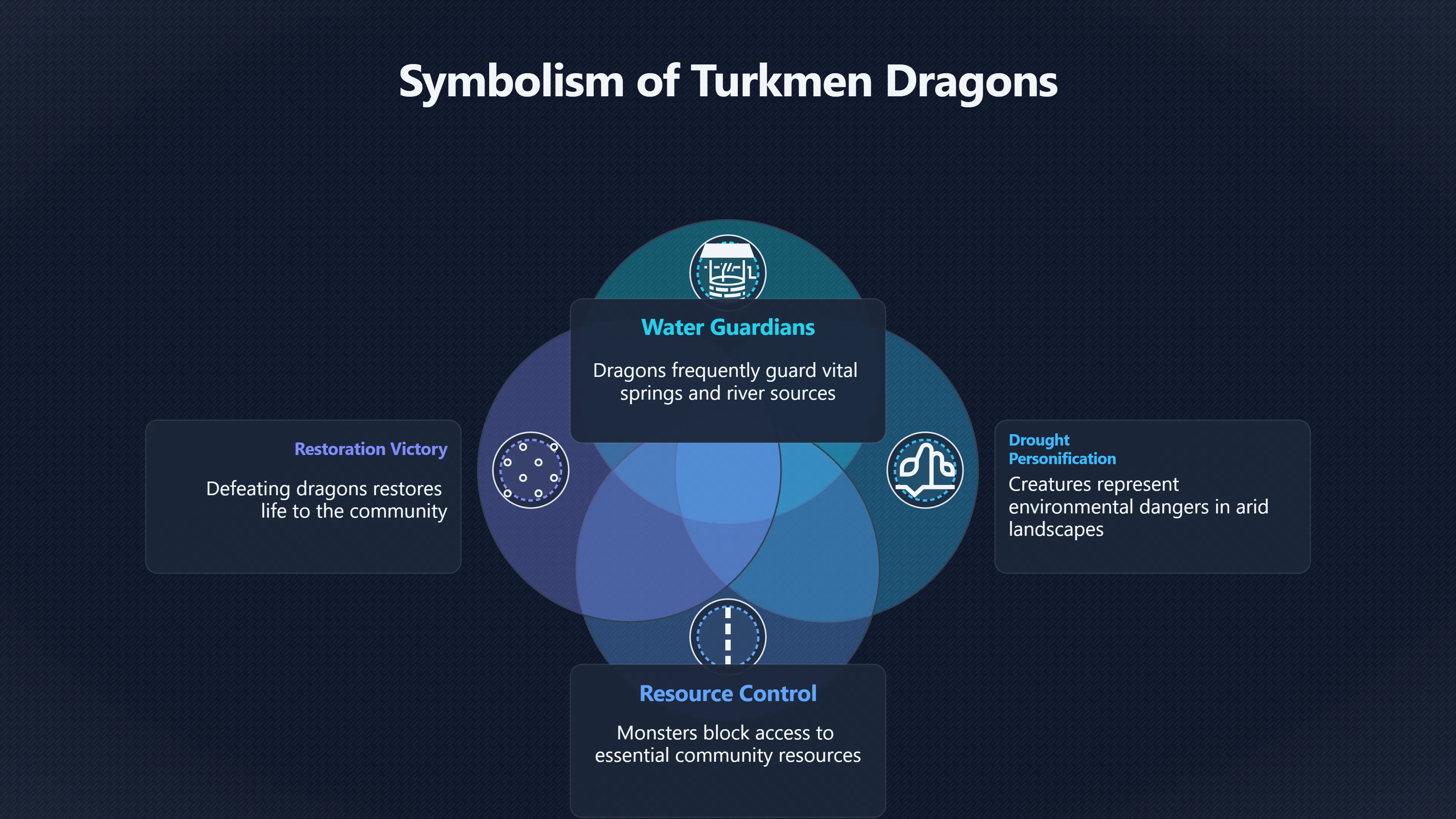
Dragons appear throughout Turkic and Iranian folklore, and Turkmen traditions share many of these themes. While modern Western audiences often picture dragons guarding treasure, Central Asian dragons frequently guard something even more valuable: water.[sosyalarastirmalar.com]sosyalarastirmalar.comthe dragon motif in anatolian legendsThe dragon was very popular from the Mediterranean to China, and quickly replaced this function in p…
This symbolism makes particular sense in Turkmenistan. Much of the country consists of arid or semi-arid landscapes where water determines whether people, livestock and crops survive. In folklore, a dragon that controls a river, spring or lake becomes a personification of environmental danger.
Stories often present dragons as creatures that:
- Block access to water.
- Cause drought or devastation.
- Demand tribute from local people.
- Threaten travellers and herds.
The hero’s victory over the dragon therefore represents more than killing a monster. It symbolises restoring life to the community. Water flows again, agriculture recovers and normal social order returns. The tale turns a practical concern of desert and steppe life into a dramatic adventure.[sosyalarastirmalar.com]sosyalarastirmalar.comthe dragon motif in anatolian legendsThe dragon was very popular from the Mediterranean to China, and quickly replaced this function in p…
These dragons should not be confused with modern lake-monster traditions or alleged unknown reptiles. Their role is mythological and symbolic. Nevertheless, they reveal how environmental realities shaped the imagery of Turkmen storytelling.
Why Seven-Headed Monsters Keep Returning
One of the most striking features of Central Asian folklore is the recurring appearance of monsters with multiple heads, especially seven-headed dragons and seven-headed ogres. Turkmen stories belong to a wider regional tradition in which many-headed creatures represent dangers so overwhelming that an ordinary enemy would not be enough.[Fairytalez]fairytalez.comThe Forty Princes and the Seven-headed DragonThe Forty Princes and the Seven-headed DragonJune 11, 2018 — A Turkish fairy tale of a Padishah's forty sons, their quest for b…
The number seven appears repeatedly across Eurasian folklore, religion and mythology. It often signals completeness, supernatural power or extraordinary significance. A seven-headed monster therefore feels greater than a single beast. It embodies a threat multiplied many times over.
In folklore across Turkic-speaking regions, many-headed monsters commonly:
- Breathe fire.
- Guard remote places.
- Demand human sacrifices.
- Possess magical powers.
- Return after apparently being defeated.
Examples from related Turkic traditions include seven-headed dragons and ogre-like beings that threaten kingdoms, consume people or challenge heroes in epic quests.[Wikipedia]WikipediaOpen source on wikipedia.org.
The multiple heads also solve a storytelling problem. A hero who defeats a normal monster proves bravery. A hero who defeats a seven-headed monster proves exceptional bravery. The creature’s exaggerated form raises the stakes and makes the eventual victory memorable.
Rather than describing a creature believed to exist in nature, the seven-headed monster functions as a narrative measure of heroic achievement.
From Monster Reports to Moral Lessons
Viewed through a modern cryptid lens, Turkmen divs and dragons can appear similar to legendary beasts elsewhere in the world. Yet their function is fundamentally different from stories about unknown animals supposedly seen in forests, mountains or lakes.
There is little evidence that Turkmen divs or seven-headed dragons were treated as hidden biological creatures waiting to be discovered. Instead, they occupy the realm of fairy tales, epic narratives and moral storytelling. Their purpose is to communicate ideas about courage, justice, temptation, survival and social order.[orient.tm]orient.tmIts characters are divs, peri, dragons.Read moreBewitching world of Turkmen fairy talesJanuary 3, 2020 — 3 Jan 2020 — The world of bewitching Turkmen fairy tales closely relates to the…
That distinction matters when examining Turkmenistan’s place in the wider history of monsters. The country’s most famous legendary beings are not cryptids in the modern sense. They are folklore beasts whose power comes from symbolism rather than eyewitness testimony.
Why These Monsters Still Matter
Divs, dragons and seven-headed monsters remain some of the most memorable figures in Turkmen folklore because they transform everyday anxieties into vivid adventures. A hostile landscape becomes a dragon. Oppression becomes a div. An overwhelming challenge becomes a seven-headed beast.
Their persistence across centuries shows how deeply shared themes connect Turkmen storytelling with the wider traditions of Central Asia and the Persian cultural world. Even when modern readers no longer believe in literal monsters, the stories continue to work because the underlying fears and hopes remain recognisable. The hero still confronts chaos, the community still needs protection, and the monster still represents whatever stands in the way of a better future.[orient.tm]orient.tmIts characters are divs, peri, dragons.Read moreBewitching world of Turkmen fairy talesJanuary 3, 2020 — 3 Jan 2020 — The world of bewitching Turkmen fairy tales closely relates to the…
Amazon book picks
Further Reading
Books and field guides related to What Do Turkmen Monster Tales Really Mean?. Use these as the next step if you want deeper reading beyond the article.
The Hero with a Thousand Faces
Explains recurring monster-versus-hero narrative patterns.

eBay marketplace picks
Marketplace Samples
Live-tested eBay searches with available results related to this page.

Endnotes
1.
Source: orient.tm
Title: Its characters are divs, peri, dragons.Read more
Link:https://orient.tm/en/posts/5313
Source snippet
Bewitching world of Turkmen fairy talesJanuary 3, 2020 — 3 Jan 2020 — The world of bewitching Turkmen fairy tales closely relates to the...
Published: January 3, 2020
2.
Source: Wikipedia
Title: Arzhang Div
Link:https://en.wikipedia.org/wiki/Arzhang_Div
3.
Source: sosyalarastirmalar.com
Link:https://www.sosyalarastirmalar.com/articles/the-dragon-motif-in-anatolian-legends.pdf
Source snippet
the dragon motif in anatolian legendsThe dragon was very popular from the Mediterranean to China, and quickly replaced this function in p...
4.
Source: fairytalez.com
Title: The Forty Princes and the Seven-headed Dragon
Link:https://fairytalez.com/forty-princes-seven-headed-dragon/
Source snippet
The Forty Princes and the Seven-headed DragonJune 11, 2018 — A Turkish fairy tale of a Padishah's forty sons, their quest for b...
Published: June 11, 2018
5.
Source: Wikipedia
Link:https://en.wikipedia.org/wiki/Yelbeghen
6.
Source: Wikipedia
Title: Div (mythology)
Link:https://en.wikipedia.org/wiki/Div_%28mythology%29
Source snippet
Div (mythology)Tricked by Ahriman (or Iblis), Zahhak grew two snakes on his shoulders and becomes the demonic serpent-king.... In Kis...
7.
Source: Wikipedia
Link:https://en.wikipedia.org/wiki/Encyclopedia
8.
Source: Wikipedia
Title: Encyclopædia Britannica
Link:https://en.wikipedia.org/wiki/Encyclop%C3%A6dia_Britannica
9.
Source: youtube.com
Title: Tengrism Episode 3: Mythology of the Turkic Peoples
Link:https://www.youtube.com/watch?v=ZINnB-ToXdI
Source snippet
Yelbeghen...
10.
Source: youtube.com
Link:https://www.youtube.com/watch?v=H9q8EhvvRyg
11.
Source: iranicaonline.org
Title: Iranica Online DĪV
Link:https://www.iranicaonline.org/articles/div/
Source snippet
Iranica OnlineDĪV - Encyclopaedia IranicaThe very Persian word dīvānagī (insanity) betrays the association of all mental illness with dem...
12.
Source: iranicaonline.org
Title: az iranian demon
Link:https://www.iranicaonline.org/articles/az-iranian-demon/
13.
Source: iranicaonline.org
Link:https://www.iranicaonline.org/articles/gul/
14.
Source: essentialhistoryandmythology.wordpress.com
Link:https://essentialhistoryandmythology.wordpress.com/2025/04/17/divs/
15.
Source: eranshahr.com
Link:https://www.eranshahr.com/myths/category/Div
Additional References
16.
Source: cais-soas.com
Link:https://www.cais-soas.com/CAIS/Mythology/div.htm
Source snippet
Div (Demon and Monster) in the Iranian MythologyDiv, (demon, monster, fiend), often confused with 'Ghul' (orge, ghoul) and jinn in both p...
17.
Source: mythsterhood.com
Title: episode 9 dragons of central asia mythsterhood
Link:https://mythsterhood.com/episode-9-dragons-of-central-asia-mythsterhood/
Source snippet
Episode 9: Dragons of Central Asia13 Oct 2020 — In a legend of the Altai, there was a seven-headed ogre... Apparently the dr...
18.
Source: youtube.com
Title: Turkish Mythology | EVREN, The Dragon That Envelopes the World
Link:https://www.youtube.com/watch?v=EVPg5XhhY6M
Source snippet
Tengrism Episode 3: Mythology of the Turkic Peoples...
19.
Source: merriam-webster.com
Link:https://www.merriam-webster.com/dictionary/encyclopaedia
20.
Source: amazon.com
Link:https://www.amazon.com/Encyclopaedia-Britannica-Books/s?k=Encyclopaedia+Britannica&rh=n%3A283155&tag=searcht-20
21.
Source: zeluna.net
Link:https://zeluna.net/russian-fairy-tale-zmey.html
22.
Source: austriaca.at
Link:https://austriaca.at/0xc1aa5572%200x003f7623.pdf
23.
Source: brill.com
Link:https://brill.com/downloadpdf/display/title/18275.pdf?srsltid=AfmBOopvrbncy-qM7hztnjrNom1RE9JPDarKa-o0xVkBOFVxJgBeJFTO
24.
Source: giggleacademy.com
Link:https://www.giggleacademy.com/blog/learning/storybooks/the-serpent-with-seven-heads-from-russian-fairy-tales
25.
Source: mariasurducan.com
Link:https://mariasurducan.com/the-seven-headed-dragon/
Topic Tree