Hidden Creatures of Gabon's Forest Rivers
Gabon’s monster tradition is not a crowded bestiary of famous global cryptids. It is better understood as a small set of striking mystery-animal stories growing out of one of Central Africa’s richest real landscapes: deep rainforest, large rivers, swamp forest, mangroves, manatees, crocodiles, hippos, forest elephants, gorillas and chimpanzees.
Page outline Jump by section
Why Gabon Is Believable Monster Country
The first thing to understand is that Gabon does not need invented wildlife to feel uncanny. More than 88% of the country is covered by rainforest, and conservation sources describe it as one of the most forested countries in the world. Its forests support major populations of forest elephants, western lowland gorillas, mandrills, forest buffalo and many birds, while its seas and coast host humpback whales, leatherback turtles, sharks and rays. That ecological richness matters because many Gabonese cryptid claims sit at the border between the known and the barely seen: a splash in a river bend, a partly glimpsed animal at dusk, an unfamiliar track, a story carried from a grandparent’s time.[UNDP]undp.orgOpen source on undp.org.
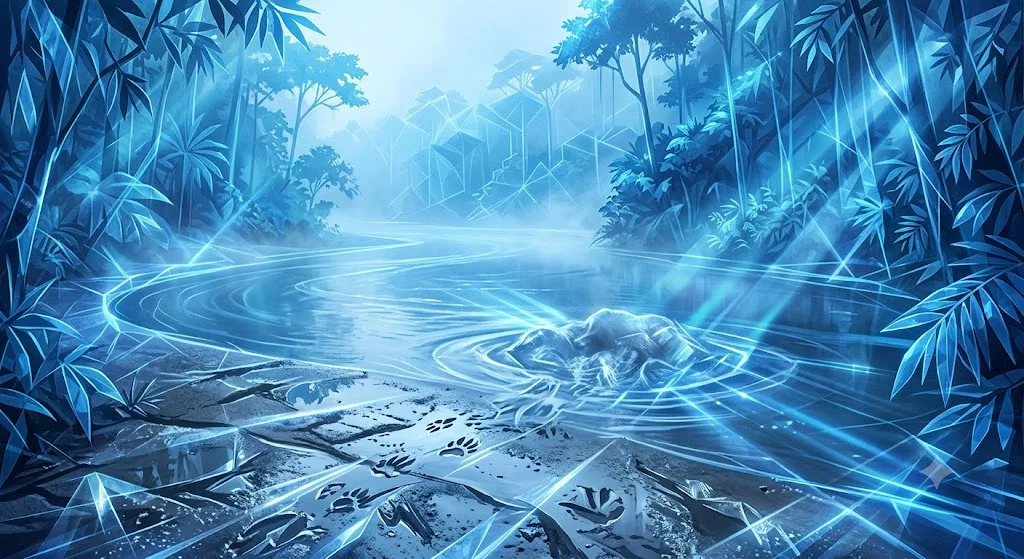
The country’s river systems are especially important. The Ogooué and its wetland landscapes create exactly the sort of environment in which large animals can be hidden, distorted or mythologised. Around Bas-Ogooué, the World Bank describes mangroves, swamp forests, wet grasslands, papyrus, lakes and river habitats supporting manatees, hippos, elephants, birds and fish, while also noting threats from logging, pollution and unregulated fishing. The West African manatee, a real and vulnerable species, inhabits shallow coastal waters, wetlands and rivers from Senegal to Angola, making it a plausible background animal for some river-monster traditions in Gabon and the wider region.[World Bank]worldbank.orgOpen source on worldbank.org.
This does not mean every Gabonese monster story is “just a manatee” or “just an elephant”. Folklore rarely works that simply. A claimed creature may combine real animal behaviour, older spiritual ideas, hunting lore, fear of dangerous water, colonial misunderstanding and later cryptozoological interpretation. Gabon’s mystery-beast history is therefore less a single unsolved zoological case than a set of overlapping stories about rivers, forests and the difficulty of seeing clearly in places where large animals really do move half-hidden.
The River Beast: Jago-Nini, Amali and N’yamala
The best-known Gabon-linked river monster appears in the orbit of Alfred Aloysius Smith, better known as Trader Horn, whose 1927 memoir became one of the sources later cryptozoologists mined for “living dinosaur” material. In the commonly quoted passage, Smith says that behind Cameroon there were things “living we know nothing about”, then names the Jago-Nini as a swamp-and-river creature, glossed as a “giant diver”, said to come out of the water and devour people. He links it with another name, Amali, and describes a large three-clawed footprint “about the size of a good frying pan”.[fandom.com]cryptidarchives.fandom.comOpen source on fandom.com.
That is vivid, but it is not strong zoological evidence. Smith’s account is retrospective, literary, filtered through colonial travel writing and dependent on stories he says old men told about what their grandfathers saw. It gives no specimen, photograph, precise date or controlled witness statement. Even so, it became important because it placed Gabonese waterways inside a larger Central African monster map. Later writers connected Jago-Nini and Amali to N’yamala, a Gabonese river creature usually associated with the Ogooué, Ngounié and related waters. Cryptid catalogues describe N’yamala as long-necked or dinosaur-like in some versions, but also preserve conflicting descriptions, including more mammal-like forms.[cryptidarchives.fandom.com]cryptidarchives.fandom.comOpen source on fandom.com.
The most repeated modern Gabon episode comes from the 1970s, when crocodile researcher James Powell reportedly heard stories around the Ogooué and Ngounié rivers. Creationist and cryptozoological retellings say Powell showed local informants pictures of living and extinct animals, and that a Fang informant identified a sauropod-like image as N’yamala. The problem is obvious: picture tests can steer people towards the categories the questioner brings with them, especially if the interviewer is already searching for a “dinosaur” solution. The same sources are valuable as records of cryptozoological history, but they need to be read as advocacy, not neutral field zoology.[Creation.com]creation.comBehemoth or bust: an expedition into Cameroon invesBehemoth or bust: an expedition into Cameroon inves
A cautious reading leaves three possibilities on the table. First, Jago-Nini and N’yamala may be local water-being traditions later squeezed into a dinosaur-shaped mould. Secondly, some reports may reflect encounters with known animals: manatees surfacing, hippos in poor visibility, crocodiles, elephants at river crossings, or unusual tracks in mud. Thirdly, some details may be story logic rather than field observation: a creature that lives in water, eats people, leaves impressive prints and is known through ancestral testimony is doing cultural work as well as zoological work. None of those explanations is as spectacular as a surviving sauropod, but each fits the evidence better than a hidden population of giant prehistoric reptiles.
How Gabon Was Pulled Into the Congo “Living Dinosaur” Story
Gabon’s river monster claims are often absorbed into the wider mokele-mbembe tradition, even though the best-known mokele-mbembe stories are more strongly associated with the Republic of the Congo, Cameroon and the wider Congo Basin. In popular cryptozoology, the names blur: Jago-Nini, Amali and N’yamala become regional variants of a long-necked aquatic beast, while the geography stretches across political borders and river basins. That is one reason Gabon appears in living-dinosaur lists even though it has fewer famous headline cases than Congo’s Lake Télé tradition.[Cryptomundo]cryptomundo.comnew mokele bknew mokele bk
The “living sauropod” interpretation has a history of its own. Palaeozoologist Darren Naish argues that the mokele-mbembe-as-sauropod image reflects early twentieth-century dinosaur enthusiasm and outdated artwork of swamp-dwelling, heavy-bodied sauropods. He notes that African stories of giant monsters existed before this, but that they did not originally sound much like modern reconstructions of sauropod dinosaurs. In that reading, Western dinosaur culture did not invent every local monster story, but it did reshape how outsiders interpreted them.[Scientific American]scientificamerican.comOpen source on scientificamerican.com.
Recent reporting makes a related point in ecological terms. National Geographic described how modern “dinosaur” sightings in Central Africa can arise when people encounter large animals more often as forest habitats shrink or human settlement pushes closer to wildlife. One conservationist in the report recalled mistaking a forest elephant for the legendary mokele-mbembe in 2003, then later laughing at her own interpretation. That is a useful model for Gabon too: in dense forest and wetland country, real animals can be startling enough to become legendary, especially when seen briefly or from fear.[National Geographic]nationalgeographic.comOpen source on nationalgeographic.com.
For Gabon, the important takeaway is not that the country has its “own dinosaur” in any confirmed sense. It is that Gabon supplied some of the names, river settings and colonial-era anecdotes that later writers folded into a pan-Central-African mystery-beast narrative. The legend changed as it travelled: a dangerous water creature became a dinosaur candidate; a local story became an expedition target; an ambiguous river animal became part of a global cryptid brand.
The Koolakamba: Gabon’s Mystery Ape
Gabon’s other major cryptid-adjacent creature is not a lake monster but an ape. The koolakamba, also spelt in several ways, was historically described as an unusual chimpanzee-like animal with gorilla-like features. Karl Shuker’s specialist cryptozoology account notes that Paul du Chaillu brought the mystery ape to European attention after shooting a specimen in Gabon’s Ashankolo Mountains in 1858, describing features such as a rounded head, bare black face, wide-set eyes, strong brow ridges, flat nose and projecting cheekbones.[ShukerNature]karlshuker.blogspot.comOpen source on blogspot.com.
Unlike Jago-Nini, the koolakamba sits close to real primatology. Nineteenth- and twentieth-century naturalists were still sorting out the variation among gorillas and chimpanzees, and local names did not map neatly onto European species categories. A 1984 Journal of Ethnobiology paper by Brian Shea is especially helpful because it treats the kooloo-kamba debate as a problem of folk classification, morphology and taxonomic confusion. Shea notes that some authors proposed a distinct chimpanzee subspecies ranging through South Cameroon, Gabon and the former French Congo, but he also concludes that poor understanding of local languages, inadequate appreciation of individual variation and eagerness to find intermediate forms all contributed to the confusion.[Society of Ethnobiology]ethnobiology.orgSociety of Ethnobiology
The most romantic version calls the koolakamba a chimpanzee-gorilla hybrid. That is the least secure interpretation. Shuker notes that no verified chimpanzee-gorilla hybrid has been recorded, and Shea’s conclusion points instead towards large male chimpanzees, small female gorillas, individual variation and classification errors as more likely explanations for many “intermediate” apes. In other words, the koolakamba is not silly because apes are imaginary; it is fascinating precisely because Gabon’s real apes are variable, difficult to classify from old accounts and entangled with local knowledge that early outsiders often misunderstood.[ShukerNature]karlshuker.blogspot.comOpen source on blogspot.com.
The koolakamba also shows how a cryptid can shrink as science improves. In an earlier era, an odd skull, a strange call or a local name could suggest a new species. Today, camera traps, genetics, long-term field studies and better primate taxonomy make it harder for a large ape population to remain zoologically invisible. Yet the historical mystery still matters because it preserves a moment when Gabonese forests were helping Europeans realise that African great apes were more diverse, behaviourally complex and locally understood than outsiders had assumed.
Smaller Oddities and the Risk of Over-Claiming
Not every Gabon mystery-animal rumour became a famous cryptid. One small but intriguing example comes from cryptozoological discussion of an alleged cat-sized mammal in Gabon said by locals to deliver a powerful electric shock when caught in fishermen’s gill nets. The report is interesting because it does not sound like a dinosaur or a monster copied from Western pop culture. It sounds like a practical fishing story: an animal in a net, a shock, a local comparison with known electric fish.[Cryptomundo]cryptomundo.comOpen source on cryptomundo.com.
That does not make it proven. Africa has real electric fish, and confusion around nets, water, pain, spines, eels, catfish or second-hand retelling could all produce a dramatic animal claim. The value of such a rumour is that it points to a different kind of cryptid tradition: not the grand “lost world” beast, but the odd animal of working landscapes, known to fishers and hunters before it reaches outsiders. In a country with extensive rivers and wetlands, those smaller reports may tell us as much about human-animal contact as the larger monster stories do.
This is where Gabon’s real conservation context becomes essential. The country’s national parks and conservation programmes are not just backdrops for strange tales; they are the reason many large animals remain present enough to be seen, misseen and mythologised. WCS describes Gabon’s forests as sheltering gorillas, chimpanzees, elephants and mandrills, with seas that support humpback whales, leatherback turtles and many sharks and rays. UNDP notes that Gabon created 13 national parks and has kept deforestation rates low compared with many tropical forest countries. These facts do not confirm cryptids, but they explain why Gabon remains one of the more plausible places for powerful animal folklore to stay alive.[gabon.wcs.org]gabon.wcs.orgOpen source on wcs.org.
Separating the record from the legend of Gabon’s cryptid traditions
The evidence for Gabon’s famous cryptid claims is thin if the question is, “Has an unknown large animal been proved?” There is no accepted body, bone, DNA sample, clear photograph, repeatable trackway or modern biological survey confirming Jago-Nini, N’yamala or a distinct koolakamba species. The river monsters rest mostly on old testimony, later retellings and cryptozoological synthesis. The ape mystery has a richer natural-history background, but the best explanations still point towards known apes, individual variation and classification problems rather than a verified hybrid or new species.[Society of Ethnobiology]ethnobiology.orgSociety of Ethnobiology
The evidence is stronger for a cultural and ecological story. Gabon has landscapes where large animals are genuinely hard to observe. It has real aquatic mammals, crocodiles, hippos, elephants and apes. It has colonial-era texts that recorded local or regional stories imperfectly. It has later cryptozoological writers who connected those stories to the mokele-mbembe tradition. And it has modern conservation pressure, where shrinking or disturbed habitats can bring people into surprising contact with wildlife. That combination is enough to explain why monster stories appear without requiring a hidden dinosaur.[worldbank.org]worldbank.orgOpen source on worldbank.org.
A useful credibility scale for Gabon’s claims looks like this:
- Strongly grounded in real animals: manatees, crocodiles, hippos, elephants, gorillas, chimpanzees and other wildlife that could inspire or distort reports.
- Historically interesting but unproven: Jago-Nini, Amali and N’yamala as named river-beast traditions recorded through old accounts and later cryptid literature.
- Taxonomically interesting but not confirmed as a cryptid: the koolakamba, best treated as a history of ape classification and local naming rather than a proven hybrid.
- Speculative and weakly supported: the claim that any Gabonese river monster represents a surviving sauropod or other prehistoric reptile.
That scale keeps the wonder without flattening the evidence. Gabon’s cryptid history is not empty; it is just not the same as a discovery record.
Why the Legends Still Matter
Gabon’s monster stories survive because they attach themselves to places that already feel larger than human certainty. The Ogooué and its wetlands are not merely map features; they are living systems where people fish, travel, fear deep water, notice tracks and remember what older generations said. The forests are not generic “jungle”; they are home to animals whose size, intelligence and rarity can unsettle even experienced observers. A forest elephant in poor visibility, a gorilla entering water, a manatee surfacing near a canoe or a crocodile sliding under papyrus can all become the seed of a story.[World Bank]worldbank.orgOpen source on worldbank.org.
The legends also matter because they warn readers against two opposite mistakes. The first is over-belief: treating every local name or dramatic colonial passage as evidence for a prehistoric survivor. The second is over-dismissal: assuming that because a dinosaur explanation fails, the story has no value. In reality, these accounts preserve traces of local environmental knowledge, colonial misunderstanding, real animal encounters and the changing global appetite for monsters.
For a Gabon cryptid page, the honest centre is therefore this: Gabon is not proven dinosaur country, but it is one of Africa’s most compelling places for mystery-animal folklore. Its best stories are river stories and ape stories, and their power comes from the closeness of the unknown to the known. The monster may not be real in the way cryptozoology wants it to be, but the forest, the river, the animals and the human uncertainty are real enough.
Amazon book picks
Further Reading
Books and field guides related to What Monsters Hide In Gabon's Forest Rivers?. Use these as the next step if you want deeper reading beyond the article.
Abominable Science!
Explains how monster traditions and alleged unknown animals develop.
King Leopold's Ghost
Provides regional historical context for colonial-era exploration narratives.
eBay marketplace picks
Marketplace Samples
Live-tested eBay searches with available results related to this page.
Endnotes
1.
Source: undp.org
Link:https://www.undp.org/africa/blog/gabon-leads-africa-preservation-and-conservation-forests
2.
Source: gabon.wcs.org
Link:https://gabon.wcs.org/Home.aspx
3.
Source: nc.iucnredlist.org
Title: IUCN Red List
Link:https://nc.iucnredlist.org/redlist/species-of-the-day/trichechus-senegalensis/pdfs/original/trichechus-senegalensis.pdf
4.
Source: cryptidarchives.fandom.com
Link:https://cryptidarchives.fandom.com/wiki/Jago-nini
5.
Source: genesispark.com
Link:https://genesispark.com/exhibits/cryptozoological-evidence/the-sauropod-paddock/the-river-monster-of-cameroon-and-gabon/
6.
Source: cryptidarchives.fandom.com
Link:https://cryptidarchives.fandom.com/wiki/N%27yamala
7.
Source: cryptidz.fandom.com
Link:https://cryptidz.fandom.com/wiki/N%27yamala
8.
Source: creation.com
Title: Behemoth or bust: an expedition into Cameroon inves
Link:https://creation.com/images/pdfs/tj/j15_2/j15_2_62-68.pdf
9.
Source: cryptomundo.com
Title: new mokele bk
Link:https://cryptomundo.com/cryptozoo-news/new-mokele-bk/
10.
Source: ethnobiology.org
Title: Society of Ethnobiology
Link:https://ethnobiology.org/sites/default/files/pdfs/JoE/4-1/Shea1984.pdf
11.
Source: cryptomundo.com
Link:https://cryptomundo.com/cryptozoo-news/electromammal/
12.
Source: cryptomundo.com
Title: » Primate Survivors & Fossils Found
Link:https://cryptomundo.com/cryptozoo-news/real-bf-9/
13.
Source: genesispark.com
Title: 2025 cameroon rafting expedition
Link:https://genesispark.com/essays/2025-cameroon-rafting-expedition/
14.
Source: genesispark.com
Link:https://genesispark.com/essays/behemoth-or-bust/
15.
Source: cryptidarchives.fandom.com
Title: Mokele mbembe
Link:https://cryptidarchives.fandom.com/wiki/Mokele-mbembe
16.
Source: cryptidz.fandom.com
Link:https://cryptidz.fandom.com/wiki/Gambo
17.
Source: cryptidz.fandom.com
Link:https://cryptidz.fandom.com/wiki/Kabagon
18.
Source: cryptidarchives.fandom.com
Title: Lake Chad monster
Link:https://cryptidarchives.fandom.com/wiki/Lake_Chad_monster
19.
Source: cryptidz.fandom.com
Title: Mokèlé mbèmbé
Link:https://cryptidz.fandom.com/wiki/Mok%C3%A8l%C3%A9-mb%C3%A8mb%C3%A9
20.
Source: cryptidarchives.fandom.com
Title: Emela ntouka
Link:https://cryptidarchives.fandom.com/wiki/Emela-ntouka
21.
Source: cryptidz.fandom.com
Title: Emela Ntouka
Link:https://cryptidz.fandom.com/wiki/Emela-Ntouka
22.
Source: itsmth.fandom.com
Title: Jago Nini
Link:https://itsmth.fandom.com/wiki/Jago-Nini
23.
Source: cryptidz.fandom.com
Link:https://cryptidz.fandom.com/wiki/Koolakamba
24.
Source: cryptomundo.com
Link:https://cryptomundo.com/cryptotourism/ngoubou/
25.
Source: cryptomundo.com
Link:https://cryptomundo.com/cryptozoo-news/mokele09/
26.
Source: cryptomundo.com
Title: powell obit
Link:https://cryptomundo.com/cryptozoo-news/powell-obit/
27.
Source: cryptomundo.com
Title: mm sighted 06
Link:https://cryptomundo.com/cryptozoo-news/mm-sighted-06/
28.
Source: national-parks.org
Link:https://national-parks.org/gabon/lope-national-park/
29.
Source: gabon.wcs.org
Title: Forest Mammal Monitoring fr CA.aspx
Link:https://gabon.wcs.org/Paysages-Prioritaires/Gabons-Forests-fr-CA/Forest-Mammal-Monitoring-fr-CA.aspx
30.
Source: creation.com
Title: mokele mbembe a living dinosaur
Link:https://creation.com/en/articles/mokele-mbembe-a-living-dinosaur
31.
Source: creation.com
Link:https://creation.com/index.php?id=326&option=com_content&view=article
32.
Source: scientificamerican.com
Link:https://www.scientificamerican.com/blog/tetrapod-zoology/misreading-the-mokele-mbembe-the-mokele-mbembe-part-1/
33.
Source: worldbank.org
Link:https://www.worldbank.org/en/news/feature/2018/06/01/lambarene-accords-residents-a-central-role-in-the-protection-of-threatened-ecosystems
34.
Source: nationalgeographic.com
Link:https://www.nationalgeographic.com/environment/article/congo-basin-mokele-mbembe-deforestation
35.
Source: karlshuker.blogspot.com
Link:https://karlshuker.blogspot.com/2013/01/going-ape-about-koolookamba.html
36.
Source: Wikipedia
Link:https://en.wikipedia.org/wiki/Koolakamba
37.
Source: Wikipedia
Title: Karl Shuker
Link:https://en.wikipedia.org/wiki/Karl_Shuker
38.
Source: Wikipedia
Link:https://en.wikipedia.org/wiki/Darren
39.
Source: karlshuker.blogspot.com
Title: GAMB O, THE GAMBIAN SEA SERPENT
Link:https://karlshuker.blogspot.com/2019/05/gambo-gambian-sea-serpent-or-how-very.html
40.
Source: karlshuker.blogspot.com
Title: jungle walruses perplexing petroglyph
Link:https://karlshuker.blogspot.com/2020/04/jungle-walruses-perplexing-petroglyph.html
41.
Source: karlshuker.blogspot.com
Title: shukernatures top ten living dinosaurs
Link:https://karlshuker.blogspot.com/2013/01/shukernatures-top-ten-living-dinosaurs.html
42.
Source: karlshuker.blogspot.com
Link:https://karlshuker.blogspot.com/2011/05/
43.
Source: karlshuker.blogspot.com
Title: TH E GRUESOME GBAHALI
Link:https://karlshuker.blogspot.com/2024/03/the-gruesome-gbahali-lurking-in-liberia.html
44.
Source: karlshuker.blogspot.com
Link:https://karlshuker.blogspot.com/2013/01/
45.
Source: karlshuker.blogspot.com
Title: the bili bondo apes unmasking congos
Link:https://karlshuker.blogspot.com/2013/02/the-bili-bondo-apes-unmasking-congos.html
46.
Source: documents1.worldbank.org
Title: Gabon REDD Readiness Project.docx
Link:https://documents1.worldbank.org/curated/en/141281569299034895/Gabon-REDD-Readiness-Project.docx
47.
Source: documents1.worldbank.org
Link:https://documents1.worldbank.org/curated/en/712831468253860531/pdf/347140GABON0co10Box303514B01Public1.pdf
48.
Source: korkion.miraheze.org
Link:https://korkion.miraheze.org/wiki/Koolakamba
49.
Source: abookofcreatures.com
Link:https://abookofcreatures.com/category/lake-monsters/page/2/
50.
Source: brickthology.com
Link:https://brickthology.com/tag/cryptid/
51.
Source: karlshuker.com
Title: Cryptozoological Bibliography (Section II)
Link:https://www.karlshuker.com/2bibliography.htm
52.
Source: pinterest.com
Link:https://www.pinterest.com/pin/173247916898656948/
53.
Source: blog.aspinallfoundation.org
Link:https://blog.aspinallfoundation.org/topic/gabon
54.
Source: monsterquestreview.blogspot.com
Title: monsterquest search for last living
Link:https://monsterquestreview.blogspot.com/2009/08/monsterquest-search-for-last-living.html
Additional References
55.
Source: youtube.com
Link:https://www.youtube.com/watch?v=PqK7J9FhdWY
Source snippet
Gabon: Saving Forest Elephants | ARTE.tv Documentary...
56.
Source: youtube.com
Title: Two Creatures, One Legend: The Biology of the Mokele Mbembe
Link:https://www.youtube.com/watch?v=uYbIP-aNpxY
Source snippet
The Mokele-Mbembe Mystery: Dinosaur, Myth, or Unknown Animal?...
57.
Source: youtube.com
Title: The Mokele-Mbembe Mystery: Dinosaur, Myth, or Unknown Animal?
Link:https://www.youtube.com/watch?v=sTVTuo48ZpQ
Source snippet
VOA Special Documentary: Saving Gabon's Forest Elephants...
58.
Source: youtube.com
Title: Gabon: Saving Forest Elephants | ARTE.tv Documentary
Link:https://www.youtube.com/watch?v=7VVsI2guqLg
Source snippet
Two Creatures, One Legend: The Biology of the Mokele Mbembe...
59.
Source: youtube.com
Title: Koolakamba: African Mystery Ape
Link:https://www.youtube.com/watch?v=Aslpsu174UM
Source snippet
Exploring Gabon: The Wildest Jungle Expedition in Africa | Atlantic | YouCurious?...
60.
Source: facebook.com
Link:https://www.facebook.com/groups/thecfz/posts/10156846576727013/
61.
Source: researchgate.net
Link:https://www.researchgate.net/publication/350857049_THE_IUCN_RED_LIST_OF_THREATENED_SPECIES-_African_Manatee_Assessment_Errata_version
62.
Source: brill.com
Link:https://brill.com/downloadpdf/display/title/5607.pdf?srsltid=AfmBOoooVWlvVjfv4GDmFGWRKqJV2qe0Zy_nhAiMOtILPiT7imQ9–6z
63.
Source: brill.com
Link:https://brill.com/downloadpdf/display/title/5607.pdf?srsltid=AfmBOopa36LC3vTxigumL31f53kGltcuzC1upHvfoJc5ppfGpD6aBXNM
64.
Source: instagram.com
Link:https://www.instagram.com/p/DUD2WiuDMLK/?hl=en
Topic Tree
Follow this branch
Related pages 192
- Antigua Cryptids
- Maldives Monsters
- Malta Monsters
- Qatar Monsters
- Argentina Monsters
- +187 more in sidebar