Within Cuba Cryptids
What Real Animals Feed Cuba's Monster Lore?
Cuba's boas, solenodons, crocodiles, wetlands, caves and mangroves help explain why strange-animal stories feel plausible.
On this page
- Boas, solenodons and other unsettling animals
- Wetlands, caves and mangrove edge spaces
- How brief encounters become mystery beast stories
Page outline Jump by section
Introduction
Many Cuban monster stories become less mysterious when viewed through the island’s remarkable wildlife. Cuba is home to the Caribbean’s largest snake, rare crocodiles, a strange venomous mammal called the solenodon, vast wetlands, cave systems and dense mangrove forests. None of these animals proves the existence of unknown creatures, but together they help explain why reports of giant serpents, lurking water beasts and unexplained animals have persisted for generations. In a landscape where people may glimpse an enormous snake crossing a swamp channel or hear an unfamiliar animal moving through darkness, ordinary wildlife can easily become extraordinary folklore.[wikipedia.org]WikipediaCuban boaCuban boa
For readers interested in Cuban monster lore, the most useful question is often not whether a creature exists, but what real animal, habitat or brief encounter may have inspired the story in the first place.
What Real Animals Feed Cuba’s Monster Lore?
Cuba differs from many Caribbean islands because it possesses several genuinely unusual native animals. Even before folklore enters the picture, the island contains species capable of surprising visitors.
Boas, solenodons and other unsettling animals
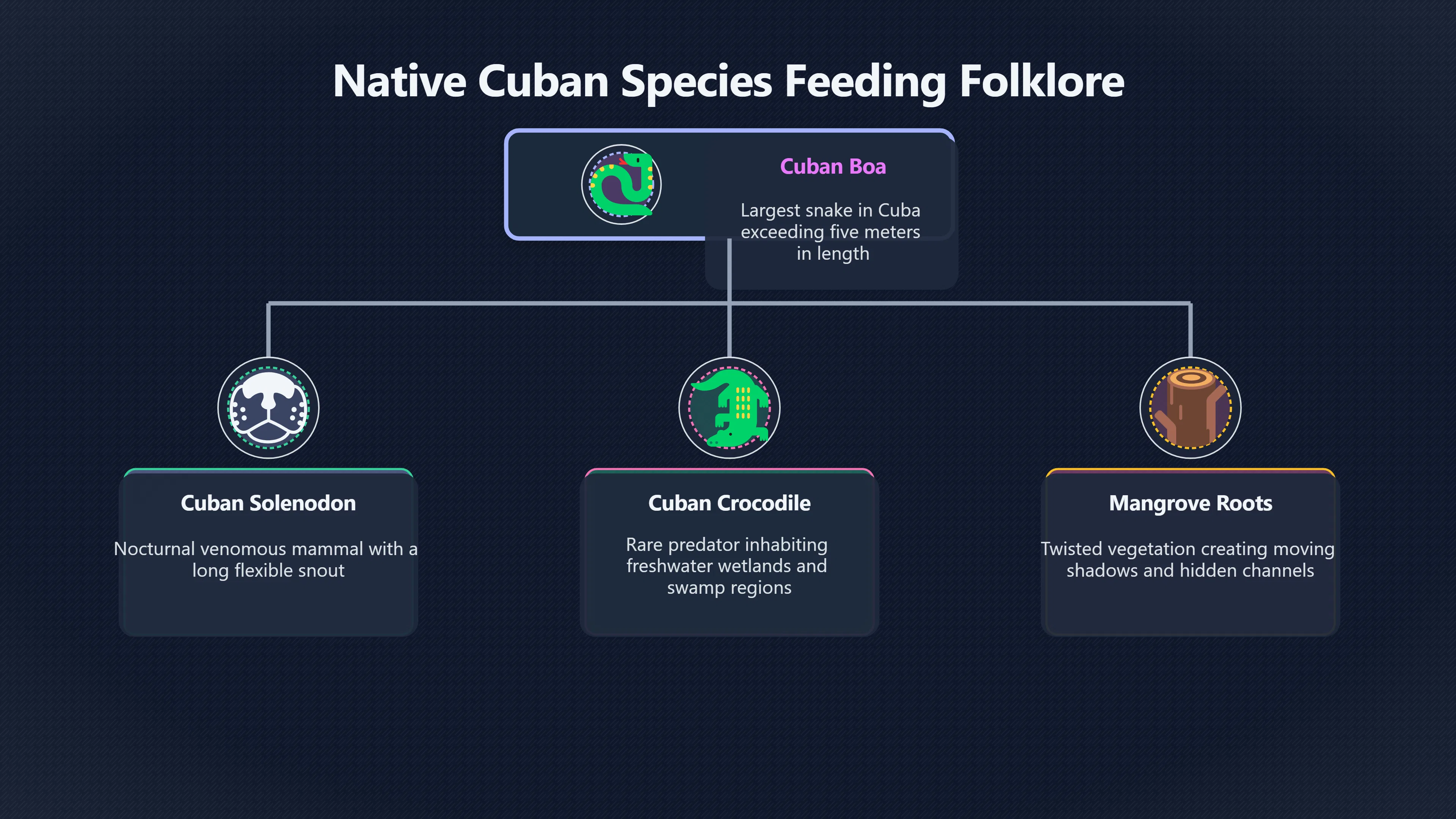
The strongest candidate behind many reports of giant serpentine creatures is the Cuban boa. This species is the largest snake in Cuba and the largest native snake in the West Indies. Exceptional individuals have reportedly exceeded five metres in length, making them large enough to create powerful impressions on anyone encountering one unexpectedly. Cuban boas inhabit forests, caves, wetlands and agricultural areas, and they are capable predators that take a wide variety of prey.[wikipedia.org]WikipediaCuban boaCuban boa
Stories of enormous water snakes or the folkloric Madre de aguas are not simply inventions detached from reality. A person seeing a large boa swimming, partially submerged in vegetation or disappearing into muddy water could easily exaggerate its size in retelling. Human memory is especially unreliable when estimating the length of snakes, and reports often grow with each repetition.
The Cuban solenodon offers a different route into mystery-animal stories. This endangered mammal is nocturnal, elusive and unlike almost any animal most people know. It has a long flexible snout, tiny eyes, dark fur and a naked tail. It spends much of its life hidden and was even thought extinct for periods of the twentieth century because sightings were so rare. It is also one of the few venomous mammals in the world.[wikipedia.org]WikipediaCuban solenodonCuban solenodon
An unexpected glimpse of a solenodon at night could easily produce a report of a strange unknown beast. Because the animal is rarely seen and moves through undergrowth after dark, witnesses may struggle to identify what they have observed. Across the world, unfamiliar nocturnal mammals frequently become the basis of monster stories, and the Cuban solenodon fits that pattern remarkably well.
Crocodiles provide another source of exaggeration. Cuba is home to the rare Cuban crocodile, a large predator associated with freshwater wetlands, particularly in the Zapata Swamp region. Encounters with crocodiles, especially in poor visibility or at a distance, can transform into stories of lake monsters, swamp beasts or mysterious aquatic creatures.[si.edu]nationalzoo.si.edu8 fascinating facts about cuban crocodile rare caribbean predatorToday, their greatest threat is the loss of the rare freshwater wetland ecosystem…Read more…
Wetlands, Caves and Mangrove Edge Spaces
Wildlife alone does not create monster traditions. Habitat matters just as much.
Many Cuban legends cluster around places where visibility is poor and where people encounter nature only briefly. These environments encourage uncertainty, and uncertainty is fertile ground for folklore.
Key settings include:
- Mangrove forests, where twisted roots, moving shadows and hidden channels make animals difficult to identify.
- Freshwater marshes and swamps, where crocodiles, snakes and water birds may appear only partially visible.
- Cave systems, which shelter bats and snakes and can distort sounds and movement.
- Riverbanks and isolated pools, traditional locations for stories of water spirits and giant serpents.
- Forest edges, where nocturnal animals emerge suddenly into human spaces.[YouTube]youtube.comCuba: Life Shelter | Go WildFrom the humid tropical jungles to the mangroves in the coast we will witness unique endogenic species…
A large snake seen through reeds rarely appears as a complete animal. Witnesses may observe only a section of its body. A crocodile’s eyes and back may be visible while the rest remains underwater. Sounds echo differently around caves and wetlands, making ordinary wildlife seem larger or stranger than it really is.
These environments help explain why Cuban folklore often focuses on hidden water, dark vegetation and elusive creatures rather than open-country monster sightings.
How Brief Encounters Become Mystery-Beast Stories
Most monster reports do not begin with a clear observation. They begin with an incomplete one.
Researchers who study eyewitness testimony have repeatedly found that people reconstruct events after the fact. When a witness catches only a glimpse of an unfamiliar animal, the brain fills gaps using memory, expectation and local stories. In Cuba, where folklore already includes giant serpents and water-dwelling beings, those cultural templates provide ready-made explanations for ambiguous encounters.
Several mechanisms appear repeatedly:
Size inflation. Large animals are often remembered as much larger than they were. A four-metre boa may become a six-metre serpent after retelling.
Night-time distortion. Many unusual Cuban animals, including solenodons, are active after dark. Low light makes accurate identification difficult.[Wikipedia]WikipediaCuban solenodonCuban solenodon
Partial visibility. Swamp water, reeds and mangrove roots conceal much of an animal’s body. Witnesses fill in missing details themselves.
Folklore reinforcement. Once a region already has stories of water monsters or giant snakes, new observations tend to be interpreted through that existing framework.
Rarity. Uncommon animals generate stronger stories because few people can immediately recognise them. The rarity of the Cuban solenodon is a good example.[Wikipedia]WikipediaCuban solenodonCuban solenodon
A person who sees an unfamiliar creature once may tell a story. A community that already expects strange creatures may turn that story into a legend.
Why Misidentifications Matter to Cuban Folklore
Explaining a monster report as a misidentified animal does not make the story less interesting. In many cases, it makes it more revealing.
Cuban monster traditions persist partly because the island genuinely contains wildlife that can seem extraordinary. The Cuban boa is large enough to inspire giant-serpent tales. The solenodon looks prehistoric and unfamiliar. Crocodiles inhabit remote wetlands that already feel mysterious. The island’s caves, mangroves and marshes provide dramatic settings where brief encounters become memorable experiences.[Wikipedia]WikipediaCuban boaCuban boa
Rather than separating folklore from nature, Cuba’s monster stories often show how closely the two interact. The legends survive not because people continually discover unknown beasts, but because the island’s real animals are unusual enough to keep those possibilities alive in the imagination.

Amazon book picks
Further Reading
Books and field guides related to What Real Animals Feed Cuba's Monster Lore?. Use these as the next step if you want deeper reading beyond the article.
The Song Of The Dodo
Relevant to understanding isolated island wildlife such as Cuba’s.
eBay marketplace picks
Marketplace Samples
Live-tested eBay searches with available results related to this page.
Endnotes
1.
Source: Wikipedia
Title: Cuban boa
Link:https://en.wikipedia.org/wiki/Cuban_boa
2.
Source: researchgate.net
Link:https://www.researchgate.net/publication/340816029_An_Overview_of_the_Past_Present_and_Future_of_the_Cuban_Boa_Chilabothrus_angulifer_Squamata_Boidae_A_Top_Terrestrial_Predator_on_an_Oceanic_Island
Source snippet
ResearchGate(PDF) An Overview of the Past, Present, and Future...The Cuban Boa (Chilabothrus angulifer) is a top terrestrial predator in...
3.
Source: Wikipedia
Title: Cuban solenodon
Link:https://en.wikipedia.org/wiki/Cuban_solenodon
4.
Source: small-mammals.org
Link:https://small-mammals.org/portfolio/cuban-solenodon/
Source snippet
Individuals have been captured in 1974 and 1975, and as recently as 2003 and...Read more...
5.
Source: pbs.org
Title: wild cuba fact sheet
Link:https://www.pbs.org/wnet/nature/blog/wild-cuba-fact-sheet/
Source snippet
Cuba Wildlife Facts | Blog | Nature1 Apr 2020 — The Cuban crocodile is another unique species. As sea levels rise, American crocodiles ar...
6.
Source: youtube.com
Link:https://www.youtube.com/watch?v=8WKjKKLX2C4
Source snippet
Cuba: Life Shelter | Go WildFrom the humid tropical jungles to the mangroves in the coast we will witness unique endogenic species...
7.
Source: researchgate.net
Link:https://www.researchgate.net/figure/The-Cuban-Boa-Chilabothrus-angulifer-is-the-largest-and-stoutest-snake-in-the-West_fig1_343380788
Source snippet
References to prey species consumed by this boa date to when the first Europeans...
8.
Source: researchgate.net
Link:https://www.researchgate.net/figure/The-Cuban-Boa-Chilabothrus-angulifer-constitutes-an-early-diverging-lineage-of-the_fig1_313475820
Source snippet
However, the only true giant is C. angulifer, the maximum verifiable sizes reported for the remaining nonCuban Chilabothrus rarely exceed...
9.
Source: researchgate.net
Link:https://www.researchgate.net/publication/343380788_Trophic_Ecology_of_the_Cuban_Boa_Chilabothrus_angulifer_Boidae
Source snippet
Trophic Ecology of the Cuban Boa, Chilabothrus angulifer...Mar 3, 2026 — The Cuban Boa (Chilabothrus angulifer) is a top terrestrial pre...
10.
Source: Wikipedia
Title: Boa constrictor
Link:https://en.wikipedia.org/wiki/Boa_constrictor
Source snippet
Boa constrictor - WikipediaCuban Boa - Chilabothrus angulifer - A-Z Animals...
11.
Source: Wikipedia
Title: Hispaniolan solenodon
Link:https://en.wikipedia.org/wiki/Hispaniolan_solenodon
Source snippet
Hispaniolan solenodonLike other solenodons, it is a venomous, insect-eating animal that lives in burrows and is active at night. It is...
12.
Source: Wikipedia
Link:https://en.wikipedia.org/wiki/Cuba
Source snippet
CubaCuba is a socialist state in which the role of the Communist Party is enshrined in the Constitution. Cuba is currently the world's...
13.
Source: Wikipedia
Title: Cuban crocodile
Link:https://en.wikipedia.org/wiki/Cuban_crocodile
Source snippet
Cuban crocodileThe Cuban crocodile (Crocodylus rhombifer) is a small-medium species of crocodile endemic to Cuba. Typical length is 2...
14.
Source: small-mammals.org
Title: saving the cuban solenodon
Link:https://small-mammals.org/2021/08/04/saving-the-cuban-solenodon/
Source snippet
Aug 4, 2021 — Cuban solenodons along with the Desmarest's hutia (Capromys pilorides), are two out of 13 remaining endemic land mammals of...
15.
Source: youtube.com
Title: Cuba Wild Island of the Caribbean
Link:http://www.youtube.com/watch?v=FYQGC9URoKk
Source snippet
Cuba's Animal Underworld | Wild Caribbean | BBC Earth...
16.
Source: youtube.com
Title: Cuba’s Animal Underworld | Wild Caribbean | BBC Earth
Link:http://www.youtube.com/watch?v=tmGqy2htFLU
Source snippet
The Cuban Boa HUNTS IN GROUPS...
17.
Source: youtube.com
Title: The Cuban Boa HUNTS IN GROUPS
Link:http://www.youtube.com/watch?v=YRJk7LA405Q
Source snippet
Solenodon: a venomous mammal rediscovered...
18.
Source: youtube.com
Title: Solenodon: a venomous mammal rediscovered!
Link:http://www.youtube.com/watch?v=cWOPC2kt_IA
Source snippet
Solenodon - A Venomous Mammal...
19.
Source: youtube.com
Link:http://www.youtube.com/watch?v=hS4uQFwqSck
Source snippet
Cuba unique wildlife documentary animals Cuba Wild Island of the Caribbean - Go Wild Go Wild...
20.
Source: eol.org
Link:https://eol.org/pages/47364711/articles
21.
Source: nationalzoo.si.edu
Title: 8 fascinating facts about cuban crocodile rare caribbean predator
Link:https://nationalzoo.si.edu/animals/news/8-fascinating-facts-about-cuban-crocodile-rare-caribbean-predator
Source snippet
Today, their greatest threat is the loss of the rare freshwater wetland ecosystem...Read more...
22.
Source: merriam-webster.com
Link:https://www.merriam-webster.com/dictionary/venomous
Source snippet
Definition & MeaningApr 26, 2026 — The meaning of VENOMOUS is producing venom in a specialized gland and capable of inflicting injury or...
23.
Source: zoo.kyiv.ua
Title: cuban boa
Link:https://zoo.kyiv.ua/en/cuban-boa/
Source snippet
Jan 8, 2026 — The body length ranges from 2 to 4.5 m. The largest individuals may reach almost 5 m, making it the largest snake species i...
24.
Source: naturerules1.fandom.com
Link:https://naturerules1.fandom.com/wiki/Cuban_Boa
Source snippet
Boa - NatureRules1 Wiki - FandomWith lengths exceeding 5 meters (16 ft) and a relatively heavy build, the Cuban boa is one of the largest...
25.
Source: animals.howstuffworks.com
Title: cuban boa
Link:https://animals.howstuffworks.com/reptiles/cuban-boa.htm
Source snippet
Close Look at the Cuban Boa of Guantanamo BayJan 24, 2024 — These massive nonvenomous snakes typically grow to around 15 feet (4 meters)...
26.
Source: aljazeera.com
Link:https://www.aljazeera.com/where/cuba/
Source snippet
Cuba | Today's latest from Al JazeeraStay on top of Cuba latest developments on the ground with Al Jazeera's fact-based news, exclusive v...
Additional References
27.
Source: westindianboas.org
Link:https://westindianboas.org/west-indian-boas/genus-chilabothrus/angulifer/
Source snippet
Chilabothrus anguliferThe longest males reached 1.74 meters SVL and the largest female 2.25 meters SVL. Interestingly, they found that sn...
28.
Source: allrecipes.com
Link:https://www.allrecipes.com/recipes/709/world-cuisine/latin-american/caribbean/cuban/
Source snippet
Cuban RecipesCraving picadillo, a Cuban sandwich, ropa vieja, or a medianoche sandwich and a mojito? Allrecipes has more than 90 top-rate...
29.
Source: zoonewengland.org
Link:https://www.zoonewengland.org/protect/around-the-globe/cuban-solenodon-conservation/
Source snippet
Cuban Solenodon ConservationThe Cuban solenodon, known in Cuba as the Almiquí, is one of the world's rarest mammals and one of the more e...
30.
Source: facebook.com
Link:https://www.facebook.com/groups/256273008390080/posts/1730282910989075/
31.
Source: responsibleherpetoculture.foundation
Title: strategic hunters cuban boas challenge notions of snake intelligence
Link:https://responsibleherpetoculture.foundation/strategic-hunters-cuban-boas-challenge-notions-of-snake-intelligence/
Source snippet
Cuban Boas Challenge Notions of Snake IntelligenceDec 17, 2025 — Discover how the Cuban boa (Chilabothrus angulifer) uses strategic, pack...
32.
Source: journals.ku.edu
Title: References to prey species consumed by this boa date to when
Link:https://journals.ku.edu/reptilesandamphibians/article/view/14176
Source snippet
Ecology of the Cuban Boa, Chilabothrus angulifer...by TM Rodríguez-Cabrera · 2020 · Cited by 8 — The Cuban Boa (Chilabothrus angulifer)...
33.
Source: instagram.com
Link:https://www.instagram.com/reel/DJ5PQgRtxns/?hl=en
Source snippet
These rare and critically endangered reptiles aren't just known for their explosive speed...
34.
Source: natureology101.wordpress.com
Link:https://natureology101.wordpress.com/2012/12/24/species-of-the-day-cuban-solenodon-solenodon-cubanus/
Source snippet
of the Day – Cuban Solenodon (Solenodon cubanus)Dec 24, 2012 — Cuban Solenodon is one of the most unusual and ancient mammal species to b...
35.
Source: reddit.com
Title: 🔥 Day 51 of posting an animal from every country
Link:https://www.reddit.com/r/NatureIsFuckingLit/comments/184k228/day_51_of_posting_an_animal_from_every_country/
Source snippet
Cuban...Solenodon: This bizarre venomous mammal that survived the asteroid that killed the dinosaurs has had its genome sequenced for th...
36.
Source: presidencia.gob.cu
Link:https://www.presidencia.gob.cu/en/cuba/
Source snippet
José Martí. Cuba. Historical overview. The name of Cuba comes...Read more...
Topic Tree