Within Egyptian Cryptids
Why Ammit Still Feels Like a Real Monster
Ammit shows how Egyptians built unforgettable monsters from crocodiles, lions, hippos and other real sources of danger.
On this page
- The crocodile, lion and hippo body plan
- Judgement, fear and the devouring of hearts
- How composite monsters shaped later creature lore
Page outline Jump by section
Introduction
Ammit is one of the reasons ancient Egyptian monster lore still feels surprisingly modern. Unlike many mythical beasts, she was built from animals that people in Egypt genuinely feared: a crocodile’s head, a lion’s forequarters and a hippopotamus’s hindquarters. To anyone living beside the Nile, those were not fantasy creatures. They were among the most dangerous animals in the known world. By combining them into a single being, Egyptian storytellers created a monster that felt plausible, memorable and terrifying. Ammit was not a hidden animal or a cryptid in the modern sense, but she reveals an important mechanism behind Egypt’s monster traditions: taking real dangers and fusing them into something greater than the sum of its parts.[Wikipedia]WikipediaOpen source on wikipedia.org.

Within Egypt’s wider history of strange creatures, Ammit shows how folklore, religion and observations of nature could merge into a single unforgettable image. Her legacy reaches far beyond ancient tomb paintings, influencing later ideas about hybrid beasts and supernatural predators.[Wikipedia]WikipediaOpen source on wikipedia.org.
The crocodile, lion and hippo body plan
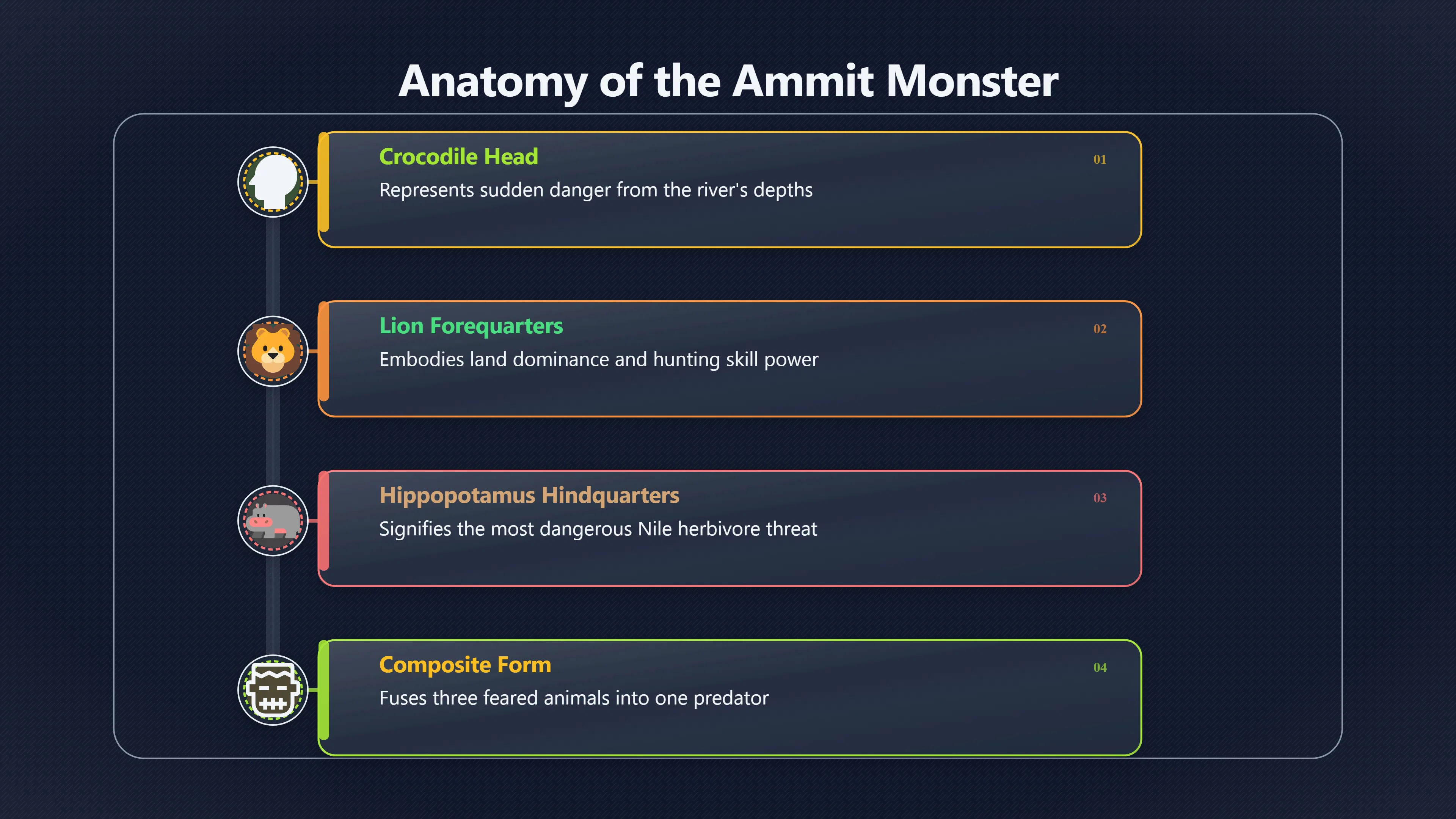
Ammit’s appearance followed a simple but powerful logic. Ancient Egyptian artists typically gave her the head of a crocodile, the front half of a lion and the rear quarters of a hippopotamus. These were not random choices. They represented three animals associated with immense strength, aggression and the ability to kill humans. Egyptian texts and later scholarly interpretations repeatedly note that the combination drew on some of the most feared large animals known to people living along the Nile.[wikipedia.org]WikipediaOpen source on wikipedia.org.
The design worked because each animal contributed a different kind of threat:
- The crocodile represented sudden danger from the river, a predator capable of dragging victims underwater.
- The lion embodied power, hunting skill and dominance on land.
- The hippopotamus, despite its modern reputation as a lumbering herbivore, was one of the Nile’s most dangerous animals and could overturn boats or attack people.[Wikipedia]WikipediaOpen source on wikipedia.org.
This combination created what might be called a “maximum danger” creature. Rather than inventing an entirely unknown beast, Egyptian imagination amplified familiar risks. That approach helps explain why Ammit remains vivid today. Readers can instantly recognise the source animals and understand why their combination would be frightening.
Interestingly, Ammit’s appearance was not completely fixed across Egyptian history. While the crocodile-lion-hippopotamus form became the standard image, some later depictions altered the details, giving her different body shapes while preserving her role as a devouring hybrid creature. The core idea mattered more than strict anatomical consistency.[Wikipedia]WikipediaOpen source on wikipedia.org.
Judgement, fear and the devouring of hearts
What made Ammit truly memorable was not her appearance but her function. She appeared in scenes of the afterlife judgement described in the Book of the Dead. According to these texts, the deceased person’s heart was weighed against the feather of Ma’at, the principle of truth, justice and cosmic order. If the heart balanced correctly, the dead could continue into the afterlife. If it proved too heavy with wrongdoing, Ammit was waiting beside the scales.[Wikipedia]WikipediaBook of the DeadBook of the Dead
Her task was simple and horrifying: she consumed the heart of the unworthy dead. Ancient Egyptians believed this punishment was more severe than ordinary death because it denied the individual a successful afterlife. Rather than facing physical destruction alone, the condemned suffered a permanent spiritual loss sometimes described as a “second death”.[wikipedia.org]WikipediaOpen source on wikipedia.org.
For readers interested in monster traditions, this is an important distinction. Ammit was not a beast roaming deserts or attacking villages. She functioned as a supernatural predator within a moral system. Fear of Ammit reinforced social ideas about honesty, justice and proper behaviour. Her monstrous form made those consequences unforgettable.[Wikipedia]WikipediaBook of the DeadBook of the Dead
The image also reflects a broader pattern in Egyptian storytelling. Dangerous animals were not merely physical threats. They became symbols of cosmic forces. A crocodile could represent more than a crocodile; a lion could signify royal power or destructive force. Ammit combined these symbolic meanings into a single creature standing at the boundary between life and death.[Wikipedia]WikipediaOpen source on wikipedia.org.
Why Ammit feels more real than many mythical beasts
Many legendary monsters are assembled from improbable features that seem detached from everyday experience. Ammit works differently. Every part of her came from animals that ancient Egyptians knew first-hand.
This grounding in reality gives her a quality that overlaps with later mystery-animal traditions. Around the world, stories of unknown beasts often begin with recognisable animals that are exaggerated, combined or misunderstood. Ammit represents a deliberate version of the same process. Instead of a witness mistaking one animal for another, Egyptian religion consciously fused several feared species into a single image.
That helps explain why modern audiences often react to Ammit differently from creatures such as dragons or giants. Her anatomy feels less like fantasy and more like an unsettling biological possibility. Even though nobody ever claimed she existed physically, the design draws its power from real ecology and genuine human fears.[Wikipedia]WikipediaOpen source on wikipedia.org.
How composite monsters shaped later creature lore
Ammit belongs to a long Egyptian tradition of composite beings. Ancient Egyptian art frequently combined animal and human traits or merged several animals into a single form. Some of these figures represented gods, others demons, guardians or embodiments of chaos. Ammit stands out because she distilled the principle into its purest monster form: combining the worst dangers people knew into one creature.[Wikipedia]WikipediaOpen source on wikipedia.org.
The influence of that idea extends far beyond ancient Egypt. Hybrid monsters appear throughout later folklore and mythology, from classical creatures assembled from multiple animals to modern fantasy beasts. The basic creative mechanism remains remarkably similar:
- Start with animals people recognise.
- Select the most feared or powerful traits.
- Combine them into a single being.
- Give that being a symbolic role larger than any real animal could fulfil.
Ammit demonstrates that this formula was already highly developed thousands of years ago. Rather than being an obscure religious figure, she offers a window into how people create monsters in the first place. The creature feels believable because it is built from reality, yet memorable because it transcends it.[Wikipedia]WikipediaOpen source on wikipedia.org.
Within Egypt’s wider tradition of strange creatures and monster imagery, that may be Ammit’s most lasting legacy. She shows that some of the most powerful monsters are not invented from nothing. They are assembled from the animals already lurking at the edge of human fear.[Wikipedia]WikipediaOpen source on wikipedia.org.

Amazon book picks
Further Reading
Books and field guides related to Why Ammit Still Feels Like a Real Monster. Use these as the next step if you want deeper reading beyond the article.
The Egyptian Myths
Explains judgement myths, the weighing of the heart, and Ammit's role.
the complete gods and goddesses of ancient egypt
Includes Ammit and the wider tradition of composite beings.
Mythology:Timeless Tales of Gods and Heroes
Helps readers compare Egyptian composite monsters with wider mythological traditions.
eBay marketplace picks
Marketplace Samples
Live-tested eBay searches with available results related to this page.
Endnotes
1.
Source: Wikipedia
Link:https://en.wikipedia.org/wiki/Ammit
2.
Source: Wikipedia
Title: Book of the Dead
Link:https://en.wikipedia.org/wiki/Book_of_the_Dead
3.
Source: Wikipedia
Title: Weighing of souls
Link:https://en.wikipedia.org/wiki/Weighing_of_souls
Source snippet
Weighing of soulsThe weighing of souls (Ancient Greek: psychostasia) is a religious motif in which a person's life is assessed by wei...
4.
Source: centreofexcellence.com
Title: She was associated with the afterlife and was known as the “
Link:https://www.centreofexcellence.com/ammit-in-egyptian-mythology/
Source snippet
Centre of ExcellenceAmmit in Egyptian Mythology: Myths, Symbols and Powers26 Jun 2024 — Composite Creature: Ammit's form itself was symbo...
5.
Source: ancientegyptonline.co.uk
Link:https://ancientegyptonline.co.uk/ammit/
Source snippet
AmmitThe ancient Egyptian goddess Ammit (also known as Ammut and Ahemait) was the personification of divine retribution. She sat beside t...
Additional References
6.
Source: pmc.ncbi.nlm.nih.gov
Title: PMCThe book of death: weighing your heart
Link:https://pmc.ncbi.nlm.nih.gov/articles/PMC3960665/
Source snippet
book of death: weighing your heart - PMCby F Carelli · 2011 · Cited by 27 — It could reveal the person's true character, even after death...
7.
Source: ancientegyptblog.com
Link:https://www.ancientegyptblog.com/?p=246
Source snippet
The Devourer20 Jun 2022 — Ammit 𓂝𓅓𓅓𓏏 was a combination of animals that were most feared by the ancient Egyptians 𓆎𓏏𓀀𓁐𓏪: she had the head...
8.
Source: bastettravel.com
Link:https://bastettravel.com/blog/ammit/
Source snippet
The Devourer of Souls in Egyptian Mythology25 May 2026 — When a soul was found unworthy, Ammit devoured its heart, severing it permanentl...
Published: May 2026
9.
Source: craiyon.com
Link:https://www.craiyon.com/en/image/zxXHatu7QXiyLr-p7L-3aQ
Source snippet
rocodile, the body of a lion, and the hindquarters of a hippopotamus...Read more...
10.
Source: darkchamberz.com
Link:https://www.darkchamberz.com/ammit-devourer-of-the-deadthe-42-ideals-of-maat-weighing-of-the-heart
Source snippet
crocodile: the three “man-eating” animals par excellence for the ancient Egyptians.Read more...
11.
Source: egypt-museum.com
Link:https://egypt-museum.com/ammit/
Source snippet
Egypt MuseumIn Ancient Egyptian belief, Ammit (also spelled Ammut or Amamet) was the personification of punishment, a final threat to tho...
12.
Source: the-demonic-paradise.fandom.com
Link:https://the-demonic-paradise.fandom.com/wiki/Ammit
Source snippet
The Demonic Paradise Wiki - FandomAmmit is depicted with the forequarters of a lion, the hindquarters of a hippopotamus, and the head of...
13.
Source: pdsh.fandom.com
Link:https://pdsh.fandom.com/wiki/Ammit
Source snippet
Public Domain Super Heroes | FandomAmmit, literally translated as "Devourer of the Dead", was an ancient Egyptian goddess with the fore...
14.
Source: reddit.com
Title: Ammit: r/Outofthe Tombs
Link:https://www.reddit.com/r/OutoftheTombs/comments/17jtq97/ammit/
Source snippet
Ammit: r/OutoftheTombs - RedditOctober 30, 2023 — The ancient Egyptian goddess Ammit (also known as Ammut and Ahemait) was the personifi...
Published: October 30, 2023
15.
Source: study.com
Title: Video: Goddess Ammit the Devourer | Mythology & Facts
Link:https://study.com/academy/lesson/video/ammit-mythology-hieroglyphics-facts.html
Source snippet
2, 2025 — Ammit had the head of a crocodile, front body of a lion, and back legs of a hippopotamus · Her name appears in hieroglyphs with...
Published: July 2, 2025
Topic Tree