Within Laos Cryptids
Why the Naga Rules Lao Monster Lore
The Naga is Laos's central creature tradition, remembered through rivers, temples, weaving, Buddhism and local identity.
On this page
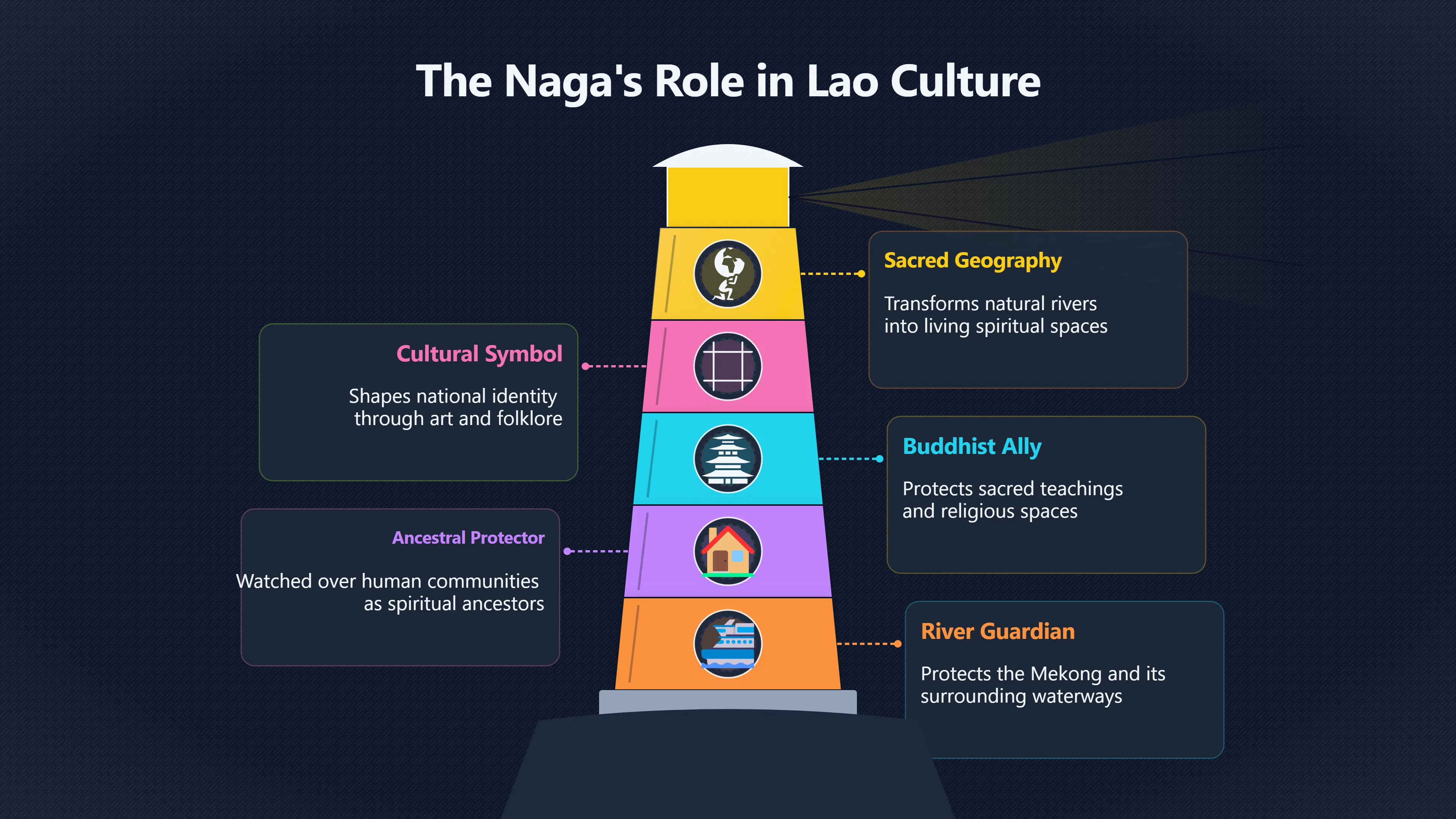
- River guardians and sacred geography
- Temples, textiles and everyday Naga imagery
- Why folklore matters more than zoology
Page outline Jump by section
Introduction
The Naga is the most important legendary creature in Laos, but it is not primarily remembered as a hidden animal lurking in remote waters. Instead, it is a guardian of rivers, communities and sacred places. In Lao tradition, the Naga is a powerful serpent-like being associated with the Mekong River, protection, fertility and the spiritual landscape of the country. While modern cryptid enthusiasts sometimes compare it to a river monster, the Naga occupies a very different role: it is woven into religion, folklore, art and national identity. UNESCO’s recognition of traditional Lao Naga motif weaving highlights just how deeply the serpent is embedded in everyday life rather than in claims of undiscovered zoology.[UNESCO Intangible Cultural Heritage]ich.unesco.orgTo show their respect, they add Naga motifs to different objects, the most common of which is…Read more…

For anyone exploring Laos’s monster lore, understanding the Naga is essential. It is the creature that shapes how rivers are imagined, how temples are decorated and how many Lao people understand the relationship between the natural and spiritual worlds.[National Geographic]nationalgeographic.comthis serpent god is everywhere in laosNational GeographicWhy Laos thinks this serpent god deserves UNESCO statusDec 21, 2021 — This year, Laos nominated naga motifs in weaving…
River Guardians and Sacred Geography
The defining feature of the Lao Naga is its connection to water. Unlike sea-serpent traditions elsewhere, Laos’s great serpent belongs to rivers, especially the Mekong. Stories place Naga beings beneath the river’s surface, within deep pools, hidden channels and sacred confluences where waterways meet. The creature is not merely a resident of the river but a guardian of it.[nationalgeographic.com]nationalgeographic.comthis serpent god is everywhere in laosNational GeographicWhy Laos thinks this serpent god deserves UNESCO statusDec 21, 2021 — This year, Laos nominated naga motifs in weaving…
Many traditions describe the Naga as an ancestral protector watching over human communities. UNESCO’s documentation of Naga weaving notes that Lao people regard Nagas as ancestors who watch over them, a belief that helps explain why the creature appears in so many aspects of daily life.[UNESCO Intangible Cultural Heritage]ich.unesco.orgTo show their respect, they add Naga motifs to different objects, the most common of which is…Read more…
The Naga’s role extends beyond individual rivers. In Lao historical tradition, serpent guardians became linked to entire cities and regions. Vientiane is often associated with Naga protectors, while traditions from Luang Prabang describe the serpent king as a guardian spirit connected to the city’s identity and river landscape. The result is a form of sacred geography in which waterways are not neutral features of the environment but living spaces watched over by powerful supernatural beings.[wikipedia.org]WikipediaOpen source on wikipedia.org.
This helps explain why the Naga survives so strongly in modern Laos. It is tied to places people still see every day: rivers, ferry crossings, fishing grounds and temple sites. The legend remains visible because the landscape itself continually reinforces it.
Why the Naga Became Laos’s Signature Creature
Many countries have famous monsters that exist mainly in stories, tourist brochures or old newspaper reports. The Naga became something larger because it merged several traditions at once.
Older river-spirit beliefs blended with Buddhist symbolism over centuries. Rather than disappearing when Buddhism spread through the region, serpent traditions were absorbed into religious life. The Naga came to be viewed as a protector of Buddhist teachings and sacred spaces. This gave the creature a respected place within mainstream culture rather than confining it to folklore on the margins.[Garland Magazine]garlandmag.comGarland MagazineWater spirits in the form of serpents: The Ular Naga of Alor…Mar 1, 2025 — Woven Naak or Naga motifs were enlisted as…
The Mekong also encouraged the legend’s growth. For generations the river served as a source of food, transport and trade, but it could also be dangerous. Seasonal floods, shifting channels and unpredictable waters inspired stories that treated the river as a powerful living force. Imagining guardian serpents beneath the surface gave a supernatural shape to those experiences.[National Geographic]nationalgeographic.comthis serpent god is everywhere in laosNational GeographicWhy Laos thinks this serpent god deserves UNESCO statusDec 21, 2021 — This year, Laos nominated naga motifs in weaving…
Unlike many cryptid traditions, there was never a strong expectation that the Naga would eventually be captured, photographed or classified by science. Its importance came from meaning rather than physical evidence. That distinction is crucial when comparing the Naga with more zoology-focused mystery creatures.
Temples, Textiles and Everyday Naga Imagery
One reason visitors often assume the Naga is everywhere in Laos is because it genuinely is.
Temple staircases frequently feature long serpent balustrades whose bodies appear to flow along railings and entrances. In Buddhist architecture, these serpent forms act as symbolic guardians marking the transition between ordinary and sacred space. Their presence reinforces the idea that Nagas protect both people and holy places.[Garland Magazine]garlandmag.comGarland MagazineWater spirits in the form of serpents: The Ular Naga of Alor…Mar 1, 2025 — Woven Naak or Naga motifs were enlisted as…
The creature is equally important in traditional weaving. UNESCO formally inscribed the traditional craft of Naga motif weaving in Lao communities on its Representative List of the Intangible Cultural Heritage of Humanity. According to UNESCO, Naga motifs are woven by hand into textiles because the serpent is believed to watch over and protect people. The motifs are not simply decorative patterns; they carry meanings connected to protection, strength and respect for ancestral traditions.[UNESCO Intangible Cultural Heritage]ich.unesco.orgThe Naga is a mythical, serpent-like creature that lives in rivers. Lao people believe that Naga are ancestors that watch over them. To s…
Across Laos, Naga imagery appears in:[en.vietnamplus.vn]en.vietnamplus.vntraditional weaving inscribed as UNESCO Intangible…Dec 7, 2023 — UNESCO has recently inscribed Lao traditional Naga motif weaving as I…
- Traditional skirts and ceremonial textiles.
- Temple roofs, staircases and carvings.
- Murals and religious artwork.
- Decorative objects associated with rituals and festivals.
- Local stories explaining rivers, settlements and sacred sites.[nationalgeographic.com]nationalgeographic.comthis serpent god is everywhere in laosNational GeographicWhy Laos thinks this serpent god deserves UNESCO statusDec 21, 2021 — This year, Laos nominated naga motifs in weaving…
This constant visibility is unusual for a legendary creature. Most cryptids survive in stories. The Naga survives in stories, architecture, crafts and public symbolism simultaneously.
Do People Report Seeing Naga Serpents?
Stories of direct encounters certainly exist. Along the Mekong, tales persist of giant serpents moving beneath the water, mysterious disturbances on the river surface and supernatural events attributed to Naga activity. The annual Naga fireball tradition on the Mekong border is perhaps the best-known modern example. Believers interpret the lights as signs of the Naga’s presence or reverence for the Buddha, while sceptics favour natural or human-made explanations.[Wikipedia]WikipediaNaga fireballNaga fireball
However, these accounts differ from classic cryptid sightings. There is no substantial body of evidence suggesting a hidden biological species inhabits the Mekong. Reports are usually framed through spiritual belief rather than zoological investigation. Witnesses often describe a sacred manifestation rather than an unknown animal.[Wikipedia]WikipediaNaga fireballNaga fireball
That distinction matters because it changes how the stories are interpreted. A Loch Ness Monster-style investigation asks whether a creature exists physically. Naga traditions more often ask what a sighting means spiritually or culturally.
Why Folklore Matters More Than Zoology
From a cryptozoological perspective, evidence for an undiscovered giant serpent living in the Mekong is extremely weak. No verified specimens, photographs or biological traces support the idea of a hidden population of enormous river serpents. Modern ecology offers no convincing mechanism for such a creature remaining undetected in the way folklore describes.[Wikipedia]WikipediaNaga fireballNaga fireball
Yet judging the Naga solely by zoological standards misses its real significance.
The Naga persists because it functions as a cultural guardian. It explains relationships between people and rivers. It provides symbols of protection and prosperity. It links Buddhist practice with older local traditions. It appears in crafts that families continue to make and pass down through generations. UNESCO’s recognition of Naga motif weaving reflects this living role within Lao society.[UNESCO Intangible Cultural Heritage]ich.unesco.orgTo show their respect, they add Naga motifs to different objects, the most common of which is…Read more…
In that sense, the Naga is arguably more influential than many creatures that cryptozoologists spend decades searching for. Its power comes not from evidence that it exists as an animal, but from the fact that it continues to shape how people imagine the Mekong, their communities and their history.

The Place of the Naga in Lao Monster Lore
When readers encounter lists of famous cryptids around the world, they often expect every legendary creature to be judged by the same standard: sightings, photographs, footprints and biological evidence. Laos’s most famous creature challenges that assumption.
The Naga sits at the boundary between folklore, religion and mystery-animal tradition. It can appear in stories about strange river phenomena, but it is fundamentally a guardian spirit rather than a candidate species. That is why it dominates Lao monster lore. Other mystery-animal stories may come and go, but the Naga remains anchored in rivers, temples, textiles and collective memory.
For Laos, the great serpent’s importance lies less in whether it swims beneath the Mekong today and more in how it continues to watch over the country’s cultural imagination.[nationalgeographic.com]nationalgeographic.comthis serpent god is everywhere in laosNational GeographicWhy Laos thinks this serpent god deserves UNESCO statusDec 21, 2021 — This year, Laos nominated naga motifs in weaving…
Amazon book picks
Further Reading
Books and field guides related to Why the Naga Rules Lao Monster Lore. Use these as the next step if you want deeper reading beyond the article.
The Element Encyclopedia of Magical Creatures
Contains serpent guardians and mythic creature lore.
The Penguin Book of Dragons
Naga traditions overlap with wider serpent and dragon mythology.
Myths and Legends of Southeast Asia
Closest mainstream match for understanding Naga traditions.
eBay marketplace picks
Marketplace Samples
Live-tested eBay searches with available results related to this page.




Endnotes
1.
Source: ich.unesco.org
Link:https://ich.unesco.org/en/RL/traditional-craft-of-naga-motif-weaving-in-lao-communities-01973
Source snippet
To show their respect, they add Naga motifs to different objects, the most common of which is...Read more...
2.
Source: ich.unesco.org
Link:https://ich.unesco.org/en/decisions/18.COM/8.B.39
Source snippet
The Naga is a mythical, serpent-like creature that lives in rivers. Lao people believe that Naga are ancestors that watch over them. To s...
3.
Source: Wikipedia
Link:https://en.wikipedia.org/wiki/N%C4%81ga
4.
Source: ich.unesco.org
Link:https://ich.unesco.org/en/decisions/16.COM/8.B.20
Source snippet
To show their respect, Lao people add naga motifs to many different objects, the most common of which is textiles through weaving. Naga w...
5.
Source: Wikipedia
Title: Naga fireball
Link:https://en.wikipedia.org/wiki/Naga_fireball
6.
Source: ich.unesco.org
Link:https://ich.unesco.org/en/video/66694
Source snippet
unesco.orgVideo: Traditional craft of Naga motif weaving in Lao...The Naga design is considered as one of the most delicate and prestigi...
7.
Source: ich.unesco.org
Link:https://ich.unesco.org/en/video/57875
Source snippet
craft of Naga motif weaving in Lao communitiesNomination: Traditional craft of Naga motif weaving in Lao communities (Lao People's Democr...
8.
Source: ich.unesco.org
Link:https://ich.unesco.org/en/8b-representative-list-01191?call=slideshow&id=01593&include=slideshow_inc.php&mode=scroll&width=620
Source snippet
craft of Naga motif weaving in Lao communitiesTraditional craft of Naga motif weaving in Lao communities (Lao People's Democratic Republi...
9.
Source: youtube.com
Title: Traditional craft of Naga motif weaving in Lao communities
Link:https://www.youtube.com/watch?v=7NDXMfhsK-0
Source snippet
The Legend of the Naga...
10.
Source: nationalgeographic.com
Title: this serpent god is everywhere in laos
Link:https://www.nationalgeographic.com/travel/article/this-serpent-god-is-everywhere-in-laos
Source snippet
National GeographicWhy Laos thinks this serpent god deserves UNESCO statusDec 21, 2021 — This year, Laos nominated naga motifs in weaving...
11.
Source: ockpoptok.com
Title: naga kingdom
Link:https://www.ockpoptok.com/blog/naga-kingdom/
Source snippet
Dec 15, 2020 — The Naga is a serpent that lives in the river. The King of Nagas lives in the Mekong River. They are everywhere in Lao cul...
12.
Source: garlandmag.com
Link:https://garlandmag.com/article/ular-naga-of-alor-and-the-phanya-naak-of-laos/
Source snippet
Garland MagazineWater spirits in the form of serpents: The Ular Naga of Alor...Mar 1, 2025 — Woven Naak or Naga motifs were enlisted as...
13.
Source: ockpoptok.com
Title: motifs lao textiles stories
Link:https://www.ockpoptok.com/blog/motifs-lao-textiles-stories/
Source snippet
Ock Pop TokMotifs: Lao textiles or the stories they tell...Nov 10, 2021 — Animal and mythical creature motifs are frequently used in the...
14.
Source: nationalgeographic.com
Link:https://www.nationalgeographic.com/travel/destination/laos?context=eyJjb250ZW50VHlwZSI6IlVuaXNvbkh1YiIsInZhcmlhYmxlcyI6eyJsb2NhdG9yIjoiL3RyYXZlbC9kZXN0aW5hdGlvbi9sYW9zIiwicG9ydGZvbGlvIjoibmF0Z2VvIiwicXVlcnlUeXBlIjoiTE9DQVRPUiJ9LCJtb2R1bGVJZCI6bnVsbH0&hubmore=&id=c78a0901-49d8-440c-9bf5-5319b1d07b78-f3-m2&page=1
Source snippet
Laos thinks this serpent god deserves UNESCO statusLaos thinks this serpent god deserves UNESCO status. See the rich spiritual and cultur...
15.
Source: nationalgeographic.com
Title: Travel dupe: This ancient temple in Laos rivals Angkor Wat
Link:https://www.nationalgeographic.com/travel/article/ancient-laos-temple-rival-angkor-wat
Source snippet
May 24, 2024 — (Why Laos thinks its legendary serpent god deserves UNESCO status.) Relics that predate Angkor are scattered throughout Va...
Published: May 24, 2024
16.
Source: ockpoptok.com
Link:https://www.ockpoptok.com/blog/motifs-stories-lao-textiles/
Source snippet
More than just motifs: The stories told in Lao textilesJan 25, 2025 — In 2023, UNESCO designated the traditional Naga motif weaving as In...
17.
Source: natgeotv.com
Title: National Geographic
Link:https://www.natgeotv.com/za/shows/natgeo/primal-survivor-mighty-mekong
Source snippet
Primal Survivor: Mighty MekongHazen Audel descends from cloud forests high above Laos to join the mighty Mekong River, as he begins the s...
Additional References
18.
Source: nakaravillasandglamping.com
Link:https://nakaravillasandglamping.com/nagas-the-serpent-deities-of-the-mekong/
Source snippet
Nagas of the Mekong: Myth, Mystery & LegendNagas powerful serpent deities believed to dwell beneath the Mekong River and the lakes of Udo...
19.
Source: en.vietnamplus.vn
Link:https://en.vietnamplus.vn/lao-traditional-weaving-inscribed-as-unesco-intangible-cultural-heritage-post274499.vnp
Source snippet
traditional weaving inscribed as UNESCO Intangible...Dec 7, 2023 — UNESCO has recently inscribed Lao traditional Naga motif weaving as I...
20.
Source: aseanall.com
Title: It can take several days to complete a single motif.” Lao
Link:https://www.aseanall.com/news/4940.html
Source snippet
UNESCO declares Lao weaving motif as form of Intangible...Dec 10, 2023 — Naga weaving entails weaving the motif by hand with a tradition...
21.
Source: facebook.com
Link:https://www.facebook.com/natgeo/posts/although-youll-see-this-dragon-like-god-everywhere-in-southeast-asiagrinning-fro/707233837440716/
Source snippet
fertility, protection, and prosperity. As a Lao immigrant...Read more...
22.
Source: english.news.cn
Link:https://english.news.cn/asiapacific/20240609/0db8f995b70a42eca907fea2514ef380/c.html
Source snippet
celebrates UNESCO's recognition of traditional Naga...Jun 9, 2567 BE — The Naga motif weaving enjoys a special position in Laos, being h...
23.
Source: english.news.cn
Link:https://english.news.cn/20240609/d15af77210e749f4941e36fad59e9a41/c.html
Source snippet
Xinhua NewsLaos celebrates UNESCO's recognition of traditional Naga...Jun 9, 2024 — The Naga motif weaving enjoys a special position in...
24.
Source: triciaannemitchell.com
Title: Nagas, the Fire Serpents of the Mekong
Link:https://triciaannemitchell.com/2012/02/21/photo-du-jour-44-nagas-the-fire-serpents-of-the-mekong/
Source snippet
May 14, 2020 — Some Laotian and Thai people believe that serpent-like creatures (nagas) inhabit the chocolate-colored waters of the Mekon...
Published: May 14, 2020
25.
Source: thestar.com.my
Link:https://www.thestar.com.my/aseanplus/aseanplus-news/2024/06/09/laos-celebrates-unesco039s-recognition-of-traditional-naga-motif-weaving
Source snippet
Laos celebrates UNESCO's recognition of traditional Naga...9 Jun 2024 — The Naga motif weaving enjoys a special position in Laos, being...
26.
Source: vientianetimes.org.la
Title: freecontent 232 Legacy y25
Link:https://www.vientianetimes.org.la/freefreenews/freecontent_232_Legacy_y25.php
Source snippet
Vientiane TimesDec 1, 2025 — The Naga—believed to be a guardian of the Mekong River and protector of Lao people—appears in countless form...
27.
Source: youtube.com
Link:https://www.youtube.com/watch?v=b179WV0QwVw
Source snippet
was said to be created by two nāga kings slithering...
Topic Tree