Within Togo Mysteries
Is the Adze Really Togo's Vampire Cryptid?
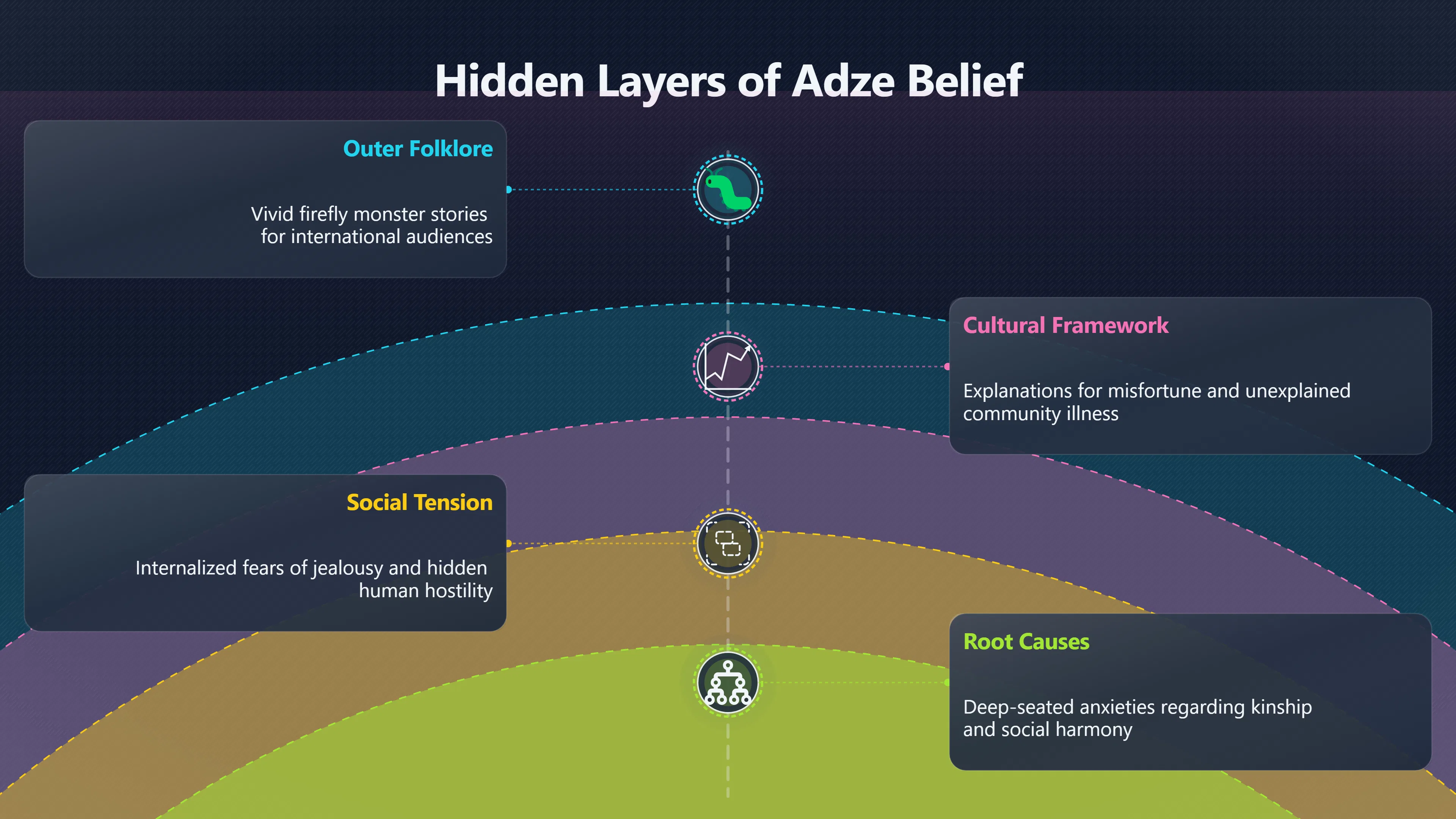
The adze is more than a firefly vampire story: it reflects Ewe ideas about envy, illness, kinship and hidden human harm.
On this page
- The firefly vampire story
- Adze belief in Ewe society
- How modern retellings changed the tradition
Page outline Jump by section
Introduction
The adze is often presented online as Togo’s answer to the vampire: a supernatural being that slips into houses as a glowing insect, drinks blood from sleeping victims, and reveals a human form when captured. That story is real enough as folklore, but it is only part of the picture. Within Ewe traditions of southern Togo and neighbouring south-eastern Ghana, the adze sits at the boundary between monster tale and witchcraft belief. The frightening firefly gives the tradition a memorable image, yet the deeper concern is usually hidden human hostility, unexplained illness, jealousy, and the fear that harm can come from within one’s own community rather than from a creature lurking in the wilderness.[Wikipedia]WikipediaAdze (folkloreDecember 14, 2025 — The adze is a vampiric being in Ewe folklore, [1] told by the people of Togo and Ghana. In the wild, the adze takes t…

For readers interested in Togo’s strange-creature traditions, this distinction matters. The adze is not primarily a mystery animal or a reported unknown species. It is a cultural explanation for misfortune that later became transformed into a monster story for wider audiences. Understanding that shift helps explain why the adze remains one of the most discussed supernatural beings associated with Togo, even though it occupies a very different place from the cryptids found in many other countries.[Cambridge University Press & Assessment]cambridge.orgCambridge University Press & AssessmentThe Dance of Alegba: Anlo-Ewe Religion (Chapter 3)Witchcraft (Ewe: adze) is believed to be a human…
Is the Adze Really Togo’s Vampire Cryptid?
The version most familiar to international audiences describes the adze as a vampiric entity that takes the form of a firefly. In that form it can enter homes through tiny openings, approach sleeping people, and feed on them. Victims are said to become weak, ill, or even die. If the creature is captured, it supposedly changes into human form and may possess other people.[Wikipedia]WikipediaAdze (folkloreDecember 14, 2025 — The adze is a vampiric being in Ewe folklore, [1] told by the people of Togo and Ghana. In the wild, the adze takes t…
Those details explain why modern monster books and folklore websites often classify the adze as a vampire or cryptid-like creature. The image is vivid and easy to retell: a tiny glowing insect hiding a dangerous supernatural predator.[Wikipedia]WikipediaAdze (folkloreDecember 14, 2025 — The adze is a vampiric being in Ewe folklore, [1] told by the people of Togo and Ghana. In the wild, the adze takes t…
Yet historical and anthropological discussions of Ewe belief place the emphasis elsewhere. In those sources, adze is closely connected with witchcraft rather than with an independent monster species. The danger is not simply an attacking creature. It is a harmful force associated with human beings, social tensions, envy, and the suspicion that someone within a family or community may be responsible for another person’s suffering.[Cambridge University Press & Assessment]cambridge.orgCambridge University Press & AssessmentThe Dance of Alegba: Anlo-Ewe Religion (Chapter 3)Witchcraft (Ewe: adze) is believed to be a human…
This is why describing the adze purely as a “firefly vampire” can be misleading. The monster story survives, but the underlying belief system concerns human relationships and social explanations for misfortune.[Cambridge University Press & Assessment]cambridge.orgCambridge University Press & AssessmentThe Dance of Alegba: Anlo-Ewe Religion (Chapter 3)Witchcraft (Ewe: adze) is believed to be a human…
The Firefly Vampire Story
The insect form is the feature that made the adze famous outside West Africa. Unlike European vampire traditions, which often involve aristocratic undead figures, the adze appears in a much smaller and more elusive shape. A glowing insect can enter a house unnoticed, making it an effective symbol of danger that arrives silently at night.[Wikipedia]WikipediaAdze (folkloreDecember 14, 2025 — The adze is a vampiric being in Ewe folklore, [1] told by the people of Togo and Ghana. In the wild, the adze takes t…
The tale contains several recurring themes:
- The adze approaches victims while they sleep.
- It enters homes through tiny gaps rather than doors.
- Illness follows the visit.
- Capture reveals a hidden human aspect.
- The threat is difficult to identify before harm occurs.[Wikipedia]WikipediaAdze (folkloreDecember 14, 2025 — The adze is a vampiric being in Ewe folklore, [1] told by the people of Togo and Ghana. In the wild, the adze takes t…
These elements create a story that works both as a supernatural narrative and as a way of explaining mysterious sickness. Several writers have suggested that the tradition may have been shaped by experiences with insect-borne disease. People became ill after night-time bites from tiny creatures they barely noticed, and the adze offered a dramatic explanation for those events. Such interpretations remain speculative, but they help explain why the insect form became so important within the folklore.[atlasobscura.com]atlasobscura.commonster mythology adzeAtlas ObscuraIn West Africa, the Adze Is an Insectoid Source of MisfortuneOct 26, 2020 — Historians believe the adze originated as an exp…
The key point is that the firefly is not merely a monster costume. It acts as a visible sign of an otherwise invisible danger.
Adze Belief in Ewe Society
To understand why the adze has endured, it is necessary to move beyond the monster narrative.
Among Ewe communities, the concept is intertwined with concerns about witchcraft, social harmony, and the causes of suffering. Academic studies describe witchcraft associated with adze as a human force linked to envy and hidden hostility. Misfortunes such as unexplained illness, repeated bad luck, or unexpected deaths could become occasions for discussing whether harmful spiritual influence was at work.[Cambridge University Press & Assessment]cambridge.orgCambridge University Press & AssessmentThe Dance of Alegba: Anlo-Ewe Religion (Chapter 3)Witchcraft (Ewe: adze) is believed to be a human…
This does not mean every difficult event was blamed on witchcraft. Rather, adze belief offered a framework through which communities could interpret experiences that otherwise seemed arbitrary or unjust. When someone prospered while others struggled, when family disputes intensified, or when sickness appeared without a clear explanation, suspicion could focus on unseen human intentions.[Cambridge University Press & Assessment]cambridge.orgCambridge University Press & AssessmentThe Dance of Alegba: Anlo-Ewe Religion (Chapter 3)Witchcraft (Ewe: adze) is believed to be a human…
Several themes appear repeatedly in discussions of adze belief:
Envy and success. Prosperity can create social tension. A successful person may become the object of jealousy, while those experiencing hardship may be suspected of harbouring resentment.[Cambridge University Press & Assessment]cambridge.orgCambridge University Press & AssessmentThe Dance of Alegba: Anlo-Ewe Religion (Chapter 3)Witchcraft (Ewe: adze) is believed to be a human…
Kinship and proximity. The feared source of harm is often imagined as someone known rather than a stranger. The danger is therefore socially intimate.[Cambridge University Press & Assessment]cambridge.orgCambridge University Press & AssessmentThe Dance of Alegba: Anlo-Ewe Religion (Chapter 3)Witchcraft (Ewe: adze) is believed to be a human…
Illness and misfortune. Unexplained suffering may be interpreted through the language of spiritual attack rather than random chance.[Cambridge University Press & Assessment]cambridge.orgCambridge University Press & AssessmentThe Dance of Alegba: Anlo-Ewe Religion (Chapter 3)Witchcraft (Ewe: adze) is believed to be a human…
Hidden identities. The notion that the adze appears harmless before revealing its true nature mirrors broader concerns about concealed motives and secret hostility.[Wikipedia]WikipediaAdze (folkloreDecember 14, 2025 — The adze is a vampiric being in Ewe folklore, [1] told by the people of Togo and Ghana. In the wild, the adze takes t…
Seen in this light, the firefly transformation becomes symbolic. A tiny, apparently harmless creature conceals a dangerous reality, just as a familiar neighbour or relative might conceal harmful intentions.
Why the Adze Belongs to a Cross-Border Tradition
Modern readers sometimes encounter the adze as a specifically Togolese creature. In reality, the tradition belongs to the wider Ewe cultural world that spans southern Togo and south-eastern Ghana. The colonial border divided territories, but it did not divide language, family connections, or shared religious ideas.[Wikipedia]WikipediaEwe peopleEwe people
As a result, accounts of the adze appear on both sides of the frontier. The story should therefore be understood as an Ewe tradition with strong roots in Togo rather than a monster confined to a single nation.[Wikipedia]WikipediaAdze (folkloreDecember 14, 2025 — The adze is a vampiric being in Ewe folklore, [1] told by the people of Togo and Ghana. In the wild, the adze takes t…
This wider setting also helps explain why different descriptions exist. Folklore changes from community to community, and stories evolve over time. Some tellings emphasise the supernatural insect, while others focus more heavily on witchcraft and social relations. Both versions belong to the same broader tradition.[Cambridge University Press & Assessment]cambridge.orgCambridge University Press & AssessmentThe Dance of Alegba: Anlo-Ewe Religion (Chapter 3)Witchcraft (Ewe: adze) is believed to be a human…
How Modern Retellings Changed the Tradition
The internet has dramatically reshaped how the adze is understood outside West Africa.
Folklore databases, monster encyclopaedias, social media posts, podcasts, and television programmes often highlight the most dramatic elements: blood-drinking, shapeshifting, possession, and nocturnal attacks. These features fit neatly into global categories such as vampires, monsters, and cryptids.[PBS]pbs.orgMonstrum | Adze: the Shapeshifting Firefly from West Africa…To the people of some West-African cultures, however, the firefly bring…
What often disappears in the process is the social meaning. The adze becomes a creature to be catalogued rather than a belief connected to family tensions, illness, and questions of responsibility. The transformation is understandable. A firefly vampire is easier to summarise than a complex system of ideas about misfortune and hidden human harm.[Cambridge University Press & Assessment]cambridge.orgCambridge University Press & AssessmentThe Dance of Alegba: Anlo-Ewe Religion (Chapter 3)Witchcraft (Ewe: adze) is believed to be a human…
This shift has produced two parallel versions of the adze:
- The folklore-monster version, popular in cryptid and supernatural media.
- The cultural-belief version, emphasised by historians and anthropologists studying Ewe society.[Wikipedia]WikipediaAdze (folkloreDecember 14, 2025 — The adze is a vampiric being in Ewe folklore, [1] told by the people of Togo and Ghana. In the wild, the adze takes t…
Neither version is entirely wrong. The monster tale genuinely exists, and it remains one of the most memorable parts of the tradition. The problem arises when the monster story is treated as the whole story.
Why the Adze Still Matters
The lasting fascination of the adze comes from the way it combines two kinds of fear. On one level, it is a classic supernatural predator that enters homes under cover of darkness. On another, it reflects anxieties about human relationships, jealousy, illness, and unseen sources of suffering.[Wikipedia]WikipediaAdze (folkloreDecember 14, 2025 — The adze is a vampiric being in Ewe folklore, [1] told by the people of Togo and Ghana. In the wild, the adze takes t…
That combination makes the adze unusual among creatures often listed as cryptids. Most cryptid traditions revolve around unknown animals living in remote places. The adze, by contrast, points back toward society itself. The real mystery is not what lurks in a distant forest or lake. It is whether harm can come from hidden motives within the community.
For that reason, the adze is best understood not simply as Togo’s vampire creature but as a meeting point between folklore and belief, where a memorable monster story carries deeper ideas about envy, vulnerability, and the search for explanations when misfortune strikes.[Cambridge University Press & Assessment]cambridge.orgCambridge University Press & AssessmentThe Dance of Alegba: Anlo-Ewe Religion (Chapter 3)Witchcraft (Ewe: adze) is believed to be a human…
Amazon book picks
Further Reading
Books and field guides related to Is the Adze Really Togo's Vampire Cryptid?. Use these as the next step if you want deeper reading beyond the article.
Witchcraft, Oracles, and Magic Among the Azande
Directly addresses African concepts of witchcraft and misfortune.
African Myths of Origin
Places the adze within broader African storytelling traditions.

eBay marketplace picks
Marketplace Samples
Live-tested eBay searches with available results related to this page.

Endnotes
1.
Source: Wikipedia
Title: Adze (folklore)
Link:https://en.wikipedia.org/wiki/Adze_%28folklore%29
Source snippet
December 14, 2025 — The adze is a vampiric being in Ewe folklore, [1] told by the people of Togo and Ghana. In the wild, the adze takes t...
Published: December 14, 2025
2.
Source: cambridge.org
Link:https://www.cambridge.org/core/books/slavery-memory-and-religion-in-southeastern-ghana-c1850present/dance-of-alegba-anloewe-religion/60FC8796E07E15B281225B2D83ABC4E0
Source snippet
Cambridge University Press & AssessmentThe Dance of Alegba: Anlo-Ewe Religion (Chapter 3)Witchcraft (Ewe: adze) is believed to be a human...
3.
Source: resolve.cambridge.org
Title: the dance of alegba anlo ewe religion
Link:https://resolve.cambridge.org/core/services/aop-cambridge-core/content/view/60FC8796E07E15B281225B2D83ABC4E0/9781316257852c3_p47-74_CBO.pdf/the-dance-of-alegba-anlo-ewe-religion.pdf
Source snippet
Cambridge University Press & Assessment3 The Dance of Alegba: Anlo-Ewe Religion(For witchcraft and envy [Ewe: n'bia], see Rosenthal 1998...
4.
Source: Wikipedia
Title: West African mythology
Link:https://en.wikipedia.org/wiki/West_African_mythology
5.
Source: pbs.org
Link:https://www.pbs.org/video/adze-the-shapeshifting-firefly-from-west-africa-baxtto/
Source snippet
Monstrum | Adze: the Shapeshifting Firefly from West Africa...To the people of some West-African cultures, however, the firefly bring...
6.
Source: vampires.fandom.com
Title: Vampires Fandom Adze
Link:https://vampires.fandom.com/wiki/Adze
7.
Source: Wikipedia
Title: Ewe people
Link:https://en.wikipedia.org/wiki/Ewe_people
8.
Source: Wikipedia
Title: Culture of Ghana
Link:https://en.wikipedia.org/wiki/Culture_of_Ghana
9.
Source: vampires.com
Title: adze firefly vampire of africa
Link:https://www.vampires.com/adze-firefly-vampire-of-africa/
10.
Source: youtube.com
Title: Adze: the Shapeshifting Firefly from West Africa | Monstrum
Link:https://www.youtube.com/watch?v=I15v-4b4Mk0
Source snippet
Adze - The creature that hides in the light...
11.
Source: youtube.com
Link:https://www.youtube.com/watch?v=Bhk7j1QR9J8
Source snippet
Every Type of Vampire Explained...
12.
Source: atlasobscura.com
Title: monster mythology adze
Link:https://www.atlasobscura.com/articles/monster-mythology-adze
Source snippet
Atlas ObscuraIn West Africa, the Adze Is an Insectoid Source of MisfortuneOct 26, 2020 — Historians believe the adze originated as an exp...
Additional References
13.
Source: eerieworlds.com
Link:https://www.eerieworlds.com/eerie-world-cards/adze
Source snippet
Eerie WorldsAdzeTales of the Adze are carried through stories from the Ewe people in Togo and Ghana. They describe a vampiric firefly, wh...
14.
Source: adeche.com
Title: the adze a deep dive into the vampiric firefly in ewe folklore
Link:https://adeche.com/blogs/learn-african-mythology/the-adze-a-deep-dive-into-the-vampiric-firefly-in-ewe-folklore?srsltid=AfmBOooAcTT49pPJpKr8TExWMTXP7OJghucGoIU-R-rufzjHYqXfhQsj
Source snippet
sorcery, and social dynamics within the Ewe community. This essay... It serves as a symbol of the dangers that arise from jealousy and e...
15.
Source: youtube.com
Title: The African Vampire You’ve Never Heard Of – The Adze
Link:https://www.youtube.com/watch?v=yef6NUbn8Vg
Source snippet
Adze: the Shapeshifting Firefly from West Africa | Monstrum...
16.
Source: youtube.com
Title: The Adze: Africa’s Scariest Vampire That Hunts at Night
Link:https://www.youtube.com/watch?v=yf6ffR4NuFY
Source snippet
The African Vampire You've Never Heard Of – The Adze...
17.
Source: researchgate.net
Link:https://www.researchgate.net/publication/397744416_Jealousy_witchcraft_and_the_fragility_of_success_cultural_beliefs_kinship_dynamics_and_social_pressures_on_African_breadwinners
18.
Source: reddit.com
Link:https://www.reddit.com/r/touhou/comments/xo6j3p/another_zun_style_shes_an_adze_an_african_firefly/
19.
Source: reddit.com
Link:https://www.reddit.com/r/UrbanMyths/comments/18o5vsa/the_adze_the_vampiric_shapeshifting_firefly/
20.
Source: reddit.com
Link:https://www.reddit.com/r/FolkloreAndMythology/comments/18o5u8u/the_adze_the_vampiric_shapeshifting_firefly/
21.
Source: instagram.com
Link:https://www.instagram.com/p/CzoOJyxCB1O/
22.
Source: facebook.com
Link:https://www.facebook.com/johanegerkranspublic/posts/the-adze-is-a-vampiric-being-in-ewe-folklore-the-ewe-live-in-ghana-and-togo-on-t/1534929243295693/
Topic Tree