Within Saint Lucia Mysteries
Why Does the Soucouyant Fly as Fire?
The soucouyant endures because its fiery transformation gives memorable form to fears of secrecy, blood-drinking and danger after dark.
On this page
- The changing forms of the soucouyant
- Possible explanations for night fireball sightings
- Why the legend still matters in Saint Lucia
Page outline Jump by section
Introduction
Among Saint Lucia’s most memorable folklore figures, none is more visually striking than the soucouyant’s transformation into a flying ball of fire. In traditional stories, the creature is not simply a witch or vampire. Its defining feature is the ability to shed its human appearance after dark and travel through the night sky as a glowing flame in search of victims. The image combines several fears at once: hidden identities, unexplained illness, danger after sunset and the unsettling idea that an ordinary neighbour might conceal something sinister. While there is no evidence that literal fireball vampires exist, the legend remains powerful because it offers a vivid explanation for strange lights, unexplained marks on the body and the uncertainty of the Caribbean night.[Wikipedia]WikipediaOpen source on wikipedia.org.

The Changing Forms of the Soucouyant
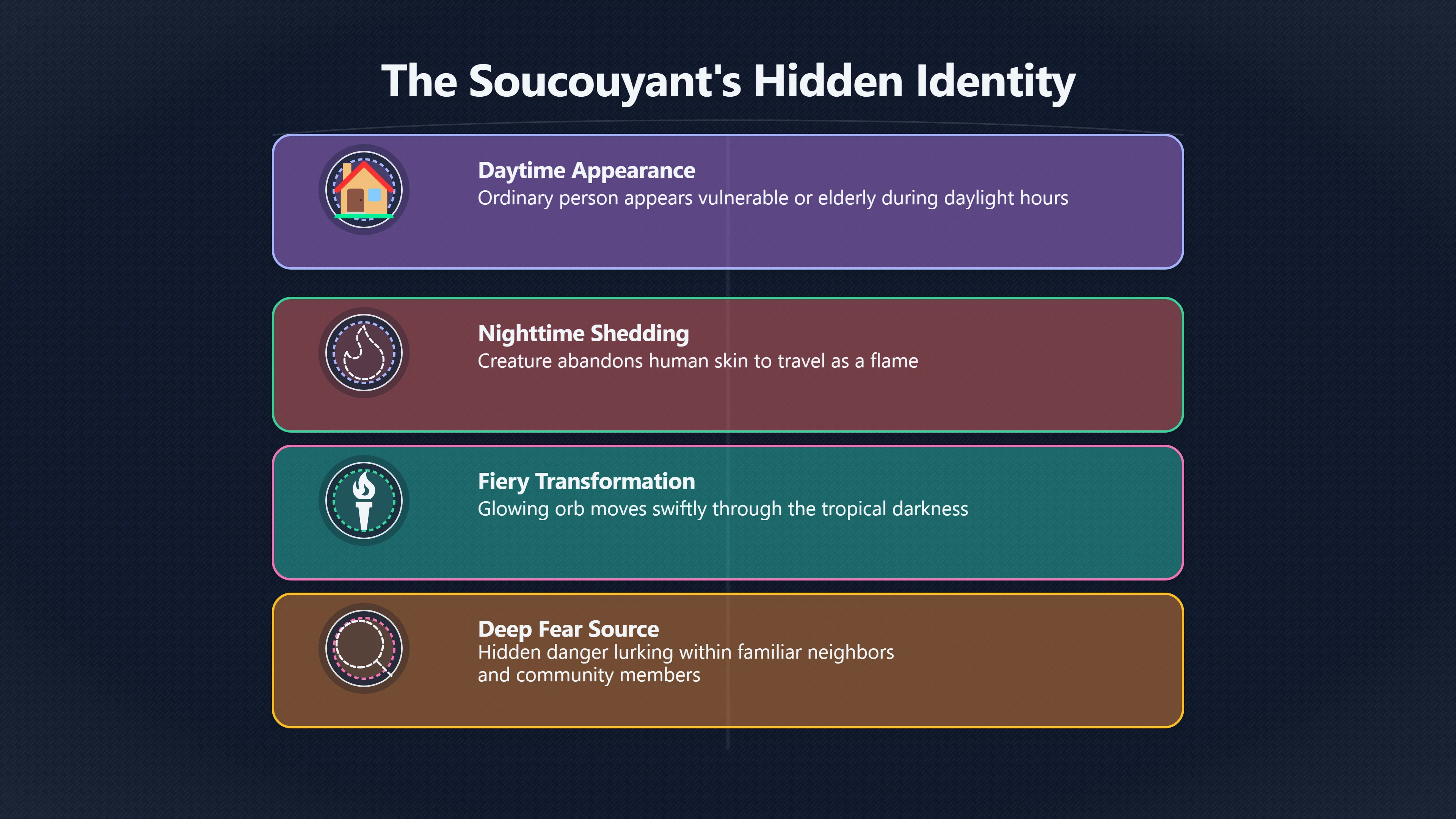
Saint Lucian accounts generally describe the soucouyant as an apparently ordinary person during daylight hours. By night, however, the creature abandons its human skin and undergoes a dramatic transformation. The discarded skin is often hidden while the being travels in another form. The most famous version is the fiery one: a glowing orb or streak of flame moving through the darkness.[Wikipedia]WikipediaOpen source on wikipedia.org.
This fireball form matters because it solves a practical storytelling problem. If the soucouyant is supposed to move quickly across villages, enter homes unnoticed and avoid recognition, a human shape would be limiting. A flying flame can appear and disappear suddenly, cross long distances and remain mysterious even when seen directly. In folklore terms, it is the perfect disguise.[Wikipedia]WikipediaOpen source on wikipedia.org.
Different Caribbean traditions sometimes describe additional forms, including birds or other nocturnal creatures, but the fireball remains the image most strongly associated with Saint Lucia and neighbouring islands. The glowing shape turns an otherwise hidden supernatural threat into something visible enough to be feared yet elusive enough to escape capture.[Wikipedia]WikipediaOpen source on wikipedia.org.
The fireball also creates a dramatic contrast between day and night. By day, the alleged soucouyant may appear vulnerable, elderly or entirely ordinary. By night, the same figure becomes swift, dangerous and difficult to identify. That contrast helps explain why the legend became linked to themes of secrecy and deception.[Wikipedia]WikipediaOpen source on wikipedia.org.
Why Fire Became the Creature’s Signature
Fire has a special place in folklore because it is both useful and threatening. A moving light in darkness naturally attracts attention, especially in rural communities where artificial lighting was historically limited. A glowing object seen briefly between trees or over a hillside can appear mysterious long before its true source becomes clear.
The soucouyant’s fiery transformation may also reflect older traditions brought into the Caribbean through the blending of African, European and Creole beliefs. Scholars and folklore researchers have noted parallels with other stories of night-flying witches, spirits and blood-drinking beings whose supernatural power is expressed through flight or luminous transformation. Over time, these influences merged into the distinctive Caribbean image of a skin-shedding fireball.[Wikipedia]WikipediaCaribbean folkloreCaribbean folklore
The result is a creature that feels uniquely suited to the region. Rather than prowling forests like a werewolf or lurking in castles like a European vampire, the soucouyant moves through tropical nights as a wandering flame, crossing gardens, roads and villages with alarming ease.[Wikipedia]WikipediaOpen source on wikipedia.org.
Possible Explanations for Night Fireball Sightings
The legend does not require real fireball sightings to survive, but unusual lights almost certainly helped keep the story alive. Throughout history, people have reported glowing objects in the night sky that later proved difficult to identify.
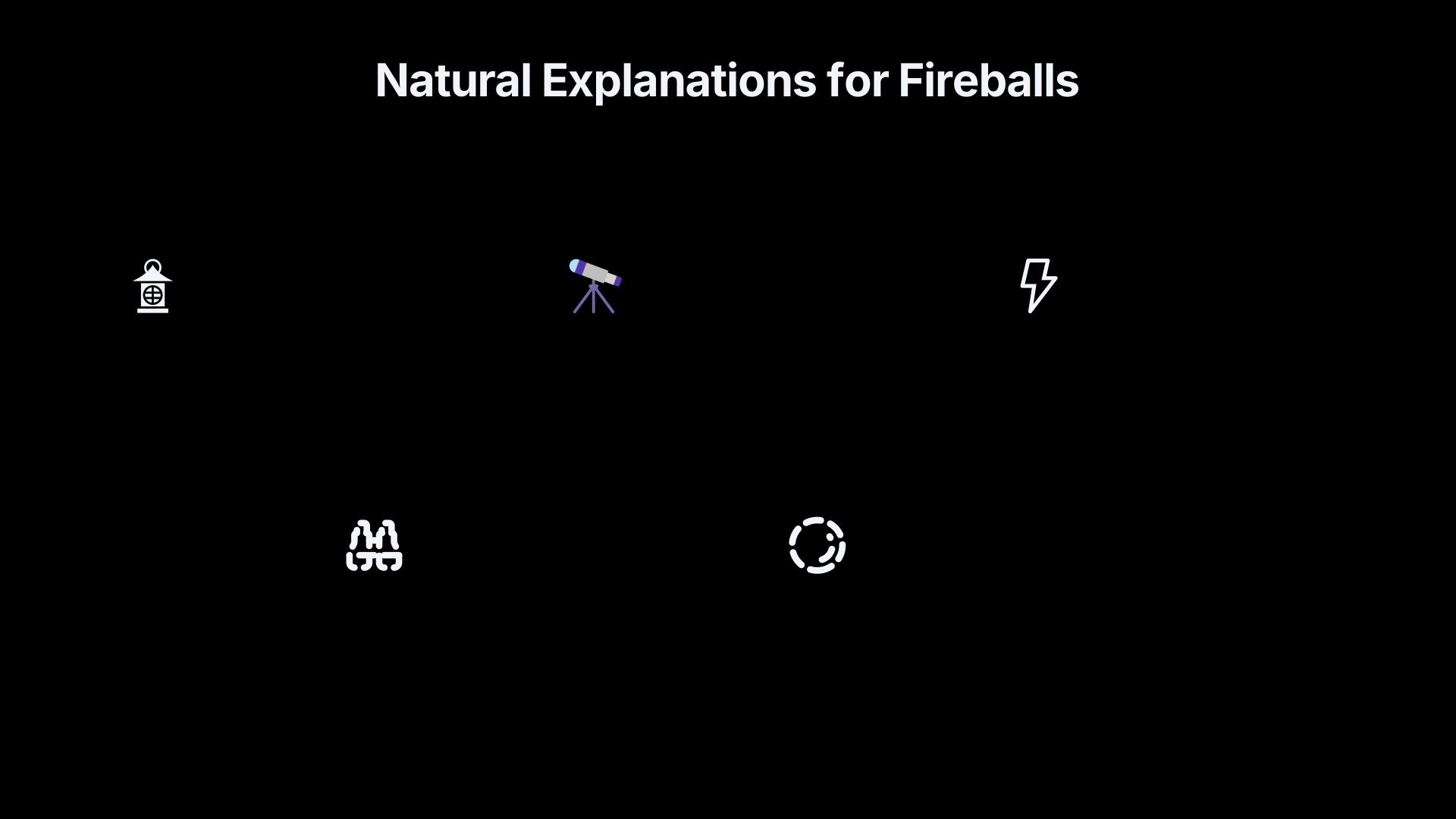
Several natural explanations are commonly suggested:
- Distant lanterns or torches. Before widespread electric lighting, a moving light could appear detached from its source, especially across uneven terrain.
- Meteors. Bright fireballs crossing the sky can be dramatic and unexpected, leaving a lasting impression on witnesses.
- Atmospheric effects. Rare luminous phenomena, including reports often grouped under the term ball lightning, have been recorded worldwide, although scientists still debate some aspects of how such events occur.[arXiv]arxiv.orgarXiv Analysis of Conditions favorable for Ball Lightning CreationAnalysis of Conditions favorable for Ball Lightning CreationJune 13, 2016…
- Misjudged distance and scale. A small light viewed in darkness can seem larger, closer or stranger than it really is.
None of these explanations directly created the soucouyant tradition, but they provide plausible sources for stories about mysterious nocturnal lights. Once a community already knows a tale about a flying fire creature, unusual lights are more likely to be interpreted through that existing cultural lens. A brief unexplained glow becomes not merely a light but a possible soucouyant.[Wikipedia]WikipediaOpen source on wikipedia.org.
The process works in reverse as well. People who grow up hearing soucouyant stories may pay closer attention to strange lights than those who do not. Folklore and observation reinforce one another, helping the legend persist even when sightings remain anecdotal.
Hidden Danger Beyond the Fireball
The flying flame is the most visible part of the legend, but the deeper fear concerns hidden danger. In traditional accounts, the real threat is not the glowing object itself. It is the idea that the creature has already blended into everyday life before revealing its true nature after dark.[Wikipedia]WikipediaOpen source on wikipedia.org.
Stories often connect the soucouyant with unexplained weakness, mysterious marks on the body or illnesses that seemed difficult to understand. In eras before modern medical knowledge, folklore provided a framework for discussing troubling events that appeared to have no obvious cause. The tale transformed uncertainty into a recognisable narrative: something had visited during the night.[Wikipedia]WikipediaOpen source on wikipedia.org.
The legend also encouraged caution. Warnings about staying indoors after dark, avoiding isolated places and being wary of suspicious behaviour gained extra force when attached to a supernatural figure. Whether listeners believed literally or not, the story carried practical social lessons about vulnerability and vigilance.
Why the Legend Still Matters in Saint Lucia
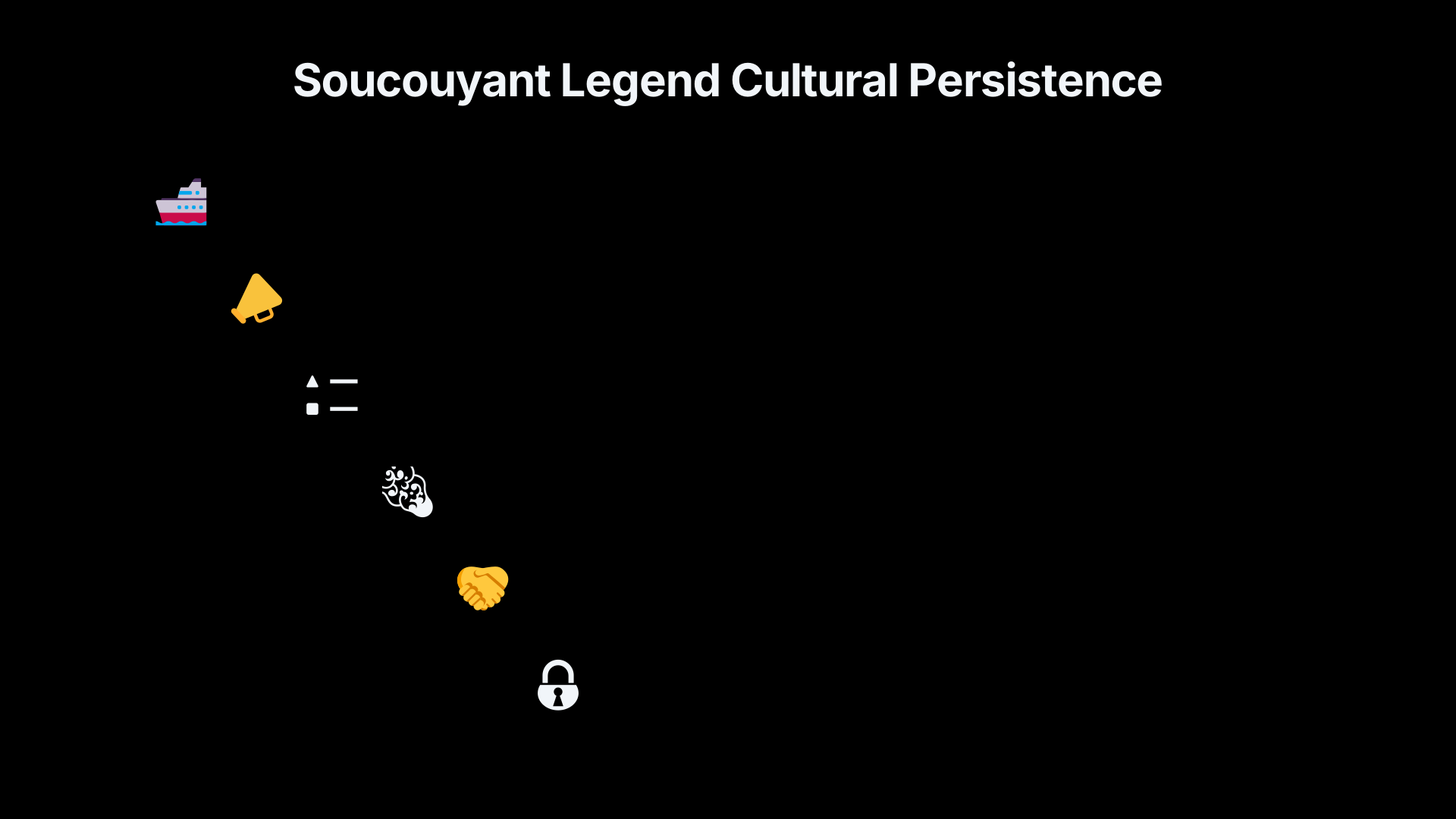
The soucouyant survives not because people regularly report fireball vampires, but because the image remains culturally powerful. Saint Lucian folklore festivals, theatre productions, storytelling events and contemporary writers continue to revisit the character as part of the island’s cultural heritage. The figure functions as both a frightening monster and a symbol of local identity.[JournoPortfolio]media.journoportfolio.comOpen source on journoportfolio.com.
Modern audiences often interpret the legend in different ways. Some view it as a supernatural warning tale. Others see it as a reflection of social anxieties about trust, ageing, secrecy or community relationships. Still others appreciate it primarily as a striking piece of Caribbean storytelling.
What has endured above all is the image itself: a hidden figure casting off an ordinary appearance and becoming a moving flame in the darkness. That transformation gives memorable form to fears that are far older than any single folktale—the fear that danger may not announce itself openly, but may arrive quietly, disguised, and only reveal its true nature after nightfall.[Wikipedia]WikipediaOpen source on wikipedia.org.
Amazon book picks
Further Reading
Books and field guides related to Why Does the Soucouyant Fly as Fire?. Use these as the next step if you want deeper reading beyond the article.
The Jumbies
Draws heavily on Caribbean supernatural beings including soucouyant traditions.
The Serpent and the Rainbow
Explores belief, fear and supernatural explanations in the region.
The Book of Imaginary Beings
Useful comparison point for shape-shifting legendary beings.
Caribbean Folklore
Provides historical and cultural background on Caribbean spirit lore.
Endnotes
1.
Source: Wikipedia
Link:https://en.wikipedia.org/wiki/Soucouyant
2.
Source: Wikipedia
Title: Caribbean folklore
Link:https://en.wikipedia.org/wiki/Caribbean_folklore
3.
Source: Wikipedia
Link:https://es.wikipedia.org/wiki/Soucouyant
4.
Source: media.journoportfolio.com
Link:https://media.journoportfolio.com/users/355480/uploads/1f99af0e-4a7f-44aa-a66e-29e777ebf843.pdf
5.
Source: Wikipedia
Link:https://fr.wikipedia.org/wiki/Soucougnan
6.
Source: Wikipedia
Link:https://en.wikipedia.org/wiki/Loogaroo
7.
Source: arxiv.org
Title: arXiv Analysis of Conditions favorable for Ball Lightning Creation
Link:https://arxiv.org/abs/1606.04421
Source snippet
Analysis of Conditions favorable for Ball Lightning CreationJune 13, 2016...
Published: June 13, 2016
8.
Source: arxiv.org
Title: arXiv A Conjecture Concerning Ball Lightning
Link:https://arxiv.org/abs/1609.04238
9.
Source: Wikipedia
Link:https://en.wikipedia.org/wiki/Will-o%27-the-wisp
10.
Source: youtube.com
Title: Caribbean Stories|Fact or FOLKlore |S1:E2| The Soucouyant
Link:https://www.youtube.com/watch?v=atnRQtK0lH8
Source snippet
Soucouyant - Folklore Spirits of Trinidad & Tobago...
11.
Source: youtube.com
Link:https://www.youtube.com/watch?v=8tgxPorbRos
12.
Source: the-demonic-paradise.fandom.com
Link:https://the-demonic-paradise.fandom.com/wiki/Soucouyant
13.
Source: folklore.usc.edu
Title: the soucouyant
Link:https://folklore.usc.edu/the-soucouyant/
Additional References
14.
Source: face2faceafrica.com
Link:https://face2faceafrica.com/article/soucouyant-the-legendary-caribbean-female-fireball-deity-rooted-in-african-wizardry
Source snippet
Face2Face AfricaSoucouyant, Caribbean female fireball deity rooted in...May 16, 2019 — Soucouyant is a female folklore character found i...
Published: May 16, 2019
15.
Source: raquelbahadoorsingh.wordpress.com
Title: Caribbean Folklore Soucouyant
Link:https://raquelbahadoorsingh.wordpress.com/soucouyant-2/
Source snippet
Caribbean FolkloreSoucouyant - Caribbean Folklore - WordPress.comThe Soucouyant possess the mystical power where she sheds her skin at ni...
16.
Source: caribbeanreads.com
Title: In this form, she can fly
Link:https://www.caribbeanreads.com/soucouyant/
Source snippet
Soucouyant - Caribbean folklore from CaribbeanReadsThe soucouyant, also known as the lagaroo is a woman by day, but in the...
17.
Source: youtube.com
Title: The Soucouyant: Caribbean’s Shape-Shifting Witch
Link:https://www.youtube.com/watch?v=wDiprvlFymo
Source snippet
The Soucouyant: Caribbean Vampire Who Sheds Her Skin...
18.
Source: folkloricfutures.com
Link:https://www.folkloricfutures.com/items/browse?sort_dir=d&sort_field=Dublin+Core%2CTitle
19.
Source: instagram.com
Link:https://www.instagram.com/p/DQOiR9ziHTJ/?hl=en
20.
Source: facebook.com
Link:https://www.facebook.com/groups/191766699268/posts/10158585025189269/
21.
Source: humanitieskansas.org
Link:https://www.humanitieskansas.org/doccenter/9aabc89965e14424a4fcefe11b99372e
22.
Source: facebook.com
Link:https://www.facebook.com/unrulynationn/videos/-the-soucouyant-caribbean-folklores-fire-woman/1191957255943479/
23.
Source: pinterest.com
Link:https://www.pinterest.com/pin/soucouyant-caribbean-myth-her-form-by-day-is-one-of-an-old-woman-but-by-night-she-strips-off-her-skin-to-reveal-a-fireball-tha–41306521565252078/
Topic Tree