Within Belize Monsters
Is Sisimito Belize's Own Bigfoot?
The Sisimito is Belize's hairy wild-man tradition, with cave, riverbank and bush-camp stories that invite both wonder and scepticism.
On this page
- Hairy man descriptions and backward feet
- Caves, rivers, dogs and old bush warnings
- Misidentified wildlife and wild man folklore
Page outline Jump by section
Introduction
The Sisimito is the closest thing Belize has to a Bigfoot legend: a powerful, hairy wild man said to roam remote forests, caves and rocky hills far from villages. Unlike the North American Sasquatch, however, the Belizean Sisimito belongs to a much older web of Central American folklore. Stories describe an ape-like being covered in hair, extraordinarily strong, difficult to track because of its backward-facing feet, and most often encountered deep in the bush. Tales told by mahogany cutters, hunters and villagers place it in caves, along river corridors and in heavily forested areas, especially in the country’s more remote districts.[Wikipedia]WikipediaOpen source on wikipedia.org.
For readers interested in cryptids, the Sisimito is fascinating because it sits on the border between monster report and traditional folklore. There are witness stories and claimed encounters, but there is no physical evidence that an unknown ape-like animal exists in Belize. The legend survives largely through oral tradition, local storytelling and its role as a warning about the dangers of the forest.[Wikipedia]WikipediaOpen source on wikipedia.org.
Is Sisimito Belize’s Own Bigfoot?
On the surface, the comparison is obvious. The Sisimito is commonly described as a large, upright, hairy creature with human-like features and immense strength. Some accounts portray it as gorilla-like, while others emphasise its human appearance beneath the fur. In modern retellings it is often labelled a Central American or “Belizean Bigfoot”, a shorthand that helps outsiders understand the creature’s place in local folklore.[Wikipedia]WikipediaOpen source on wikipedia.org.
Yet the similarities only go so far. North American Bigfoot traditions usually focus on mysterious sightings of a potentially undiscovered animal. Sisimito stories often contain overtly supernatural elements. The creature may disguise itself, follow people through the forest, punish hunters, or display abilities that place it firmly in the realm of folklore rather than zoology.[Wikipedia]WikipediaOpen source on wikipedia.org.
Belizean versions also overlap with wider Central American traditions found in Honduras, Guatemala and neighbouring regions. This suggests that the legend is part of a broader cultural story rather than a creature reported only within Belize’s borders.[Wikipedia]WikipediaOpen source on wikipedia.org.
Hairy-Man Descriptions and the Mystery of the Backward Feet
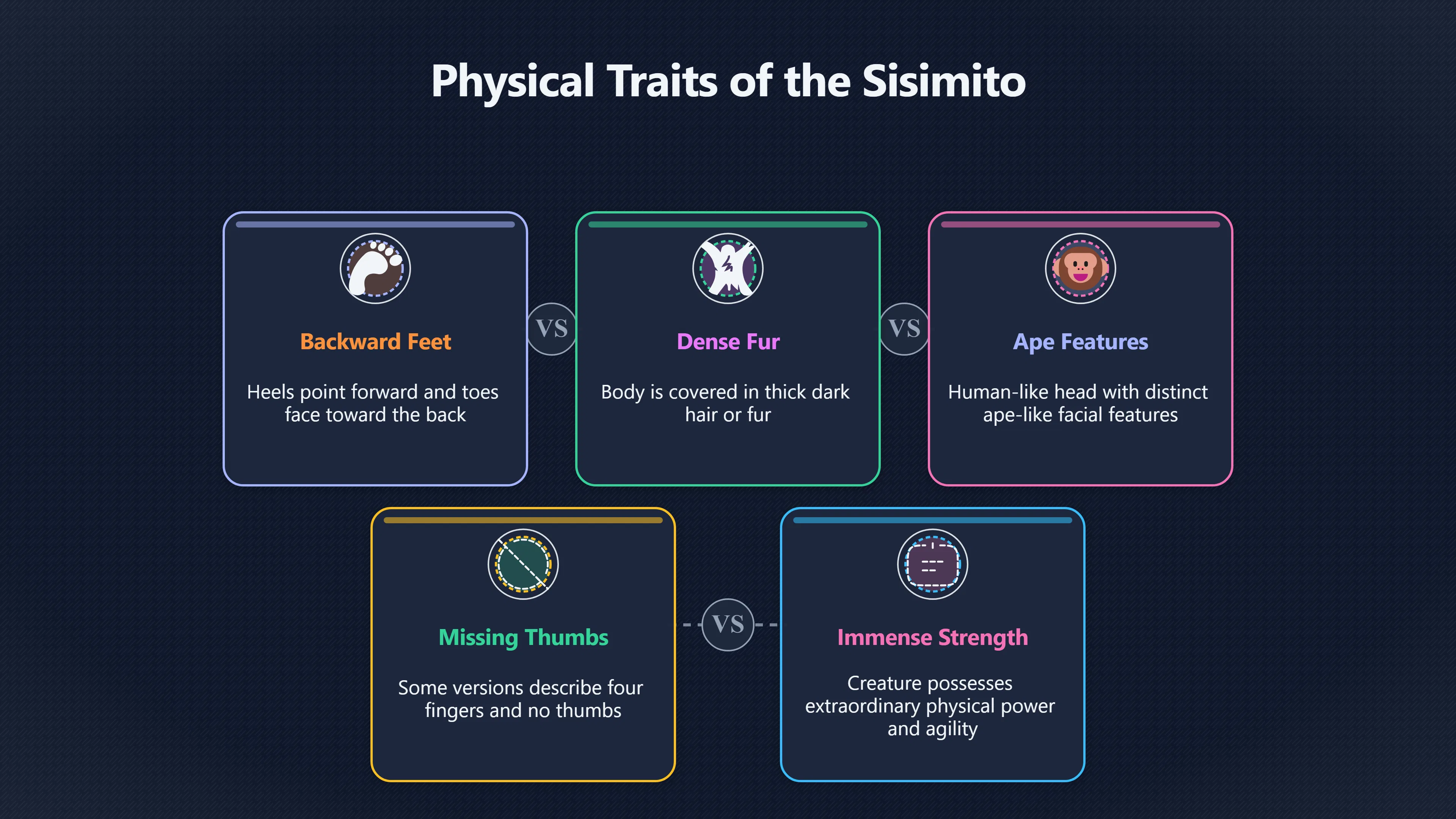
The most distinctive feature of the Sisimito is its feet. According to the traditional description, the creature’s feet point backwards. A track that appears to lead away may actually indicate that the creature is approaching. This detail appears again and again in Belizean accounts and is one of the strongest identifiers of the legend.[ambergriscaye.com]ambergriscaye.comIn other words, his heels were at the front and the toes at the back. Therefore whenever you saw his footprints…Read more…
Other recurring characteristics include:
- A body covered in dark hair or fur.
- Great physical strength.
- Four fingers and missing thumbs in some versions.
- A human-like head with ape-like features.[mybeautifulbelize.com]mybeautifulbelize.comMy Beautiful Belize Lizard TalesMy Beautiful BelizeLizard Tales - The Sisimite/SisimitoFeb 8, 2013 — What they saw looked like a man covered with hair from head to foot…
- Awkward movement caused by unusual legs or a lack of visible knees.
- Large footprints in mud or soft ground.[wikipedia.org]WikipediaOpen source on wikipedia.org.
The backward-foot motif is especially important because it appears in many tropical forest traditions throughout the Americas. In folklore, reversed feet symbolise a being that belongs to the wild rather than the human world. They also create a ready-made explanation for mysterious tracks whose direction seems confusing. Rather than functioning as biological evidence, the feature works as a storytelling device that reinforces the creature’s uncanny nature.[Wikipedia]WikipediaOpen source on wikipedia.org.
Why Caves, Rivers and Bush Camps Appear So Often
Older Belizean stories frequently place the Sisimito in caves and rugged forest country. Tales collected from Belize describe the creature living among rocky hills, remote caverns and heavily wooded areas far from settled communities. Mahogany camps and logging operations were particularly important settings because workers spent long periods in isolated forests where strange sounds, fleeting glimpses and unexplained tracks naturally attracted attention.[Wikipedia]WikipediaOpen source on wikipedia.org.
Some traditions place the creature in villages such as Ranchito and Hill Bank, while other stories connect it with forested areas of Toledo and regions near the Guatemalan border. These locations share a common feature: they were historically places where dense bush met human activity.[Wikipedia]WikipediaOpen source on wikipedia.org.
Rivers play an equally important role. A widespread belief holds that the Sisimito fears large bodies of water and avoids crossing them. Dogs are said to have a similar effect. As a result, many stories include dramatic escapes in which travellers reach a riverbank or are protected by their hunting dogs.[Wikipedia]WikipediaOpen source on wikipedia.org.
These details reveal something about the social function of the legend. Bush workers, hunters and children were being reminded that the forest could be dangerous. Knowing where to camp, travelling with companions and keeping dogs nearby were all practical habits wrapped inside a memorable supernatural story.
Encounters, Warnings and Campfire Stories
Unlike some cryptid traditions that revolve around a handful of famous sightings, Sisimito lore survives through families of stories rather than a single celebrated encounter. Many accounts follow familiar patterns.
A hunter hears movement in the darkness. A traveller notices strange tracks. Someone encounters a hairy figure near a cave entrance. The creature then demonstrates enormous strength or terrifying aggression before disappearing back into the forest.[My Beautiful Belize]mybeautifulbelize.comMy Beautiful Belize Lizard TalesMy Beautiful BelizeLizard Tales - The Sisimite/SisimitoFeb 8, 2013 — What they saw looked like a man covered with hair from head to foot…
In some Belizean versions, the Sisimito attacks people who wander into the bush on religious holidays or who kill animals unnecessarily. Other stories portray it as a dangerous man-eater. These variations matter because they reveal that the legend functions partly as a moral warning. The creature punishes behaviour considered reckless, disrespectful or harmful to the forest.[Wikipedia]WikipediaOpen source on wikipedia.org.
One recurring theme is that the Sisimito follows footprints. Folklore even offers tricks for escaping it, including confusing its tracking ability or exploiting its backward feet. Such details are less like eyewitness testimony and more like traditional folklore rules, passed from storyteller to storyteller over generations.[Wikipedia]WikipediaOpen source on wikipedia.org.
Could Real Animals Be Behind the Legend?
No verified evidence supports the existence of an unknown ape-like species in Belize. There are no confirmed bones, bodies, hair samples or photographs that have convinced zoologists. The lack of physical evidence is especially significant because Belize’s mammals are relatively well documented.[Wikipedia]WikipediaOpen source on wikipedia.org.
Several factors may have helped create and sustain the legend:
Misidentified wildlife. Belize’s forests contain spider monkeys, howler monkeys, tapirs, peccaries and other animals that can produce startling sounds or leave unusual impressions in soft ground. Poor visibility and brief encounters can encourage misinterpretation.
Forest acoustics. Dense jungle often amplifies, distorts and carries sounds in unexpected ways. A noise heard at night may seem much closer, larger or stranger than it really is.
Camp storytelling. Logging camps and hunting expeditions created ideal conditions for folklore. Long nights, isolation and shared experiences helped stories spread and evolve.
Older wild-man traditions. The Sisimito resembles a broad family of “wild man” figures found across Central America. Rather than emerging from a specific sighting, it may represent a long-standing cultural archetype adapted to Belizean landscapes.[wikipedia.org]WikipediaOpen source on wikipedia.org.

Why reports of Sisimito persisted
The Sisimito survives because it is more than a monster. It embodies the idea that the forest is powerful, unpredictable and deserving of respect. In a country where caves, rivers and dense jungle remain central to cultural identity, the creature still serves as a memorable symbol of the unknown spaces beyond the village edge.[Wikipedia]WikipediaOpen source on wikipedia.org.
For cryptid enthusiasts, the Sisimito offers many of the ingredients that make Bigfoot stories compelling: footprints, remote habitats, eyewitness traditions and the possibility of something unseen in the wilderness. For folklorists, however, the backward feet, cave dwelling, fear of dogs and moral lessons point toward a traditional wild-man figure rather than an undiscovered species.[Wikipedia]WikipediaOpen source on wikipedia.org.
That tension between mystery animal and cautionary folklore is precisely what has kept Belize’s hairy wild man alive in local memory long after the supposed sightings themselves faded into legend.[Wikipedia]WikipediaOpen source on wikipedia.org.
Amazon book picks
Further Reading
Books and field guides related to Is Sisimito Belize's Own Bigfoot?. Use these as the next step if you want deeper reading beyond the article.
Sasquatch: Legend Meets Science
Examines evidence and folklore surrounding hairy wild-man reports.
Field Guide To Bigfoot, Yeti, & Other Mystery Primates Worldwide
Places the Sisimito within a worldwide tradition of mystery primates.
eBay marketplace picks
Marketplace Samples
Live-tested eBay searches with available results related to this page.


Endnotes
1.
Source: Wikipedia
Link:https://en.wikipedia.org/wiki/Sisimito
2.
Source: ambergriscaye.com
Link:https://ambergriscaye.com/25years/elsisimito.html
Source snippet
In other words, his heels were at the front and the toes at the back. Therefore whenever you saw his footprints...Read more...
3.
Source: Wikipedia
Link:https://es.wikipedia.org/wiki/Sisimite
4.
Source: ambergriscaye.com
Link:https://ambergriscaye.com/forum/ubbthreads.php/posts/462748/belizean-folklore-the-legends-of-belize.html
Source snippet
Belizean Folklore: The Legends of BelizeThe Scary Sisimito Legend has it that the hairy male Sisimitos and female Sisimitas lived deep in...
5.
Source: mybeautifulbelize.com
Title: My Beautiful Belize Lizard Tales
Link:https://mybeautifulbelize.com/lizard-tales-the-sisimitesisimito/
Source snippet
My Beautiful BelizeLizard Tales - The Sisimite/SisimitoFeb 8, 2013 — What they saw looked like a man covered with hair from head to foot...
6.
Source: thequestebooks.com
Title: The Quest e Books Sisimito: The Big Foot of Belize
Link:https://www.thequestebooks.com/post/the-sisimito
Source snippet
He often follows the footprints left by humans to catch them, kill them, and then rip off their...Read more...
7.
Source: facebook.com
Link:https://www.facebook.com/unrulynationn/posts/sisimito-the-backward-footed-beast-of-belize/122118916436417000/
Source snippet
The Backward-Footed Beast of BelizeThe Sisimito - Lenca Folklore (also known as the Sisimite) is a legendary bipedal, ape-like creature o...
8.
Source: geography.wisc.edu
Link:https://geography.wisc.edu/cartography/projects/G572/2013FA/Fall2013LimbachAngela/finalcode/cpages/belize.html
Source snippet
has it that the hairy male Sisimitos and female Sisimitas lived deep in the caves of Belize. Their short, hirsute figures made them appea...
Additional References
9.
Source: facebook.com
Link:https://www.facebook.com/CorozalDaily/posts/the-legendary-sisimitebelize-yucatec-maya-sisimite-native-to-the-world-of-the-ma/2911652189051137/
Source snippet
***THE LEGENDARY SISIMITE*** Belize Yucatec MayaThe Sisimite has been described as a hairy ape-like creature, much larger than a human, w...
10.
Source: reddit.com
Link:https://www.reddit.com/r/bigfoot/comments/mpke8g/i_am_from_belize_here_in_our_country_theres_folk/
Source snippet
sisemite female and sisimito male..i have heard somthing along the line of they are dirty spirits that...
11.
Source: facebook.com
Title: Have you heard the Belizean folk tale about Sisemite?
Link:https://www.facebook.com/SwordExperience/photos/have-you-heard-the-belizean-folk-tale-about-sisemitethe-sisemite-or-sisimito-is-/2323489571231807/
Source snippet
24 Feb 2019 — Usually depicted as a male, Sisemite lived in caves and survived by eating raw game meat. What he was commonly known for wa...
12.
Source: mayabelize.wordpress.com
Title: the other people in the rainforest
Link:https://mayabelize.wordpress.com/2013/07/03/the-other-people-in-the-rainforest/
Source snippet
“Other” People in the RainforestJul 3, 2013 — This “duende” looks as though his father might be a sisimito. Why else would his feet point...
13.
Source: belize-travel-blog.chaacreek.com
Link:https://belize-travel-blog.chaacreek.com/2013/04/belizean-folklore-the-legends-of-belize/
Source snippet
Belize Travel BlogBelizean Folklore: The Legends of BelizeMay 14, 2016 — Legend has it that the hairy male Sisimitos and female Sisimitas...
Published: May 14, 2016
14.
Source: explorebelizeplaces.com
Link:https://explorebelizeplaces.com/?p=427
Source snippet
The Sisimito in Belize: Jungle Monster of Myth and MysteryJun 6, 2025 — Described as a hairy, bipedal monster with human-like features, t...
15.
Source: instagram.com
Title: word tzitzimitl
Link:https://www.instagram.com/p/DHPxRsgMU6R/?hl=en
Source snippet
While known to the Maya for centuries...The Sisimite has been described as a hairy ape-like creature, much larger than a human, with th...
16.
Source: larubeya.com
Title: Get to know Belize’s Folklore
Link:https://www.larubeya.com/the-legends-belize-folklore-myths-broken/
Source snippet
These short, fur-covered beings bear a closer resemblance to...Read more...
17.
Source: youtube.com
Title: Sisimito (Maya bigfoot) by Andy Chuc
Link:http://www.youtube.com/watch?v=v1UyReZXEm8
Source snippet
Lenda Urbana: Belize - Lenda do Sisimito (ou Sisimite)...
18.
Source: youtube.com
Link:http://www.youtube.com/watch?v=rgu-euzL_n0
Source snippet
"Sisimito" Belize legend "Legends of Belize" features Belizean Mythical Creatures Greater Belize Media | GBM...
Topic Tree