Within Santomean Mysteries
How a Limbless Amphibian Becomes a Monster
The yellow cobra bobo shows how a brief encounter, an unfamiliar body shape and a misleading name can create a mystery-animal tale.
On this page
- What the cobra bobo really is
- Why rain and disturbed soil trigger sightings
- How names and memory reshape encounters
Page outline Jump by section
Introduction
The cobra bobo is one of the best examples in São Tomé and Príncipe of how an ordinary animal can acquire the aura of a mystery creature. Unlike stories about unknown monsters, the cobra bobo is a real species: a bright yellow, limbless amphibian known scientifically as Schistometopum thomense, found only on São Tomé and nearby Ilhéu das Rolas. Yet its appearance, behaviour and name make it easy to understand why people unfamiliar with the island’s wildlife might remember an encounter as something far stranger.[Wikipedia]WikipediaSchistometopum thomenseSchistometopum thomense

The importance of the cobra bobo is not that it represents an undiscovered beast. Rather, it shows the mechanism by which monster reports are created. A brief glimpse of a snake-like animal emerging from wet soil, combined with uncertainty, surprise and retelling, can transform a routine wildlife sighting into a story about an unusual or mysterious creature. In a country where large-animal cryptid traditions are scarce, the cobra bobo offers a useful case study in how legends can grow from genuine encounters.[Wikipedia]WikipediaSchistometopum thomenseSchistometopum thomense
What the cobra bobo really is
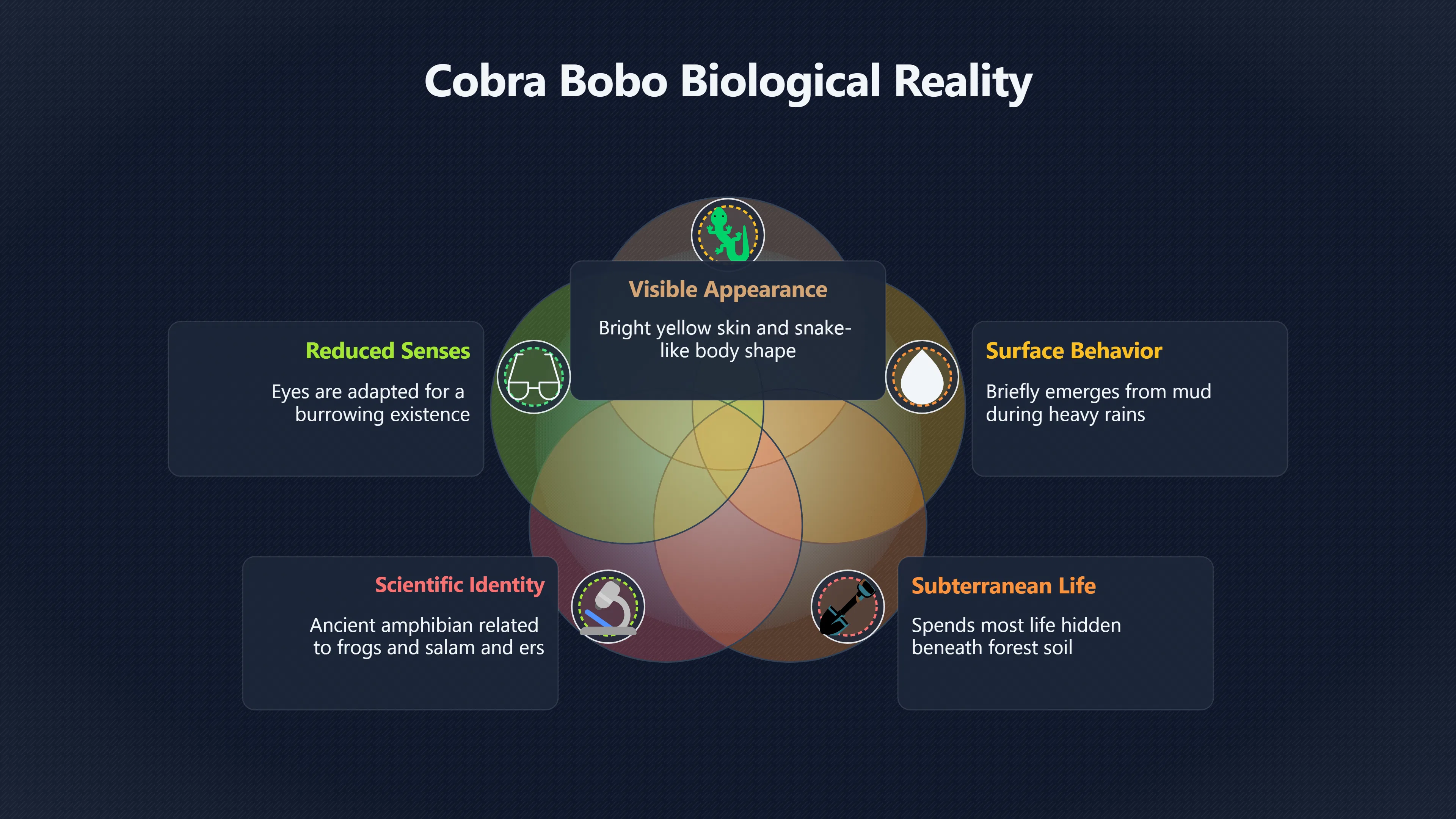
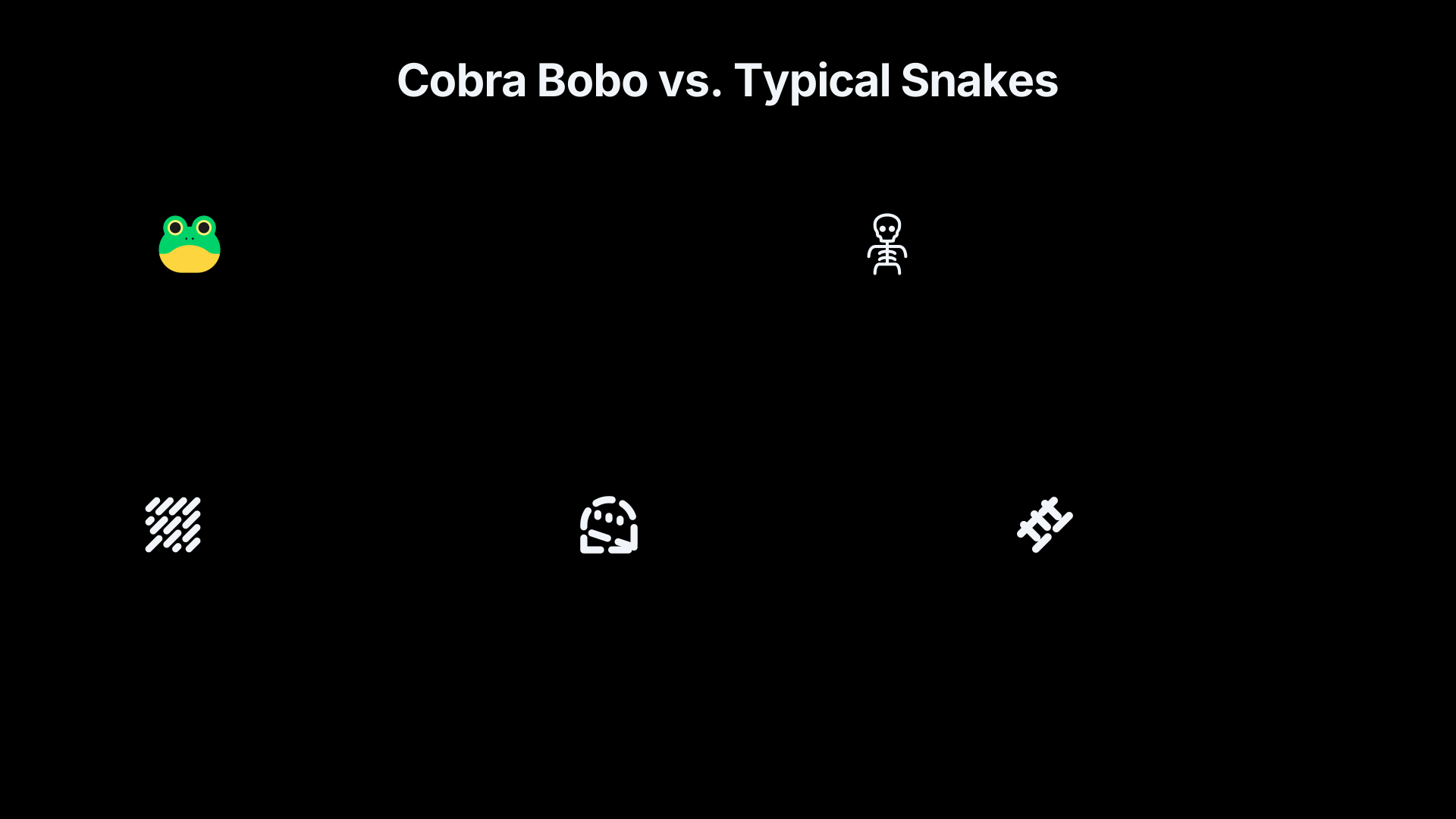
The cobra bobo is a caecilian, a member of an ancient group of amphibians that resemble worms or snakes but are actually more closely related to frogs and salamanders. Caecilians are limbless, spend much of their lives underground and have reduced eyes adapted to a burrowing existence. Because most people rarely see them, even in places where they occur naturally, they often appear unfamiliar and unsettling.[Wikipedia]WikipediaOpen source on wikipedia.org.
On São Tomé, the species is notable for its striking yellow colour. Individuals are typically around 30 centimetres long, although size varies across the island. The animal lives beneath the soil in forests, plantations and other moist habitats, remaining hidden for much of its life.[Wikipedia]WikipediaSchistometopum thomenseSchistometopum thomense
Several features encourage mistaken identification:
- It has no visible limbs.
- Its body shape closely resembles a small snake.
- Its skin is smooth and shiny.
- It often appears suddenly from the ground rather than from vegetation or open water.
- Many observers encounter it only briefly.[Tetrapod Zoology]tetzoo.comthe amazing caeciliansTetrapod ZoologyThe Amazing Caecilians25 Oct 2022 — All extant caecilians are long-bodied, limbless, superficially worm-like amphibians w…
For someone expecting a snake, a worm or a lizard, the cobra bobo does not fit neatly into any familiar category. That uncertainty is often where monster stories begin.
Why rain and disturbed soil trigger sightings
The cobra bobo spends most of its life hidden underground. As a result, people usually encounter it only when environmental conditions force it closer to the surface. Heavy rain, saturated soil, digging, farming activity and disturbed ground can all increase the likelihood of sightings.[Wikipedia]WikipediaSchistometopum thomenseSchistometopum thomense
This pattern is important because surprise plays a major role in the creation of unusual-animal reports. A person walking through a plantation after rain may suddenly notice a bright yellow, snake-like creature emerging from mud. The encounter is unexpected, brief and often emotionally memorable.
Modern research on caecilians also suggests that these animals can show surface activity under particular environmental conditions despite being primarily subterranean. Their hidden lifestyle means that many observations occur during unusual circumstances rather than during normal daily activity.[PMC]pmc.ncbi.nlm.nih.govPMCCircadian rhythm and surface activity in soil-dwellingby A Prakash · 2024 · Cited by 4 — The findings of this study suggest that caecilians have a weak circadian surface-activity rhythm, a…
When sightings happen under poor visibility, in heavy rain or in dense vegetation, several distortions can occur:
- Length is often overestimated.
- Colour may appear more vivid than it really is.
- Movement may seem unusual because observers are unfamiliar with caecilian locomotion.
- Witnesses may remember the encounter as lasting longer than it actually did.
These are common features of mystery-animal reports worldwide. The cobra bobo simply provides a local São Toméan example.
How names and memory reshape encounters
The name “cobra bobo” is arguably as important as the animal itself. To an outsider, the word “cobra” immediately suggests a snake, even though the creature is an amphibian. The label encourages people to interpret what they have seen through the mental framework of snake stories rather than amphibian biology.[Wikipedia]WikipediaSchistometopum thomenseSchistometopum thomense
Names often act as shortcuts in memory. Once an unusual encounter is described as involving a “cobra”, later retellings may emphasise snake-like features while overlooking details that point to its true identity. Over time, the remembered creature can become larger, stranger or more threatening than the original animal.
This process is not unique to São Tomé. Around the world, unfamiliar wildlife has repeatedly been transformed into local monsters through a combination of naming, storytelling and incomplete observation. The cobra bobo demonstrates the same pattern on a small island scale:
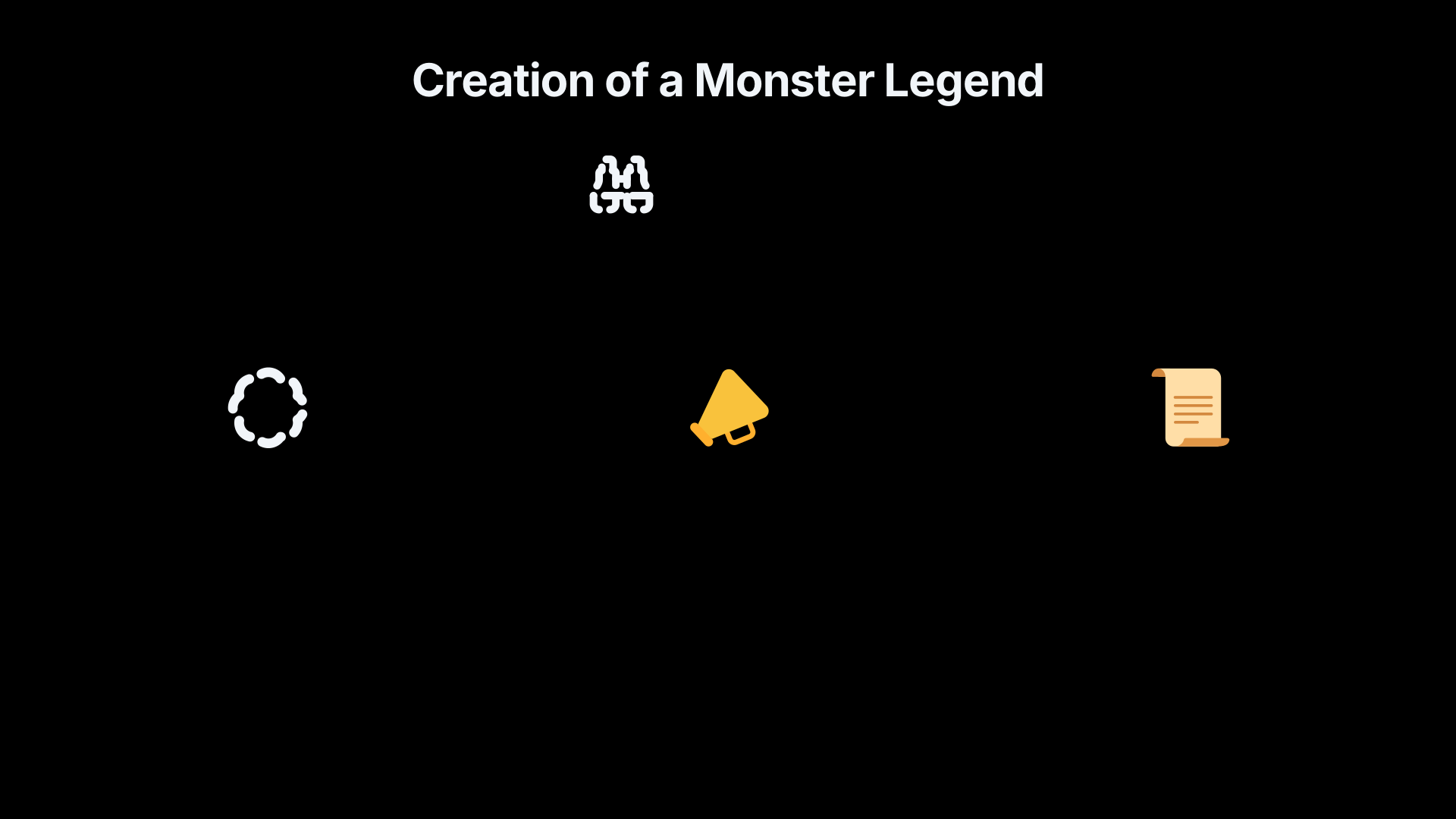
- An observer encounters an unfamiliar animal.
- The sighting is brief and surprising.
- The observer interprets it using familiar categories.
- The story is retold.
- Certain details become exaggerated while others disappear.
The resulting account may sound far more mysterious than the original event.
Why the cobra bobo matters in the history of monster reports
The cobra bobo occupies an interesting position between ordinary zoology and folklore. It is not a cryptid in the strict sense because scientists know exactly what it is. Yet it helps explain how cryptid traditions develop in the first place.
Many famous mystery creatures begin with three ingredients:
- An unusual but real animal.
- Limited opportunities for observation.
- Human storytelling.
The cobra bobo contains all three. Its bright colour, underground lifestyle and snake-like shape make it memorable, while its rarity in everyday experience ensures that many people lack a clear frame of reference when they see one.[wikipedia.org]WikipediaSchistometopum thomenseSchistometopum thomense
In the context of São Tomé and Príncipe, the cobra bobo therefore serves less as a monster and more as a lesson. It illustrates how unfamiliar wildlife can generate mystery, how names influence interpretation, and how ordinary encounters can evolve into tales of strange creatures. The real story is not an undiscovered beast hiding in the forest. It is the remarkably human process by which a limbless amphibian becomes a monster in memory.
Amazon book picks
Further Reading
Books and field guides related to How a Limbless Amphibian Becomes a Monster. Use these as the next step if you want deeper reading beyond the article.
The Book of Barely Imagined Beings
Perfect fit for a strange amphibian often mistaken for something monstrous.
eBay marketplace picks
Marketplace Samples
Live-tested eBay searches with available results related to this page.
![Listing image for The Cute Monsters Doll Character Action Figure Collectible Toys [Random Colour]](/assets/images/marketplace-covers/29f5d3d446a0ddba82a6.jpg)
Endnotes
1.
Source: Wikipedia
Title: Schistometopum thomense
Link:https://en.wikipedia.org/wiki/Schistometopum_thomense
2.
Source: Wikipedia
Title: Wildlife of São Tomé and Príncipe
Link:https://en.wikipedia.org/wiki/Wildlife_of_S%C3%A3o_Tom%C3%A9_and_Pr%C3%ADncipe
3.
Source: Wikipedia
Link:https://en.wikipedia.org/wiki/Caecilian
4.
Source: pmc.ncbi.nlm.nih.gov
Title: PMCCircadian rhythm and surface activity in soil-dwelling
Link:https://pmc.ncbi.nlm.nih.gov/articles/PMC11061191/
Source snippet
by A Prakash · 2024 · Cited by 4 — The findings of this study suggest that caecilians have a weak circadian surface-activity rhythm, a...
5.
Source: pmc.ncbi.nlm.nih.gov
Link:https://pmc.ncbi.nlm.nih.gov/articles/PMC4149351/
6.
Source: tetzoo.com
Title: the amazing caecilians
Link:https://tetzoo.com/blog/2022/10/25/the-amazing-caecilians
Source snippet
Tetrapod ZoologyThe Amazing Caecilians25 Oct 2022 — All extant caecilians are long-bodied, limbless, superficially worm-like amphibians w...
7.
Source: calacademy.org
Link:https://www.calacademy.org/press/releases/study-indicates-s%C3%A3o-tom%C3%A9-island-has-two-species-of-caecilians-found-nowhere-else-on
8.
Source: kids.kiddle.co
Title: Schistometopum thomense
Link:https://kids.kiddle.co/Schistometopum_thomense
9.
Source: pubmed.ncbi.nlm.nih.gov
Link:https://pubmed.ncbi.nlm.nih.gov/25171066/
Additional References
10.
Source: researchgate.net
Link:https://www.researchgate.net/publication/380212524_Circadian_rhythm_and_surface_activity_in_soil-dwelling_caecilians_Amphibia_Gymnophiona
Source snippet
ResearchGate(PDF) Circadian rhythm and surface activity in soil-dwelling...23 Apr 2024 — The findings of this study suggest that caecili...
11.
Source: sci.news
Link:https://www.sci.news/biology/sao-tome-caecilian-two-species-09645.html
Source snippet
Breaking Science NewsSao Tome Caecilian is Actually Two Different Species...11 May 2021 — The São Tomé caecilian is an elongate, limbles...
Published: May 2021
12.
Source: a-z-animals.com
Title: A-Z Animals Caecilian Animal Facts
Link:https://a-z-animals.com/animals/caecilian/
Source snippet
A-Z AnimalsCaecilian Animal Facts - GymnophionaCaecilians (Gymnophiona) are hidden, worm- or snake-like amphibians often called “blind” o...
13.
Source: zootracker.app
Title: Zoo Tracker São Thomé caecilian
Link:https://zootracker.app/en/animals/sao-thome-caecilian
Source snippet
São Thomé caecilian - ZooTrackerLocally known as cobra bobo (silly snake), this species is often mistaken for a snake by island...
14.
Source: youtube.com
Title: Have You Ever Seen a Legless Amphibian? (Kaup’s Caecilian)
Link:https://www.youtube.com/watch?v=xRxKYq4uqqM
Source snippet
Caecilian amphibian evolution biology Caecilian facts: they're amphibians! | Animal Fact Files Animal Fact Files...
15.
Source: youtube.com
Title: S. Thomense: The Coolest Slimy Worm Thingy You’ve Never Seen
Link:https://www.youtube.com/watch?v=M2M3kXVlvyg
Source snippet
There's something off about this banana... (São Tomé Caecillian)...
16.
Source: youtube.com
Link:https://www.youtube.com/watch?v=tm5KSneojjk
Source snippet
Caecilian facts: they're amphibians! | Animal Fact Files...
17.
Source: youtube.com
Title: Schistometopum thomense (São Tomé Caecilian, cobra bobo)
Link:https://www.youtube.com/watch?v=nENlpTtrZ_8
Source snippet
S. Thomense: The Coolest Slimy Worm Thingy You've Never Seen...
18.
Source: youtube.com
Title: Caecilian facts: they’re amphibians! | Animal Fact Files
Link:https://www.youtube.com/watch?v=qpRF51u5PhY
Source snippet
Have You Ever Seen a Legless Amphibian? (Kaup's Caecilian)...
19.
Source: researchgate.net
Link:https://www.researchgate.net/publication/265167199_Population_Genetics_of_the_Sao_Tome_Caecilian_Gymnophiona_Dermophiidae_Schistometopum_thomense_Reveals_Strong_Geographic_Structuring
Topic Tree