Within Burundi Beasts
Did Lake Tanganyika Have a Monster?
The lake monster tradition centres on a few vivid reports, especially a 1914 Burundi-shore sighting with little hard evidence.
On this page
- The 1914 Thierfelder sighting
- Older regional sea serpent claims
- Why the evidence remains weak
Page outline Jump by section
Introduction
Did Lake Tanganyika have a monster? The short answer is that a handful of witnesses claimed to see something extraordinary in the lake, particularly along the Burundian shore, but no convincing physical evidence has ever been produced. Unlike famous lake-monster traditions that generated decades of repeated sightings, photographs and organised searches, the Lake Tanganyika story rests on a small collection of scattered reports that are difficult to verify and often reached the public years after the alleged events. What keeps the legend alive is not the quantity of evidence but the vividness of a few accounts, especially a remarkable 1914 sighting near the Burundi shoreline.[Cryptid Archives]cryptidarchives.fandom.comLake Tanganyika monsterCryptid ArchivesLake Tanganyika monster | Encyclopaedia of CryptozoologyThe lake monster was first mentioned in 1893, when Joseph Augustu…

For readers interested in Burundi’s mystery-animal traditions, the Lake Tanganyika monster occupies an unusual position. It is the country’s closest equivalent to a classic lake monster, yet it remains more a story about uncertain observations and folklore than about a well-defined unknown creature.
The 1914 Thierfelder Sighting
The most famous Lake Tanganyika monster report linked directly to Burundi is usually attributed to German physician M. V. Thierfelder. According to later retellings, Thierfelder was working in the region during a sleeping-sickness epidemic when he and a companion observed a strange animal emerging from the waters of a bay along the Burundian shore.[Reddit]reddit.comOverview of Lake Tanganyika and its cryptidsIt was a creature that looked like a monstrous serpent. However, it did not swim like s…
What made the account memorable was the creature’s reported movement. Rather than swimming like an ordinary snake, it was said to travel with several loops of its body rising vertically above the water. Thierfelder reportedly counted multiple arches or coils standing clear of the surface. The animal then approached the rocky shoreline before disappearing. Later summaries described it as a giant serpent-like creature, although exact details vary between retellings.[Reddit]reddit.comOverview of Lake Tanganyika and its cryptidsIt was a creature that looked like a monstrous serpent. However, it did not swim like s…
Several features of the story have helped it survive in cryptozoological literature:
- It was allegedly observed by educated adults rather than anonymous storytellers.
- The description was unusual enough to stand out from ordinary crocodile or snake sightings.
- The setting—a vast, deep African Great Lake—fits popular expectations of where undiscovered animals might hide.
At the same time, the account has serious limitations. No photograph, specimen, sketch made at the scene, or independent investigation survives. Most modern versions of the story come through later secondary sources rather than a widely available contemporary scientific report.[Cryptid Archives]cryptidarchives.fandom.comLake Tanganyika monsterCryptid ArchivesLake Tanganyika monster | Encyclopaedia of CryptozoologyThe lake monster was first mentioned in 1893, when Joseph Augustu…
Older Regional Sea-Serpent Claims
The 1914 report did not appear in a vacuum. Earlier stories had already attached mysterious creatures to Lake Tanganyika.
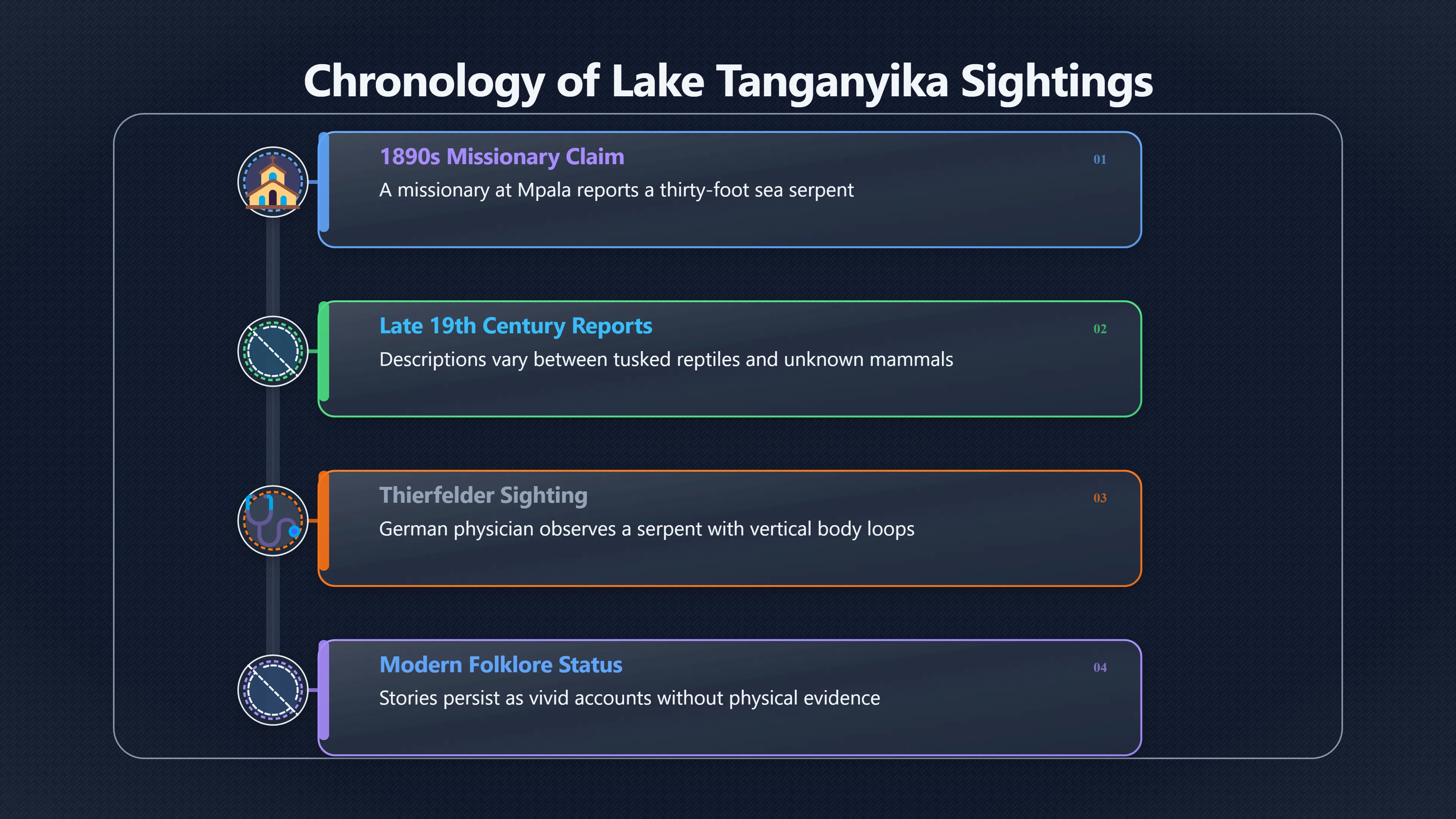
One of the earliest known references comes from explorer Joseph Augustus Moloney, who wrote in the 1890s that a missionary at Mpala on the lake’s western shore claimed to have seen a roughly thirty-foot “sea serpent” both in the water and resting on land. Mpala lay on the wider Tanganyika shoreline rather than in Burundi itself, but the story helped establish the idea that enormous serpentine animals might inhabit the lake.[Cryptid Archives]cryptidarchives.fandom.comLake Tanganyika monsterCryptid ArchivesLake Tanganyika monster | Encyclopaedia of CryptozoologyThe lake monster was first mentioned in 1893, when Joseph Augustu…
Other reports from the late nineteenth and early twentieth centuries described creatures that were supposedly tusked, fanged, amphibious or reptilian. The problem is that these descriptions do not match one another very well. Some resemble giant snakes, some resemble unknown mammals, and others sound like exaggerated versions of familiar animals. Rather than converging on a single identifiable creature, the reports point in several different directions.[Cryptid Archives]cryptidarchives.fandom.comLake Tanganyika monsterCryptid ArchivesLake Tanganyika monster | Encyclopaedia of CryptozoologyThe lake monster was first mentioned in 1893, when Joseph Augustu…
That inconsistency is important. In cryptid investigations, repeated descriptions of the same distinctive features can strengthen a case. Around Lake Tanganyika, the alleged monster changes shape from report to report, making it difficult to argue that witnesses were all seeing the same unknown species.[Cryptid Archives]cryptidarchives.fandom.comLake Tanganyika monsterCryptid ArchivesLake Tanganyika monster | Encyclopaedia of CryptozoologyThe lake monster was first mentioned in 1893, when Joseph Augustu…
Why Lake Tanganyika Encourages Monster Stories
Even without a hidden creature, Lake Tanganyika possesses many characteristics that encourage unusual sightings.
The lake is immense, stretching through four countries and reaching extraordinary depths. Weather conditions can change rapidly, visibility can be poor, and observers often view objects across long distances over reflective water. Such environments have generated monster traditions around the world. A distant animal, floating vegetation, waves, or multiple objects moving together can appear far stranger than they really are.[Wikipedia]WikipediaOpen source on wikipedia.org.
The northern reaches of the lake, including Burundi’s shoreline, also support large wildlife. Crocodiles and hippos are capable of producing dramatic surface disturbances, especially when seen briefly or under poor viewing conditions. A line of swimming animals, partially submerged bodies, or repeated surfacing movements can create the impression of multiple humps or coils. These explanations are less exciting than a prehistoric survivor, but they fit known ecology far better.
Another factor is storytelling itself. Once a region becomes associated with a monster legend, later witnesses may interpret ambiguous sights through that existing narrative. The legend helps shape what people think they have seen.
Why the Evidence Remains Weak
The strongest reason most researchers remain sceptical is the lack of physical evidence.
More than a century has passed since the famous Burundi-linked sighting. During that time there have been no accepted photographs, no recovered remains, no verified tracks, and no biological samples pointing to a large unknown aquatic animal in Lake Tanganyika. If a breeding population of giant serpentine creatures existed in one of Africa’s most studied lakes, many zoologists would expect stronger evidence to have appeared by now.[Cryptid Archives]cryptidarchives.fandom.comLake Tanganyika monsterCryptid ArchivesLake Tanganyika monster | Encyclopaedia of CryptozoologyThe lake monster was first mentioned in 1893, when Joseph Augustu…
The historical record is also surprisingly thin. Many modern discussions rely on repeated retellings of a small number of old stories. As accounts pass from book to book, details sometimes become more dramatic while the original documentation becomes harder to trace. This makes it difficult to separate what witnesses allegedly reported from what later writers added or emphasised.[Cryptid Archives]cryptidarchives.fandom.comLake Tanganyika monsterCryptid ArchivesLake Tanganyika monster | Encyclopaedia of CryptozoologyThe lake monster was first mentioned in 1893, when Joseph Augustu…
Sceptics therefore point to several possibilities:
- Misidentified crocodiles or hippos.
- Ordinary snakes viewed under unusual conditions.
- Optical distortions caused by distance, waves and light.
- Exaggeration during retelling.
- Folklore influenced by existing sea-serpent traditions.
None of these explanations can be proven for every historical report, but collectively they require fewer assumptions than the existence of a giant undiscovered lake monster.
What the Legend Means Today
The Lake Tanganyika monster remains intriguing precisely because it sits between folklore and observation. The 1914 Burundi-shore sighting is vivid enough to capture the imagination, yet too poorly documented to convince most investigators. Earlier sea-serpent stories show that unusual creatures had already become part of the lake’s storytelling culture, while the absence of hard evidence keeps the legend firmly in the realm of mystery rather than zoology.[Cryptid Archives]cryptidarchives.fandom.comLake Tanganyika monsterCryptid ArchivesLake Tanganyika monster | Encyclopaedia of CryptozoologyThe lake monster was first mentioned in 1893, when Joseph Augustu…
For Burundi’s monster tradition, that uncertainty is the real story. The lake monster is not a confirmed animal hiding in deep water, nor is it merely a modern invention. It is a collection of memorable reports attached to one of Africa’s most dramatic lakes—a legend sustained by a few striking eyewitness claims and by the enduring appeal of wondering what might still lurk beyond sight.[Cryptid Archives]cryptidarchives.fandom.comLake Tanganyika monsterCryptid ArchivesLake Tanganyika monster | Encyclopaedia of CryptozoologyThe lake monster was first mentioned in 1893, when Joseph Augustu…
Amazon book picks
Further Reading
Books and field guides related to Did Lake Tanganyika Have a Monster?. Use these as the next step if you want deeper reading beyond the article.
Still in Search of Prehistoric Survivors
Covers reports of unknown aquatic and monster-like animals.
STILL IN SEARCH OF PREHISTORIC
Covers reports of unknown aquatic and monster-like animals.
The Book of Imaginary Beings
Provides broader context for legendary creature traditions.
eBay marketplace picks
Marketplace Samples
Live-tested eBay searches with available results related to this page.
Endnotes
1.
Source: reddit.com
Link:https://www.reddit.com/r/Cryptozoology/comments/1o8j4dh/reported_from_the_lake_of_the_same_name_the_lake/
Source snippet
Overview of Lake Tanganyika and its cryptidsIt was a creature that looked like a monstrous serpent. However, it did not swim like s...
2.
Source: Wikipedia
Link:https://en.wikipedia.org/wiki/Mpala
3.
Source: cryptidarchives.fandom.com
Title: Lake Tanganyika monster
Link:https://cryptidarchives.fandom.com/wiki/Lake_Tanganyika_monster
Source snippet
Cryptid ArchivesLake Tanganyika monster | Encyclopaedia of CryptozoologyThe lake monster was first mentioned in 1893, when Joseph Augustu...
4.
Source: cryptidarchives.fandom.com
Title: ↑ Arthur, W. S. “Sea Serpents and Other Monsters,” Sydney
Link:https://cryptidarchives.fandom.com/wiki/List_of_sea_serpent_sightings_in_the_Indian_Ocean_%281914%E2%80%931945%29
Source snippet
of sea serpent sightings in the Indian Ocean (1914–1945)Court of Hluhluwe, South Africa, wrote to the press to describe a "monster" he ha...
Additional References
5.
Source: brill.com
Link:https://brill.com/display/book/9789004664579/9789004664579_webready_content_text.pdf?srsltid=AfmBOopcehLD5WzTzt_kJvWHcLnmfnmQ7iV1-cP6rrC_3HYKv65xoXvi
Source snippet
BEMBALAND CHURCHa reputation on Lake Tanganyika which was enhanced in Bembaland.35. He... killed a snake near the village, and Muchila p...
6.
Source: facebook.com
Link:https://www.facebook.com/TheFolklorePodcast/posts/the-dingonek-was-a-creature-which-was-said-to-have-been-seen-in-1907-by-a-huntin/1461062369368012/
Source snippet
The Folklore PodcastThis creature is said to reside in Lake Tanganyika in Burundi, a country in East Africa. The lake monster was suppose...
7.
Source: facebook.com
Link:https://www.facebook.com/groups/monstertalkgroupmail/posts/9216439635041442/
8.
Source: m.facebook.com
Link:https://m.facebook.com/CryptozoologyFacts/photos/this-drawing-of-the-lake-tanganyika-monster-was-created-by-philippe-coudray-for-/929700902499419/
Source snippet
drawing of the Lake Tanganyika Monster...This drawing of the Lake Tanganyika Monster... Joseph Augustus Moloney claimed that a Mpala mi...
9.
Source: facebook.com
Link:https://www.facebook.com/CryptozoologyFacts/posts/this-drawing-of-the-lake-tanganyika-monster-was-created-by-philippe-coudray-for-/1068754915260683/
Source snippet
This drawing of the Lake Tanganyika Monster was created...This creature is said to reside in Lake Tanganyika in Burundi, a country in Ea...
10.
Source: facebook.com
Link:https://www.facebook.com/CryptozoologyFacts/photos/this-drawing-of-the-lake-tanganyika-monster-was-created-by-philippe-coudray-for-/1068754798594028/
Source snippet
ng sea serpent in the waters. He later claimed to see the...Read more...
11.
Source: facebook.com
Title: This drawing of the Lake Tanganyika Monster
Link:https://www.facebook.com/CryptozoologyFacts/photos/this-drawing-of-the-lake-tanganyika-monster-was-created-by-philippe-coudray-for-/1315339807268858/
Source snippet
Joseph Augustus Moloney claimed that a Mpala missionary described a 30 foot long sea serpent in the waters. He later claimed to s...
12.
Source: facebook.com
Link:https://www.facebook.com/groups/kaijuareunusuallytall/posts/2158998098183993/
Source snippet
Ultraman** versus **Skydon**, the massively heavy space...This creature is said to reside in Lake Tanganyika in Burundi, a country in Ea...
13.
Source: facebook.com
Link:https://www.facebook.com/instituteofmetaphysics/posts/in-1893-a-mpala-missionary-claimed-to-have-seen-a-sea-serpent-in-lake-tanganyika/1521406596382208/
Source snippet
In 1893, a Mpala missionary claimed to have seen a sea...Sea serpents, also known as sea dragons, were prevalent in ancient myths and ar...
14.
Source: youtube.com
Title: Lake Tanganyika’s Mystery: A Man-Eating Crocodile | GEDEON DOC
Link:https://www.youtube.com/watch?v=ccpPWJrgC2E
Source snippet
[GUSTAVE]({{ 'gustave/' | relative_url }}), THE INVINCIBLE MONSTER OF BURUNDI...
Topic Tree