Within Moldova Monsters
Why Dragons Dominate Moldavian Monster Folklore
Moldavian tales place dragons, enchanted horses and animal helpers in forests, underworlds and kingdoms where lost light must be restored.
On this page
- Dragons that steal light and brides
- Magical animals that help the hero
- How wonder tales differ from cryptid reports
Page outline Jump by section
Introduction
Moldova’s most memorable monster tradition is not a catalogue of alleged sightings but a world of wonder tales populated by dragons, enchanted horses, magical birds and talking animal helpers. In the stories collected and published by folklorist Grigore Botezatu, these creatures do not lurk in remote lakes waiting to be discovered. They occupy a mythic landscape where kingdoms fall into darkness, heroes descend into the underworld and magical animals become the difference between failure and survival.[Internet Archive]archive.orgMoldavian FolktalesInternet ArchiveMOLDAVIAN FOLKTALES: GRIGORE BOTEZATU7 Jan 2016 — MOLDAVIAN FOLKTALES; Topics: SOVIET CHILDREN'S BOOK IN ENGLISH, KIDS…
For readers interested in cryptids and mystery beasts, this distinction matters. Moldova’s strongest creature traditions survive in folklore rather than eyewitness archives. The dragons and magical animals of these tales reveal what local communities imagined as dangerous, powerful or miraculous long before modern monster hunting became popular. Their importance lies less in claims of physical existence than in the stories they carried across generations.[Internet Archive]archive.orgMoldavian FolktalesInternet ArchiveMOLDAVIAN FOLKTALES: GRIGORE BOTEZATU7 Jan 2016 — MOLDAVIAN FOLKTALES; Topics: SOVIET CHILDREN'S BOOK IN ENGLISH, KIDS…
Why Dragons Dominate Moldavian Monster Folklore
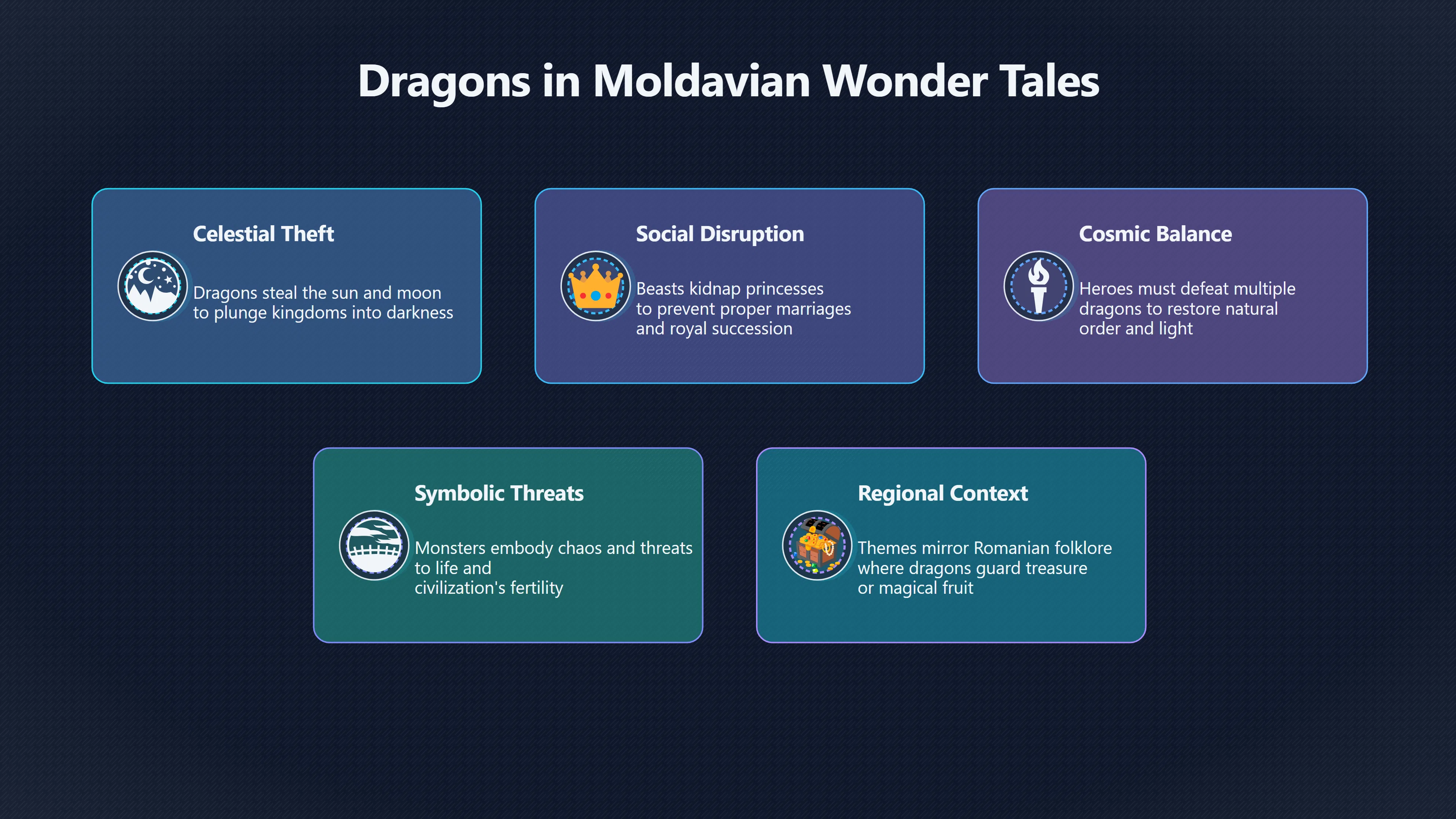
The most powerful beasts in Moldavian wonder tales are dragons. These are not simply giant reptiles. They are cosmic enemies capable of upsetting the natural order itself.
In several tales preserved by Botezatu, dragons steal the sun, moon and stars, plunging entire kingdoms into darkness. Heroes must journey beyond the ordinary world, descend into underground realms and confront multiple dragon adversaries before light can be restored. One story, Dragan the Bold, centres on three dragons who abduct royal daughters and carry away the heavenly lights. Another follows Ionike Fet-Frumos as he battles dragons named Dusk, Evening and Midnight to free the stolen sun.[Wikipedia]WikipediaOpen source on wikipedia.org.
These stories place dragons at the centre of a struggle between order and chaos. They are not random monsters attacking villages. They embody the forces that threaten life, fertility and civilisation itself. Similar themes appear throughout Romanian and Moldavian folklore, where dragon-like beings often steal something precious—light, treasure, magical fruit or a bride—and force a hero to undertake a dangerous quest.[Wikipedia]WikipediaOpen source on wikipedia.org.
Dragons That Steal Light and Brides
Two recurring dragon roles appear again and again:
- The thief of celestial light. The dragon removes the sun, moon or stars, creating darkness across the world. The hero’s victory restores cosmic balance.[Wikipedia]WikipediaOpen source on wikipedia.org.
- The abductor of women. Dragons frequently kidnap princesses or seek unwanted marriages. Their defeat restores social order and allows proper marriages and succession to continue.[Wikipedia]WikipediaOpen source on wikipedia.org.
The dragon’s connection with marriage is particularly striking. Unlike many Western European dragons that primarily guard treasure, Moldavian and related regional traditions often portray dragon figures as rivals to human heroes in courtship and family life. The monster threatens both the kingdom and the household.
In the tale of Carminea, a dragon successfully wins a marriage challenge and claims a noblewoman as his bride. Rather than accept this fate, the heroine receives guidance from a magical horse and kills the dragon herself, making the story unusual because the dragon is defeated by the intended victim rather than a male rescuer.[Wikipedia]WikipediaThe Horse LurjaThe Horse Lurja
Magical Animals That Help the Hero
If dragons represent danger, magical animals usually represent wisdom, loyalty and hidden power.
The most important helper in Moldavian tales is often the enchanted horse. These animals rarely begin as magnificent creatures. They are commonly disguised as weak, neglected or ageing horses ignored by everyone except the future hero. Once recognised and treated with respect, they reveal extraordinary abilities.[Wikipedia]WikipediaOpen source on wikipedia.org.
In How Ionike Fet-Frumos Freed the Sun, the hero chooses a seemingly worthless colt that transforms into a mighty supernatural steed. The horse not only carries him into danger but repeatedly provides the knowledge needed to survive dragon traps and magical attacks.[Wikipedia]WikipediaOpen source on wikipedia.org.
The horse often acts as adviser, scout and protector all at once. Unlike a modern fantasy mount, it is effectively a second hero. In some stories the horse possesses knowledge unavailable to humans and can interpret supernatural threats before they appear.[Wikipedia]WikipediaOpen source on wikipedia.org.
The Animal Helper as a Source of Wisdom
Several patterns recur in Moldavian tales:[researchgate.net]researchgate.netSource details in endnotes.
- Animals recognise hidden truths before humans do.
- Magical creatures reward kindness and loyalty.
- The hero succeeds by listening rather than commanding.
- The helper frequently understands the rules of the otherworld better than any human character.[Wikipedia]WikipediaOpen source on wikipedia.org.
This differs sharply from many modern monster traditions, where unusual animals are sources of fear. In Moldavian folklore, remarkable beasts are often allies rather than threats.
Enchanted Birds, Talking Creatures and Living Transformations
Dragons and horses dominate the stories, but they are not the only magical animals.
Several Moldavian tales feature supernatural birds that blur the line between animal and human. In the story of Break-of-Day, a mysterious white bird with a golden tail turns out to be an enchanted maiden trapped by dark powers. The quest revolves around uncovering the bird’s true identity and breaking the enchantment.[Wikipedia]WikipediaPovestea cu măr moramăr și păsărica a ciutăPovestea cu măr moramăr și păsărica a ciută
Other stories use shape-shifting creatures and magical transformations to connect the human world with the supernatural one. Animals may conceal enchanted people, carry messages between worlds or serve as guardians of hidden realms.[Wikipedia]WikipediaPovestea cu măr moramăr și păsărica a ciutăPovestea cu măr moramăr și păsărica a ciută
One of the most remarkable examples appears in the tale of Carminea. After years of faithful service, the magical horse Gaitan dies, yet its body transforms into an entire enchanted landscape. Parts of the horse become a castle, orchard, servants and guardian animals. The helper does not merely save the heroine; it literally becomes the foundation of her future life.[Wikipedia]WikipediaThe Horse LurjaThe Horse Lurja
Such transformations illustrate how Moldavian wonder tales treat animals as beings linked to deep magical forces rather than ordinary wildlife.
What These Creatures Meant to Traditional Audiences
The dragons and magical beasts of Moldavian folklore were never intended as realistic animals.
Their purpose was symbolic as well as entertaining. Dragons embodied threats that seemed overwhelming: darkness, chaos, invasion, loss and disorder. Magical horses represented loyalty, hidden potential and wisdom gained through humility. Enchanted birds often symbolised transformation and liberation.[Wikipedia]WikipediaOpen source on wikipedia.org.
The stories also taught practical lessons. Heroes rarely triumph through strength alone. Success usually depends on recognising value where others see weakness, honouring promises and accepting guidance from unlikely sources. The magical animal helper becomes a narrative reward for good character.[Wikipedia]WikipediaOpen source on wikipedia.org.
This helps explain why these tales survived for generations. They were not merely stories about monsters. They were stories about how people should behave when confronted by danger, temptation or uncertainty.
How Wonder Tales Differ from Cryptid Reports
For anyone exploring Moldova’s monster traditions, it is important to separate folklore creatures from cryptids.
A cryptid tradition usually develops through alleged real-world encounters. Witnesses claim to see an unknown animal, reports accumulate, investigators search for evidence and debates emerge over possible explanations. Moldova has relatively little of this type of creature lore. The country lacks a famous equivalent of the Loch Ness Monster or Bigfoot.[Internet Archive]archive.orgMoldavian FolktalesInternet ArchiveMOLDAVIAN FOLKTALES: GRIGORE BOTEZATU7 Jan 2016 — MOLDAVIAN FOLKTALES; Topics: SOVIET CHILDREN'S BOOK IN ENGLISH, KIDS…
The dragons and magical beasts of Moldavian folklore belong to a different category altogether. They inhabit timeless kingdoms, underground worlds and enchanted forests. Their stories involve impossible feats, magical transformations and cosmic events. No one collected footprints from the dragon that stole the sun because the tale was never presented as a literal wildlife report.[Wikipedia]WikipediaOpen source on wikipedia.org.
Yet these stories remain highly relevant to a study of monsters. They reveal the imaginative foundations from which later beast legends grow. Before newspapers reported mysterious creatures and before cryptozoologists searched for unknown animals, Moldavian storytellers were already filling their landscape with dragons, magical horses and other extraordinary beings. Those wonder tales remain the richest and most enduring part of Moldova’s monster heritage.[Internet Archive]archive.orgMoldavian FolktalesInternet ArchiveMOLDAVIAN FOLKTALES: GRIGORE BOTEZATU7 Jan 2016 — MOLDAVIAN FOLKTALES; Topics: SOVIET CHILDREN'S BOOK IN ENGLISH, KIDS…

Amazon book picks
Further Reading
Books and field guides related to Why Dragons Dominate Moldavian Monster Folklore. Use these as the next step if you want deeper reading beyond the article.
The Complete World of Greek Mythology
Provides broader dragon and heroic-myth context for Moldovan folklore.
The Element Encyclopedia of Magical Creatures
Covers dragons, magical animals and legendary beings.
Fairy and Folk Tales of the Irish Peasantry
Demonstrates how traditional wonder tales preserve supernatural creatures.
eBay marketplace picks
Marketplace Samples
Live-tested eBay searches with available results related to this page.
Endnotes
1.
Source: archive.org
Title: Moldavian Folktales
Link:https://archive.org/details/MoldavianFolktales
Source snippet
Internet ArchiveMOLDAVIAN FOLKTALES: GRIGORE BOTEZATU7 Jan 2016 — MOLDAVIAN FOLKTALES; Topics: SOVIET CHILDREN'S BOOK IN ENGLISH, KIDS...
2.
Source: Wikipedia
Link:https://en.wikipedia.org/wiki/Greuceanu
3.
Source: Wikipedia
Link:https://en.wikipedia.org/wiki/Zmeu
4.
Source: Wikipedia
Title: The Horse Lurja
Link:https://en.wikipedia.org/wiki/The_Horse_Lurja
5.
Source: Wikipedia
Title: The Fairy Aurora
Link:https://en.wikipedia.org/wiki/The_Fairy_Aurora
6.
Source: Wikipedia
Title: Povestea cu măr moramăr și păsărica a ciută
Link:https://en.wikipedia.org/wiki/Povestea_cu_m%C4%83r_moram%C4%83r_%C8%99i_p%C4%83s%C4%83rica_a_ciut%C4%83
7.
Source: archive.org
Title: moldovian folk tales kishinev literatura artistika 1986
Link:https://archive.org/details/moldovian-folk-tales-kishinev-literatura-artistika-1986
Source snippet
Internet ArchiveMoldovian Folk Tales: Grigore Botezatu30 Dec 2024 — A collection of Moldovian Folk Tales. Collected and Retold by Grigor...
Additional References
8.
Source: alluringcreations.co.za
Link:https://alluringcreations.co.za/wp/my-top-heroes-romanian-folktales/
Source snippet
Alluring CreationsMy Top Heroes from Romanian Folktales #Im4RoThe Sun and the Moon are stolen by three vicious dragons, balauri, and thei...
9.
Source: facebook.com
Title: Moldavian and Romanian woodland spirits
Link:https://www.facebook.com/groups/thedivineshekhinah/posts/1798766517485019/
Source snippet
January 29, 2026 — Iyele or Ielele ("Them") are Moldavian and Romanian wind or woodland spirits, sometimes called Ladies of the F...
Published: January 29, 2026
10.
Source: books.google.com
Link:https://books.google.com/books/about/Moldavian_Folk_tales.html?id=7UCFmgEACAAJ
Source snippet
Google BooksMoldavian Folk-talesBibliographic information; Title, Moldavian Folk-tales; Contributor, Grigore G. Botezatu; Edition, 2...
11.
Source: researchgate.net
Link:https://www.researchgate.net/publication/351654488_Archetype_Of_Power_In_Folklore_Russian_And_Moldovan-Romanian_Folk_Tales
12.
Source: facebook.com
Link:https://www.facebook.com/groups/MN.Mens.Conference/posts/3919245111485611/
13.
Source: goodreads.com
Link:https://www.goodreads.com/book/show/57533604-moldavian-legends
14.
Source: youtube.com
Title: A Guide to Romanian Folklore
Link:https://www.youtube.com/watch?v=MUGn_xU68VE
Source snippet
8 Mythical Creatures from Romanian Folklore You've Never Heard Of...
15.
Source: youtube.com
Title: Romanian Mythology
Link:https://www.youtube.com/watch?v=2LDwGFjRZ20
Source snippet
Romania's REAL Monsters: Folklore Beyond Dracula...
16.
Source: youtube.com
Link:https://www.youtube.com/watch?v=I7yfg32YfiM
Source snippet
Romanian Mythology - Balaur...
17.
Source: multicoloreddiary.blogspot.com
Title: Dragons are people too (Following folktales around the world 60
Link:https://multicoloreddiary.blogspot.com/2018/02/dragons-are-people-too-following.html
Topic Tree