Within Romanian Monsters
How Close Are Strigoi to Dracula?
The strigoi tradition grew from fears about death, illness and social disorder rather than sightings of a mystery animal.
On this page
- Living and Dead Strigoi
- The Marotinu de Sus Exhumation
- How Dracula Tourism Reframed Local Belief
Page outline Jump by section
Introduction
When people ask whether Romania is really the land of vampires, the answer is both yes and no. Romania has a long tradition of belief in the strigoi, but these figures were not originally treated as hidden creatures waiting to be discovered. They belonged to a social and spiritual world shaped by fears of illness, unexplained deaths, family conflict and the uneasy boundary between the living and the dead. In traditional belief, a strigoi could be a dangerous living person, a restless dead relative, or a supernatural force blamed for misfortune.[Wikipedia]WikipediaOpen source on wikipedia.org.

That distinction is important. The strigoi tradition is one of Romania’s most famous monster legacies, yet it sits closer to folklore, ritual and community anxiety than to modern cryptid hunting. The story became globally famous because of its connection to vampire imagery and, later, to Dracula tourism. The reality behind the legend reveals far more about how communities explained tragedy and uncertainty than about blood-drinking monsters roaming the countryside.[Wikipedia]WikipediaOpen source on wikipedia.org.
How Close Are Strigoi to Dracula?
The connection between strigoi and Dracula is real, but indirect.
Bram Stoker’s Dracula drew upon a wider Eastern European vampire tradition rather than simply copying Romanian folklore. Modern readers often assume that every Romanian vampire story resembles Count Dracula, yet traditional strigoi beliefs were usually local, family-centred and practical. The feared threat was often a recently deceased relative believed to be causing sickness, bad luck, livestock losses or unexplained deaths within the household.[Wikipedia]WikipediaOpen source on wikipedia.org.
In village traditions, the question was rarely whether a supernatural predator was stalking strangers. Instead, people worried that someone they knew might return after death and continue influencing the family. The focus was on maintaining social and spiritual order rather than battling an aristocratic Gothic villain. This difference explains why Romanian vampire traditions often appear surprisingly domestic when compared with the dramatic imagery popularised by novels and films.[Wikipedia]WikipediaOpen source on wikipedia.org.
Living and Dead Strigoi
One of the most distinctive features of Romanian belief is that not all strigoi were thought to be dead.
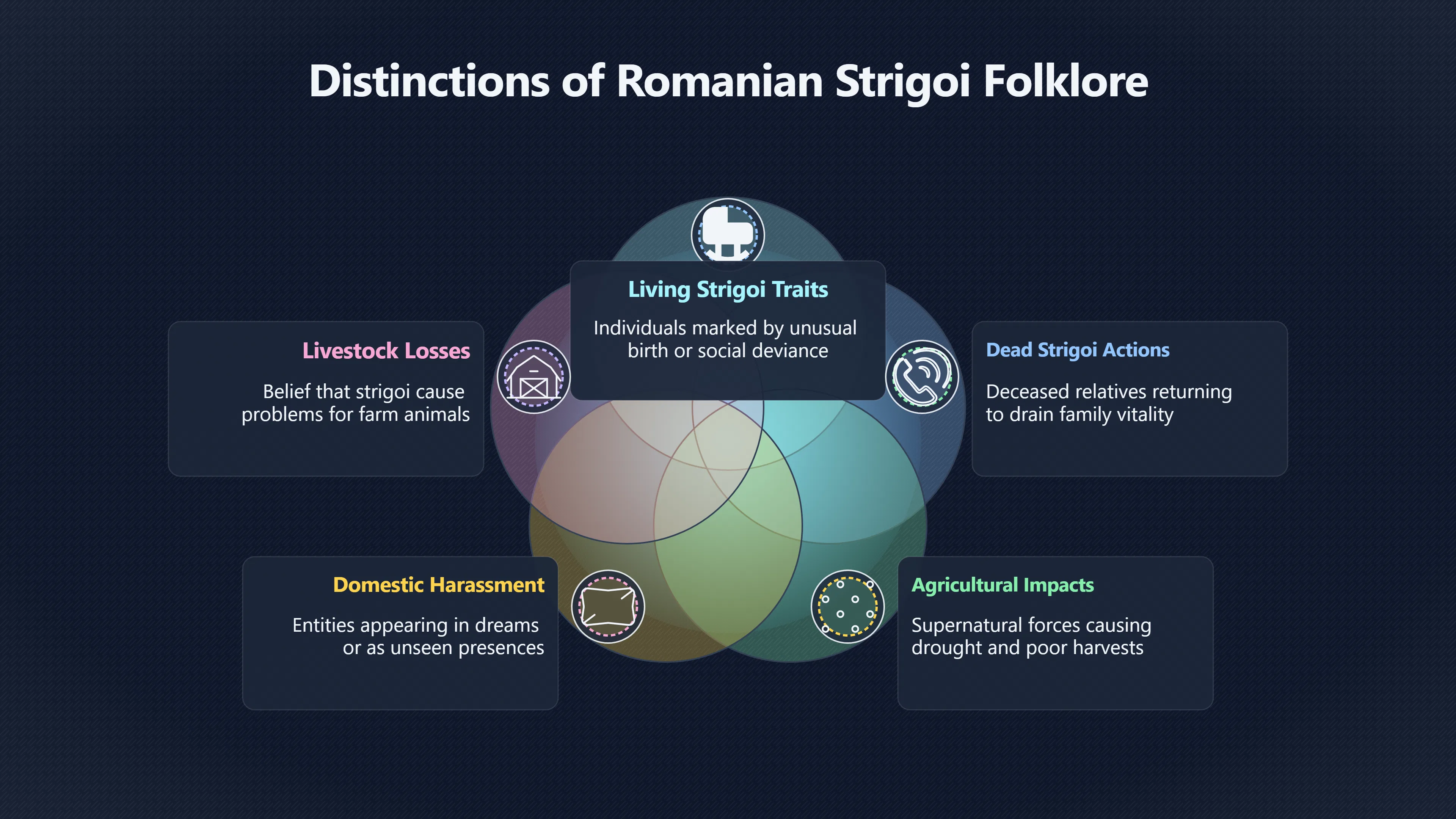
Traditional folklore distinguished between living strigoi and dead strigoi. A living strigoi was believed to be a person marked by unusual circumstances of birth, behaviour or destiny. Folklore collected by Romanian writers and ethnographers recorded many supposed signs: unusual birth conditions, perceived magical abilities, social deviance or a reputation for causing misfortune. Such individuals were feared because people believed they could harm neighbours, livestock or crops even while alive.[Wikipedia]WikipediaOpen source on wikipedia.org.
The dead strigoi were considered more dangerous. These were individuals believed to leave the grave after death and continue affecting the living. Their supposed activities included:
- Draining the vitality of relatives.
- Causing illness within a family.
- Bringing drought, poor harvests or livestock problems.
- Appearing in dreams or visions.
- Returning in animal form or as an unseen presence.[Wikipedia]WikipediaOpen source on wikipedia.org.
From a modern perspective, these beliefs often functioned as explanations for events that lacked obvious causes. Before modern medicine and scientific understandings of disease, a sequence of illnesses within one household could seem to demand a supernatural explanation. A suspected strigoi offered a way to identify a cause and take action.[Wikipedia]WikipediaOpen source on wikipedia.org.
Why Communities Believed
The strigoi tradition flourished in situations where grief, disease and uncertainty intersected.
Many classic vampire accusations emerged after clusters of deaths, unexplained wasting illnesses or recurring family misfortune. Anthropologists studying vampire traditions across Eastern Europe have long noted that communities often turned to supernatural explanations when ordinary explanations seemed inadequate. In Romanian contexts, the suspected strigoi became a symbolic source of disorder. The belief transformed random suffering into a story with a culprit and a solution.[Wikipedia]WikipediaOpen source on wikipedia.org.
This is why strigoi stories are best understood not as reports of mystery animals or hidden species but as cultural responses to fear and loss.
The Marotinu de Sus Exhumation
The most famous modern strigoi case occurred not in the distant past but in 2004.
In the village of Marotinu de Sus in Dolj County, relatives of a recently deceased man named Petre Toma became convinced that he had returned as a strigoi. Family members reported illness, nightmares and a feeling that the dead man was tormenting them. Acting on traditional beliefs, several villagers exhumed the body, removed the heart, burned it and used its ashes in a ritual intended to stop the haunting. Police later intervened and participants were prosecuted for disturbing a grave.[wikipedia.org]WikipediaOpen source on wikipedia.org.
The incident attracted international attention because it seemed to demonstrate that vampire beliefs had survived into the twenty-first century. Journalists often presented the story as a bizarre relic of medieval superstition. Yet the event is more revealing when viewed as a case study in how folklore persists.
For the participants, the ritual was not theatrical entertainment. It was a practical attempt to solve what they believed was a genuine problem. Reports from the village described the action as a continuation of older customs rather than a performance staged for outsiders.[The Guardian]theguardian.comThe GuardianA village still in thrall to Dracula | World news18 Jun 2005 — Six local men did was enact an ancient Romanian ritual for dea…
At the same time, the case highlights a tension visible throughout modern Romania. Official institutions, law enforcement and contemporary medicine operate alongside older folk explanations that remain meaningful to some communities. The Marotinu de Sus exhumation became famous precisely because it exposed that cultural overlap so clearly.[The Independent]independent.co.ukthe real vampire slayers 397874The IndependentThe real vampire slayers28 Oct 2007 — In 2004, Romanian police were called to investigate the desecration of a grave in a…
What the Case Does and Does Not Show
The Marotinu de Sus episode is sometimes cited as proof that vampires are still feared across Romania. That overstates the situation.
The case demonstrates that traditional beliefs survived in at least some rural communities. It does not show widespread national acceptance of vampire folklore as literal fact. Most Romanians today encounter the strigoi primarily through folklore, literature, tourism and popular culture rather than through active belief. The case is remarkable because it was unusual enough to become international news.[The Guardian]theguardian.comThe GuardianA village still in thrall to Dracula | World news18 Jun 2005 — Six local men did was enact an ancient Romanian ritual for dea…
How Dracula Tourism Reframed Local Belief
The worldwide success of Dracula transformed how outsiders understand Romanian vampire traditions.
Before the twentieth century, strigoi beliefs were local concerns rooted in family relationships, death rituals and village life. After Dracula became a global cultural icon, international visitors increasingly arrived in Romania expecting castles, vampires and Gothic mysteries. The result was a gradual merging of several different traditions into a single tourist narrative.[Wikipedia]WikipediaOpen source on wikipedia.org.
This reframing created a curious contrast:
- Traditional strigoi stories focused on relatives, neighbours and community tensions.
- Dracula stories centred on an immortal aristocratic predator.
- Tourism promoted Transylvania as a land of vampires.
- Folklore scholars continued to emphasise the older social and ritual functions of the belief.[Wikipedia]WikipediaOpen source on wikipedia.org.
The popularity of Dracula has therefore preserved interest in Romanian vampire traditions while simultaneously reshaping them. Many visitors arrive looking for the fictional count and discover a far older body of folklore concerned with death, family and misfortune.
In modern Romania, the strigoi survives less as a feared supernatural threat than as a powerful cultural symbol. It remains one of the clearest examples of how folklore can evolve: from village explanations of illness and bad luck, to newspaper headlines about vampire hunts, and finally into a global tourism brand linked forever to Transylvania and Dracula.[Wikipedia]WikipediaOpen source on wikipedia.org.

Amazon book picks
Further Reading
Books and field guides related to How Close Are Strigoi to Dracula?. Use these as the next step if you want deeper reading beyond the article.
The World of Lore: Monstrous Creatures
Explores dark legends, supernatural fears and cultural beliefs.
eBay marketplace picks
Marketplace Samples
Live-tested eBay searches with available results related to this page.

Endnotes
1.
Source: Wikipedia
Link:https://en.wikipedia.org/wiki/Strigoi
2.
Source: upi.com
Title: Family exhumes ‘vampire’ relative
Link:https://www.upi.com/Odd_News/2004/02/26/Family-exhumes-vampire-relative/84711077817552/
Source snippet
Family exhumes 'vampire' relative - UPI.com26 Feb 2004 — A Romanian family convinced a late relative was a vampire dug up his body, pi...
3.
Source: pbs.org
Link:https://www.pbs.org/wnet/secrets/vampire-legend-vampire-slaying-ritual-romania/2343/
Source snippet
Vampire-Slaying Ritual in Romania | Secrets of the DeadA group of villagers has performed a vampire-slaying ritual on a recently burie...
4.
Source: Wikipedia
Title: Romanian language
Link:https://en.wikipedia.org/wiki/Romanian_language
Source snippet
Romanian languageThe official and main language of Romania and Moldova. Romanian is part of the Eastern Romance sub-branch of Romance...
5.
Source: pbs.org
Title: secrets dead vampire slaying ritual romania
Link:https://www.pbs.org/video/secrets-dead-vampire-slaying-ritual-romania/
6.
Source: theguardian.com
Link:https://www.theguardian.com/world/2005/jun/19/theobserver
Source snippet
The GuardianA village still in thrall to Dracula | World news18 Jun 2005 — Six local men did was enact an ancient Romanian ritual for dea...
7.
Source: independent.co.uk
Title: the real vampire slayers 397874
Link:https://www.independent.co.uk/news/world/europe/the-real-vampire-slayers-397874.html
Source snippet
The IndependentThe real vampire slayers28 Oct 2007 — In 2004, Romanian police were called to investigate the desecration of a grave in a...
8.
Source: unnaturalworld.fandom.com
Link:https://unnaturalworld.fandom.com/wiki/Strigoi
Source snippet
Unnatural World Wiki - FandomIn Romanian mythology, Strigoi are either witches or the evil souls of the dead rising from the tombs (or li...
9.
Source: vampires.fandom.com
Link:https://vampires.fandom.com/wiki/Strigoi
10.
Source: reddit.com
Title: Romanian Vampire
Link:https://www.reddit.com/r/Paranormal/comments/duge9q/romanian_vampire_strigoi/
Additional References
11.
Source: facebook.com
Link:https://www.facebook.com/johanegerkranspublic/posts/finally-getting-to-the-original-gangstas-of-the-vampire-world-heres-my-first-tak/1585523988236218/
Source snippet
(or living) that transform into an animal or phantomatic...Read more...
12.
Source: youtube.com
Title: The Strigoi: From Romanian Folklore to Vampire Panic
Link:https://www.youtube.com/watch?v=_o2JBNlQ_N4
Source snippet
Before Dracula: Dark Origins of the Strigoi | Romanian Vampire Myth...
13.
Source: youtube.com
Title: Romanian Vampire Folklore (Strigoi and Moroi)
Link:https://www.youtube.com/watch?v=0ZX9qcuEE8k
Source snippet
MODERN VAMPIRE! The Story of Petre Toma 2003...
14.
Source: facebook.com
Link:https://www.facebook.com/groups/1331722814218106/posts/1753581715365545/
Source snippet
Villagers in Romania kill suspected vampire in 2004 ritualIn 2004, in the Romanian village of Marotinu de Sus, six men did the unthinkabl...
15.
Source: youtube.com
Link:https://www.youtube.com/watch?v=LTHtPFHmEAg
Source snippet
Romanian Monsters (Vampire, Werewolf, Witch origin) - Strigoi...
16.
Source: academia.edu
Link:https://www.academia.edu/113967875/The_Trope_of_the_Vampire_and_Strigoi_in_Romanian_Culture_and_Cultural_Products_Imported_to_Romania_18391947
17.
Source: thebibleofmysteries.blogspot.com
Link:https://thebibleofmysteries.blogspot.com/2011/04/strigoi.html
18.
Source: obscurix.com
Link:https://obscurix.com/magazine/classic-obscurix-archive/paranormal/strigoi-and-moroi-vampires-of-romania/
19.
Source: reddit.com
Link:https://www.reddit.com/r/RomanceClub/comments/mdoqs4/the_strigoi/
20.
Source: transylvaniaworld.com
Link:https://www.transylvaniaworld.com/concepts/definition-vampire-concept.html
Topic Tree