Within Uruguay Cryptids
Why Does Uruguay Still Remember the Lobizon?
Uruguay's best-known monster tradition blends Guarani mythology, European werewolf lore and the eerie shapes of elusive wild canids.
On this page
- From Luison to the Seventh Son
- How Uruguay Preserved the Legend
- Could Real Canids Reinforce the Story?
Page outline Jump by section
Introduction
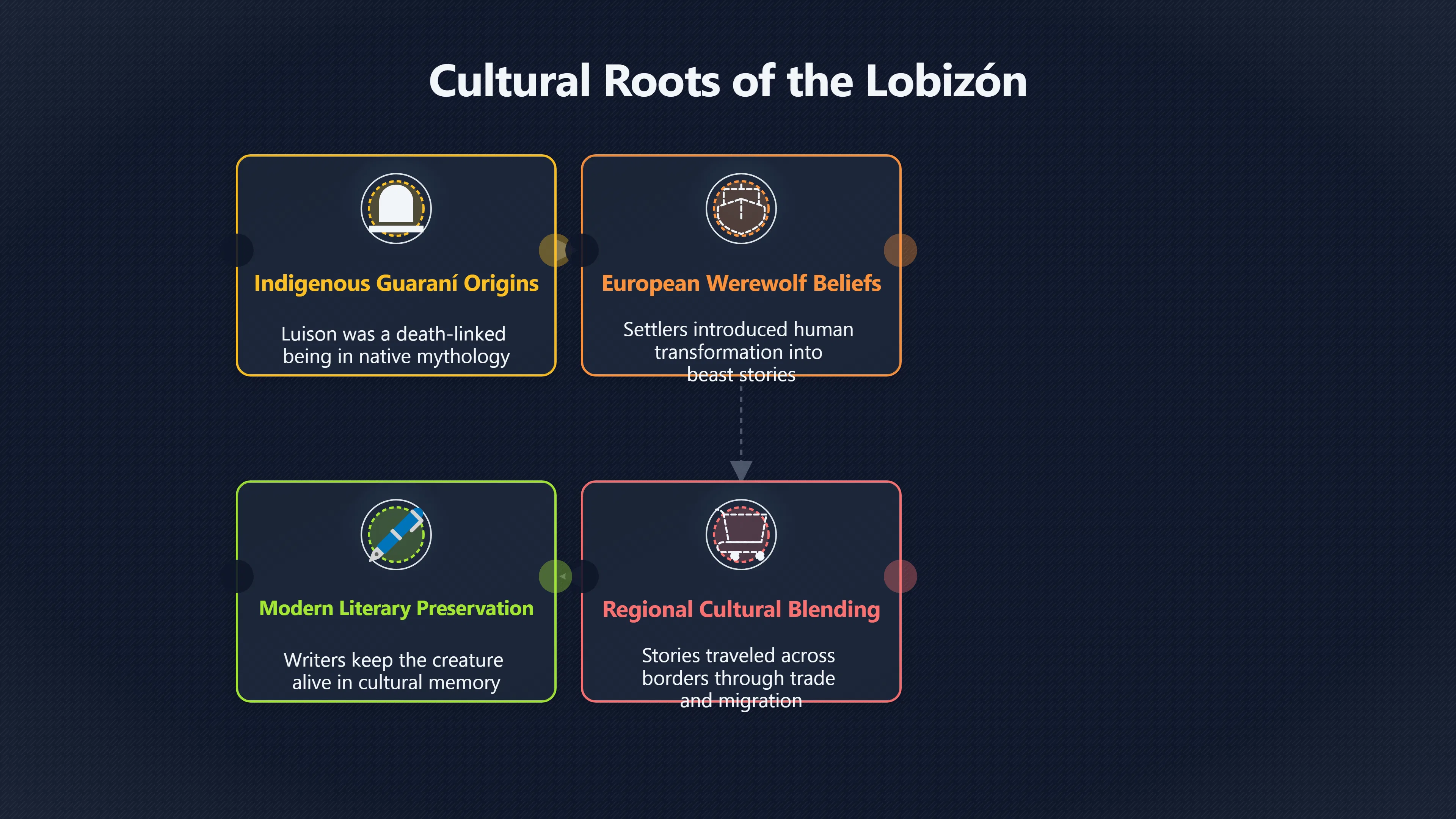
The lobizón is Uruguay’s best-known monster tradition, but it is not simply a South American version of the European werewolf. The figure survived in Uruguay because several older traditions merged together: Indigenous Guaraní stories about a feared death-linked being, European beliefs about human transformation into beasts, and the experience of living in a countryside where strange-looking wild canids occasionally appeared at the edge of sight. Over time, the creature changed from a specific mythological monster into a broader symbol of rural mystery, folklore and cultural memory. Today, the lobizón is remembered less as a literal threat and more as one of the most enduring legends shared across northern Uruguay and the wider Río de la Plata region.[Wikipedia]WikipediaOpen source on wikipedia.org.

Why Does Uruguay Still Remember the Lobizón?
Unlike many monster stories that arrived fully formed from Europe, the lobizón developed through cultural blending. Northern Uruguay sits within a larger cultural zone that includes Paraguay, southern Brazil and north-eastern Argentina. In this region, stories travelled across borders through migration, trade, oral storytelling and shared rural traditions. The result was a creature that looked familiar to Europeans yet remained rooted in local beliefs.[Wikipedia]WikipediaOpen source on wikipedia.org.
The lobizón occupies an unusual place in Uruguayan folklore because it bridges several categories at once. It is a monster, a cautionary tale, a family curse, and a reflection of anxieties about death, isolation and social difference. As belief in literal transformation faded during the twentieth century, the story persisted through literature, folklore collections and rural storytelling rather than through claims of ongoing attacks or sightings.
From Luison to the Seventh Son
The deepest roots of the legend lie in the Guaraní figure often called Luison, one of the most feared beings in Guaraní mythology. In traditional accounts, Luison was associated with death, graveyards and the boundary between the living and the dead. Rather than resembling the classic European wolf-man, he was often imagined as a monstrous dog-like creature connected with decay and cemeteries.[Wikipedia]WikipediaOpen source on wikipedia.org.
European settlers introduced their own folklore about werewolves and cursed families. South America had no native wolves, but the idea of human transformation into a beast was already familiar across parts of Europe. Over generations, these imported beliefs merged with the older Guaraní tradition. The result was the lobizón: a creature that inherited the deathly associations of Luison while gaining the shape-shifting characteristics of the werewolf.[wikipedia.org]WikipediaOpen source on wikipedia.org.
One of the most famous additions was the “seventh son” curse. In many versions of the legend, the seventh consecutive male child in a family was believed to be destined to become a lobizón upon reaching adolescence. This idea was so widespread in parts of the Southern Cone that it influenced real social behaviour and even inspired official responses in neighbouring Argentina. Although Uruguay never developed the same legal traditions, the belief circulated widely through the same regional folklore network.[smithsonianmag.com]smithsonianmag.comargentina has superstition 7th sons will turn werewolves 180953746In Argentina, the werewolf is referred to as el lobison.Read more…
How the Creature’s Appearance Kept Changing
One reason the lobizón remains memorable is that no single description ever became definitive.
In some stories the creature is:
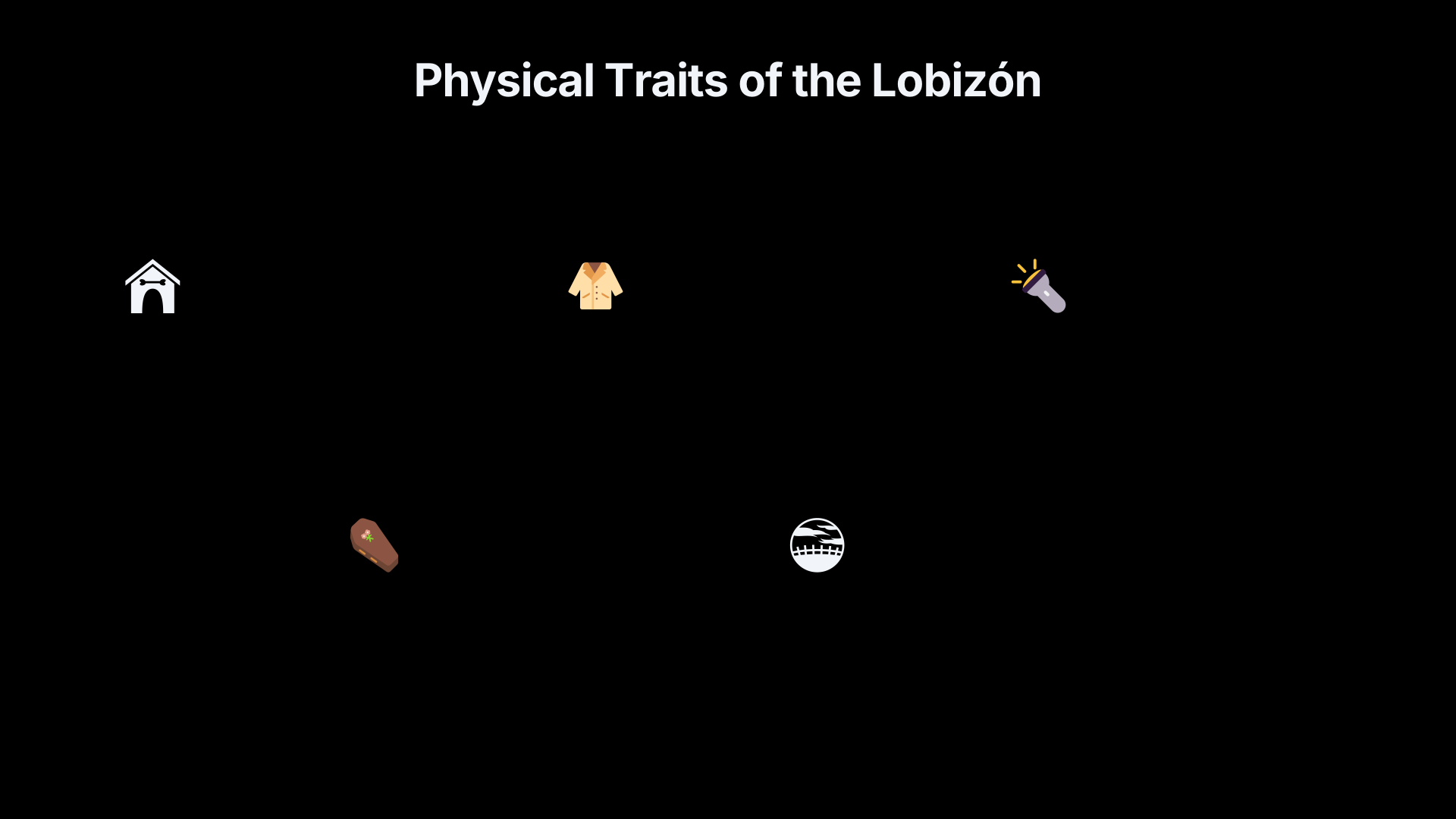
- A huge black dog roaming country roads.
- A wolf-like beast despite wolves being absent from South America.
- A gaunt, long-limbed animal with glowing eyes.
- A human who temporarily transforms into an animal form.
- A cemetery-haunting creature associated with corpses and bad omens.[Wikipedia]WikipediaOpen source on wikipedia.org.
These shifting descriptions reveal how folklore adapts. Older Guaraní traditions emphasised death and cemeteries. Later versions borrowed features from European werewolves, including transformation and lunar associations. Some modern retellings portray the lobizón almost as a horror-film monster, while literary versions often treat it as a tragic or cursed figure rather than a predator.[Wikipedia]WikipediaOpen source on wikipedia.org.
The changing appearance is therefore evidence of cultural evolution rather than eyewitness consistency. Each generation reshaped the creature to fit contemporary fears and storytelling styles.
How Uruguay Preserved the Legend
In Uruguay, the lobizón survived primarily through oral tradition. Rural communities passed stories between generations, especially in areas culturally connected to Paraguay, Brazil and northern Argentina. Because the legend belonged to everyday storytelling rather than a single sacred text, local versions developed distinctive details. Some emphasised curses, others transformation, and others the creature’s appearance near graveyards or isolated roads.
As urbanisation increased and belief in supernatural creatures declined, the lobizón moved into literature and cultural memory. Uruguayan writers and folklorists continued to reference the figure, preserving it as part of the country’s rural heritage even when fewer people accepted it as a literal reality. In this sense, the lobizón followed the path of many European folklore creatures: it became a cultural symbol after it stopped functioning as an active belief for most people.
The creature’s persistence also reflects geography. Northern Uruguay remained connected to a wider Guaraní cultural sphere long after national borders were established. As a result, stories about the lobizón continued circulating even when they were becoming less central in major cities.[Wikipedia]WikipediaOpen source on wikipedia.org.
Could Real Canids Reinforce the Story?
The lobizón is fundamentally a folklore creature, but some real animals may have helped keep the image believable.
The strongest candidate is the maned wolf, South America’s largest wild canid. Despite its name, it is neither a true wolf nor a fox. It has exceptionally long legs, a reddish coat, a dark mane and a distinctive silhouette unlike most other canids. The species historically occurred in northern Uruguay and remains associated with the broader region, though it is now rare there.[tetzoo.com]tetzoo.comTetrapod Zoology The Incredible South American Maned WolfTetrapod ZoologyThe Incredible South American Maned WolfMarch 15, 2022 — 15 Mar 2022 — The Maned wolf is an inhabitant of South American…
A brief glimpse of a solitary maned wolf at dusk could easily appear uncanny. Its unusual proportions make it look taller than expected, and its movements can seem strange to observers unfamiliar with the species. Wildlife organisations frequently note its elusive and nocturnal habits, characteristics that naturally encourage folklore.[World Wildlife Fund]worldwildlife.orgWorld Wildlife Fund Meet the solitary, nocturnal maned wolfWorld Wildlife Fund Meet the solitary, nocturnal maned wolf
This does not mean that sightings of maned wolves created the lobizón legend. The folklore clearly predates modern wildlife observations and has deep mythological roots. However, encounters with unusual canids may have reinforced existing beliefs by providing a real-world shape onto which people could project an already familiar monster.[Wikipedia]WikipediaOpen source on wikipedia.org.

A Monster That Became a Cultural Memory
The most interesting aspect of the lobizón is not whether it exists, but how it changed. The creature began as a feared Guaraní supernatural being linked to death and misfortune. It absorbed European werewolf traditions, acquired the famous seventh-son curse, and gradually transformed into a broader regional legend shared across several countries.[Wikipedia]WikipediaOpen source on wikipedia.org.
In modern Uruguay, the lobizón survives largely through stories, literature and folklore rather than through sustained reports of an unknown animal. Yet that endurance is precisely what makes it important. The legend preserves traces of Indigenous mythology, colonial cultural exchange and rural life, all wrapped into a creature whose appearance has never stopped changing. Rather than a hidden species, the lobizón is best understood as a living example of how monster traditions evolve while remaining recognisably themselves.[Wikipedia]WikipediaOpen source on wikipedia.org.
Amazon book picks
Further Reading
Books and field guides related to Why Does Uruguay Still Remember the Lobizon?. Use these as the next step if you want deeper reading beyond the article.
The World of Lore: Monstrous Creatures
Examines how monster legends survive in cultural memory.
eBay marketplace picks
Marketplace Samples
Live-tested eBay searches with available results related to this page.
Endnotes
1.
Source: Wikipedia
Link:https://en.wikipedia.org/wiki/Luison
2.
Source: Wikipedia
Link:https://es.wikipedia.org/wiki/Lobis%C3%B3n
3.
Source: Wikipedia
Link:https://pt.wikipedia.org/wiki/Luison
4.
Source: Wikipedia
Link:https://es.wikipedia.org/wiki/Luis%C3%B3n
5.
Source: Wikipedia
Title: Seventh son of a seventh son
Link:https://en.wikipedia.org/wiki/Seventh_son_of_a_seventh_son
6.
Source: canids.org
Link:https://www.canids.org/species/view/PREKGA855611
Source snippet
Maned wolfThe species historically ranged into northern Uruguay, but to date there have been only sporadic and unconfirmed occurren...
7.
Source: Wikipedia
Title: Maned wolf
Link:https://en.wikipedia.org/wiki/Maned_wolf
8.
Source: smithsonianmag.com
Title: argentina has superstition 7th sons will turn werewolves 180953746
Link:https://www.smithsonianmag.com/smart-news/argentina-has-superstition-7th-sons-will-turn-werewolves-180953746/
Source snippet
In Argentina, the werewolf is referred to as el lobison.Read more...
9.
Source: tetzoo.com
Title: Tetrapod Zoology The Incredible South American Maned Wolf
Link:https://tetzoo.com/blog/2022/3/15/the-incredible-south-american-maned-wolf
Source snippet
Tetrapod ZoologyThe Incredible South American Maned WolfMarch 15, 2022 — 15 Mar 2022 — The Maned wolf is an inhabitant of South American...
Published: March 15, 2022
10.
Source: worldwildlife.org
Title: World Wildlife Fund Meet the solitary, nocturnal maned wolf
Link:https://www.worldwildlife.org/news/magazine/winter-2023/meet-the-solitary-nocturnal-maned-wolf/
11.
Source: mythus.fandom.com
Link:https://mythus.fandom.com/wiki/Luison
Additional References
12.
Source: scribd.com
Link:https://www.scribd.com/document/840383066/libizon
Source snippet
Lobizón: The Seventh Son Legend in Argentina | PDFIt explains the origin of the werewolf legend, specifically the 'lobizón' in Arge...
13.
Source: youtube.com
Title: Myth or reality? The story behind the ‘curse’ of the seventh son
Link:https://www.youtube.com/watch?v=_LsXB8TQGzA
Source snippet
4 Horror Legends from Paraguay That Will Give You Nightmares...
14.
Source: youtube.com
Title: Werewolves Around the World | From Myths to Monsters | FHM
Link:https://www.youtube.com/watch?v=r1r1FHjd64w
Source snippet
Did they catch the werewolf? 3 sightings that no one can explain...
15.
Source: youtube.com
Title: 4 Horror Legends from Paraguay That Will Give You Nightmares
Link:https://www.youtube.com/watch?v=xW_Voygcf5s
Source snippet
Werewolves Around the World | From Myths to Monsters | FHM...
16.
Source: x.com
Link:https://x.com/Dr_TheHistories/status/2064982044585951719
17.
Source: instagram.com
Link:https://www.instagram.com/p/DZa_cR4y-mJ/
18.
Source: facebook.com
Link:https://www.facebook.com/worldwildlifefund/posts/its-giving-main-character-energy-this-wild-looking-canid-is-the-maned-wolf-dont-/1669823214509142/
19.
Source: reddit.com
Link:https://www.reddit.com/r/cryptids/comments/1pwah6s/meet_the_lobiz%C3%B3n_argentinian_and_paraguayan/
20.
Source: facebook.com
Link:https://www.facebook.com/itseriksen/posts/not-a-fox-not-a-wolf-something-uniquely-in-between-meet-the-maned-wolf-natures-m/1852469919003261/
21.
Source: medium.com
Link:https://medium.com/%40morena.rodriguezcesar/the-largest-canid-in-south-america-the-mystical-aguar%C3%A1-guaz%C3%BA-2e3fb5d882e1
Topic Tree