Within Serbian Cryptids
Why Serbian Folklore Is Full of Water Beasts
Bukavac stories and river-spirit traditions show how dangerous waters, strange calls and violent weather became memorable monsters.
On this page
- The bukavac of marshes and pools
- River spirits, drowning and dangerous currents
- Wildlife sounds behind hidden monster voices
Page outline Jump by section
Introduction
Serbia’s folklore is crowded with creatures that emerge from water, storms and marshland rather than from deep forests or mountain caves. Long before modern monster reports, people living beside the Danube, Sava, Tisa and countless smaller rivers developed stories that explained dangerous currents, sudden drownings, strange night-time noises and destructive weather. The result was a tradition of water demons and storm beings that sits somewhere between cautionary folklore and early attempts to make sense of a risky natural environment.
Unlike modern cryptid claims, these creatures were rarely presented as undiscovered animals. They belonged to the world of folk belief. Yet they remain important because they reveal how unusual sounds, dangerous waterways and violent weather could be transformed into memorable monsters. Among them, the best-known Serbian water beast is the Bukavac, a roaring creature said to lurk in pools, lakes and marshes, while regional traditions also describe supernatural defenders and attackers associated with storms, hail and destructive winds.[Wikipedia]WikipediaOpen source on wikipedia.org.
Why Water Became a Home for Monsters
For much of Serbian history, rivers and wetlands were both essential and dangerous. Floodplains provided fishing grounds, transport routes and fertile farmland, but they also concealed deep channels, mud, sudden currents and poor visibility.
In traditional communities, unexplained drownings demanded explanation. Children were warned about approaching rivers after dark, livestock occasionally vanished near marshes, and unfamiliar sounds echoed across wetlands at night. Folklore supplied a cast of beings that personified these risks. Water spirits, demons and monsters transformed environmental hazards into stories that could be remembered and passed on through generations.
This pattern appears across Europe, but Serbian traditions developed their own local forms, particularly in the lowland regions of northern Serbia and the historical area of Syrmia, where marshes, ponds and river channels played a major role in everyday life.[Wikipedia]WikipediaOpen source on wikipedia.org.
The Bukavac of Marshes and Pools
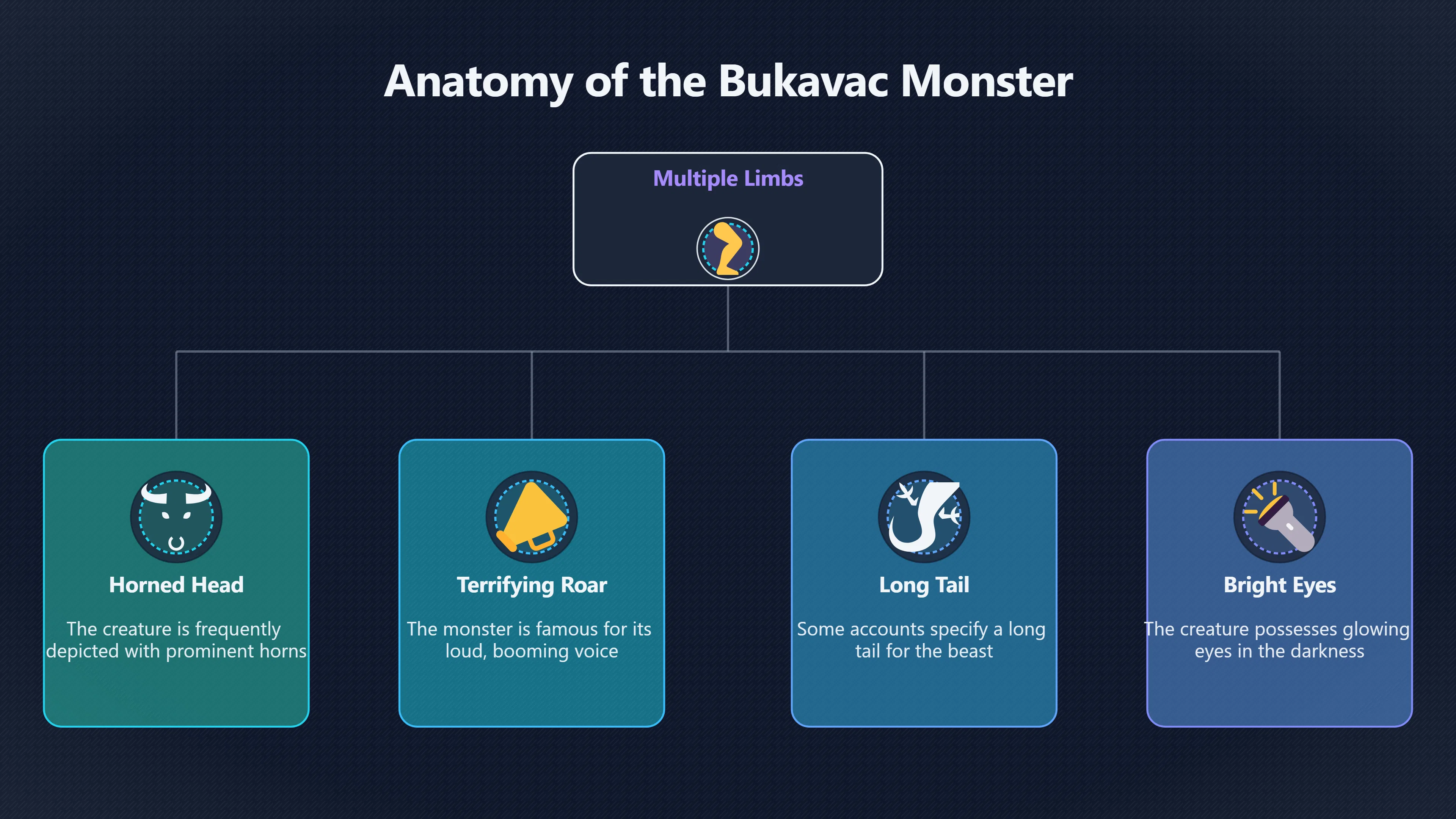
The Bukavac is the most distinctive Serbian water monster. Traditional descriptions place it in lakes, pools, swamps and slow-moving waters, especially in the Syrmia region. It is usually portrayed as a grotesque beast with multiple legs, horns and a powerful voice. Some accounts describe six legs, bright eyes and a long tail. Others focus less on appearance and more on its terrifying roar.[Wikipedia]WikipediaOpen source on wikipedia.org.
A recurring feature of the legend is noise. The creature’s name is linked to the idea of loud sound or uproar, and stories claim it emerged from water at night to bellow or roar across the landscape. According to folklore, it attacked animals and travellers who ventured too close to its territory after dark. In some versions it leapt onto victims and strangled them.[Wikipedia]WikipediaOpen source on wikipedia.org.
What makes the Bukavac interesting from a modern perspective is that it occupies a space between monster and environmental warning. It is not a creature associated with hidden treasure or magical rewards. Instead, it punishes people who linger around dangerous water at night. In that sense, the legend functions almost like a survival lesson wrapped in a frightening story.
The Bukavac occasionally appears in modern cryptid compilations, but there is little evidence of contemporary eyewitness traditions claiming a real unknown animal. Its roots are overwhelmingly folkloric rather than zoological.[Wikipedia]WikipediaOpen source on wikipedia.org.
River Spirits, Drowning and Dangerous Currents
The Bukavac was not the only supernatural presence linked to Serbian waterways. Folk traditions from different regions describe rivers as places inhabited by spirits, fairies and unseen forces capable of luring, confusing or harming travellers.
Many of these stories served a practical purpose. Waterways are unpredictable. Currents can change rapidly, riverbanks collapse and deep pools may appear deceptively calm from the surface. Communities without modern rescue services often explained such dangers through supernatural agency.
In parts of eastern Serbia, river locations acquired reputations as enchanted places where spirits gathered or where supernatural beings interacted with humans. Folklore surrounding rivers such as the Zamna includes beliefs in magical waters, gatherings of fairies and the presence of water spirits inhabiting particular stretches of the landscape.[Wikipedia]WikipediaOpen source on wikipedia.org.
These traditions did not usually describe a single identifiable monster. Instead, they created a broader cultural idea that certain waters were inhabited, aware and potentially hostile. That atmosphere helped later generations interpret unusual events through a supernatural lens.

Storm Beasts and the Battle for the Weather
Serbian folklore also populated the sky with supernatural forces. Hailstorms and violent weather could devastate crops, making storms one of the greatest threats to rural life. As a result, folk belief developed figures that either caused storms or fought against them.
One important tradition concerns extraordinary individuals known in different regions as weather fighters or protectors. Stories held that these people could leave their bodies in spirit during sleep and battle beings responsible for destructive storms, hail and torrential rain. Their task was to divert dangerous clouds away from villages and fields.[Wikipedia]WikipediaOpen source on wikipedia.org.
In southern Serbian and wider Balkan traditions, storm-bringing entities were sometimes imagined as monstrous beings leading hail clouds across the countryside. Folk narratives described aerial battles in which supernatural defenders intercepted these forces before crops were destroyed.[Wikipedia]WikipediaOpen source on wikipedia.org.
Although these figures are not cryptids in the modern sense, they belong to the same tradition of explaining natural dangers through creature stories. Just as the Bukavac explained the hazards of dark water, storm beings explained the terrifying power of weather.
Wildlife Sounds Behind Hidden Monster Voices
One of the most revealing aspects of Serbian water-monster folklore is its emphasis on sound.
The Bukavac is remembered primarily for its roar. Yet wetlands are naturally noisy places. Frogs, bitterns, waterfowl, foxes and other animals can produce startling calls, especially at night. Across Europe, booming bittern calls in marshes have historically inspired stories about hidden monsters because the source is difficult to locate in darkness.
Water itself can also generate mysterious sounds. Wind moving through reeds, waves striking banks and echoes across open wetlands can create noises that seem to come from invisible creatures. For people living before electric lighting and modern acoustic knowledge, such sounds could be genuinely unsettling.
This does not mean the Bukavac originated from one specific animal. Folklore rarely has a single source. Instead, unusual sounds, dangerous water and inherited stories reinforced one another over generations, creating a monster that felt entirely real within its cultural setting.
From Folk Demon to Modern Monster
Today the Bukavac survives mostly in folklore collections, mythology references and cryptid catalogues rather than in active monster hunts. Its importance lies less in the possibility of an unknown animal and more in what it reveals about Serbian attitudes toward water and wilderness.
The creature stands at the meeting point of environmental reality and imagination. Marshes were dangerous, night sounds were unsettling and rivers could kill without warning. A six-legged roaring beast emerging from dark water gave those fears a memorable shape.[Wikipedia]WikipediaOpen source on wikipedia.org.
For readers exploring Serbia’s mystery-creature traditions, the Bukavac and related storm beings are a reminder that not every monster story begins with a claimed sighting. Sometimes the monster arrives first, carrying generations of local experience about floods, storms, deep water and the strange noises that echo across wetlands after sunset.
Amazon book picks
Further Reading
No matched book cards were available for Why Serbian Folklore Is Full of Water Beasts, so this fallback keeps a direct Amazon reading path visible.
Topical books
Serbian river folklore guide
Browse books, explainers and reference titles related to this topic.
Search AmazonRelated search
Serbian water monsters guide
Browse books, explainers and reference titles related to this topic.
Search AmazonRelated search
Bukavac folklore guide
Browse books, explainers and reference titles related to this topic.
Search AmazonEndnotes
1.
Source: Wikipedia
Link:https://en.wikipedia.org/wiki/Bukavac
2.
Source: Wikipedia
Link:https://en.wikipedia.org/wiki/Zduha%C4%87
3.
Source: Wikipedia
Link:https://en.wikipedia.org/wiki/Zamna
4.
Source: mythbeasts.com
Link:https://mythbeasts.com/beast/bukavac/
Source snippet
Six-Horned Water Demon from Serbian River FolkloreBooks: In Serbian folklore anthologies, the Bukavac often appears as a featured creatur...
5.
Source: facebook.com
Title: bukavac serbian mythologyhave you ever heard the story of a lake monsterthat ha
Link:https://www.facebook.com/amazingfactswow1/posts/-bukavac-serbian-mythologyhave-you-ever-heard-the-story-of-a-lake-monsterthat-ha/1204523172739587/
Source snippet
Bukavac | Serbian Mythology Have you...16 Jun 2026 — ▫Bukavac Bukavac is demonic creature from Southern Slavic tales... ▫Psoglav Psogla...
6.
Source: auntyflo.com
Link:https://www.auntyflo.com/magic/bukavac
Additional References
7.
Source: mythus.fandom.com
Link:https://mythus.fandom.com/wiki/List_of_Slavic_creatures
Source snippet
of Slavic creatures | Myth and Folklore Wiki - FandomBukavac is a demonic creature from Southern Slavic tales, especially of...
8.
Source: facebook.com
Link:https://www.facebook.com/SlavicSpirituality/posts/bukavac-is-demonic-creature-from-southern-slavic-tales-especially-of-serbs-that-/1600252213480965/
Source snippet
▫Psoglav Psoglav is demon from Serbian folklore. It is...
9.
Source: cryptidz.fandom.com
Title: Cryptid Wiki Bukavac
Link:https://cryptidz.fandom.com/wiki/Bukavac
Source snippet
Cryptid WikiBukavac - Cryptid Wiki - FandomBukavac is a mythical creature in Slavic mythology. Belief in it existed in Srijem (a county n...
10.
Source: youtube.com
Title: Water Monsters of the Slavs | Slavic Mythology | Myths and Legends
Link:https://www.youtube.com/watch?v=80hNdsMvqOk
Source snippet
Bauk The Terrifying Serbian Folklore Monster...
11.
Source: obscure.gamepuppet.com
Link:https://obscure.gamepuppet.com/data/bukavac.htm
Source snippet
Obscure Life-FormsBukavac (Serbo-Croatian) is a demonic mythical creature in Slavic mythology. Belief in it existed in Syrmia. Bukavac wa...
12.
Source: reddit.com
Link:https://www.reddit.com/r/serbia/comments/uqiyf3/what_are_some_mythical_creatures_or_beings_that/
13.
Source: instagram.com
Link:https://www.instagram.com/p/DWp_taWjDwE/
14.
Source: instagram.com
Link:https://www.instagram.com/p/B664ruOHN6P/
15.
Source: instagram.com
Link:https://www.instagram.com/p/C891c0IIoWS/?hl=en
16.
Source: youtube.com
Title: Monsters of Slavic Mythology
Link:https://www.youtube.com/watch?v=UrGXs6AX8O4
Source snippet
Water Monsters of the Slavs | Slavic Mythology | Myths and Legends...
Amazon book picks
Further Reading
Books and field guides related to Why Serbian Folklore Is Full of Water Beasts. Use these as the next step if you want deeper reading beyond the article.
Russian Fairy Tales (Illustrated by Ivan Bilibin)
Contains related Slavic creature motifs and water-spirit themes.

The Penguin Book of Dragons
Useful for understanding dragon and monster traditions in Eastern Europe.
The Book of Imaginary Beings
Broad survey of mythological creatures and monster archetypes.
Topic Tree