Within South Sudan Cryptids
Was the Lau Ever a Real Animal?
The lau appears in local vocabulary and colonial reports, but every claimed specimen or extraordinary measurement breaks down under scrutiny.
On this page
- The 1929 dictionary entry
- Travellers, hunters and second hand testimony
- Missing bones and broken chains of evidence
Page outline Jump by section
Introduction
The lau is South Sudan’s most famous mystery animal, but the earliest evidence for it is far less dramatic than later retellings suggest. At the heart of the legend lies a simple fact: people living around the Upper Nile wetlands had a name for a feared water creature, and that name entered written records during the colonial period. What never appeared was the kind of evidence that would establish the lau as a real, unknown species.
The earliest references describe a dangerous aquatic animal associated with the marshes of what is now South Sudan, particularly the Sudd, Lake No and neighbouring Nile channels. Yet every supposed specimen, bone, measurement or physical trace either vanished, lacked documentation, or turned out to be compatible with known animals. The result is a fascinating case in which folklore, local ecological knowledge and colonial curiosity produced a famous monster tradition without producing a convincing zoological record.[ia801308.us.archive.org]ia801308.us.archive.orgNuer-English Dictionarylou big water animal much feared. (now extinct, possibly mythical) lou white… Huffman, Ray. 8576. Nuer-English…
Was the Lau Ever a Real Animal?
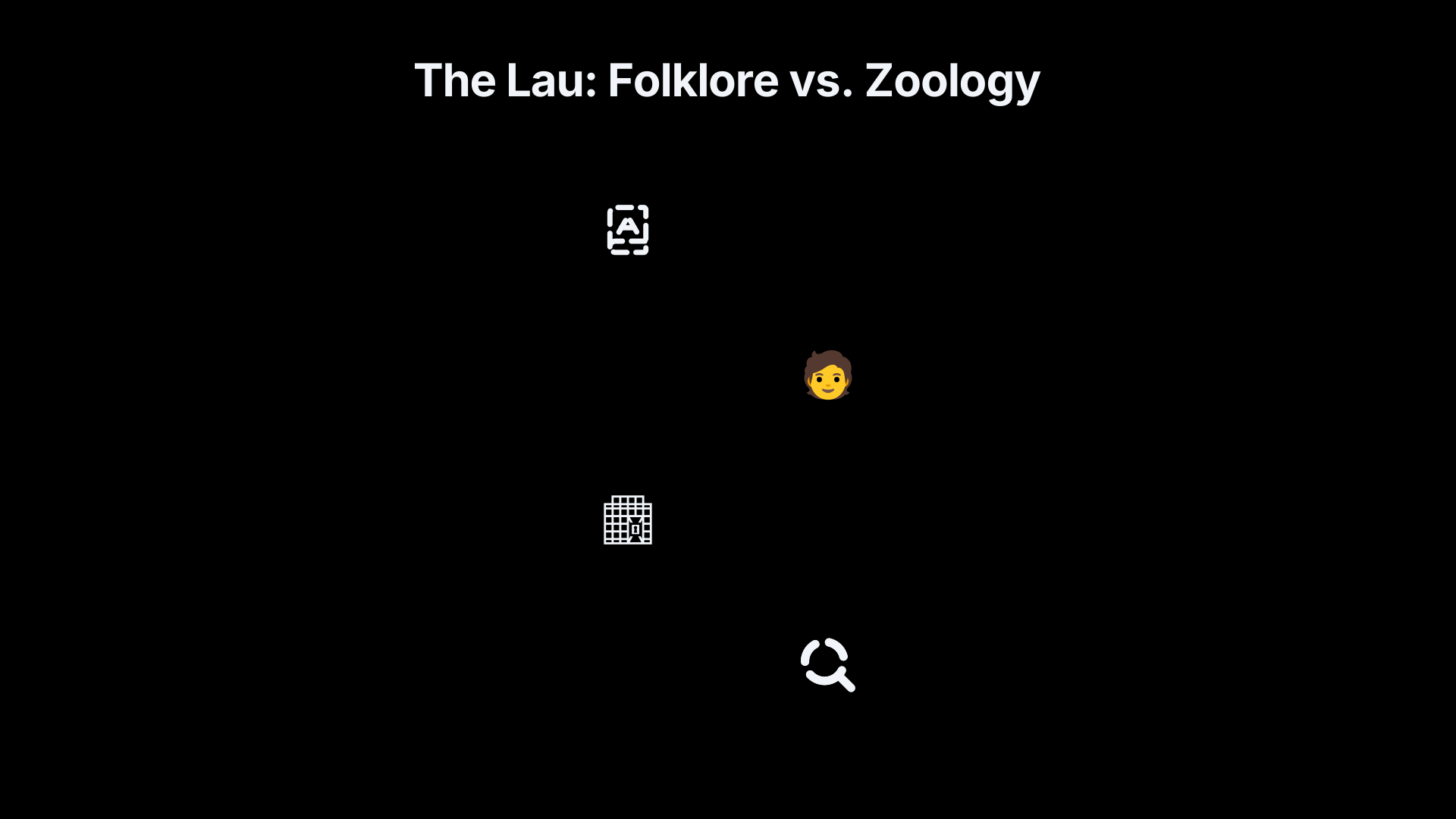
The strongest evidence that the lau existed as a recognised creature in local tradition comes from language rather than biology. The name was known among Nuer speakers and was important enough to be recorded by missionaries and administrators working in the region during the early twentieth century. That tells us the creature was culturally real, but it does not tell us whether it represented an undiscovered species, an exaggerated version of a known animal, or a supernatural being.
This distinction matters because many later cryptozoological accounts blur together folklore and zoology. The historical record shows that the lau was already being treated with uncertainty by some of the people who first wrote about it. Even early collectors noted that reports were inconsistent and that witnesses often relied on stories passed down by others rather than direct observation.[cryptidarchives.fandom.com]cryptidarchives.fandom.comEncyclopaedia of Cryptozoology - FandomThe lau was a cryptid reported from the marshes of the White Nile, in what is now South Sudan, des…
The 1929 Dictionary Entry
The most important early document is Ray Huffman’s Nuer-English Dictionary, published in 1929. Under the entry “lou”, Huffman recorded it simply as a “big water animal much feared” and added a striking note: “now extinct, possibly mythical.”[ia801308.us.archive.org]ia801308.us.archive.orgNuer-English Dictionarylou big water animal much feared. (now extinct, possibly mythical) lou white… Huffman, Ray. 8576. Nuer-English…
That brief definition is valuable for several reasons.
First, it confirms that the creature was part of local vocabulary rather than a later invention by cryptozoologists. Second, it shows that uncertainty surrounded the animal even in the 1920s. Huffman did not describe a specimen, provide measurements or cite a recent sighting. Instead, the entry treats the lou as something remembered and feared, but already regarded by some informants as either vanished or legendary.[ia801308.us.archive.org]ia801308.us.archive.orgNuer-English Dictionarylou big water animal much feared. (now extinct, possibly mythical) lou white… Huffman, Ray. 8576. Nuer-English…
For historians of folklore, this tiny dictionary entry is actually stronger evidence than many sensational monster stories. It is a contemporary record showing that the name existed in local usage. At the same time, it is weak zoological evidence because it provides no anatomical details and no physical proof that such an animal ever lived.
Travellers, Hunters and Second-Hand Testimony
The more elaborate lau stories entered print through colonial-era travellers, hunters and officials. One of the most frequently cited sources was information gathered from a telegraph operator and hunter named Stephens, who collected stories from people living in the Nile marshes. These accounts placed the creature in wetlands stretching between Malakal, Lake No, Shambe and other Upper Nile locations.[cryptidarchives.fandom.com]cryptidarchives.fandom.comEncyclopaedia of Cryptozoology - FandomThe lau was a cryptid reported from the marshes of the White Nile, in what is now South Sudan, des…
Descriptions varied considerably. Some witnesses reportedly described a gigantic python-like animal. Others spoke of an enormous water beast with whisker-like appendages, tentacles or coarse hairs around the head. Length estimates ranged from plausible sizes to extraordinary claims of forty feet or more.[cryptidarchives.fandom.com]cryptidarchives.fandom.comEncyclopaedia of Cryptozoology - FandomThe lau was a cryptid reported from the marshes of the White Nile, in what is now South Sudan, des…
The problem is that nearly all of this testimony was second-hand. The stories were often collected from people recounting what relatives, neighbours or earlier generations had reported. As the chain of narration lengthened, the creature became larger and stranger. Features such as tentacles, booming calls and deadly magical powers entered the tradition, making it increasingly difficult to separate possible animal observations from folklore.
Even later enthusiasts who took the lau seriously recognised the contradictions. Some descriptions resemble giant snakes. Others suggest enormous catfish. Still others sound closer to spirit creatures than biological animals. The lack of a consistent description is one reason researchers have struggled to treat the lau as a single identifiable species.[cryptidarchives.fandom.com]cryptidarchives.fandom.comEncyclopaedia of Cryptozoology - FandomThe lau was a cryptid reported from the marshes of the White Nile, in what is now South Sudan, des…

Missing Bones and Broken Chains of Evidence
The most intriguing claims involved physical remains. Stephens reportedly received bones that local people identified as belonging to a lau and wore as protective charms or talismans. If genuine remains had survived, they might have provided the strongest evidence in the entire case.[cryptidarchives.fandom.com]cryptidarchives.fandom.comEncyclopaedia of Cryptozoology - FandomThe lau was a cryptid reported from the marshes of the White Nile, in what is now South Sudan, des…
Instead, the trail ends almost immediately.
The bones were never scientifically described in a way that would allow independent verification. No museum specimen appears to have been preserved. Later commentary suggested that the remains were not unusually large and could have come from ordinary pythons or other known animals. Without documented collection data, photographs or surviving material, the alleged bones contribute very little to the case.[cryptidarchives.fandom.com]cryptidarchives.fandom.comEncyclopaedia of Cryptozoology - FandomThe lau was a cryptid reported from the marshes of the White Nile, in what is now South Sudan, des…
This pattern repeats throughout the history of the lau. Reports mention tracks, carcasses, attacks and remains, but the evidence disappears whenever it approaches scientific scrutiny. There are no verified skeletons, no preserved skins, no teeth with reliable provenance and no modern photographs accepted by zoologists. Every chain of evidence breaks before reaching a point where it can be tested.
Why the Evidence Keeps Collapsing
One explanation is that the lau was never a single creature at all. Some researchers have argued that the name may have functioned as a catch-all label for large, dangerous water animals encountered in the wetlands. Under that interpretation, reports could have mixed observations of crocodiles, African rock pythons, giant catfish and other aquatic wildlife into a single legendary beast.[cryptidarchives.fandom.com]cryptidarchives.fandom.comEncyclopaedia of Cryptozoology - FandomThe lau was a cryptid reported from the marshes of the White Nile, in what is now South Sudan, des…
The geography of the Upper Nile encourages this process. The Sudd and surrounding marshes are vast, difficult to navigate and rich in wildlife. People living in such landscapes naturally develop stories about dangerous creatures, especially when genuine hazards already exist. A fisherman seeing a massive catfish, a hunter encountering a giant python and a traveller hearing a distant unexplained sound might all contribute pieces to the same tradition.
The conflicting descriptions also fit this interpretation. A whiskered lau points toward catfish. A serpent-like lau points toward pythons. A monstrous water predator with supernatural qualities belongs more to folklore than zoology. Rather than identifying an unknown animal, the legend may preserve several overlapping traditions under one name.[cryptidarchives.fandom.com]cryptidarchives.fandom.comEncyclopaedia of Cryptozoology - FandomThe lau was a cryptid reported from the marshes of the White Nile, in what is now South Sudan, des…

What the Earliest Evidence Actually Proves
The earliest evidence for the lau proves less than believers hope and more than sceptics sometimes acknowledge.
It does not prove that a giant unknown animal lived in South Sudan. No verified specimen, photograph or anatomical description supports that conclusion. The extraordinary size claims and dramatic stories remain unconfirmed.[cryptidarchives.fandom.com]cryptidarchives.fandom.comEncyclopaedia of Cryptozoology - FandomThe lau was a cryptid reported from the marshes of the White Nile, in what is now South Sudan, des…
However, the evidence does prove that the lau was a genuine part of local tradition before modern cryptozoology popularised it. The 1929 dictionary entry and related colonial-era records show that people around the Upper Nile recognised the name and associated it with a feared water creature. The legend was not invented by later writers; it already existed in local memory.[ia801308.us.archive.org]ia801308.us.archive.orgNuer-English Dictionarylou big water animal much feared. (now extinct, possibly mythical) lou white… Huffman, Ray. 8576. Nuer-English…
That leaves the lau in an unusual position. As a cultural tradition, it is well attested. As a biological animal, it remains unproven. The earliest records preserve a fascinating glimpse of how stories about dangerous wetlands, real wildlife and community memory can merge into one of South Sudan’s most enduring mystery-animal legends.[ia801308.us.archive.org]ia801308.us.archive.orgNuer-English Dictionarylou big water animal much feared. (now extinct, possibly mythical) lou white… Huffman, Ray. 8576. Nuer-English…
eBay marketplace picks
Marketplace Samples
Live-tested eBay searches with available results related to this page.




Endnotes
1.
Source: ia801308.us.archive.org
Link:https://ia801308.us.archive.org/10/items/nuerenglishdicti00huffuoft/nuerenglishdicti00huffuoft.pdf
Source snippet
Nuer-English Dictionarylou big water animal much feared. (now extinct, possibly mythical) lou white... Huffman, Ray. 8576. Nuer-English...
2.
Source: cryptidarchives.fandom.com
Link:https://cryptidarchives.fandom.com/wiki/Lau
Source snippet
Encyclopaedia of Cryptozoology - FandomThe lau was a cryptid reported from the marshes of the White Nile, in what is now South Sudan, des...
3.
Source: archive.org
Title: Cryptozoology djvu.txt
Link:https://archive.org/stream/Cryptozoology_201608/Cryptozoology_djvu.txt
Additional References
4.
Source: facebook.com
Title: newspaper headlines for tuesday 7 july 2026nationtinubus reforms need time infra
Link:https://www.facebook.com/OmumuMediaNetwork/posts/newspaper-headlines-for-tuesday-7-july-2026nationtinubus-reforms-need-time-infra/1314932050807452/
Source snippet
NEWSPAPER HEADLINES FOR TUESDAY, 7 JULY, 2026...*NEWSPAPER HEADLINES FOR TUESDAY, 7 JULY, 2026* *NATION* *Tinubu's reforms need time, in...
5.
Source: reddit.com
Title: The lau is a cryptid from the marshes of South Sudan
Link:https://www.reddit.com/r/HighStrangeness/comments/164ku89/the_lau_is_a_cryptid_from_the_marshes_of_south/
Source snippet
It's...The lau is a cryptid from the marshes of South Sudan. It's described as a long serpent with barbs like a catfish. Reports of the...
6.
Source: facebook.com
Link:https://www.facebook.com/TheFolklorePodcast/posts/the-lau-is-a-creature-reported-from-the-south-of-sudan-particularly-in-the-area-/1466371225503793/
Source snippet
a around Lake No where it is said to roam in the swamps...
7.
Source: youtube.com
Link:https://www.youtube.com/watch?v=fTLDiX7AKvQ
Source snippet
g. There is concern that the giant panda will soon become extinct...
8.
Source: youtube.com
Title: Could These Mythical Creatures Be Real?
Link:https://www.youtube.com/watch?v=M9g7nR4vPSo
Source snippet
DG Halloween...Investigating 20 Creatures Humanity Erased from Memory | Deep Dive Documentary. Mr.Ravenhurst · 339K; This Preh...
9.
Source: youtube.com
Link:https://www.youtube.com/watch?v=xhqS3tNIMRo
Source snippet
Why Sudan Split in Two - Sudan's 22-Year Civil War Explained...
10.
Source: dlib.indiana.edu
Link:https://dlib.indiana.edu/collections/nuer/edward/linguistics.html
Source snippet
Development of Nuer Linguistics29 Aug 2003 — His Nuer-English Vocabulary was published posthumously in 1923, four years after his death d...
11.
Source: scribd.com
Link:https://www.scribd.com/document/814192284/cryptid-mustelids-html
12.
Source: trees-dla.ac.uk
Link:https://www.trees-dla.ac.uk/projects/human-or-animal-biomolecular-analysis-upper-palaeolithic-bone-artefacts-explore-raw
13.
Source: thetedkarchive.com
Link:https://www.thetedkarchive.com/library/e-e-evans-pritchard-the-nuer
Topic Tree