Cryptid Reports from Chad's Water and Stone
Chad’s cryptid tradition is not built around one world-famous monster in the way Scotland has Loch Ness. It is more fragmented, and that is part of what makes it interesting.
Page outline Jump by section
Introduction
The most useful way to read Chad’s monster lore is not as a list of “hidden animals waiting to be proven”, but as a set of claims shaped by landscape, memory, animal danger, and the long gap between local knowledge and outside documentation. In Chad, the boundary between folklore, misidentified wildlife, cryptozoological speculation and ecological reality is especially thin.
Why Chad’s mystery animals gather around water and stone
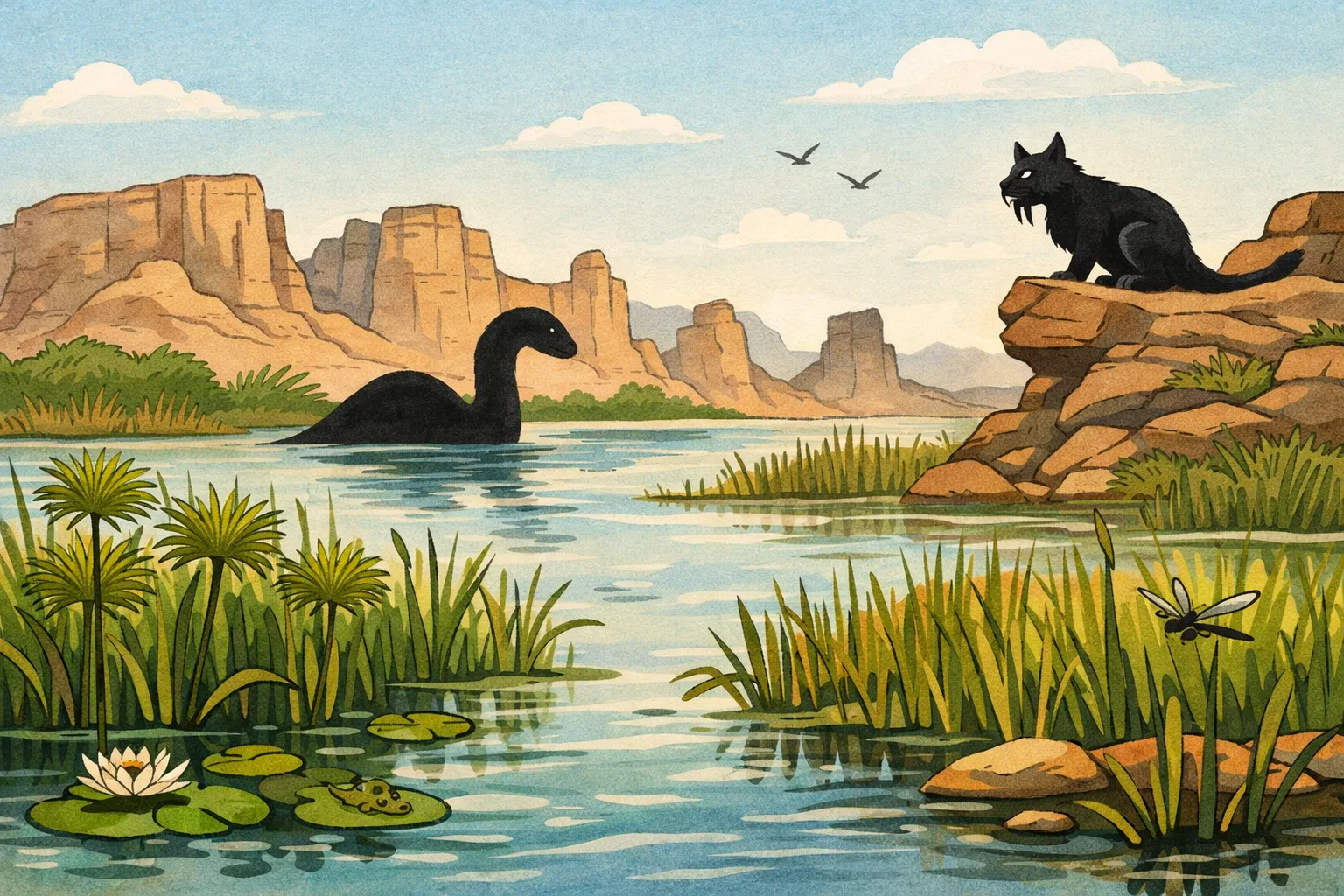
Chad’s monster geography follows the country’s extremes. In the west, Lake Chad is a vast, shifting wetland system shared with Nigeria, Niger and Cameroon. UNESCO’s tentative Lake Chad Cultural Landscape description emphasises its mix of open water, polders, ponds, natron-rich wetlands, islands, papyrus, spirulina, floodplains, fish, birds and long-settled fishing and farming communities. That kind of landscape is ideal for rumours of large animals: reeds hide bodies, water distorts size, and real creatures can be heard or felt before they are clearly seen.[UNESCO World Heritage Centre]whc.unesco.orgWorld Heritage Centre Lake Chad Cultural Landscape (NigeriaWorld Heritage Centre Lake Chad Cultural Landscape (Nigeria
In the east and north-east, the Ennedi Massif provides the opposite kind of monster habitat: dry sandstone cliffs, shaded gorges, gueltas and cave-like spaces. Modern conservation descriptions of Ennedi stress its exceptional contrast: a desert region where waterholes still support monitored wildlife such as red-necked ostrich, addax, dorcas gazelle, Barbary sheep and West African crocodile. A place where crocodiles survive in isolated Saharan pools already feels halfway to legend, even before any “sabre-toothed” cat is added to the story.[African Parks]africanparks.orgAfrican Parks Ennedi Biodiversity Conservation | African ParksAfrican Parks Ennedi Biodiversity Conservation | African Parks
These two environments also explain why Chad’s cryptids are not usually described as ghosts or shapeshifters in the popular paranormal sense. They are normally remembered as animals: cats, aquatic mammals, reptile-like lake creatures, or oversized predators. Their strangeness comes from being too large, in the wrong place, half-hidden, or described with features that do not match any known local species.
The Ennedi “mountain tiger”: Chad’s most distinctive cryptid
The creature most strongly associated with Chad in cryptozoological writing is the Ennedi tiger, often grouped under the French label “tigre de montagne”, meaning mountain tiger. It is usually described as a very large cat-like predator from the Ennedi Plateau, Tibesti Mountains, Guéra Massif and other highland areas. Reports compiled by cryptozoological sources give it names linked to different areas, including hadjel or biscoro in Guéra, nisi or noso in Tibesti, and other regional forms such as yassou in Ouaddaï.[Cryptid Archives]cryptidarchives.fandom.comCryptid Archives Tigre de montagne | Encyclopaedia of Cryptozoology | FandomCryptid Archives Tigre de montagne | Encyclopaedia of Cryptozoology | Fandom
The repeated description is striking: a feline larger than a lion, reddish or brownish, sometimes with pale vertical stripes, a short tail or no obvious tail, and very long canine teeth. Some versions make it cave-dwelling and nocturnal. Others emphasise its strength or its alleged habit of carrying prey. The “sabre-tooth” interpretation is a later cryptozoological framing; local reports do not prove a prehistoric survivor, but they gave writers such as Bernard Heuvelmans and later compilers material for that speculation.[Wikipedia]WikipediaTigre d'EnnediTigre d'Ennedi
The problem is evidence. There is no examined body, skull, skin, clear photograph, camera-trap record or accepted biological specimen. The strongest sources are not zoological papers but cryptozoological summaries that cite earlier travellers, hunters and investigators. The Encyclopaedia of Cryptozoology page notes that the Chad version was reported by hunter Christian Le Noël in the 1960s and lists the alleged Chad localities, but it also relies on specialist cryptozoological literature rather than independently verified field evidence.[Cryptid Archives]cryptidarchives.fandom.comCryptid Archives Tigre de montagne | Encyclopaedia of Cryptozoology | FandomCryptid Archives Tigre de montagne | Encyclopaedia of Cryptozoology | Fandom
A sceptical reading does not require treating the whole tradition as worthless. Large predators can become enlarged in oral retelling, especially when they are rare, dangerous or mostly encountered through tracks, kills and night sounds. Chad has had real large carnivores, and leopards remain relevant to any discussion of mystery cats: the IUCN Red List identifies south-eastern Chad, eastern Central African Republic and western South Sudan as one of Africa’s important leopard strongholds. A leopard glimpsed briefly in poor light, or described by someone emphasising its danger rather than its exact anatomy, could easily feed “unknown cat” traditions.[IUCN Red List]iucnredlist.orgOpen source on iucnredlist.org.
That said, the Ennedi tiger is not simply “a leopard” in the way the legend is told. The very features that make it memorable — huge protruding teeth, cave lairs, a near-tailless body, and a sometimes striped coat — are also the features that make it zoologically doubtful. The animal survives best as a legendary predator of Chad’s highlands: not proven, but tightly attached to a landscape where cliffs, caves, scarce water and real carnivores have always made animal encounters feel dramatic.

Lake Chad’s water monsters and the problem of moving wetlands
Lake Chad’s monster tradition is harder to pin down because the lake itself is not a fixed stage. Its water area has changed enormously over recent decades. FAO described the lake as having shrunk from about 25,000 square kilometres in 1963 to less than 1,500 square kilometres in 2001, while USGS notes that drought and increased water use reduced it to less than a tenth of its 1960s area. More recent reporting and satellite observation complicate the simple “disappearing lake” story, because seasonal and longer-term fluctuations can bring water back into areas that had been dry.[fao.org]fao.orgOpen source on fao.org.
That matters for monster stories. A lake of islands, reeds, channels, floodplains and receding water creates many opportunities for ambiguous sightings. Known animals can appear in unexpected places after floods. Large fish disturb shallow water. Hippos, crocodiles, otters and monitor lizards can be misread when partly submerged. UNESCO’s Lake Chad description lists hippopotamus, Nile crocodile, Nile monitor, turtles, otters, around 120 fish species and more than 350 bird species as part of the wider lake fauna.[UNESCO World Heritage Centre]whc.unesco.orgWorld Heritage Centre Lake Chad Cultural Landscape (NigeriaWorld Heritage Centre Lake Chad Cultural Landscape (Nigeria
Cryptozoological catalogues have attached several mystery-animal claims to Lake Chad, the Dagana Marshes and the Ounianga Lakes. George M. Eberhart’s Mysterious Creatures lists an “Auli”, an unknown sirenian-like animal, with reported distribution including Lake Chad, the Dagana Marshes and Ounianga Lakes. The same entry describes a 1900 or 1901 Dagana Marshes incident in which Dr Auguste Morel, travelling with local fishermen, reportedly encountered a large disturbance in the water that nearly upset boats and left crushed reeds but no tracks. Eberhart also gives possible explanations, including an extended or unconfirmed manatee presence in the Chari–Lake Chad system.[National Digital Library of Ethiopia]ndl.ethernet.edu.etOpen source on edu.et.
The manatee idea is intriguing but weak. West African manatees are real animals, and their secretive behaviour in turbid rivers has often made them a source of rumour elsewhere. But the cited cryptozoological entry itself says their presence in the Chari River and Lake Chad has been suspected, not confirmed. That makes the Auli less a “lost manatee of Chad” than a useful example of how a real animal group can become an explanatory candidate when sightings are large, aquatic and indistinct.[National Digital Library of Ethiopia]ndl.ethernet.edu.etOpen source on edu.et.
Water lions, water elephants and the fossil temptation
Some Chad-linked lake and marsh reports belong to a wider Central African pattern: “water lion” and “water elephant” stories. These are not always Chad-specific, but Chad appears in the same network because Lake Chad was repeatedly imagined by early twentieth-century European writers as a possible refuge for large unknown amphibious animals.[Cryptid Archives]cryptidarchives.fandom.comCryptid Archives Water lionCryptid Archives Water lion
One of the more revealing episodes concerns the Rothschild-Neuville tusk and the old speculation about a surviving Deinotherium, a prehistoric relative of elephants with downward-curving lower tusks. A cryptozoological summary of the case records that French zoologist Édouard Louis Trouessart argued in 1911 for a large marsh-dwelling animal around Central African lakes, “notably Chad”, and that the Paris Museum later sent Émile Gromier and Charles Le Petit on a mission to Lake Chad in search of it. The expedition did not find the supposed animal.[Cryptid Archives]cryptidarchives.fandom.comOpen source on fandom.com.
This is a good example of how cryptid ideas change over time. A local or traveller’s report of a large wetland animal becomes a possible unknown pachyderm; the unknown pachyderm becomes linked to a fossil animal; later writers reassess the idea and point out problems. The same source notes that later discussion rejected or complicated the Deinotherium explanation: terminal Deinotherium species were East African fossils from roughly one to nearly two million years ago, and their size and ecology did not neatly fit the tusk or the open papyrus-marsh image.[Cryptid Archives]cryptidarchives.fandom.comOpen source on fandom.com.
For Chad, the lesson is not that a prehistoric elephant once hid in Lake Chad. It is that European cryptozoology often used Chad’s remoteness, wetlands and incomplete outside surveying as a blank space where fossil-survivor stories could be imagined. The stronger modern interpretation is more modest: large aquatic-animal reports may combine real hippos, crocodiles, manatees beyond confirmed range, big fish, reeds, fear, and retelling.
The known animals behind the legends
Chad does not need invented monsters to feel zoologically surprising. The country’s real fauna already includes animals that can produce monster-like reports when glimpsed briefly or encountered in marginal habitats.
Crocodiles in desert pools are the clearest example. Ennedi’s West African crocodiles are monitored as key species, and the survival of crocodiles in Saharan gueltas is one of the region’s most memorable natural facts. A traveller who hears “crocodiles in the desert” for the first time is already hearing a true story that sounds like folklore.[African Parks]africanparks.orgAfrican Parks Ennedi Biodiversity Conservation | African ParksAfrican Parks Ennedi Biodiversity Conservation | African Parks
Hippos and crocodiles in Lake Chad help explain water-monster claims. WWF described Lake Chad as home to hippopotamuses and Nile crocodiles, while UNESCO’s Lake Chad listing includes those species among the area’s notable fauna. Even where populations are reduced or locally rare, the cultural memory of large dangerous wetland animals can outlast regular sightings.[WWF Panda]wwf.panda.orgwwf newswwf news
Leopards and other carnivores are relevant to the mountain-cat stories. A confirmed leopard is not a sabre-toothed tiger, but rare big cats generate exaggerated accounts across the world. The IUCN’s note on south-eastern Chad as part of an important leopard stronghold makes a known-felid explanation more plausible than a surviving prehistoric cat.[IUCN Red List]iucnredlist.orgOpen source on iucnredlist.org.
Large fish, otters and monitor lizards matter because many water sightings are partial. A slick back, tail, head, wake or reed movement can become a creature in memory, especially if the observer is startled. UNESCO’s Lake Chad fauna list includes otters, Nile monitors and numerous fish species, all of which can contribute to ambiguous water encounters without requiring a new species.[UNESCO World Heritage Centre]whc.unesco.orgWorld Heritage Centre Lake Chad Cultural Landscape (NigeriaWorld Heritage Centre Lake Chad Cultural Landscape (Nigeria
None of these explanations solves every story neatly. Folklore rarely works like a police sketch. But they show why Chad’s cryptids feel attached to real ecosystems rather than floating free as pure fantasy.
Folklore, oral tradition and cryptozoology are not the same thing
A major trap in writing about Chad’s mystery animals is treating all strange creature stories as if they were modern eyewitness reports. Chad has rich oral storytelling traditions, but a folktale is not automatically a cryptid claim. Joseph Brahim Seid’s Told by Starlight in Chad, for example, is widely described as a collection drawing on Chadian fable and oral-story modes rather than a field guide to unknown animals.[Google Books]books.google.comBooks Told by Starlight in ChadBooks Told by Starlight in Chad
That distinction matters. In a folktale, an animal may speak, transform, punish pride, reward cleverness or explain a social rule. In a cryptid report, the claim is usually that someone saw, heard, tracked, killed or narrowly avoided a real animal. Chad’s public-facing monster history needs both categories, but it should not flatten them into one.
The Ennedi tiger sits closer to cryptozoological claim than to ordinary fable because it is presented as a physical predator with locations, names and alleged sightings. The Lake Chad Auli sits in the same uncertain space because it is attached to a reported encounter in a specific marsh. By contrast, literary or moral animal tales from Chadian storytelling are better understood as folklore, even when they contain marvellous creatures.
The changing story around Chad’s cryptid traditions
Chad’s mystery-beast stories seem to have passed through three broad stages.
First came local and regional animal knowledge: names for feared predators, strange wetland disturbances, dangerous water places, and stories linked to hunters, herders, fishermen and travellers. This layer is the hardest to reconstruct because much of it reached print through outsiders.
Second came colonial and early scientific curiosity. European travellers, museum figures and naturalists encountered reports of unknown animals in Central African wetlands and sometimes interpreted them through the zoological debates of their own time. The Lake Chad “water elephant” speculation and the failed search for a possible Deinotherium-like animal belong to this stage.[Cryptid Archives]cryptidarchives.fandom.comOpen source on fandom.com.
Third came modern cryptozoological synthesis. Writers such as Heuvelmans, Eberhart and later online catalogues grouped scattered reports into named categories: “tigre de montagne”, “water lion”, “Auli”, “Lake Chad monster”. This made the stories easier to find, but it also risked making separate local traditions look more unified than they really were.[edu.et]ndl.ethernet.edu.etOpen source on edu.et.
The result is a country file full of vivid creatures but uneven evidence. Chad’s cryptid tradition is therefore best read as a layered archive: local memory at the base, colonial reporting in the middle, and modern monster classification on top.
What would count as better evidence?
For the Ennedi tiger, the evidence would need to move beyond repeated description. A clear camera-trap image, identifiable scat, hair with DNA, a skull, a skin with reliable provenance, or a documented livestock-kill pattern unlike known predators would change the discussion. Modern wildlife monitoring in Ennedi already uses camera traps and surveys for conservation, which makes the absence of a verified giant unknown cat more significant over time.[African Parks]africanparks.orgAfrican Parks Ennedi Biodiversity Conservation | African ParksAfrican Parks Ennedi Biodiversity Conservation | African Parks
For Lake Chad’s aquatic creatures, better evidence would need to separate known species from unknown ones. That means photographs with scale, repeated sightings in the same channel or marsh, environmental DNA sampling, or carcasses examined by zoologists. In a wetland where hippos, crocodiles, otters, monitors and large fish are already part of the ecological picture, “something big moved in the reeds” is not enough.[UNESCO World Heritage Centre]whc.unesco.orgWorld Heritage Centre Lake Chad Cultural Landscape (NigeriaWorld Heritage Centre Lake Chad Cultural Landscape (Nigeria
There is also a practical reason evidence remains thin: Chad’s key monster landscapes are difficult places to survey. Lake Chad’s waters, islands and floodplains shift; security and humanitarian pressures have affected access; Ennedi’s terrain is remote and logistically demanding. Thin evidence does not prove a cryptid, but it does explain why stories can survive without being cleanly resolved.[AP News]apnews.comAP News Report: Climate change fueling conflict in Lake Chad BasinAP News Report: Climate change fueling conflict in Lake Chad Basin
The best reading of Chad’s cryptids today
Chad’s creature lore is strongest when treated as evidence-aware folklore rather than failed zoology. The Ennedi tiger is a memorable highland predator legend, probably shaped by real carnivores, fear of remote caves, and later sabre-tooth speculation. The Lake Chad monsters are better understood as wetland mystery-animal claims produced by reeds, shifting water, dangerous known fauna and occasional reports that were never followed by specimens. The “water elephant” material shows how quickly a vague animal report can become attached to prehistoric-survivor thinking when a region is seen as remote enough to hide almost anything.
The stories remain worth telling because they reveal how people imagine animal danger in Chad’s most dramatic landscapes. In the west, the monster is a disturbance in water, a crushed reed bed, a wake, a body half-seen among islands. In the east, it is a cave predator in red stone country, larger than a lion and armed with impossible teeth. Neither has been proven, but both are rooted in places where the real natural world is already strange enough to keep legends alive.
Amazon book picks
Further Reading
Books and field guides related to What Lurks in Chad's Water and Stone?. Use these as the next step if you want deeper reading beyond the article.
Still in Search of Prehistoric Survivors
Relevant to mountain-tiger and prehistoric-survivor themes.
STILL IN SEARCH OF PREHISTORIC
Relevant to mountain-tiger and prehistoric-survivor themes.

eBay marketplace picks
Marketplace Samples
Example marketplace items related to this page. Use the search link to explore similar finds on eBay.


Endnotes
1.
Source: whc.unesco.org
Title: World Heritage Centre Lake Chad Cultural Landscape (Nigeria)
Link:https://whc.unesco.org/en/tentativelists/6360/
2.
Source: Wikipedia
Title: Tigre d’Ennedi
Link:https://fr.wikipedia.org/wiki/Tigre_d%27Ennedi
3.
Source: fao.org
Link:https://www.fao.org/land-water/news/news-details/es/c/267309/
4.
Source: eros.usgs.gov
Link:https://eros.usgs.gov/earthshots/lake-chad-west-africa
5.
Source: wwf.panda.org
Title: wwf news
Link:https://wwf.panda.org/wwf_news/?187921%2FDecade-old-dream-comes-true-for-Lake-Chad=
6.
Source: books.google.com
Title: Books Told by Starlight in Chad
Link:https://books.google.com/books/about/Told_by_Starlight_in_Chad.html?id=J9eOAAAAMAAJ
7.
Source: archive.org
Link:https://archive.org/stream/Cryptozoology_201608/Cryptozoology_djvu.txt
8.
Source: ia802806.us.archive.org
Link:https://ia802806.us.archive.org/16/items/islaminsubsahara0000zogh/islaminsubsahara0000zogh.pdf
9.
Source: archive.org
Link:https://www.archive.org/stream/1902proceedings00inteuoft/1902proceedings00inteuoft_djvu.txt
10.
Source: archive.org
Link:https://archive.org/stream/ArabicDialects/Arabic%20Dialects_djvu.txt
11.
Source: portals.iucn.org
Link:https://portals.iucn.org/library/node/19216
12.
Source: worldheritageoutlook.iucn.org
Link:https://worldheritageoutlook.iucn.org/node/1188
13.
Source: iucn.org
Link:https://iucn.org/our-union/commissions/group/iucn-ssc-hyaena-specialist-group
14.
Source: portals.iucn.org
Link:https://portals.iucn.org/library/sites/library/files/documents/1998-013.pdf
15.
Source: iucn.org
Link:https://iucn.org/sites/default/files/import/downloads/iucn_redlist_brochure2.pdf
16.
Source: iucn.org
Link:https://iucn.org/resources/conservation-tool/iucn-red-list-threatened-species
17.
Source: iucn.org
Title: red list 60 years of success report 03.10.25
Link:https://iucn.org/sites/default/files/2025-10/red-list-60-years-of-success-report-03.10.25.pdf
18.
Source: Wikipedia
Title: Lake Chad
Link:https://en.wikipedia.org/wiki/Lake_Chad
19.
Source: Wikipedia
Title: Ennedi Plateau
Link:https://en.wikipedia.org/wiki/Ennedi_Plateau
20.
Source: Wikipedia
Title: Ouadi Rimé Ouadi Achim Faunal Reserve
Link:https://en.wikipedia.org/wiki/Ouadi_Rim%C3%A9-Ouadi_Achim_Faunal_Reserve
21.
Source: Wikipedia
Title: West African mythology
Link:https://en.wikipedia.org/wiki/West_African_mythology
22.
Source: Wikipedia
Title: Striped hyena
Link:https://en.wikipedia.org/wiki/Striped_hyena
23.
Source: fao.org
Link:https://www.fao.org/fishery/organization/lcbc/en
24.
Source: unesdoc.unesco.org
Link:https://unesdoc.unesco.org/ark%3A/48223/pf0000246938
25.
Source: youtube.com
Title: Cryptid Profile: The Ennedi Tiger, Alleged Living Sabre-Tooth Tiger
Link:https://www.youtube.com/watch?v=h8d2QQ7Jb2o
Source snippet
Ennedi Tiger - Some Cryptozoology A-Z...
26.
Source: youtube.com
Title: Ennedi Tiger
Link:https://www.youtube.com/watch?v=hQ_scmRkl7o
Source snippet
cryptid Cryptids and Monsters: Ennedi Tiger, a living sabretooth-tiger found in Sub-Saharan Africa williamdefalco...
27.
Source: africanparks.org
Title: African Parks Ennedi Biodiversity Conservation | African Parks
Link:https://www.africanparks.org/the-parks/ennedi/ennedi-biodiversity-conservation
28.
Source: cryptidarchives.fandom.com
Title: Cryptid Archives Tigre de montagne | Encyclopaedia of Cryptozoology | Fandom
Link:https://cryptidarchives.fandom.com/wiki/Tigre_de_montagne
29.
Source: iucnredlist.org
Link:https://www.iucnredlist.org/species/pdf/254576956
30.
Source: ndl.ethernet.edu.et
Link:https://ndl.ethernet.edu.et/bitstream/123456789/46979/1/George%20M.%20Eberhart.pdf
31.
Source: cryptidarchives.fandom.com
Title: Cryptid Archives Water lion
Link:https://cryptidarchives.fandom.com/wiki/Water_lion
32.
Source: cryptidarchives.fandom.com
Title: Cryptid Archives Water elephant | Encyclopaedia of Cryptozoology
Link:https://cryptidarchives.fandom.com/wiki/Water_elephant
33.
Source: cryptidarchives.fandom.com
Link:https://cryptidarchives.fandom.com/wiki/Rothschild-Neuville_tusk
34.
Source: cryptidarchives.fandom.com
Title: Cryptid Archives Category:Chad
Link:https://cryptidarchives.fandom.com/wiki/Category%3AChad
35.
Source: apnews.com
Title: AP News Report: Climate change fueling conflict in Lake Chad Basin
Link:https://apnews.com/article/f17edcd6e0dbe3e6a5411b7de7911537
36.
Source: cryptidarchives.fandom.com
Title: Lake Chad monster
Link:https://cryptidarchives.fandom.com/wiki/Lake_Chad_monster
37.
Source: cryptidarchives.fandom.com
Title: Mourou ngou
Link:https://cryptidarchives.fandom.com/wiki/Mourou-ngou
38.
Source: cryptidz.fandom.com
Title: Ennedi Tiger
Link:https://cryptidz.fandom.com/wiki/Ennedi_Tiger
39.
Source: cryptidz.fandom.com
Title: Water lion
Link:https://cryptidz.fandom.com/wiki/Water_lion
40.
Source: itsmth.fandom.com
Title: Ennedi Tiger
Link:https://itsmth.fandom.com/wiki/Ennedi_Tiger
41.
Source: itsmth.fandom.com
Link:https://itsmth.fandom.com/wiki/Hadjel
42.
Source: animals-are-cool.fandom.com
Title: Ennedi Tiger
Link:https://animals-are-cool.fandom.com/wiki/Ennedi_Tiger
43.
Source: toonboyfans2022.fandom.com
Title: Ennedi Tiger
Link:https://toonboyfans2022.fandom.com/wiki/Ennedi_Tiger
44.
Source: cryptidz.fandom.com
Title: Hadjel (cryptid)
Link:https://cryptidz.fandom.com/wiki/Hadjel_%28cryptid%29
45.
Source: cryptidz.fandom.com
Title: Auli (Africa)
Link:https://cryptidz.fandom.com/wiki/Auli_%28Africa%29
46.
Source: cryptidarchives.fandom.com
Title: Les Derniers Dragons d’Afrique
Link:https://cryptidarchives.fandom.com/wiki/Les_Derniers_Dragons_d%27Afrique
47.
Source: cryptidarchives.fandom.com
Link:https://cryptidarchives.fandom.com/wiki/Category%3AAfrica
48.
Source: iucnredlist.org
Title: IUC N Red List No information is available for this page
Link:https://www.iucnredlist.org/search?query=Caracal+caracal&searchType=species
49.
Source: iucnredlist.org
Link:https://www.iucnredlist.org/es/search?searchType=species&taxonomies=100041
50.
Source: iucnredlist.org
Link:https://www.iucnredlist.org/fr/search/map?searchType=species&taxonomies=101738
51.
Source: iucnredlist.org
Link:https://www.iucnredlist.org/species/pdf/50659089/attachment
52.
Source: iucnredlist.org
Title: country codes
Link:https://www.iucnredlist.org/resources/country-codes
53.
Source: weekly-wonder-blog.tumblr.com
Link:https://weekly-wonder-blog.tumblr.com/page/24
54.
Source: explore-chad.org
Title: The Ennedi Massif
Link:https://explore-chad.org/en/the-ennedi-massif/
55.
Source: pinterest.com
Link:https://www.pinterest.com/pin/720716746679064503/
56.
Source: iucnredlist-doi-pdfs.s3.eu-west-1.amazonaws.com
Link:https://iucnredlist-doi-pdfs.s3.eu-west-1.amazonaws.com/IUCN.UK.2020-1.RLTS.T15954A163991139.en.5.pdf?X-Amz-Algorithm=AWS4-HMAC-SHA256&X-Amz-Credential=REDACTED&X-Amz-Date=20260705T131119Z&X-Amz-Expires=7200&X-Amz-Signature=REDACTED&X-Amz-SignedHeaders=host
57.
Source: omc.obta.al.uw.edu.pl
Link:https://www.omc.obta.al.uw.edu.pl/myth-survey/country/43
58.
Source: news.mongabay.com
Title: african parks to manage gorges rock art and crocodiles of chads ennedi
Link:https://news.mongabay.com/2018/02/african-parks-to-manage-gorges-rock-art-and-crocodiles-of-chads-ennedi/
59.
Source: ebsco.com
Link:https://www.ebsco.com/research-starters/earth-and-atmospheric-sciences/lake-chad
60.
Source: christoph.today
Link:https://christoph.today/chad/
Additional References
61.
Source: youtube.com
Title: The Ennedi Tiger: A Living Sabertooth?
Link:https://www.youtube.com/watch?v=_8WqQtiWc4k
Source snippet
Cryptids and Monsters: Ennedi Tiger, a living sabretooth-tiger found in Sub-Saharan Africa...
62.
Source: youtube.com
Link:https://www.youtube.com/watch?v=fEQPjpTh9-g
Source snippet
The Hidden Cryptids of Africa...
63.
Source: facebook.com
Link:https://www.facebook.com/CopernicusEU/posts/copernicus-for-ecosystems-monitoringlake-chad-was-once-one-of-the-largest-lakes-/549831367185846/
64.
Source: academia.edu
Link:https://www.academia.edu/342224/Panthera_onca_Jaguar_THE_IUCN_RED_LIST_OF_THREATENED_SPECIES
65.
Source: researchgate.net
Link:https://www.researchgate.net/publication/235967597_Vulnerability_of_Striped_Hyaenas_Hyaena_hyaena_in_a_human-dominated_landscape_of_Central_Iran
66.
Source: safaritalk.net
Link:https://www.safaritalk.net/topic/20810-beyond-the-red-list-rising-from-the-ashes-in-the-ouadi-rim%C3%A9-ouadi-achim-game-reserve-tchad/
67.
Source: researchgate.net
Link:https://www.researchgate.net/publication/339352091_DYING_LAKE_CHAD_ADAPTIVE_STRATEGIES_TO_CLIMATE_CHANGE_AND_WATER_SCARCITY_OF_THE_LAKE_CHAD_BASIN
68.
Source: messybeast.com
Link:https://messybeast.com/genetics/anomalous-bigcats.html
69.
Source: facebook.com
Link:https://www.facebook.com/wildlifeatrisk/posts/africas-lake-chad-is-a-sliver-of-its-former-self-and-irans-lake-urmia-has-shrunk/1229047177230120/
70.
Source: wildcatconservation.org
Link:https://wildcatconservation.org/wild-cats/africa/african-golden-cat/
Topic Tree
Follow this branch
Related pages 192
- Antigua Cryptids
- Maldives Monsters
- Malta Monsters
- Qatar Monsters
- Argentina Monsters
- +187 more in sidebar