Within Slovenian Monsters
Why Did Slovenia's Karst Landscape Breed Dragons?
Stories from Zaplana, Rodik and other karst landscapes turned floods, springs and unstable ground into signs of hidden dragons.
On this page
- Dragons Beneath Springs, Hills and Villages
- Zaplana, Rodik and Place Based Traditions
- Floods, Tremors and Natural Explanations
Page outline Jump by section
Introduction
Slovenia’s underground dragon stories did not emerge from empty fantasy. They grew out of one of Europe’s most unusual landscapes: the limestone karst of south-western and central Slovenia, where rivers disappear underground, springs burst unexpectedly from hillsides, caves stretch for kilometres beneath villages and floodwaters can seem to arrive from nowhere. In this environment, dragons became a way of explaining hidden forces that people could observe but not fully understand. Rather than soaring above castles, many Slovenian dragons lived beneath the ground, inside mountains, caves and subterranean lakes. Their movements were said to trigger floods, tremors and strange changes in the landscape. Over time, specific places such as Zaplana and Rodik developed their own dragon traditions, turning local geology into living folklore.[openedition.org]journals.openedition.orgOpenEdition JournalsThe Mythological Landscape of Rodik: Oral Tradition and…22 Jul 2022 — The article discusses the rich oral traditio…

Why Did Slovenia’s Karst Landscape Breed Dragons?
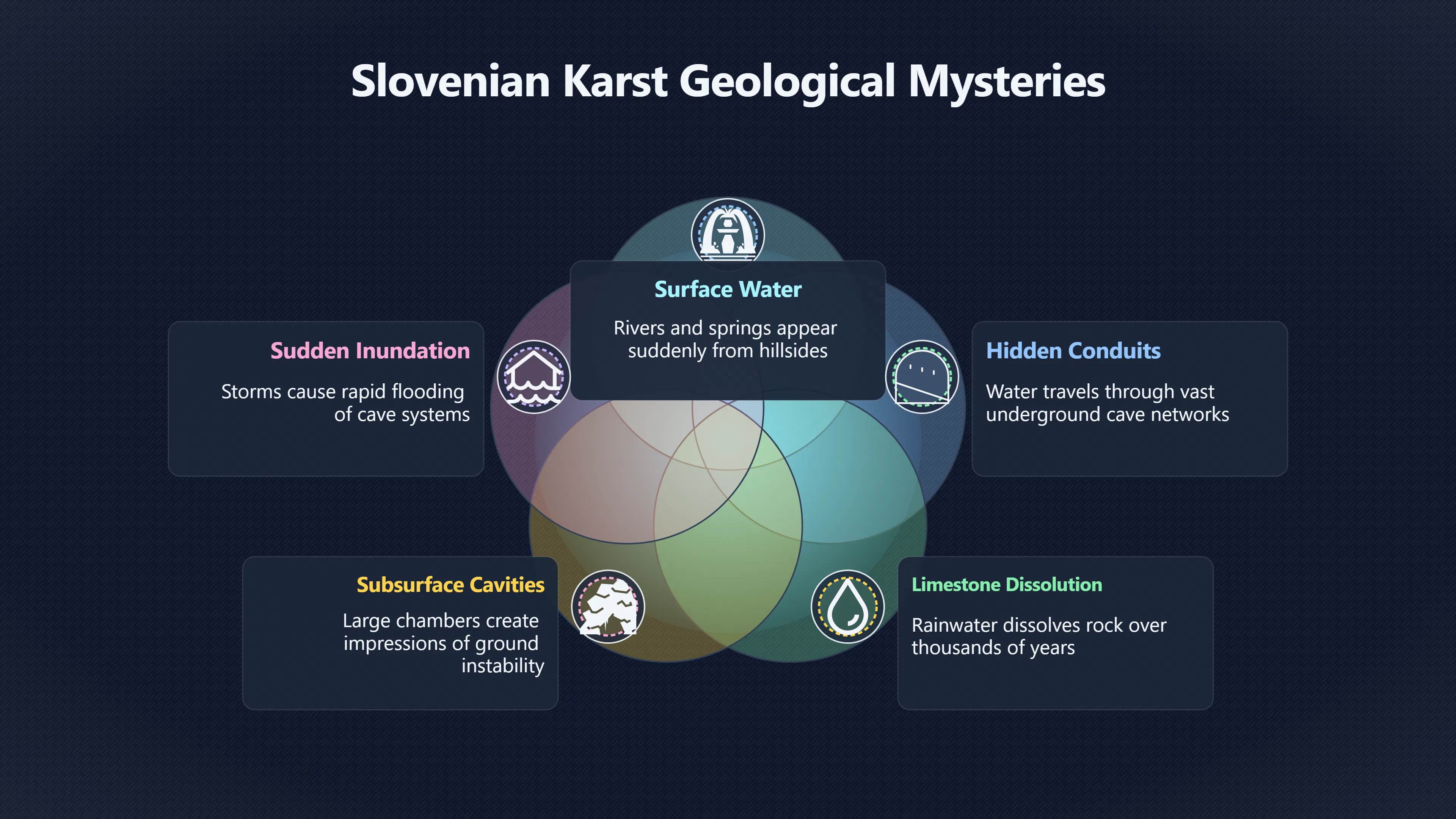
Karst terrain creates natural mysteries. Rainwater dissolves limestone over thousands of years, forming sinkholes, underground rivers, caverns and hidden chambers. Water may vanish into the earth and reappear many kilometres away. Entire cave systems can flood rapidly after storms, while springs that seem dormant suddenly begin flowing again. In pre-scientific communities, these events demanded explanations.
The Slovenian Karst and neighbouring Dinaric karst regions are especially dramatic examples of this process. Rivers such as the Reka disappear underground, travel through vast cave networks and re-emerge elsewhere. Heavy rainfall can produce spectacular surges of underground water, creating floods that appear disconnected from visible rivers on the surface.[Wikipedia]WikipediaŠkocjan Caves Regional ParkŠkocjan Caves Regional Park
Folklore answered these puzzles with dragons. If water erupted from a hillside, perhaps a dragon had stirred below. If a flood arrived unexpectedly, perhaps an underground beast had shifted in its lair. The dragon became a narrative mechanism linking visible effects to invisible causes. In this sense, Slovenian dragon legends functioned less as monster sightings and more as folk geology.[OpenEdition Journals]journals.openedition.orgOpenEdition JournalsThe Mythological Landscape of Rodik: Oral Tradition and…22 Jul 2022 — The article discusses the rich oral traditio…
Dragons Beneath Springs, Hills and Villages
Many Slovenian dragon traditions are tied directly to places where water emerges from underground. Springs were especially important because they represented visible connections between the human world and the unseen realm below.
One recurring pattern involves a dragon dwelling inside a cave or beneath a hill, controlling subterranean waters. When the creature became restless, floods followed. Similar stories attached dragons, serpents or other powerful beings to enclosed hills that were believed to contain dangerous quantities of water. Folklore collected from the Karst region describes hills whose collapse or disturbance could unleash catastrophic flooding upon nearby settlements.[CO Meeting Organizer]meetingorganizer.copernicus.orgCO Meeting Organizer Mythological landscape of Karst, SloveniaFrom the…12 Jun 2026 — Another cosmic mountain is Nanos, which was believed to stand on pillars, and if they were to collapse, the reg…
The logic was understandable. Villagers could see water emerging from caves and springs but could not see the underground channels feeding them. The dragon provided a memorable explanation for a hidden hydrological system.
These stories also reflected genuine danger. Karst landscapes can experience sudden inundation, unstable ground and dramatic changes in water flow. What modern geology explains through limestone erosion and underground drainage networks was once interpreted through the behaviour of powerful subterranean creatures.[Wikipedia]WikipediaŠkocjan Caves Regional ParkŠkocjan Caves Regional Park
Zaplana, Rodik and Place-Based Traditions
Zaplana’s hidden dragons
The plateau of Zaplana, south-west of Ljubljana, preserves some of Slovenia’s strongest associations between dragons and the underground world. Local tradition connected the heavily forested landscape with dragon activity, and the area became linked to stories about dragon births and hidden lairs. Modern cultural presentations of the folklore still emphasise Zaplana as a place where dragons belong naturally to the landscape rather than merely appearing in isolated tales.[KAP Jasa - kite team Slovenia]kapjasa.siA place where dragons live – and are born.Read moreKAP Jasa - kite team SloveniaZaplana: the Birthplace of Dragons6 May 2019 — Vast, deep forests of Zaplana plateau, some 30 km southwest o…
The setting helps explain the tradition. Zaplana lies within a region shaped by karst processes, where caves, springs and concealed waterways contribute to an atmosphere of mystery. The dragon legend effectively transformed geological complexity into a local identity.
Rodik’s mythological landscape
Rodik offers a different but equally revealing example. Folklore researchers have documented a remarkably rich mythological landscape around the village, including traditions concerning the creature known as the Lintvern, a dragon-like being associated with the local terrain. Rather than existing as a single story, the dragon formed part of a broader network of myths tied to specific rocks, hills, caves and pathways.[OpenEdition Journals]journals.openedition.orgOpenEdition JournalsThe Mythological Landscape of Rodik: Oral Tradition and…22 Jul 2022 — The article discusses the rich oral traditio…
The landscape itself became a story map. Certain locations were remembered because something supernatural was believed to have happened there. In modern times, this heritage has been preserved through the Rodik Mythical Park, which interprets local folklore within the physical environment that inspired it.[potkamna.si]potkamna.siOpen source on potkamna.si.
Rodik demonstrates how Slovenian dragon traditions were often inseparable from place. The creature mattered because it explained a particular hill, spring, cave or geological feature known to the community.
The “Baby Dragons” That Seemed to Confirm the Legends
What made Slovenia’s underground dragon stories unusually persuasive was the occasional appearance of a real animal that seemed to support them.
Heavy rains sometimes washed pale cave-dwelling salamanders out of underground systems and into springs. To local observers, these creatures looked extraordinary: white-skinned, elongated, blind and unlike familiar surface animals. People concluded that they must be the offspring of a much larger hidden dragon living underground.[postojnska-jama.eu]postojnska-jama.euBaby Dragons' Secret StoriesPeople in the Karst were used to living surrounded by caves, shafts, intermittent rivers, lakes and unusual s…
The animal was the olm, now recognised as one of Europe’s most remarkable cave species. The association was recorded as early as the seventeenth century by the scholar Janez Vajkard Valvasor, who described reports that strange creatures emerging from springs were the young of subterranean dragons.[Wikipedia]WikipediaOpen source on wikipedia.org.
Today the olm remains strongly linked to dragon folklore. Postojna Cave openly embraces the tradition, presenting olms as the legendary “baby dragons” of the Slovenian underground. Conservation campaigns, tourism initiatives and educational programmes continue to use this connection between folklore and biology.[slovenia.info]slovenia.infoI feel SloveniaMeet "baby dragons" in Postojna CaveHuman fish offspring hatched at the Postojna Cave. Learn about the life of dragon babi…
Floods, Tremors and Natural Explanations
From a modern perspective, the underground dragons of Slovenia are best understood as cultural responses to unusual geological processes.
Karst systems behave differently from ordinary landscapes. Water can travel through hidden conduits, accumulate in underground chambers and emerge unpredictably through springs. Cave rivers can rise dramatically during storms, while sinkholes and subsurface cavities create an impression of instability.[Wikipedia]WikipediaŠkocjan Caves Regional ParkŠkocjan Caves Regional Park
To earlier generations, these events appeared mysterious because the mechanisms were invisible. A dragon sleeping beneath a hill was a practical explanation for phenomena that lacked an obvious surface cause.
The persistence of the legends also reflects how well they fit the environment. Slovenia’s karst region genuinely feels as though something is happening beneath the ground. Rivers vanish. Water appears unexpectedly. Strange animals emerge after floods. Hills conceal vast cave systems. Even after scientific explanations became available, the dragon remained a compelling symbol for the hidden world below.
That is why Slovenia’s underground dragons occupy a distinctive place in the country’s mystery-animal traditions. They are not simply monsters. They are folklore shaped directly by geology, turning caves, springs and disappearing rivers into stories that helped communities make sense of a landscape full of unseen forces.[openedition.org]journals.openedition.orgOpenEdition JournalsThe Mythological Landscape of Rodik: Oral Tradition and…22 Jul 2022 — The article discusses the rich oral traditio…

eBay marketplace picks
Marketplace Samples
Live-tested eBay searches with available results related to this page.




Endnotes
1.
Source: journals.openedition.org
Link:https://journals.openedition.org/gaia/2710?lang=en
Source snippet
OpenEdition JournalsThe Mythological Landscape of Rodik: Oral Tradition and...22 Jul 2022 — The article discusses the rich oral traditio...
2.
Source: kapjasa.si
Title: A place where dragons live – and are born.Read more
Link:https://kapjasa.si/en/zaplana-the-birthplace-of-dragons/
Source snippet
KAP Jasa - kite team SloveniaZaplana: the Birthplace of Dragons6 May 2019 — Vast, deep forests of Zaplana plateau, some 30 km southwest o...
Published: May 2019
3.
Source: postojnska-jama.eu
Link:https://www.postojnska-jama.eu/en/wonderland-stories/baby-dragons-secret-stories/
Source snippet
Baby Dragons' Secret StoriesPeople in the Karst were used to living surrounded by caves, shafts, intermittent rivers, lakes and unusual s...
4.
Source: Wikipedia
Title: Škocjan Caves Regional Park
Link:https://en.wikipedia.org/wiki/%C5%A0kocjan_Caves_Regional_Park
5.
Source: Wikipedia
Title: Krka Cave
Link:https://en.wikipedia.org/wiki/Krka_Cave
6.
Source: potkamna.si
Link:https://www.potkamna.si/en/etapa/2021121307573553/mythical-landscape-karst-caves-and-white-horses/
7.
Source: Wikipedia
Link:https://en.wikipedia.org/wiki/Olm
8.
Source: slovenia.info
Link:https://www.slovenia.info/en/stories/meet-baby-dragons-in-postojna-cave
Source snippet
I feel SloveniaMeet "baby dragons" in Postojna CaveHuman fish offspring hatched at the Postojna Cave. Learn about the life of dragon babi...
9.
Source: caves.org
Link:https://caves.org/wp-content/uploads/Publications/JCKS/v83/83_2_57.pdf
10.
Source: postojnska-jama.eu
Link:https://www.postojnska-jama.eu/en/postojna-cave/10-years-of-the-world-famous-baby-dragons-from-postojna-cave
11.
Source: slovenia.info
Link:https://www.slovenia.info/en/stories/explore-the-world-of-slovenian-myths-and-legends
12.
Source: meetingorganizer.copernicus.org
Title: CO Meeting Organizer Mythological landscape of Karst, Slovenia
Link:https://meetingorganizer.copernicus.org/EGU26/EGU26-22259.html?pdf=
Source snippet
From the...12 Jun 2026 — Another cosmic mountain is Nanos, which was believed to stand on pillars, and if they were to collapse, the reg...
13.
Source: environment.ec.europa.eu
Title: Environment Postojna Cave – Baby dragon guardians
Link:https://environment.ec.europa.eu/topics/nature-and-biodiversity/natura-2000-award/meet-natura-2000-heroes/postojna-cave-baby-dragon-guardians_en
Additional References
14.
Source: youtube.com
Title: Searching for the Human Fish | Cave Exploring in Slovenia
Link:https://www.youtube.com/watch?v=YiWkczEMSoE
Source snippet
Discovering a Real Dragon in Seven Worlds, One Planet | Lorraine...
15.
Source: arxiv.org
Title: ar Xivopen KARST: A novel open-source flow simulator for karst systems
Link:https://arxiv.org/abs/2503.22320
16.
Source: youtube.com
Title: Baby Dragons’ Morph Video – one year in 24 seconds
Link:https://www.youtube.com/watch?v=IJG0QpHVFCk
Source snippet
Searching for the Human Fish | Cave Exploring in Slovenia...
17.
Source: facebook.com
Link:https://www.facebook.com/Postojnacavepark/posts/-join-the-baby-dragon-guardians-in-protecting-one-of-natures-greatest-wonders-th/1007182008101970/
18.
Source: facebook.com
Link:https://www.facebook.com/kartarentals/videos/deep-inside-slovenias-postojna-cave-lives-one-of-europes-strangest-animals-the-o/2149604479157221/
19.
Source: facebook.com
Link:https://www.facebook.com/slovenian.consulate.sa/posts/meet-the-baby-dragons-of-postojna-cave-sloveniahidden-deep-within-the-undergroun/1169883621849035/
20.
Source: facebook.com
Link:https://www.facebook.com/Postojnacavepark/posts/ten-years-ago-something-incredible-happened-in-postojna-cave-slovenia-for-the-fi/1340651058088395/
21.
Source: youtube.com
Link:https://www.youtube.com/watch?v=lJpTiJAz8eg
22.
Source: youtube.com
Title: THE LARGEST CAVE IN EUROPE: I met the “Baby Dragons” at Postojna Cave!
Link:https://www.youtube.com/watch?v=nQplcYZpxrQ
Source snippet
Baby Dragons in Postojna Cave...
23.
Source: youtube.com
Title: Baby Dragons in Postojna Cave
Link:https://www.youtube.com/watch?v=eXiz0Pa3MaU
Source snippet
Baby Dragons' Morph Video – one year in 24 seconds...
Topic Tree