Strange Creature Lore from Comoros
Comoros is not a classic “monster country” in the Loch Ness sense. There is no well-documented national lake beast, phantom cat flap, or modern newspaper-backed cryptid tradition that dominates the islands.
Page outline Jump by section
What creatures are actually associated with Comoros?
The safest answer is that Comoros has a creature tradition rather than a single celebrity cryptid. Public “mythical creatures by country” lists often reduce Comoros to jinn, and that is not entirely wrong, but it is too neat. Comorian belief and storytelling draw on Arab, African, Islamic, and Madagascan traditions, and one cultural survey notes that many Comorians believe in jinn and “other spirits of the earth” alongside Sunni Islam. It also describes invisible communication, healers, astrology, amulets, and propitiation of possessor spirits as part of the wider religious landscape.[EveryCulture]everyculture.comOpen source on everyculture.com.
For a cryptid-minded reader, the important point is that these beings are not usually presented as zoological puzzles. They are not “unknown apes” or “surviving plesiosaurs”. They are social and moral figures: strangers who may not be what they seem, beautiful spouses with hidden animal traits, beings of the bush, tricksters, ogres, and spirits whose identity can shift according to the teller. In related Comorian-archipelago folktale material from Mayotte, storytellers do not always sharply separate a djinn from other dangerous or supernatural beings, and some “ogres” are described as bird-like monsters with feathers, wings, tails, and horns.[Internet Archive]archive.orgInternet Archive Full text of "Folktales of Mayotte, an African IslandInternet Archive Full text of "Folktales of Mayotte, an African Island
This makes Comoros a poor fit for a monster-hunting checklist but a strong fit for an island folklore page. The mystery is less “what animal is hiding in the forest?” and more “what kind of being is hiding under a human or animal surface?”
The jinn: spirit, shapeshifter, or monster?
Jinn are the most widely named supernatural beings connected with Comorian monster folklore. In Islamic and wider Middle Eastern tradition, jinn are not merely demons; they are a separate order of beings, capable of moral choice and often imagined as invisible or shapeshifting. A scholarly overview of jinn belief notes that they may appear as humans, animals, trees, or other forms, while medical-anthropological writing on possession describes jinn as real beings within Islamic belief who belong to a world other than humanity.[Digital Commons]digitalcommons.andrews.eduOpen source on andrews.edu.
In Comoros, this broad jinn framework meets local island storytelling. A general culture source describes Comorian belief in jinn and earth spirits as deriving from Arab, African, and Madagascan traditions, which is exactly the blend one would expect in an Indian Ocean archipelago between East Africa, Madagascar, and the Arab maritime world.[EveryCulture]everyculture.comOpen source on everyculture.com.
The result is not a tidy bestiary. A jinn may function as a spirit, a seducer, a trickster, a hidden spouse, a dangerous stranger, or a being whose animal nature breaks through its disguise. That flexible role matters. It means that Comorian jinn stories can look like monster tales, but their “evidence” belongs to folklore, ritual, family warning, and performance rather than field reports or biological traces.
Animal husbands and hidden bodies
One of the strongest creature motifs in the Comorian cultural zone is the dangerous or deceptive spouse. In Folktales of Mayotte, an African Island, Lee Haring discusses repeated versions of a tale in which a heroine refuses suitable suitors, chooses a man herself, and then discovers that he is an animal, djinn, ogre, or other dangerous being. Haring notes that this plot is especially popular in Africa, Madagascar, and the Indian Ocean islands.[library.oapen.org]library.oapen.orgFolktales of Mayotte, an African IslandFolktales of Mayotte, an African Island
These tales are rich in monster imagery. In one example, a disguised being is exposed when horns, a tail, long hair, and red eyes appear; the woman is revealed as a djinni and eventually returns with her children to the plant-world from which she came. In another cluster, the dangerous husband may be described as a kaka, lolo, or djinn, with storytellers varying the exact label. Some versions reveal him through monstrous eating habits, attacks on birds, or a hidden body that becomes animal-like when he thinks no one is watching.[Internet Archive]archive.orgInternet Archive Full text of "Folktales of Mayotte, an African IslandInternet Archive Full text of "Folktales of Mayotte, an African Island
The most striking passage for a creature reader is the description of Comorian ogres as bird-like monsters with feathers and wings, but also tails and horns like an animal. That is a proper monster image: not a known species, but a hybrid body that exposes the false humanity of the character.[Internet Archive]archive.orgInternet Archive Full text of "Folktales of Mayotte, an African IslandInternet Archive Full text of "Folktales of Mayotte, an African Island
The likely function is not to record a literal hidden animal. These stories dramatise suspicion of strangers, anxiety around marriage, gendered vulnerability, family rescue, and the dangers of trusting appearances. They also give narrators room for humour, satire, and local variation. A husband might be a djinn in one telling, a cannibal ogre in another, and a more ambiguous forest being in a third.
Where do reports and stories cluster?
Because the Comorian creature tradition is mostly oral and folkloric, “sighting areas” are not mapped like modern cryptid reports. Instead, the meaningful landscapes are the places where stories make danger plausible: forests, fields, shorelines, caves, lava landscapes, and the sea.
Grande Comore, or Ngazidja, is dominated by Mount Karthala, an active volcano rising to 2,361 metres. Its caldera, volcanic slopes, and lava terrain naturally lend themselves to stories of hidden places and uncanny encounters. The Comoros Biodiversity Network describes Karthala as a major protected area and notes the ecological importance of its forest.[km.chm-cbd.net]km.chm-cbd.netProtected areas | Comoros BiodiversityProtected areas | Comoros Biodiversity
Mohéli, or Mwali, is another important imaginative landscape because its forests, reefs, turtles, and marine protected areas make it the most visibly wildlife-rich of the Union’s islands. UNESCO describes the Mwali Biosphere Reserve as covering the entire land and marine territory of Mohéli, with high biological diversity and endemicity in the south-west Indian Ocean.[UNESCO]unesco.orgOpen source on unesco.org.
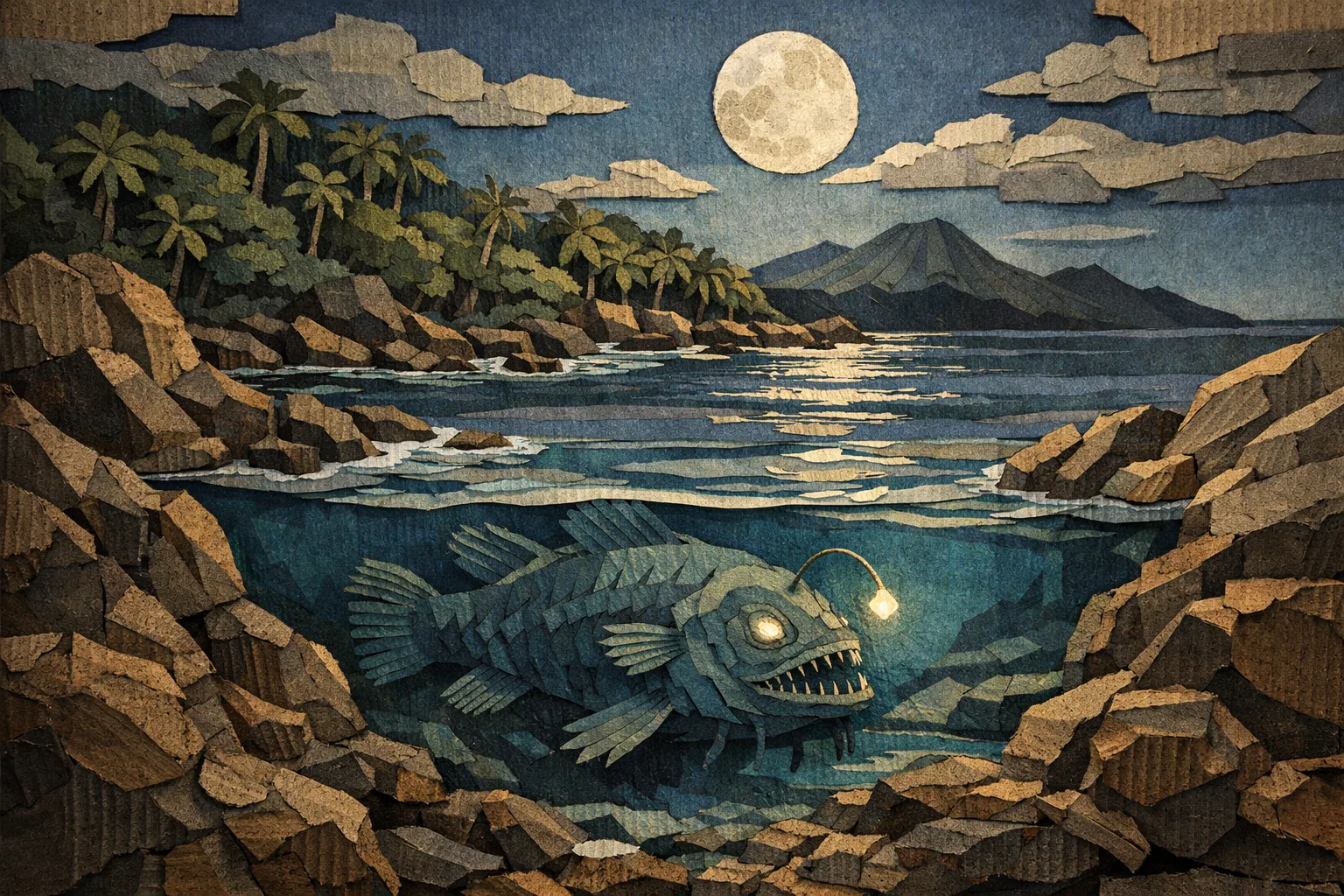
The south-west coast of Grande Comore matters for a different reason: it is the famous coelacanth zone. The Comoros Biodiversity Network states that volcanic seabed caves near the coast shelter the coelacanth, linking the country’s most extraordinary real animal with exactly the sort of hidden, rocky, underwater habitat that monster traditions often love.[km.chm-cbd.net]km.chm-cbd.netProtected areas | Comoros BiodiversityProtected areas | Comoros Biodiversity
The coelacanth: Comoros’ real “monster fish”
If Comoros has one creature that belongs on every mystery-animal page, it is the coelacanth. It is not a cryptid today, because it is a scientifically recognised fish. But its modern story is so close to cryptozoological fantasy that it has become part of the broader “animals thought extinct but found alive” imagination.
The Natural History Museum explains that coelacanths were believed to have died out 70 million years ago until a living specimen was found in 1938. That first modern specimen was recognised in South Africa, but the second scientifically recorded living coelacanth came from the Comoro Islands in 1952, when a local fisher, Ahmadi Abdulla, claimed the reward being offered by J. L. B. Smith. Crucially, the museum notes that while this was western science’s second recorded living coelacanth, the fish was locally known as gombessa and had been caught by night fishers at a rate of two or three per year.[Natural History Museum]nhm.ac.ukOpen source on nhm.ac.uk.
That detail changes the story. To outsiders, the coelacanth was a resurrection from deep time. To Comorian fishers, it was an unusual but known deep-water fish. The “mystery” lay partly in the gap between local knowledge and scientific awareness.
The coelacanth also explains why Comoros can be more important to cryptid history than it first appears. Monster-hunting often asks whether remote communities might know animals that formal science has overlooked. The coelacanth is a rare case where something close to that scenario really happened — though not because of a monster legend, and not because the animal was unknown to everyone. It was known locally, misaligned with scientific expectation, and then dramatically reclassified in global imagination.[Natural History Museum]nhm.ac.ukOpen source on nhm.ac.uk.
Why the islands feel creature-rich even without a famous cryptid
Comoros has the right ingredients for strange animal stories: volcanic terrain, isolated forests, sea caves, coral reefs, rare bats, introduced lemurs, endemic birds, deep water close to shore, and a long history of cultural exchange. One Earth describes the Comoros forests ecoregion as part of the Afrotropics, with high local biodiversity, many endemic birds, endemic reptiles, fruit bats, and introduced mongoose lemurs. It also notes the continuing threat of cyclones, volcanic activity, erosion, and habitat loss.[One Earth]oneearth.orgOne Earth Comoros Forests | One EarthOne Earth Comoros Forests | One Earth
This ecology matters because folklore often grows around real environmental edges. A giant fruit bat seen at dusk can look startling if the viewer is unused to it. A lemur in the trees, especially given Comoros’ links with Madagascar, can feed stories of semi-human forest life. A deep-water fish dragged up at night may seem prehistoric long before anyone names it scientifically. A lava tube or volcanic cave can become the kind of place where hidden beings belong.
None of that proves a mystery animal. It simply explains why Comorian landscapes are good at producing the mood of one. The islands do not need a manufactured “Comoros Nessie” to feel strange. Their real biology and geology already do much of the work.
Misidentifications and natural explanations
The most plausible explanations for Comorian mystery-creature material depend on the type of claim.
For sea creatures, misidentified real animals are the obvious starting point. Comorian waters include turtles, dolphins, whales, reef fish, rays, and deep-water species. Mohéli is especially associated with marine conservation, and UNDP reported in 2024 that Mohéli’s park is internationally recognised for sea-turtle nesting, with tens of thousands of landings each year.[UNDP]undp.orgprotecting biodiversity comoros vital priority country africa and worldprotecting biodiversity comoros vital priority country africa and world
For flying or night creatures, fruit bats deserve attention. The Livingstone’s fruit bat, also called the Comoro flying fox, is one of the flagship animals of the Comoros forests ecoregion and is found only on Ndzuani and Mwali. Large bats can easily become exaggerated in memory, especially in low light, but they are also a reminder that “monstrous” impressions may come from real endangered wildlife rather than imaginary beasts.[One Earth]oneearth.orgOne Earth Comoros Forests | One EarthOne Earth Comoros Forests | One Earth
For forest beings, introduced lemurs, endemic reptiles, owls, and other nocturnal animals may shape the background texture of stories, but the jinn and ogre tales themselves should not be reduced too crudely to animal sightings. They are narrative beings. Their horns, tails, wings, and hidden bodies are symbolic as much as zoological.[Internet Archive]archive.orgInternet Archive Full text of "Folktales of Mayotte, an African IslandInternet Archive Full text of "Folktales of Mayotte, an African Island
Folklore, not field evidence
The evidence base for Comorian cryptids is thin if the question is “are there unknown animals being reported?” There are no strong mainstream sources showing an active, well-documented Comorian cryptid flap with named witnesses, repeated locations, photographs, casts, carcasses, or official investigations. The better evidence supports a different conclusion: Comoros has a rich supernatural and animal-shaped folklore tradition, while its strongest mystery-animal case is the real coelacanth.
That distinction is important. Calling every jinn or ogre a cryptid flattens the tradition. A cryptid is usually an alleged biological animal. A jinn is a religious and folkloric being. A cannibal husband tale is not a zoological report. A coelacanth is not an unconfirmed monster. Comoros sits between these categories, which is why it is valuable for a country-level cryptid project: it shows where the borders blur.
The most useful reading is therefore layered:
- Folklore layer: jinn, ogres, animal spouses, tricksters, hidden bodies, and dangerous outsiders.
- Landscape layer: forests, volcanic slopes, lava caves, coastlines, reefs, and deep-water caves.
- Natural-history layer: coelacanths, fruit bats, turtles, lemurs, endemic birds, reptiles, and marine life.
- Cryptid-history layer: the coelacanth as a real example of local knowledge preceding global scientific recognition.
How the Comoros creature tradition changed over time
The older material is oral, flexible, and performance-based. In the Mayotte and wider Comorian-archipelago examples, narrators reshape stock plots according to local concerns, village rivalries, gender tensions, political feeling, and comic timing. Haring’s discussion repeatedly shows that the same underlying tale can turn into a djinn story, an ogre story, a trickster story, or a satire depending on who is telling it and why.[Internet Archive]archive.orgInternet Archive Full text of "Folktales of Mayotte, an African IslandInternet Archive Full text of "Folktales of Mayotte, an African Island
The modern layer is different. Online lists tend to compress Comoros into a single entry: “jinn”. Travel writing and conservation pages, meanwhile, emphasise volcanoes, turtles, bats, reefs, and the coelacanth. That shift changes the country’s monster image from oral household warning to biodiversity wonder. A reader searching today for “Comoros cryptids” is more likely to find generic jinn lists, the coelacanth story, and scattered folklore references than a sustained local monster tradition.[worldpopulationreview.com]worldpopulationreview.commythical creatures by countrymythical creatures by country
The best modern synthesis is not to force these strands into one creature. Comoros is a place where spirits may wear animal signs, ogres may look partly bird, and the sea really did hide a fish that science once thought belonged to prehistory. That is stranger, and more honest, than inventing a national monster where the evidence does not support one.
Amazon book picks
Further Reading
Books and field guides related to What Strange Creatures Haunt Comoros?. Use these as the next step if you want deeper reading beyond the article.
The Mythology Book
Helps readers place Comorian creature traditions in a wider context.
Legends of the Fire Spirits
Strong match for spirit and creature traditions in Comoros.
Abominable Science!
Useful for comparing folklore creatures with zoological mystery claims.
eBay marketplace picks
Marketplace Samples
Live-tested eBay searches with available results related to this page.


Endnotes
1.
Source: everyculture.com
Link:https://www.everyculture.com/Bo-Co/Comoros.html
2.
Source: archive.org
Title: Internet Archive Full text of “Folktales of Mayotte, an African Island”
Link:https://archive.org/stream/a94e57a8-fe20-4100-9796-0b8954a57cc8/a94e57a8-fe20-4100-9796-0b8954a57cc8_djvu.txt
3.
Source: library.oapen.org
Title: Folktales of Mayotte, an African Island
Link:https://library.oapen.org/bitstream/handle/20.500.12657/64033/9781805110064.pdf?isAllowed=y&sequence=1
4.
Source: km.chm-cbd.net
Title: Protected areas | Comoros Biodiversity
Link:https://km.chm-cbd.net/en/protected-areas
5.
Source: unesco.org
Link:https://www.unesco.org/en/mab/mwali
6.
Source: undp.org
Title: protecting biodiversity comoros vital priority country africa and world
Link:https://www.undp.org/africa/stories/protecting-biodiversity-comoros-vital-priority-country-africa-and-world
7.
Source: cbd.int
Link:https://www.cbd.int/countries/profile/?country=km
8.
Source: km.chm-cbd.net
Title: biodiversity 1
Link:https://km.chm-cbd.net/en/biodiversity-1
9.
Source: km.chm-cbd.net
Title: biodiversity 2
Link:https://km.chm-cbd.net/en/biodiversity-2
10.
Source: ia903100.us.archive.org
Title: African Folklore An Encyclopedia
Link:https://ia903100.us.archive.org/30/items/africanfolkloreanencyclopedia/African%20Folklore%20-%20An%20Encyclopedia.pdf
11.
Source: nhm.ac.uk
Link:https://www.nhm.ac.uk/discover/coelacanths-the-fish-that-outdid-the-loch-ness-monster.html
12.
Source: worldpopulationreview.com
Title: mythical creatures by country
Link:https://worldpopulationreview.com/country-rankings/mythical-creatures-by-country
13.
Source: digitalcommons.andrews.edu
Link:https://digitalcommons.andrews.edu/cgi/viewcontent.cgi?article=1268&context=jams
14.
Source: oneearth.org
Title: One Earth Comoros Forests | One Earth
Link:https://www.oneearth.org/ecoregions/comoros-forests/
15.
Source: mythus.fandom.com
Link:https://mythus.fandom.com/wiki/Jinn
16.
Source: scholarworks.uark.edu
Link:https://scholarworks.uark.edu/cgi/viewcontent.cgi?article=1008&context=wllcuht
17.
Source: planetescape.pl
Link:https://planetescape.pl/en/kraj/komory/
18.
Source: Wikipedia
Link:https://en.wikipedia.org/wiki/Jinn
19.
Source: Wikipedia
Title: Comoros forests
Link:https://en.wikipedia.org/wiki/Comoros_forests
20.
Source: volcanocafe.org
Title: the comoro islands
Link:https://www.volcanocafe.org/the-comoro-islands/
21.
Source: tripadvisor.com
Title: Mount Karthala
Link:https://www.tripadvisor.com/Attraction_Review-g480174-d480342-Reviews-Mount_Karthala-Grande_Comore.html
22.
Source: iucncontributionsfornature.org
Link:https://www.iucncontributionsfornature.org/countries/46
23.
Source: wildwonderswatcher.com
Link:https://wildwonderswatcher.com/en/regions/africa/comoros
24.
Source: cc-tapis.com
Link:https://cc-tapis.com/collections/cryptid
Additional References
25.
Source: youtube.com
Title: The Coelacanth: A Living Fossil’s Astonishing Comeback
Link:https://www.youtube.com/watch?v=Ds_84byxmGo
Source snippet
Discover the COMOROS: 10 INTERESTING FACTS YOU MAY NOT KNOW ABOUT This Country...
26.
Source: youtube.com
Title: Loch Ness Outdone: Rediscovery of the Coelacanth
Link:https://www.youtube.com/watch?v=nscc9AG_RQg
Source snippet
The Coelacanth: A Living Fossil's Astonishing Comeback...
27.
Source: academia.edu
Link:https://www.academia.edu/41363265/Complex_Plots_in_Madagascar_Folktales
28.
Source: academia.edu
Link:https://www.academia.edu/38156779/Seven_Comoran_folktales_docx
29.
Source: reddit.com
Link:https://www.reddit.com/r/Cryptozoology/comments/177zxtd/a_visual_representation_of_countries_without/
30.
Source: noe.org
Link:https://noe.org/en/actions/nos-actions-aux-comores/
31.
Source: nairobiconvention.org
Link:https://www.nairobiconvention.org/comoros-country-profile/comoros-biodiversity/
32.
Source: biodb.com
Link:https://biodb.com/region/comoros/
33.
Source: travelinspires.org
Link:https://travelinspires.org/comoros-conservation-travel-2/
34.
Source: comtourvoyages.com
Link:https://comtourvoyages.com/en/
Topic Tree
Follow this branch
Related pages 192
- Antigua Cryptids
- Maldives Monsters
- Malta Monsters
- Qatar Monsters
- Argentina Monsters
- +187 more in sidebar