Within Portugal Monsters
How Did the Atlantic Become a Monster?
Adamastor gave a giant's face to storms, shipwrecks and the terror of sailing into seas that Europeans barely understood.
On this page
- Adamastor's appearance in The Lusiads
- Storms, dangerous capes and sailors' fears
- From epic giant to Lisbon monument and cultural symbol
Page outline Jump by section
Introduction
Among Portugal’s many monsters, none is more unusual than Adamastor. Unlike a dragon from folklore or a creature supposedly glimpsed in the wild, Adamastor began as a literary invention. Yet he became one of the country’s most enduring monsters because he gave a face, a voice and a personality to something very real: the terror of sailing into dangerous Atlantic waters that Europeans barely understood. Created by the poet Luís de Camões in The Lusiads (1572), Adamastor appears as a gigantic being who rises from storm clouds near the southern tip of Africa and warns Portuguese sailors that the sea ahead will bring suffering, shipwreck and death.[Wikipedia]WikipediaOs LusíadasOs Lusíadas

For readers interested in Portugal’s monster traditions, Adamastor occupies a fascinating middle ground. He is not a cryptid in the modern sense, and no one claimed to discover his bones or photograph him at sea. Instead, he transformed genuine maritime dangers into a monster story powerful enough to survive for more than four centuries. In doing so, he became Portugal’s most famous monster of the Atlantic.
How Did the Atlantic Become a Monster?
Long before accurate charts and modern navigation, the oceans beyond Europe seemed unpredictable and frightening. Portuguese sailors pushing down the coast of Africa during the fifteenth century encountered unfamiliar currents, violent storms and coastlines where many ships were lost. The most feared obstacle was the southern tip of Africa, originally known by the Portuguese as the Cape of Storms because of its dangerous weather and rough seas.[Turismo de Lisboa]visitlisboa.comTurismo de LisboaMiradouro de Santa CatarinaIt has a small garden, but it's the vast terrace that's the real attraction, with a huge stat…
Camões transformed these hazards into a living creature. In The Lusiads, Vasco da Gama’s fleet approaches the cape when an enormous figure appears in the sky. The giant is described as grotesque and immense, with a threatening face and a terrifying presence. Rather than merely representing bad weather, Adamastor speaks directly to the sailors and predicts future disasters for those who challenge his domain.[ukzn.ac.za]researchspace.ukzn.ac.zaadamastor, gigantomachies, and theJanuary 25, 2010 — When they reach the Cape they are confronted by an apparition of its pe…
This was a remarkably effective piece of storytelling. Sailors already feared the cape. Camões gave that fear a name and a body.
Adamastor’s Appearance in The Lusiads
Adamastor appears in the fifth canto of Portugal’s national epic, a poem celebrating Vasco da Gama’s voyage to India and the broader achievements of Portuguese exploration. The monster emerges as a supernatural guardian of the sea route around southern Africa.[Wikipedia]WikipediaOs LusíadasOs Lusíadas
Within the story, Adamastor explains that he was once a giant associated with the ancient Titans. Because of a tragic and doomed love, he was transformed and bound to the cape itself. Some interpretations describe him as becoming part of the mountains and rocky coastline around the Cape of Good Hope. He therefore exists simultaneously as a giant, a storm spirit and the landscape itself.[EBSCO]ebsco.comThe Lusiads: Analysis of Major CharactersThe spirit says he was once a Titan named Adamastor. He has been made into a range of mount…
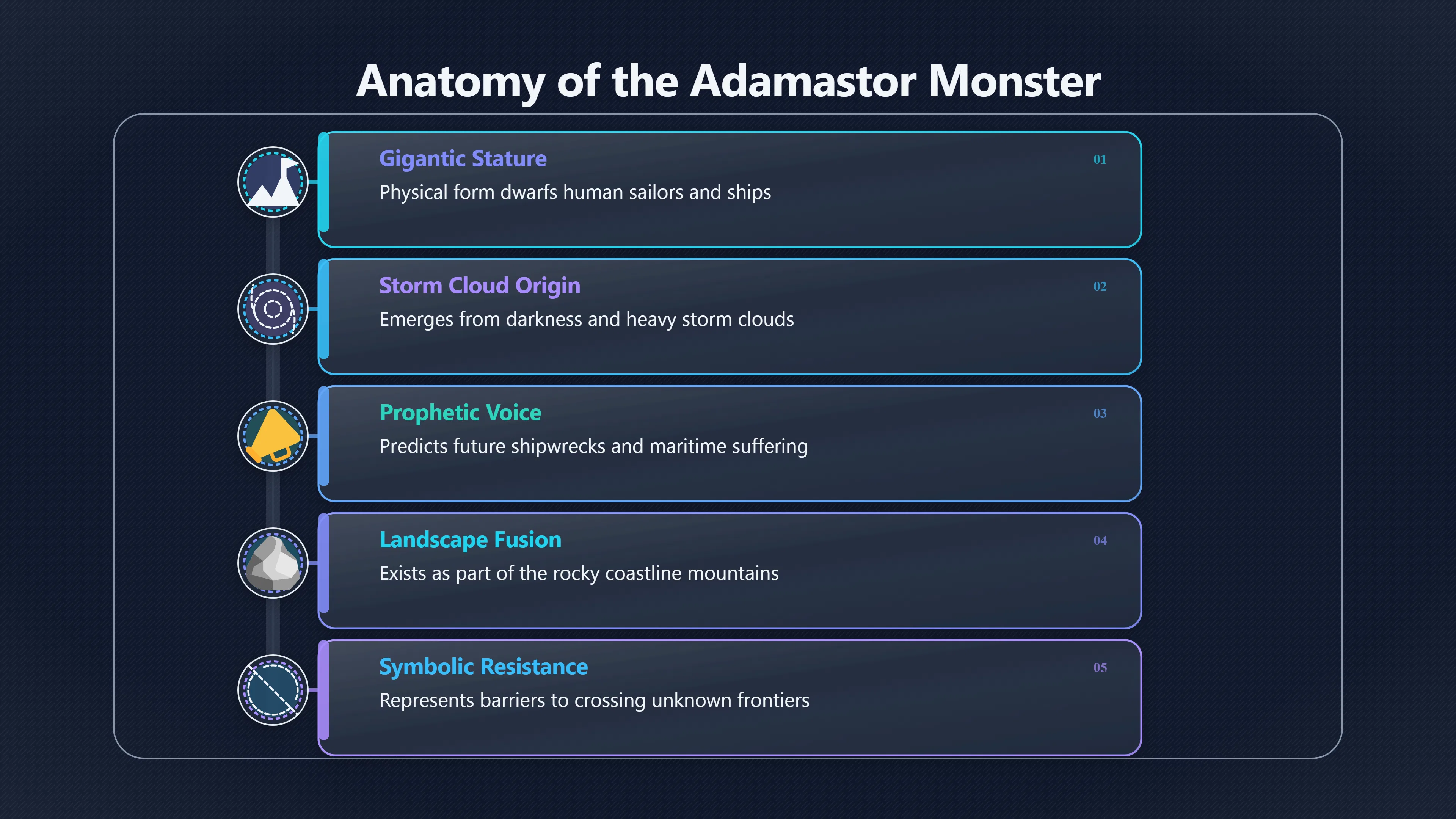
Several features made the character memorable:
- He is physically enormous, dwarfing human sailors.
- He emerges from storm clouds and darkness rather than from the sea itself.
- He predicts future shipwrecks and suffering.
- He embodies both natural forces and human fear.
- He represents resistance to exploration and the crossing of unknown frontiers.[ukzn.ac.za]researchspace.ukzn.ac.zaadamastor, gigantomachies, and theJanuary 25, 2010 — When they reach the Cape they are confronted by an apparition of its pe…
Unlike dragons or sea serpents, Adamastor is not hunting sailors for food. His role is symbolic. He is the personification of everything that could go wrong beyond the edge of familiar waters.
Storms, Dangerous Capes and Sailors’ Fears
The enduring power of Adamastor comes from the fact that the dangers he represented were real.
The waters around the Cape of Good Hope are among the most challenging maritime environments in the world. Powerful currents, strong winds and sudden storms have contributed to countless shipwrecks over the centuries. To sailors of the Age of Discovery, these conditions could easily feel supernatural.[Turismo de Lisboa]visitlisboa.comTurismo de LisboaMiradouro de Santa CatarinaIt has a small garden, but it's the vast terrace that's the real attraction, with a huge stat…
Adamastor effectively gathered several fears into a single image:
Fear of the unknown. Maps ended where experience ended. Much of the ocean beyond Africa remained mysterious to Europeans.
Fear of nature. Storms could destroy a vessel without warning.
Fear of punishment. In many cultures, venturing beyond accepted limits risked divine or supernatural retribution. Adamastor’s warnings echo this older idea.[ResearchSpace]researchspace.ukzn.ac.zaadamastor, gigantomachies, and theJanuary 25, 2010 — When they reach the Cape they are confronted by an apparition of its pe…
Fear of loss. Portuguese maritime history includes numerous tragedies, and Adamastor’s prophecy foreshadows the hardships and shipwrecks that followed many voyages.[Wikipedia]WikipediaAdamastor (mitologiaAdamastor (mitologia
From a modern perspective, Adamastor resembles a giant sea monster, but he functions more like a mythological explanation for hazardous geography. He is the Atlantic transformed into a character.

Was Adamastor Ever Treated as a Real Monster?
There is no historical evidence that Adamastor was regarded as a genuine unknown creature living in the ocean. He originated in literature, and readers understood that Camões had created him as part of an epic poem.[Wikipedia]WikipediaOs LusíadasOs Lusíadas
However, the distinction between literature and belief was not always as sharp as it is today. The giant drew upon older traditions in which mountains, capes and storms were associated with supernatural beings. To audiences familiar with classical myths and maritime legends, Adamastor felt believable in an emotional sense even if he was not considered zoologically real.[EBSCO]ebsco.comThe Lusiads: Analysis of Major CharactersThe spirit says he was once a Titan named Adamastor. He has been made into a range of mount…
That helps explain why the character escaped the pages of a poem and entered popular culture. Adamastor became shorthand for dangerous seas, maritime courage and the struggle between human ambition and nature.
In cryptid terms, he is best understood as a legendary monster rather than a mystery animal claim.
From Epic Giant to Lisbon Monument and Cultural Symbol
Many literary monsters remain trapped in books. Adamastor did not.
In Lisbon, a monumental sculpture of the giant was unveiled in 1927 at the Santa Catarina viewpoint overlooking the Tagus estuary. The location is fitting: from this hilltop, visitors can watch the waters that once carried Portuguese ships toward the Atlantic and beyond.[wikipedia.org]WikipediaOpen source on wikipedia.org.
Today the site is widely known as the Adamastor viewpoint. The giant sits above the river as a reminder of Portugal’s maritime past and of the fears associated with ocean exploration. Tourism guides and local cultural organisations still describe the figure as a symbol of the dangers faced by sailors during the Age of Discovery.[visitlisboa.com]visitlisboa.comTurismo de LisboaMiradouro de Santa CatarinaIt has a small garden, but it's the vast terrace that's the real attraction, with a huge stat…
Adamastor also continued to evolve in literature and art. Writers, artists and scholars have repeatedly revisited the giant, sometimes treating him as a symbol of colonial expansion, sometimes as a symbol of resistance, and sometimes simply as the embodiment of untamed nature.[SciELO]scielo.org.zaSci ELODecolonising Adamastor: From The Lusiads to ThirteenSci ELODecolonising Adamastor: From The Lusiads to Thirteen
Few fictional monsters have enjoyed such a long afterlife.
Why Adamastor Still Matters
Portugal’s monster traditions include dragons, werewolves and enchanted serpents, but Adamastor stands apart because he represents a specific historical experience. He is the monster created when sailors confronted an ocean that seemed limitless, dangerous and unknowable.
The giant’s enduring appeal lies in a simple idea: every era creates monsters for its greatest fears. For medieval villagers, those fears might appear as wolves in the forest. For ocean-going explorers, they emerged from storm clouds at the edge of the map.
Adamastor remains memorable because he captures a moment when the Atlantic itself seemed alive. He turned wind, waves and shipwrecks into a single colossal figure and gave Portugal one of the most distinctive monsters in European cultural history.[ukzn.ac.za]researchspace.ukzn.ac.zaThis section of the poem describes a Portuguese voyageAdamastor, gigantomachies, and the literature of exile in…Canto 5 of Luis Vaz de Camoes' Portuguese epic poem Lusiads, te…
Amazon book picks
Further Reading
Books and field guides related to How Did the Atlantic Become a Monster?. Use these as the next step if you want deeper reading beyond the article.
Over the Edge of the World
Explores the fears and realities of early ocean voyages that inspired sea-monster imagery.
The Book of Imaginary Beings
Places Adamastor within the wider tradition of symbolic monsters.
eBay marketplace picks
Marketplace Samples
Live-tested eBay searches with available results related to this page.




Endnotes
1.
Source: Wikipedia
Title: Os Lusíadas
Link:https://en.wikipedia.org/wiki/Os_Lus%C3%ADadas
2.
Source: enotes.com
Link:https://www.enotes.com/topics/luis-vaz-de-camoes/criticism/criticism/david-quint-essay-date-1993
Source snippet
The Epic Curse and Camões' Adamastor - David QuintIn the fifth canto of the Lusíadas, Vasco da Gama is the guest of the African kin...
3.
Source: Wikipedia
Link:https://de.wikipedia.org/wiki/Adamastor
4.
Source: ebsco.com
Link:https://www.ebsco.com/research-starters/literature-and-writing/lusiads-analysis-major-characters
Source snippet
The Lusiads: Analysis of Major CharactersThe spirit says he was once a Titan named Adamastor. He has been made into a range of mount...
5.
Source: Wikipedia
Title: Adamastor (mitologia)
Link:https://pt.wikipedia.org/wiki/Adamastor_%28mitologia%29
6.
Source: Wikipedia
Link:https://en.wikipedia.org/wiki/Adamastor
7.
Source: getlisbon.com
Title: tracing luis de camoes in lisbon
Link:https://getlisbon.com/discovering/tracing-luis-de-camoes-in-lisbon/
8.
Source: Wikipedia
Title: Jardim do Alto de Santa Catarina
Link:https://pt.wikipedia.org/wiki/Jardim_do_Alto_de_Santa_Catarina
9.
Source: youtube.com
Title: The Lusiads
Link:https://www.youtube.com/watch?v=VfKqn775BjE
10.
Source: youtube.com
Link:https://www.youtube.com/watch?v=zJ01buAVyQ0
Source snippet
THE LUSIADS: OCEANS OF DESTINY | A CINEMATIC ROCK CONCEPT ALBUM...
11.
Source: youtube.com
Title: Luís de Camões and The Lusiads // Learn Portuguese
Link:https://www.youtube.com/watch?v=DlqYHWggdsk
Source snippet
The Lusiads | Analysis of Canto IX Part 1 – The Island of Love...
12.
Source: youtube.com
Title: The Lusiads | Analysis of Canto IX Part 1 – The Island of Love
Link:https://www.youtube.com/watch?v=4TdczidEl1Y
13.
Source: researchspace.ukzn.ac.za
Title: This section of the poem describes a Portuguese voyage
Link:https://researchspace.ukzn.ac.za/items/84b19524-a191-4a02-9c32-5f3979a99ea7
Source snippet
Adamastor, gigantomachies, and the literature of exile in...Canto 5 of Luis Vaz de Camoes' Portuguese epic poem Lusiads, te...
14.
Source: visitlisboa.com
Link:https://www.visitlisboa.com/en/places/miradouro-de-santa-catarina
Source snippet
Turismo de LisboaMiradouro de Santa CatarinaIt has a small garden, but it's the vast terrace that's the real attraction, with a huge stat...
15.
Source: researchspace.ukzn.ac.za
Link:https://researchspace.ukzn.ac.za/bitstreams/adddbc32-9960-44fc-8baa-2b6b803806ed/download
Source snippet
adamastor, gigantomachies, and theJanuary 25, 2010 — When they reach the Cape they are confronted by an apparition of its pe...
Published: January 25, 2010
16.
Source: otukdojoao.com
Link:https://www.otukdojoao.com/en/adamastor-viewpoint-santa-catarina-lisbon/
17.
Source: scielo.org.za
Title: Sci ELODecolonising Adamastor: From The Lusiads to Thirteen
Link:https://scielo.org.za/pdf/jls/v38n2/05.pdf
18.
Source: scielo.org.za
Link:https://scielo.org.za/scielo.php?pid=S1753-53872022000200005&script=sci_arttext
19.
Source: youtube.com
Link:https://www.youtube.com/watch?v=9Ixhw1G_-ec
Additional References
20.
Source: capepoint.co.za
Link:https://capepoint.co.za/cape-of-myths-the-story-of-adamastor-2/
21.
Source: youtube.com
Title: THE LUSIADS: OCEANS OF DESTINY | A CINEMATIC ROCK CONCEPT ALBUM
Link:https://www.youtube.com/watch?v=V7RLNT3ooKQ
Source snippet
Luís de Camões and The Lusiads // Learn Portuguese...
22.
Source: komoot.com
Link:https://www.komoot.com/de-de/highlight/7043109
23.
Source: facebook.com
Link:https://www.facebook.com/groups/Illustration.Digital.Painting/posts/29068362586113108/
24.
Source: medium.com
Link:https://medium.com/globetrotters/old-lisbon-never-gets-old-cfc5a46e249e
25.
Source: lisboacool.com
Link:https://lisboacool.com/en/visit/santa-catarina-viewpoint-to-observe-right-from-the-top
26.
Source: alamy.com
Link:https://www.alamy.com/stock-photo/statue-of-adamastor.html
27.
Source: thelisbonconnection.com
Link:https://www.thelisbonconnection.com/tag/adamastor/
28.
Source: scispace.com
Link:https://scispace.com/pdf/adamastor-gigantomachies-and-the-literature-of-exile-in-1rq6iwzbie.pdf
29.
Source: airial.travel
Title: miradouro de santa catarina adamastor lisbon S7i PBn2x
Link:https://airial.travel/attractions/portugal/lisboa/miradouro-de-santa-catarina-adamastor-lisbon-S7iPBn2x
Topic Tree