Within Georgia Cryptids
Georgia's Water Dragon Before Nessie
Gveleshapi is not a single lake monster but a broader Georgian serpent-dragon tradition linked to dangerous water.
On this page
- What the gveleshapi is
- Rivers, lakes and heroic combat
- Why it differs from modern lake monsters
Page outline Jump by section
Introduction
Among Georgia’s legendary creatures, the gveleshapi is one of the most important and oldest. Unlike modern lake-monster stories that focus on a single mysterious creature in one body of water, the gveleshapi belongs to a much broader tradition. It is a serpent-dragon associated with rivers, lakes, springs and floods, appearing throughout Georgian folklore as a dangerous force connected to water itself. In different stories it blocks rivers, controls springs, causes disasters and battles heroic figures who restore order to the landscape.[wikipedia.org]WikipediaGeorgian mythologyMay 7, 2026 — Gveleshapi (გველეშაპი [ka], in ancient sources გველ-ვეშაპი – Snake-whale) – Evil serpent that ruled and lived in lakes, riv…

For readers interested in Georgia’s monster traditions, the gveleshapi is significant because it sits at the boundary between mythology and what would later become “lake monster” folklore. Rather than being treated as an unknown animal, it was understood as a supernatural being whose presence explained the power, unpredictability and danger of water in a mountainous country crossed by fast rivers and prone to destructive floods.[wikipedia.org]WikipediaGeorgian mythologyMay 7, 2026 — Gveleshapi (გველეშაპი [ka], in ancient sources გველ-ვეშაპი – Snake-whale) – Evil serpent that ruled and lived in lakes, riv…
What the gveleshapi is
The gveleshapi is usually described as a gigantic serpent or dragon. Traditional sources place it in lakes, rivers, springs and other water sources. In Georgian mythology it is often portrayed as an enemy of humans, associated with flooding, water shortages and other disasters affecting communities. Heroes and culture-bringers are frequently depicted fighting and defeating these creatures.[Wikipedia]WikipediaGeorgian mythologyMay 7, 2026 — Gveleshapi (გველეშაპი [ka], in ancient sources გველ-ვეშაპი – Snake-whale) – Evil serpent that ruled and lived in lakes, riv…
The name itself hints at its hybrid nature. Scholars note that the word combines terms associated with a serpent and a great aquatic creature, producing an image closer to a water-dragon than a simple snake. The result is a being that can inhabit rivers and lakes while possessing the power and symbolic weight of a dragon.[mythsterhood.com]mythsterhood.comSerpents of the Southern CaucasusThe Georgian word for dragon, gveleshapi, is actually a composite of whale and serpent…Read more…
An interesting feature of the tradition is that the creature was not always purely evil. Some interpretations of older mythological layers suggest that water-dragons may once have been viewed as powerful guardians or possessors of water before later heroic tales transformed them into monsters that had to be defeated. This shift mirrors patterns found across Eurasian mythology, where ancient water spirits gradually become enemies of civilisation.[Gods and Monsters - Mythology and Wonder]godsandmonsters.infoGods and Monsters - Mythology and WonderGeorgian Mythology: The Complete Guide to the Caucasus…Gveleshapi — the Georgian dragon, a nam…
Rivers, lakes and heroic combat
The most memorable gveleshapi stories are not about sightings but about conflict. A village loses access to water, a river becomes dangerous, or a spring falls under the control of a monstrous being. A hero then confronts the dragon and restores access to life-giving water. In this sense, the creature functions as a mythological explanation for both environmental danger and human survival.[mythlok.com]mythlok.comThis dualGveleshapi: The Water Dragon That Ruled Chaos and CreationFloods, droughts, and water scarcity became associated with its presence…
Georgian heroic traditions contain numerous dragon-fighting motifs. Semi-divine heroes and legendary champions battle destructive beings that threaten communities, crops and livestock. The gveleshapi often occupies the role of the chaos creature whose defeat allows society to flourish.[AllGeo]allgeo.orgGeorgian Mythology - Key Characters and ConceptsKHVTIS-SHVILNI: A group of heroes, who were born to gods and had semi-divine nature…
Water is the crucial element. Unlike many European dragons that guard treasure or live in caves, the gveleshapi is tied specifically to water sources. It may dwell in a lake, occupy a river, control a spring or threaten a settlement through flooding. This relationship reflects the practical importance of water in the Caucasus, where rivers can sustain communities but also cause destruction.[wikipedia.org]WikipediaGeorgian mythologyMay 7, 2026 — Gveleshapi (გველეშაპი [ka], in ancient sources გველ-ვეშაპი – Snake-whale) – Evil serpent that ruled and lived in lakes, riv…
The motif is so deeply rooted that modern cultural works still use the gveleshapi as a symbol of conflict over water access. Contemporary Georgian storytellers have employed the dragon image as a metaphor for forces that separate people from rivers and traditional water sources, showing how the ancient legend remains culturally meaningful.[chaikhana]chaikhana.mediaGveleshapi, the water dragonGveleshapi, the water dragon - Chai KhanaGveleshapi, the water dragon… A journey across Europe through the eyes of Georgian m…

A family of Caucasus water-serpents
The gveleshapi does not exist in isolation. Across the South Caucasus, related dragon and water-serpent traditions appear in neighbouring cultures. Armenian mythology, for example, preserves the vishap, another dragon strongly associated with lakes, springs and water sources. Ancient “dragon stones” in the Armenian Highlands have also been linked to water cults and water symbolism.[wikipedia.org]WikipediaOpen source on wikipedia.org.
These parallels do not mean the stories are identical, but they suggest a long regional tradition in which serpentine beings were connected to rivers, springs, fertility and storms. The Georgian gveleshapi belongs to this wider Caucasian pattern while retaining its own local character and heroic narratives.[mythsterhood.com]mythsterhood.comSerpents of the Southern CaucasusThe Georgian word for dragon, gveleshapi, is actually a composite of whale and serpent…Read more…
The persistence of these stories across borders is one reason scholars tend to view them as mythology rather than evidence for a specific unknown animal. The legends behave like a cultural tradition that adapts to local landscapes rather than a record of repeated encounters with one physical creature.[scitepress.org]scitepress.orgMythological Parallels in Georgian and Chechen LegendsGeorgian sources of the late Middle. Ages refer to the dragon as Gvelesha…
Why it differs from modern lake monsters
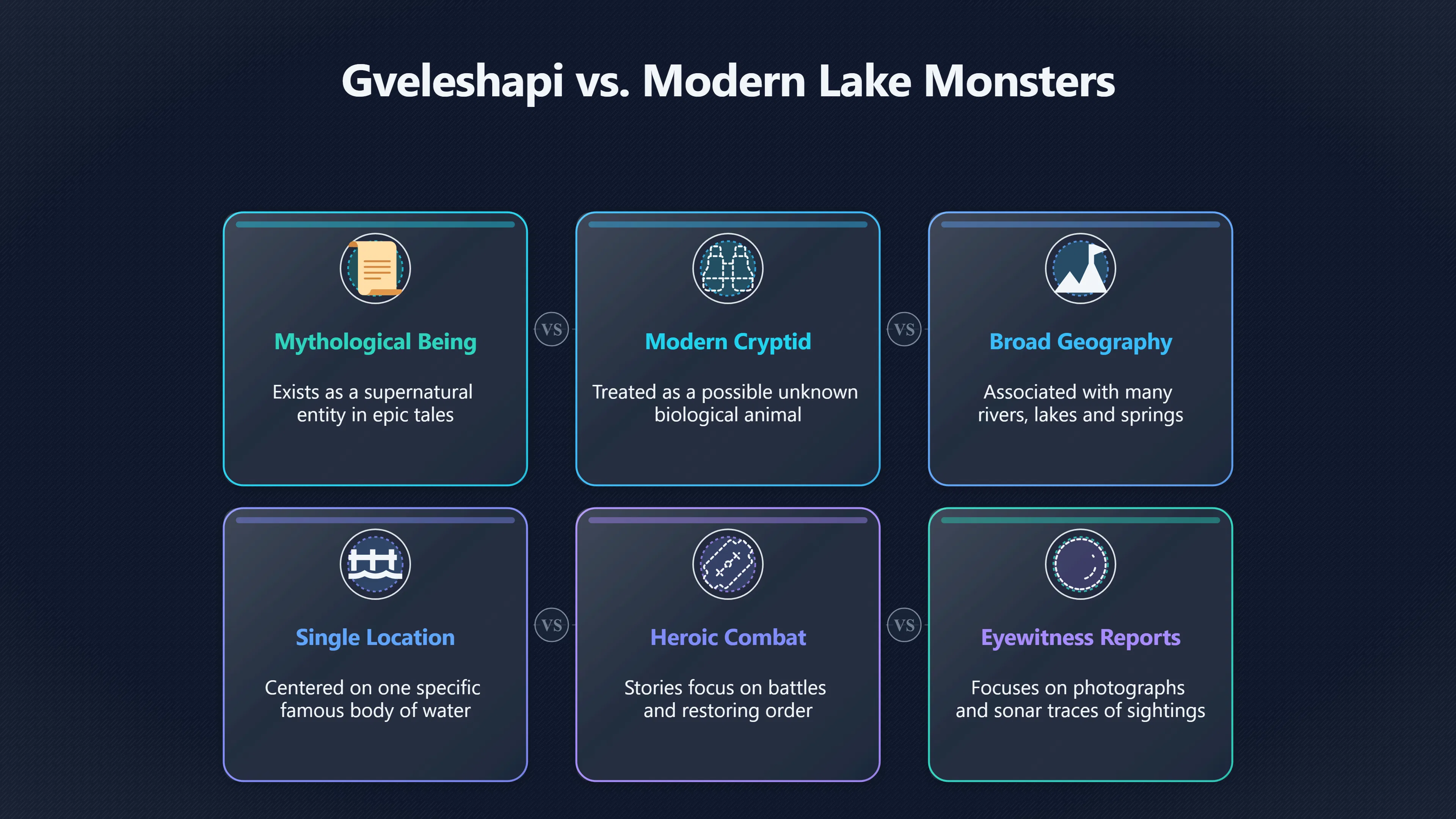
Readers familiar with Loch Ness, Lake Champlain or other famous lake-monster traditions may expect a Georgian equivalent. The gveleshapi is something different.
Modern lake-monster legends usually centre on eyewitness reports. People claim to see a creature in a particular lake, and debates focus on photographs, sonar traces, misidentifications or hoaxes. The creature is often treated as a possible unknown animal. By contrast, the gveleshapi is primarily a mythological being embedded in epic tales, folklore and religious imagination.[Wikipedia]WikipediaGeorgian mythologyMay 7, 2026 — Gveleshapi (გველეშაპი [ka], in ancient sources გველ-ვეშაპი – Snake-whale) – Evil serpent that ruled and lived in lakes, riv…
Several differences stand out:
- No single location: The gveleshapi is associated with many rivers, lakes and springs rather than one famous body of water.[Wikipedia]WikipediaGeorgian mythologyMay 7, 2026 — Gveleshapi (გველეშაპი [ka], in ancient sources გველ-ვეშაპი – Snake-whale) – Evil serpent that ruled and lived in lakes, riv…
- Heroic narratives: Stories focus on battles between heroes and dragons, not eyewitness sightings.[AllGeo]allgeo.orgGeorgian Mythology - Key Characters and ConceptsKHVTIS-SHVILNI: A group of heroes, who were born to gods and had semi-divine nature…
- Symbolic role: The creature explains floods, droughts, blocked water sources and the struggle to control nature.[mythlok.com]mythlok.comThis dualGveleshapi: The Water Dragon That Ruled Chaos and CreationFloods, droughts, and water scarcity became associated with its presence…
- Mythological ancestry: It belongs to an ancient family of water-serpent traditions found across the Caucasus and beyond.[mythsterhood.com]mythsterhood.comSerpents of the Southern CaucasusThe Georgian word for dragon, gveleshapi, is actually a composite of whale and serpent…Read more…
Because of these differences, the gveleshapi is best understood not as Georgia’s version of Nessie but as a much older and broader water-dragon tradition.
From monster to cultural symbol
Today the gveleshapi survives mainly in folklore, literature, art and discussions of Georgian mythology. There is no recognised modern “gveleshapi sighting” tradition comparable to contemporary cryptid investigations. Instead, the creature endures as a symbol of dangerous water, untamed nature and the heroic struggle to bring order to the landscape.[Gods and Monsters - Mythology and Wonder]godsandmonsters.infoGods and Monsters - Mythology and WonderGeorgian Mythology: The Complete Guide to the Caucasus…Gveleshapi — the Georgian dragon, a nam…
For anyone exploring Georgia’s strange-creature heritage, the gveleshapi is therefore less a cryptid in the modern sense and more a window into how earlier generations understood rivers, lakes and floods. It represents a world in which water was not merely a resource but a living force, guarded by immense serpents and dragons whose defeat explained why communities could survive and prosper.[mythlok.com]mythlok.comThis dualGveleshapi: The Water Dragon That Ruled Chaos and CreationFloods, droughts, and water scarcity became associated with its presence…
Amazon book picks
Further Reading
Books and field guides related to Georgia's Water Dragon Before Nessie. Use these as the next step if you want deeper reading beyond the article.
The Dragon Chronicles
Explores dragon traditions that parallel serpent-water monsters.
The Book of Imaginary Beings
Provides broader context for legendary serpent and dragon beings.
eBay marketplace picks
Marketplace Samples
Live-tested eBay searches with available results related to this page.


Endnotes
1.
Source: Wikipedia
Title: Georgian mythology
Link:https://en.wikipedia.org/wiki/Georgian_mythology
Source snippet
May 7, 2026 — Gveleshapi (გველეშაპი [ka], in ancient sources გველ-ვეშაპი – Snake-whale) – Evil serpent that ruled and lived in lakes, riv...
Published: May 7, 2026
2.
Source: godsandmonsters.info
Link:https://godsandmonsters.info/welcome-to-gods-and-monsters/georgian-mythology/
Source snippet
Gods and Monsters - Mythology and WonderGeorgian Mythology: The Complete Guide to the Caucasus...Gveleshapi — the Georgian dragon, a nam...
3.
Source: mythlok.com
Title: This dual
Link:https://mythlok.com/gveleshapi/
Source snippet
Gveleshapi: The Water Dragon That Ruled Chaos and CreationFloods, droughts, and water scarcity became associated with its presence...
4.
Source: academia.edu
Link:https://www.academia.edu/74029691/Image_of_Dragon_in_Georgian_Mythology
Source snippet
Image of Dragon in Georgian Mythology... water causes drought or vice versa, threatens the earth with a flood.... Worshiping the...
5.
Source: Wikipedia
Title: List of legendary creatures by type Gveleshapi (Georgian)
Link:https://en.wikipedia.org/wiki/List_of_legendary_creatures_by_type
Source snippet
List of legendary creatures by typeGveleshapi (Georgian) - Snake-whale monster associated with lakes, rivers and springs. Said to be c...
6.
Source: mythsterhood.com
Title: Serpents of the Southern Caucasus
Link:https://mythsterhood.com/serpents-of-the-southern-caucasus/
Source snippet
The Georgian word for dragon, gveleshapi, is actually a composite of whale and serpent...Read more...
7.
Source: allgeo.org
Link:https://www.allgeo.org/index.php/en/1865-georgian-mythology-key-characters-and-concepts
Source snippet
Georgian Mythology - Key Characters and ConceptsKHVTIS-SHVILNI: A group of heroes, who were born to gods and had semi-divine nature...
8.
Source: chaikhana.media
Title: Gveleshapi, the water dragon
Link:https://chaikhana.media/en/stories/1511/gveleshapi-the-water-dragon
Source snippet
Gveleshapi, the water dragon - Chai KhanaGveleshapi, the water dragon... A journey across Europe through the eyes of Georgian m...
9.
Source: Wikipedia
Link:https://en.wikipedia.org/wiki/Vishap
10.
Source: arxiv.org
Link:https://arxiv.org/abs/2508.11324
11.
Source: arxiv.org
Link:https://arxiv.org/abs/2605.02991
Source snippet
Vishap epoch unitary society in Armenian Highlands, c. 4000 BC: data analysis consequences...
12.
Source: scitepress.org
Link:https://www.scitepress.org/publishedPapers/2022/116082/pdf/index.html
Source snippet
Mythological Parallels in Georgian and Chechen LegendsGeorgian sources of the late Middle. Ages refer to the dragon as Gvelesha...
13.
Source: Wikipedia
Title: Georgian language
Link:https://en.wikipedia.org/wiki/Georgian_language
Source snippet
Georgian languageIt is the official language of Georgia and the native or primary language of 88% of its population. [2] It also serve...
14.
Source: Wikipedia
Link:https://en.wikipedia.org/wiki/Georgians
Source snippet
Georgiansa nation and Caucasian ethnic group native to present-day Georgia and surrounding areas historically associated with the Geor...
15.
Source: georgian.io
Link:https://georgian.io/
Source snippet
HomeGrowth equity firm investing in market-leading B2B software companies across the AI technology stack...
Additional References
16.
Source: mythicalgodsandcreatures.com
Link:https://mythicalgodsandcreatures.com/georgian-mythical-creatures/
Source snippet
The Gveleshapi is a massive water serpent said to cause floods and droughts until defeated by a hero. Its legend...Read more...
17.
Source: youtube.com
Link:https://www.youtube.com/watch?v=0MsAlR_Ltsc
Source snippet
The Oldest Flood Myth and its OriginToday we're going to look at the origin and age of the flood myths sometimes referred to as the diluv...
18.
Source: isfnr.org
Link:https://www.isfnr.org/files/Nature_spirits_Zugdidi.pdf
Source snippet
i's wives, Snake. Gveleshapi (Dragon), Kondriskatsi (Dwarf)...Read more...
19.
Source: facebook.com
Link:https://www.facebook.com/archaeologymag/posts/theyre-called-dragon-stones-but-many-are-decorated-with-images-of-fish-now-archa/1339096108251688/
Source snippet
They're called “dragon stones,” but many are decorated...In Armenian mythology, vishaps represent dragons—protectors of water sources...
20.
Source: clcl.uiowa.edu
Title: georgian language and culture resources
Link:https://clcl.uiowa.edu/language-resources/georgian-language-and-culture-resources
Source snippet
Dictionaries, Encyclopedias & Digital Libraries... Grammar... Vocabulary... Reading & Writing... Listening & Speaking.Read more...
21.
Source: x.com
Title: (formerly Twitter)Thomas Wier
Link:https://x.com/thomas_wier/status/1762035285737513295
Source snippet
X (formerly Twitter)Thomas Wier - Weekly Georgian EtymologyWeekly Georgian Etymology: გველეშაპი gvelešaṗi 'dragon', from Middle Georgian...
22.
Source: compmyth.org
Link:https://www.compmyth.org/wp-content/uploads/2019/07/IACM_Yerevan_2014_program_FINAL.pdf
Source snippet
FIGHTING DRAGONS AND MONSTERS: HEROIC...by C MYTHOLOGY · 2014 — In the paper, we will present a myth, or rather a mythologem, on twins r...
23.
Source: digitalprojects.binghamton.edu
Link:https://digitalprojects.binghamton.edu/s/creating-collective-memory/page/water-dragons-and-serpents
Source snippet
Dragons and Serpents · Creating Collective MemoryThe Australian water dragon exists in Aboriginal mythology, where it is believed to be a...
24.
Source: youtube.com
Link:https://www.youtube.com/shorts/uwBnGFWezZ0
Source snippet
rgian #todayilearned... This content isn't available. Skip video...
25.
Source: beastsoflegend.com
Title: vishap sky serpent
Link:https://beastsoflegend.com/bestiary/asia-2/west-asia/vishap-sky-serpent/
Source snippet
Vishap: Armenian Sky SerpentDec 27, 2025 — Gveleshapi (Georgian water serpent): emphasizes well and river guardianship. Shahmaran (Anatol...
Topic Tree