Within Uruguay Cryptids
Are Uruguay's Sea Monsters Really Marine Wildlife?
Whales, seals, wakes and decomposing sea animals can become convincing monsters when distance and rough water hide their true shapes.
On this page
- Animals Commonly Seen off the Coast
- How Distance Distorts Size and Shape
- Why Carcasses Become Mystery Creatures
Page outline Jump by section
Introduction
Uruguay’s coastline has produced its share of “sea monster” stories, but most of them become less mysterious when viewed against the rich marine life of the South Atlantic. The country’s Atlantic shore and the outer Río de la Plata are frequented by southern right whales, dolphins, sea lions, fur seals and, on occasion, elephant seals. Many of these animals are large, unusual-looking and often seen only briefly through surf, fog or rough water. Under those conditions, ordinary wildlife can appear extraordinary.[iberia.com]iberiaclubmagazine.iberia.comIberia Club MagazineWhale watching in Uruguay | Iberia ClubEvery year, between July and November, Uruguay's become a natural sanctuary fo…
Unlike countries that possess a famous named sea serpent legend, Uruguay’s coastal monster tradition is largely a story of misidentification. Reports tend to cluster around distant dark shapes, unusual swimming behaviour, floating carcasses and fleeting encounters from beaches or boats. Understanding these accounts means understanding how marine animals look when only part of the body is visible above the water.
Are Uruguay’s Sea Monsters Really Marine Wildlife?
The simplest answer is usually yes. Uruguay sits within an ecosystem that supports some of the largest marine mammals on Earth. Southern right whales migrate along the coast, while colonies of South American sea lions and fur seals occupy offshore islands and rocky haul-outs. Whale and dolphin conservation organisations describe the country’s coastal waters as an important habitat for cetaceans and pinnipeds throughout the year.[missionblue.org]missionblue.orgMission BlueThe Whale and Dolphin Sanctuary of Uruguay Declared a…Oct 26, 2018 — The Uruguayan Sanctuary for Whales and Dolphins is a…
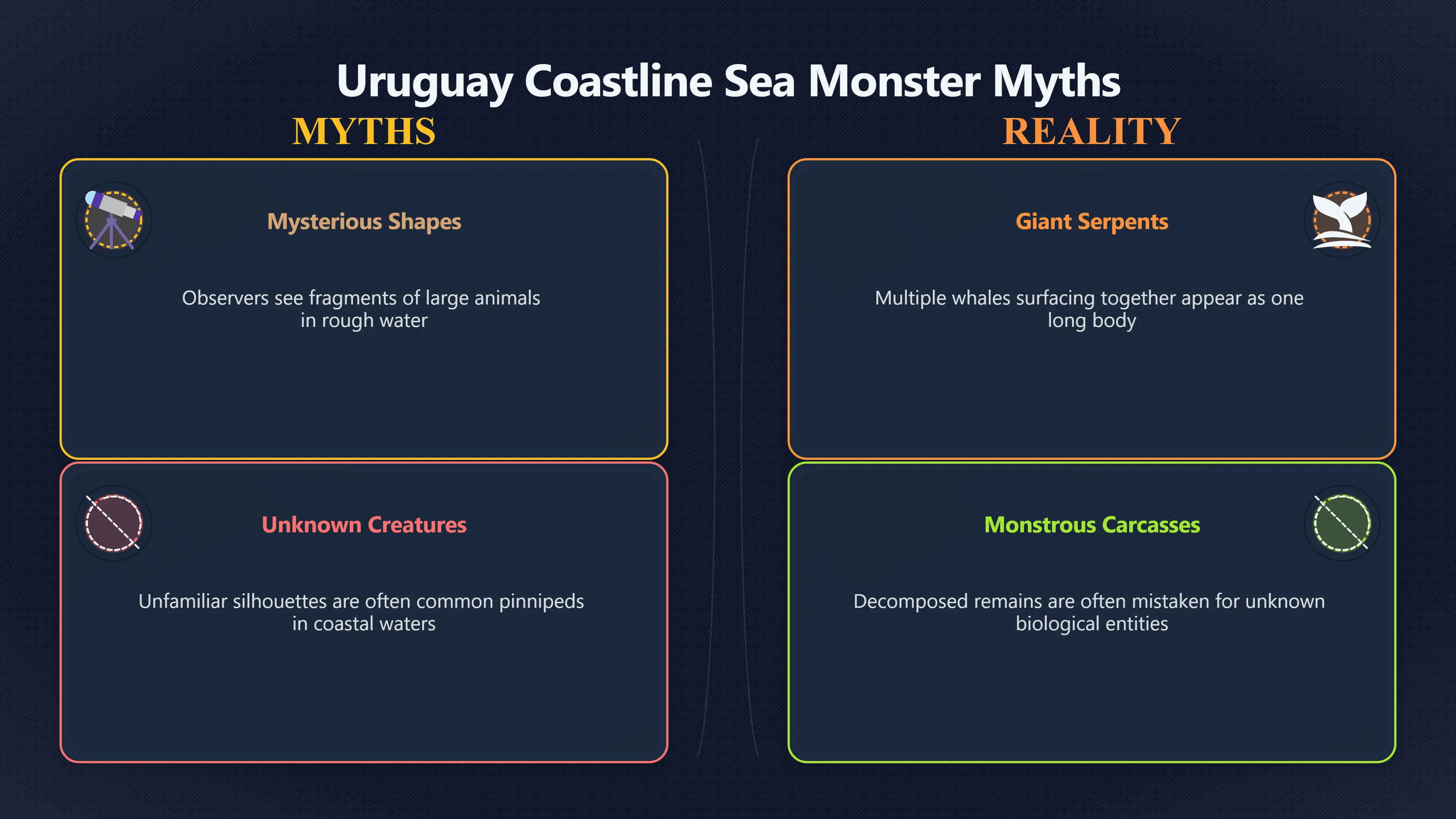
When observers encounter an unfamiliar shape offshore, they often see only fragments of an animal. A whale’s back may emerge in a sequence of dark humps. A swimming sea lion may expose only its head and neck. Several animals travelling together can appear to be one enormous creature. These visual effects have contributed to sea-monster reports around the world and provide a far more likely explanation than the presence of an undiscovered giant animal.
The occasional modern viral sighting follows the same pattern. Grainy footage, uncertain distances and brief observations create room for speculation, but clear identification is usually impossible from the available evidence.[Surfer]surfer.comMysterious Creature Charges Surfers in South AmericaFootage shows an unknown animal breaching near a crowd of surfers in Uruguay; one…Read more…
Animals Commonly Seen off the Coast
Several species repeatedly create the conditions for mistaken identity.
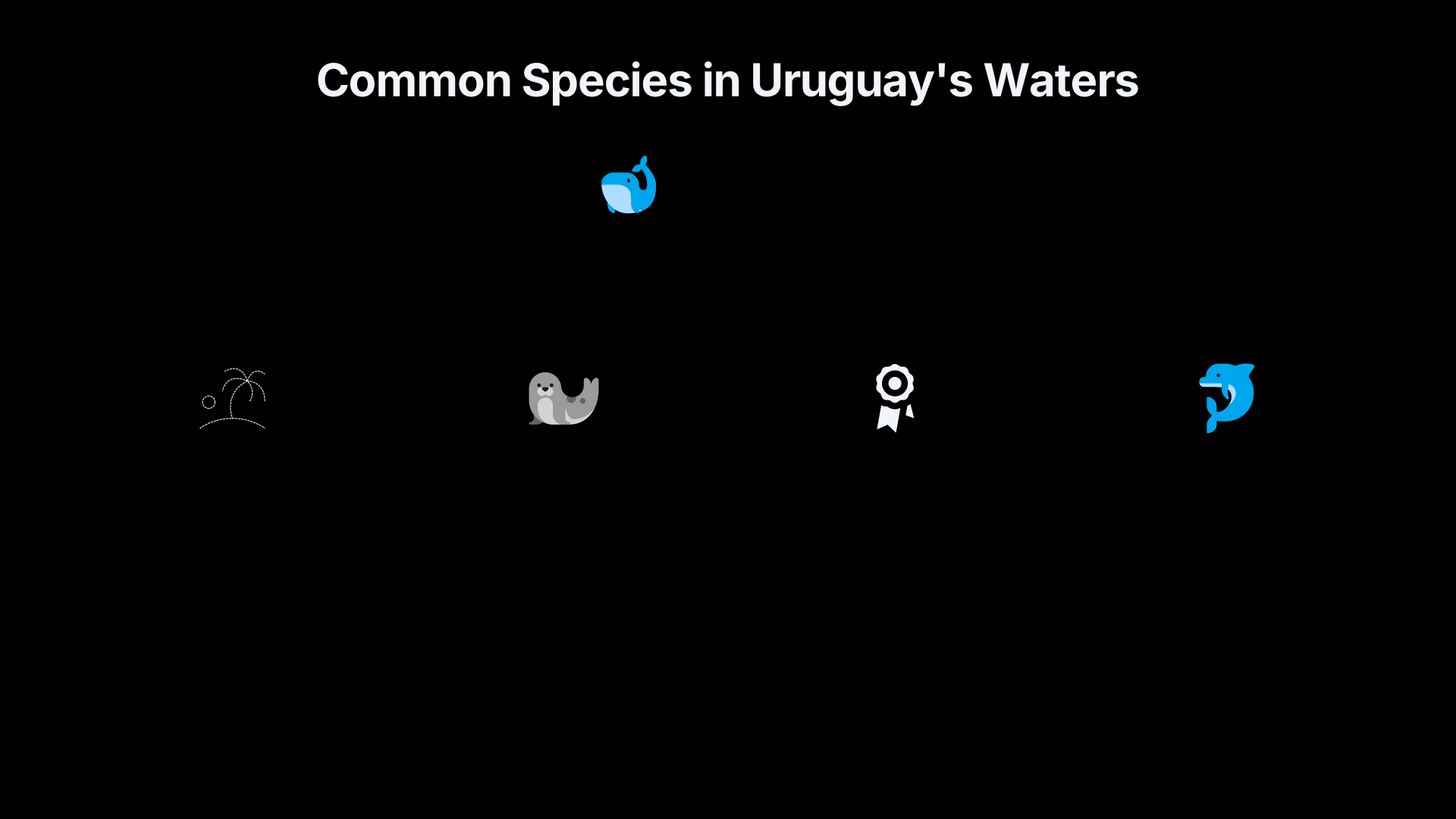
Southern right whales are perhaps the most impressive. Adults can exceed 15 metres in length, and Uruguay’s coast becomes an important viewing area during the migration season. From shore, observers often see only portions of the animal as it surfaces and dives. A series of rolling backs can resemble multiple humps or a giant serpent-like body.[iberia.com]iberiaclubmagazine.iberia.comIberia Club MagazineWhale watching in Uruguay | Iberia ClubEvery year, between July and November, Uruguay's become a natural sanctuary fo…
South American sea lions and fur seals are abundant around Isla de Lobos near Punta del Este, one of the region’s most important pinniped colonies. Seen at a distance, a swimming sea lion’s raised head and elongated neck can resemble the classic profile of a small sea monster.[atlasobscura.com]atlasobscura.comAtlas Obscura Isla de Lobos in UruguayAtlas ObscuraIsla de Lobos in UruguayApril 5, 2021 — 5 Apr 2021 — Isla de Lobos. This small island off the coast of Uruguay hosts the lar…
Elephant seals are much rarer visitors, which ironically makes them more likely to be misidentified. Their large size, unusual proportions and infrequent appearances mean that many beachgoers have never seen one before. Historical records show occasional seal occurrences along the Uruguayan coast, including species not normally expected by casual observers.[FAOHome]fao.orgOpen source on fao.org.
Dolphins and porpoises can also create misleading impressions. Fast-moving animals surfacing in sequence sometimes appear to be parts of a single larger creature, especially in choppy water or poor light.[Mission Blue]missionblue.orgMission BlueThe Whale and Dolphin Sanctuary of Uruguay Declared a…Oct 26, 2018 — The Uruguayan Sanctuary for Whales and Dolphins is a…
How Distance Distorts Size and Shape
Most coastal monster reports depend on a surprisingly simple problem: people are poor at judging size over open water.
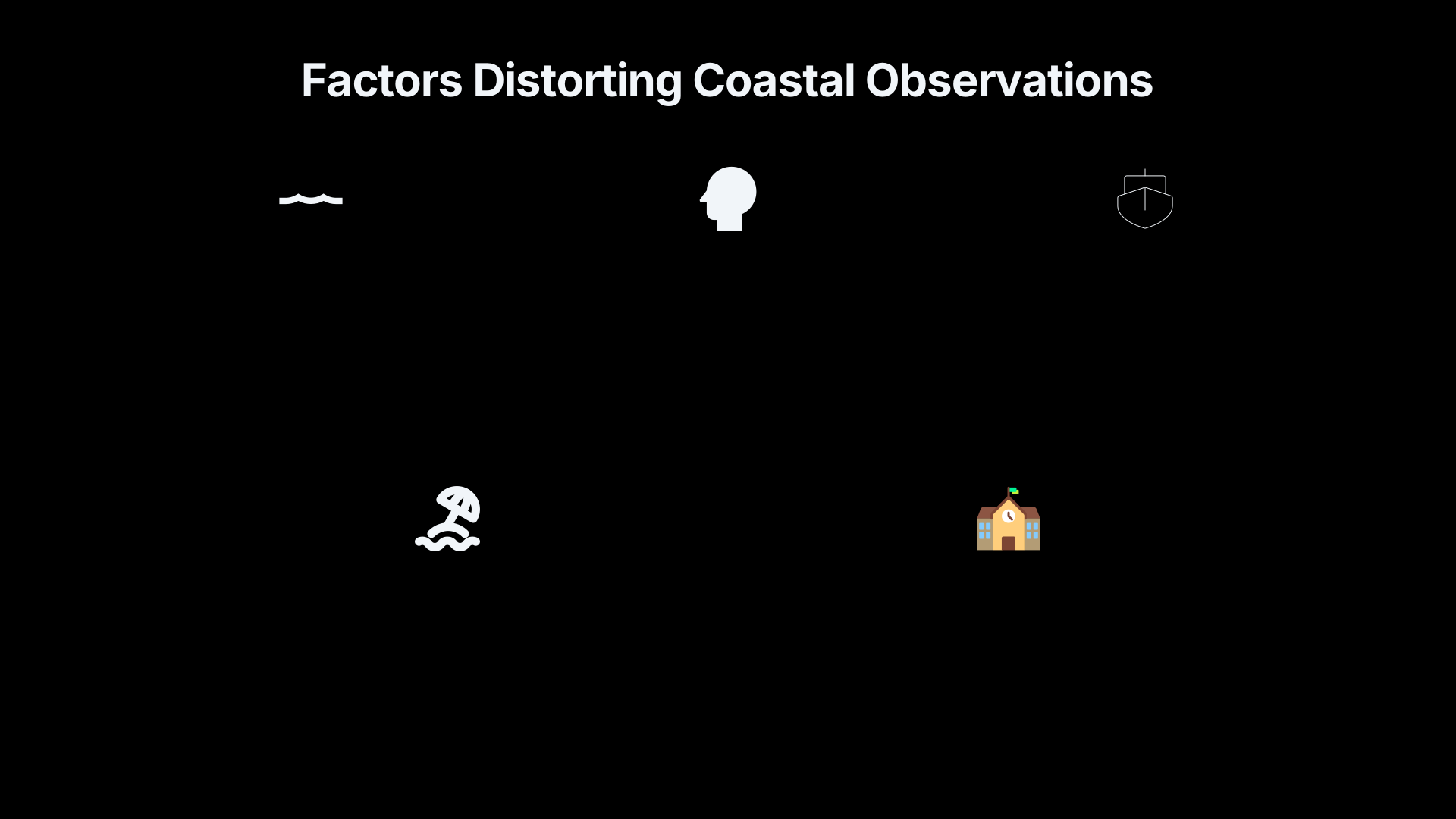
The ocean provides few reliable reference points. Without nearby objects for comparison, a medium-sized animal can appear enormous. A sea lion several hundred metres offshore may seem much larger than it really is, while a whale partly hidden by waves can look strangely elongated.
Water itself creates additional illusions:
- Waves conceal sections of an animal’s body.
- Heat haze can distort outlines.
- Reflected light can alter perceived colours.
- Several animals surfacing together may seem connected.
- Objects rise and disappear behind swells, creating the impression of a long undulating creature.
Whales are especially effective at producing monster-like silhouettes. A surfacing right whale may reveal only a curved back, then another section moments later, encouraging observers to interpret separate appearances as a single long body. Researchers studying right whales off Uruguay note their regular presence in coastal waters, making them a realistic source for many unidentified offshore sightings.[researchgate.net]researchgate.netSightings of southern right whales, Eubalaena australis, off…Historical accounts, incidental sightings and recent survey…
The same principle applies to sea lions and fur seals. When swimming, much of the body remains submerged. Observers often see only a dark head moving through the water, a shape that can look surprisingly unfamiliar when viewed from a beach rather than in a wildlife documentary.[NOAA Fisheries]fisheries.noaa.govOpen source on noaa.gov.
Why Carcasses Become Mystery Creatures
Some of the most dramatic sea-monster stories begin not with living animals but with dead ones.
When whales, sharks or other large marine animals decompose, their bodies change rapidly. Skin slips away, bones become exposed and connective tissues stretch into strange shapes. A badly decomposed carcass can look completely unlike the animal it once was.
These remains are often called “globsters” in popular discussion. Throughout the world, unusual beach strandings have repeatedly been promoted as unknown creatures before scientific examination identified them as decomposed whales or other familiar marine animals.
Several biological processes contribute to the confusion:
- Soft tissues decay at different rates.
- Scavengers remove recognisable features.
- Gas buildup changes body shape.
- Skin and blubber separate from underlying structures.
- Water movement tears remains into unfamiliar forms.
Because Uruguay’s coastline lies on major marine migration routes and regularly hosts large marine mammals, stranded remains occasionally attract speculation. Yet the historical pattern elsewhere strongly suggests that apparently monstrous carcasses usually prove to be ordinary animals altered by decomposition.[missionblue.org]missionblue.orgMission BlueThe Whale and Dolphin Sanctuary of Uruguay Declared a…Oct 26, 2018 — The Uruguayan Sanctuary for Whales and Dolphins is a…
Why Uruguay Produces More Misidentifications Than Monsters
Uruguay’s coast is unusually well suited to creating marine mysteries without requiring any unknown species.
The country combines migrating whales, large seal colonies, seasonal wildlife movements, long viewing distances and busy tourist beaches. Many observers encounter marine mammals only briefly and often without binoculars or specialised knowledge. A person familiar with dogs, cattle or birds may have little experience identifying a whale’s surfacing pattern or a sea lion’s silhouette at sea.
As a result, Uruguay’s coastal monster tradition tends to be less about hidden creatures and more about the gap between what people expect to see and what actually inhabits the South Atlantic. The real animals are already impressive enough. A right whale breaching offshore, a solitary elephant seal on a beach or a sea lion rising unexpectedly from the surf can look astonishing even when correctly identified.[iberia.com]iberiaclubmagazine.iberia.comIberia Club MagazineWhale watching in Uruguay | Iberia ClubEvery year, between July and November, Uruguay's become a natural sanctuary fo…
For that reason, Uruguay’s most enduring marine mysteries are not evidence of undiscovered sea monsters. They are examples of how ordinary wildlife, viewed under unusual conditions, can briefly become legendary.
Amazon book picks
Further Reading
Books and field guides related to Are Uruguay's Sea Monsters Really Marine Wildlife?. Use these as the next step if you want deeper reading beyond the article.
The World of Lore: Monstrous Creatures
Examines legendary creatures and their cultural origins.
eBay marketplace picks
Marketplace Samples
Live-tested eBay searches with available results related to this page.

Endnotes
1.
Source: iberiaclubmagazine.iberia.com
Link:https://iberiaclubmagazine.iberia.com/en/articles/2025/3/uruguay-whales/
Source snippet
Iberia Club MagazineWhale watching in Uruguay | Iberia ClubEvery year, between July and November, Uruguay's become a natural sanctuary fo...
2.
Source: surfer.com
Title: Mysterious Creature Charges Surfers in South America
Link:https://www.surfer.com/news/mysterious-creature-surfers-in-uruguay-video
Source snippet
Footage shows an unknown animal breaching near a crowd of surfers in Uruguay; one...Read more...
3.
Source: researchgate.net
Link:https://www.researchgate.net/publication/272894572_Sightings_of_southern_right_whales_Eubalaena_australis_off_Uruguay
Source snippet
Sightings of southern right whales, Eubalaena australis, off...Historical accounts, incidental sightings and recent survey...
4.
Source: journal.iwc.int
Title: No previous study of southern right
Link:https://journal.iwc.int/index.php/jcrm/article/download/568/293
Source snippet
pp361-364_jnl 503_Tellechea_Norbis:Layout 1by JS Tellechea · 2012 · Cited by 5 — This paper describes sound production by southern right...
5.
Source: Wikipedia
Title: Isla de Lobos
Link:https://en.wikipedia.org/wiki/Isla_de_Lobos
6.
Source: fisheries.noaa.gov
Link:https://www.fisheries.noaa.gov/seals-sea-lions
7.
Source: Wikipedia
Title: Unusual articles
Link:https://en.wikipedia.org/wiki/Wikipedia%3AUnusual_articles
8.
Source: Wikipedia
Title: Southern right whale
Link:https://en.wikipedia.org/wiki/Southern_right_whale
9.
Source: missionblue.org
Link:https://missionblue.org/2018/10/the-whale-and-dolphin-sanctuary-of-uruguay-declared-a-hope-spot-in-support-of-cetacean-conservation/
Source snippet
Mission BlueThe Whale and Dolphin Sanctuary of Uruguay Declared a...Oct 26, 2018 — The Uruguayan Sanctuary for Whales and Dolphins is a...
10.
Source: gaiafoundation.org
Link:https://gaiafoundation.org/the-whale-and-dolphin-sanctuary-of-uruguay-declared-a-hope-spot-in-support-of-cetacean-conservation/
Source snippet
Gaia FoundationThe Whale and Dolphin Sanctuary of Uruguay Declared a...The Uruguayan Sanctuary for Whales and Dolphins is a one-of-a-kin...
11.
Source: atlasobscura.com
Title: Atlas Obscura Isla de Lobos in Uruguay
Link:https://www.atlasobscura.com/places/isla-de-lobos
Source snippet
Atlas ObscuraIsla de Lobos in UruguayApril 5, 2021 — 5 Apr 2021 — Isla de Lobos. This small island off the coast of Uruguay hosts the lar...
Published: April 5, 2021
12.
Source: internationalparks.org
Link:https://www.internationalparks.org/uruguay/Isla%20e%20Islote%20de%20Lobos
13.
Source: fao.org
Link:https://www.fao.org/fishery/openasfa/cc829684-852c-4c9a-a891-be899245df90/en
14.
Source: gaiafoundation.org
Link:https://gaiafoundation.org/celebrating-the-isla-de-lobos-marine-protected-area-in-uruguay/
15.
Source: tripadvisor.com
Title: Isla de Lobos
Link:https://www.tripadvisor.com/Attraction_Review-g294066-d2630506-Reviews-Isla_de_Lobos-Punta_del_Este_Maldonado_Department.html
16.
Source: missionblue.org
Link:https://missionblue.org/2025/05/whale-and-dolphin-sanctuary-of-uruguays-hope-spot-champions-celebrate-the-designation-of-uruguays-first-ever-oceanic-marine-protected-area/
Additional References
17.
Source: marinemammalhabitat.org
Link:https://www.marinemammalhabitat.org/factsheets/southern-brazil-and-uruguay-coastal-ecosystems-imma/
Source snippet
Marine Mammal Protected Areas Task ForceSouthern Brazil and Uruguay Coastal Ecosystems IMMASouth American fur seals (Arctocephalus austra...
18.
Source: youtube.com
Title: 5 TIPS for seeing WHALES in Uruguay
Link:https://www.youtube.com/watch?v=cZeKpPb2n1U
Source snippet
A Leviathan on the Beach: The Corpse of a Sperm Whale Washes Up in Montevideo...
19.
Source: youtube.com
Title: Britain’s Sea Monster, The Basking Shark
Link:https://www.youtube.com/watch?v=psY_sE1a5cg
Source snippet
St. Augustine Sea Monster | What Washed Shore in 1896?...
20.
Source: youtube.com
Title: 11 Most Mysterious Creatures Found on Beaches
Link:https://www.youtube.com/watch?v=jUfztuVsGnQ
Source snippet
Britain's Sea Monster, The Basking Shark - Colin Speedie...
21.
Source: facebook.com
Link:https://www.facebook.com/missionblue/posts/a-whale-wonderland-uruguays-whale-and-dolphin-sanctuary-is-the-first-step-of-pro/887663839380376/
22.
Source: dokumen.pub
Link:https://dokumen.pub/bigfoot-to-mothman-a-global-encyclopedia-of-legendary-beasts-and-monsters-9781440877254-1440877254-a-5826593.html
23.
Source: archive.org
Link:https://archive.org/stream/Cryptozoology_201608/Cryptozoology_djvu.txt
24.
Source: marinemammalhabitat.org
Link:https://www.marinemammalhabitat.org/wp-content/uploads/imma-factsheets/SouthWestAtlanticOcean/Southern-Brazil-and-Uruguay-Coastal-Ecosystems-SouthWestAtlanticOcean.pdf
25.
Source: sealsitters.org
Link:https://www.sealsitters.org/marine-mammals
26.
Source: turismorocha.gub.uy
Link:https://turismorocha.gub.uy/en/attractions/nature/natural-reserve-of-sea-lions-in-cabo-polonio-rocha-uruguay
Topic Tree