Within Kyrgyz Monsters
Is the Almas Kyrgyzstan's Bigfoot?
Kyrgyzstan's wildman lore belongs to a wider Central Asian tradition where hairy human-like beings blur into bears, mountains and herding tales.
On this page
- Where Kyrgyz wildman stories fit
- Almas, bears and local categories
- Why the legend crosses borders
Page outline Jump by section
Introduction
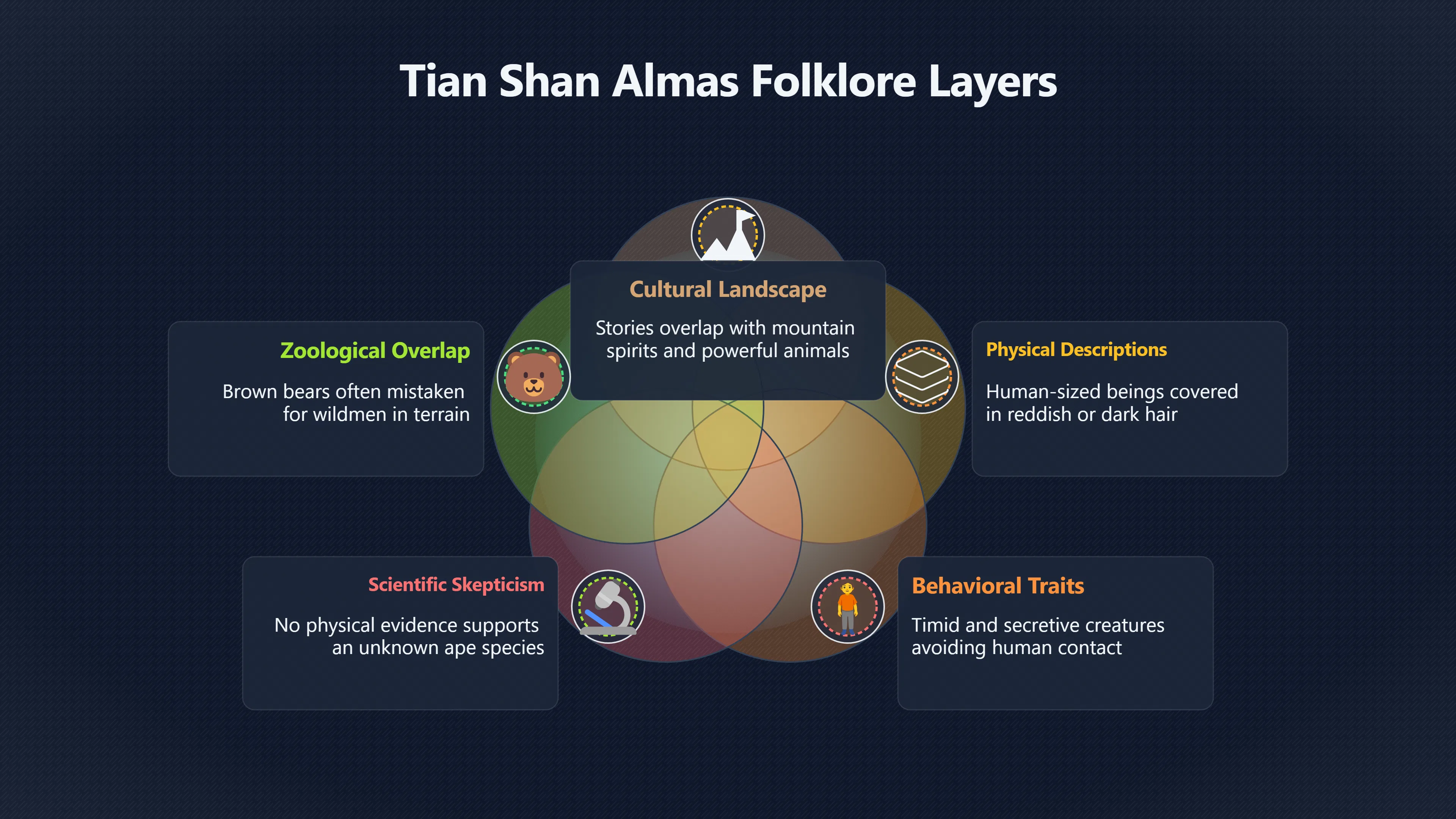
The Almas is often described as Central Asia’s answer to Bigfoot: a hairy, human-like wildman said to inhabit remote mountain regions from the Caucasus to Mongolia. In Kyrgyzstan, the legend is most closely associated with the Tian Shan mountains, where isolated valleys, seasonal herding routes and difficult terrain have long encouraged stories about mysterious beings living beyond ordinary human settlements. Unlike some cryptid traditions that revolve around a single famous sighting, the Kyrgyz Almas is part of a wider cultural landscape in which wild humans, powerful animals and mountain spirits frequently overlap.[Wikipedia]WikipediaAlmas (folkloreAlmas (folklore

For readers looking for a simple answer, the Almas is not a documented species. No physical evidence has convinced mainstream zoologists that an unknown ape or surviving ancient human population exists in the Tian Shan. Yet the stories remain important because they reveal how people understood wilderness, danger and the blurred boundary between humanity and nature in one of Eurasia’s great mountain systems.[Wikipedia]WikipediaAlmas (folkloreAlmas (folklore
Where Kyrgyz wildman stories fit
Kyrgyz Almas traditions belong to a broad Central Asian wildman complex that stretches across Kazakhstan, Kyrgyzstan, western China and Mongolia. Researchers studying regional folklore have noted that stories from Kyrgyzstan tend to resemble those found further east, rather than the somewhat different wildman traditions reported from the Pamirs and parts of Tajikistan. In this cultural zone, the creature is usually imagined not as a giant monster but as a shy, hairy, human-like being that avoids contact with people.[ResearchGate]researchgate.net318563173 Wildmen in Central AsiaResearchGate(PDF) Wildmen in Central Asia8 Aug 2017 — We focus here on the wildmen in Mongolia, Kazakstand, and Kyrgyzstan, describing an…
The Tian Shan provides a natural setting for such stories. The range extends for roughly 2,000 kilometres across Central Asia and contains high meadows, forests, glaciers and remote valleys where herders may spend long periods far from towns. Historically, shepherds, hunters and travellers were the people most likely to encounter unusual animals or unexplained tracks. In oral tradition, these landscapes became places where encounters with wildmen could plausibly occur.[Wikipedia]WikipediaTian Shan montane steppe and meadowsTian Shan montane steppe and meadows
Unlike North American Bigfoot lore, which often focuses on footprints, photographs and modern expeditions, Almas accounts are usually embedded in local storytelling. Reports describe fleeting encounters, figures glimpsed at a distance, strange tracks, or tales passed down through families rather than carefully documented investigations.[ResearchGate]researchgate.net318563173 Wildmen in Central AsiaResearchGate(PDF) Wildmen in Central Asia8 Aug 2017 — We focus here on the wildmen in Mongolia, Kazakstand, and Kyrgyzstan, describing an…
Is the Almas supposed to be an animal or a wild human?
One of the most interesting features of the Almas tradition is that the creature is rarely portrayed as a completely separate species. Many descriptions place it somewhere between human and animal.
Nineteenth-century explorer Nikolai Przhevalsky recorded reports from Central Asia describing a “man-beast” with a human-like face, dark hair and the ability to walk upright. Later descriptions collected by researchers portrayed the Almas as roughly human-sized, covered in reddish or dark hair, physically powerful but generally timid and secretive.[Wikipedia]WikipediaAlmas (folkloreAlmas (folklore
This ambiguity matters because many traditional societies did not draw the same strict line between humans and wild creatures that modern biology does. The Almas often occupies a middle category: neither ordinary person nor ordinary animal. In some stories it seems almost like a remnant of an earlier stage of humanity, living beyond civilisation in mountain wilderness.[Wikipedia]WikipediaAlmas (folkloreAlmas (folklore
That idea later attracted cryptozoologists, particularly during the Soviet period. Some researchers speculated that Almas reports might preserve memories of a surviving population of archaic humans such as Neanderthals. These proposals generated attention but never produced convincing physical evidence. Modern genetics and palaeoanthropology have not supported claims that a hidden population of ancient humans survives in the Tian Shan.[Wikipedia]WikipediaAlmas (folkloreAlmas (folklore

Almas, bears and local categories
A recurring challenge in evaluating Almas stories is that the reported creature often resembles animals already known to inhabit Central Asian mountains.
Brown bears are particularly relevant. A bear standing upright, seen briefly at long range or in poor weather, can appear surprisingly human-like. Mountain terrain can distort perceptions of size and distance, while fleeting encounters leave plenty of room for interpretation. Modern genetic testing of hair samples attributed to Almas-like creatures elsewhere in Eurasia has repeatedly identified ordinary animals, especially brown bears.[Wikipedia]WikipediaAlmas (folkloreAlmas (folklore
The issue is not simply mistaken identity. In many traditional mountain cultures, categories overlap. A bear may be viewed not only as an animal but also as a creature possessing unusual intelligence, strength or almost human qualities. Stories can therefore move easily between descriptions of bears, wild people and other powerful mountain beings.[ResearchGate]researchgate.net318563173 Wildmen in Central AsiaResearchGate(PDF) Wildmen in Central Asia8 Aug 2017 — We focus here on the wildmen in Mongolia, Kazakstand, and Kyrgyzstan, describing an…
For herding communities in the Tian Shan, practical concerns also shaped the legend. Remote grazing grounds expose people to predators, harsh weather and isolation. Stories about mysterious wild inhabitants can function as warnings about dangerous places, reminders to respect the mountains, or explanations for unexpected events. The Almas becomes less a zoological claim and more a way of talking about the untamed landscape itself.[ResearchGate]researchgate.net318563173 Wildmen in Central AsiaResearchGate(PDF) Wildmen in Central Asia8 Aug 2017 — We focus here on the wildmen in Mongolia, Kazakstand, and Kyrgyzstan, describing an…
Why the legend crosses borders
The Almas is unusual because it ignores modern national boundaries. Stories occur across a vast arc of Central Asia, from the Caucasus through Kazakhstan and Kyrgyzstan to Mongolia. This distribution suggests that the tradition spread through cultural exchange, migration routes and shared pastoral lifestyles rather than emerging from a single local mystery.[Wikipedia]WikipediaAlmas (folkloreAlmas (folklore
The historical movement of nomadic and semi-nomadic peoples across mountain and steppe environments helped carry stories from one region to another. Herding communities often shared similar experiences: long journeys through remote terrain, encounters with large mammals, and a need to explain strange sights in places where few people travelled. The result was a family of related wildman traditions rather than one fixed creature.[ResearchGate]researchgate.net318563173 Wildmen in Central AsiaResearchGate(PDF) Wildmen in Central Asia8 Aug 2017 — We focus here on the wildmen in Mongolia, Kazakstand, and Kyrgyzstan, describing an…
This broader context explains why the Almas is sometimes compared with the Yeti, Bigfoot or other wildman figures. The comparison is useful up to a point, but the Almas remains distinct. It is generally portrayed as more human-sized, more deeply rooted in pastoral folklore and more closely connected to ideas about wild humanity than to giant ape-like monsters.[Wikipedia]WikipediaAlmas (folkloreAlmas (folklore

Why the story survives
The endurance of the Almas legend has less to do with evidence than with setting. The Tian Shan remains one of the world’s great mountain landscapes, filled with valleys that still feel remote despite modern technology. Such environments naturally encourage stories about hidden inhabitants.
The legend also survives because it occupies several roles at once. It is a cryptid for enthusiasts, a folklore figure for cultural historians, a symbol of wilderness for mountain communities and a reminder that not every strange report has a simple explanation. Even when individual sightings can be attributed to bears, misidentifications or storytelling traditions, the Almas continues to express a powerful idea: that beyond the last pasture and beyond the familiar tracks, the mountains may still contain something unknown.[Wikipedia]WikipediaAlmas (folkloreAlmas (folklore
Amazon book picks
Further Reading
Books and field guides related to Is the Almas Kyrgyzstan's Bigfoot?. Use these as the next step if you want deeper reading beyond the article.
Sasquatch: Legend Meets Science
Provides a useful comparison point for Almas narratives.
eBay marketplace picks
Marketplace Samples
Live-tested eBay searches with available results related to this page.


Endnotes
1.
Source: Wikipedia
Title: Almas (folklore)
Link:https://en.wikipedia.org/wiki/Almas_%28folklore%29
2.
Source: researchgate.net
Title: 318563173 Wildmen in Central Asia
Link:https://www.researchgate.net/publication/318563173_Wildmen_in_Central_Asia
Source snippet
ResearchGate(PDF) Wildmen in Central Asia8 Aug 2017 — We focus here on the wildmen in Mongolia, Kazakstand, and Kyrgyzstan, describing an...
3.
Source: Wikipedia
Title: Tian Shan montane steppe and meadows
Link:https://en.wikipedia.org/wiki/Tian_Shan_montane_steppe_and_meadows
4.
Source: cryptidz.fandom.com
Link:https://cryptidz.fandom.com/wiki/Almas
Source snippet
Cryptid Wiki - FandomThe Almas is an ape cryptid reported from Central Asia. They are said to inhabit the Asian mountain regions of the...
Additional References
5.
Source: reddit.com
Link:https://www.reddit.com/r/mongolia/comments/1igmg8p/about_the_almas_the_mongolian_wildman/
Source snippet
About the Almas, the Mongolian wildman: r/mongoliaAccording to Mongolian folklore, the Gobi desert and the Altai areas of South West Mon...
6.
Source: crazyalchemist.com
Link:https://www.crazyalchemist.com/bestiary/almas/
Source snippet
Almas: Wild Man of the Altai MountainsAlmas. Almas: the wild man of the Altai Mountains. Mongolian herders describe a stocky, hairy biped...
7.
Source: digitalcollections.sit.edu
Link:https://digitalcollections.sit.edu/cgi/viewcontent.cgi?article=1780&context=isp_collection
Source snippet
The Legend of the Almas: A Comparative and Critical...by N Wenzel · 2009 — Traditionally, western Mongolia, including the aimags of Khovd...
8.
Source: academia.edu
Link:https://www.academia.edu/90729294/Specialized_wool_production_economy_of_prehistoric_farmstead_of_Chap_I_in_the_highlands_of_Central_Tian_Shan_Kyrgyzstan_
Source snippet
ands (2,000 masl and higher) have been poorly studied to date.Read more...
9.
Source: facebook.com
Link:https://www.facebook.com/groups/amalgamania/posts/3439216706300951/
Source snippet
s. The Alma has also been seen in Kazakstan and the...Read more...
10.
Source: facebook.com
Link:https://www.facebook.com/groups/281886105961506/posts/1781428779340557/
Source snippet
tains and forests, similar to the Yeti. The Almas is said...
11.
Source: facebook.com
Link:https://www.facebook.com/kyrgyzamericanfoundation/posts/the-kyrgyz-legend-of-the-horned-mother-deer-reflects-the-totemic-symbolism-and-s/1283099840649274/
Source snippet
cred role of the deer associated with the ancient...
12.
Source: dnagenics.com
Link:https://www.dnagenics.com/ancestry/sample/view/profile/id/da117?srsltid=AfmBOor3lACun4Sd2iJznos0RrOXGEDRREtIFUu6cCZa9cuINrOFopgv
Source snippet
DA117 - A man buried in Kyrgyzstan in the Modern eraTraditionally, the Kyrgyz people were nomads, moving through the mountainous terrain...
13.
Source: pmc.ncbi.nlm.nih.gov
Link:https://pmc.ncbi.nlm.nih.gov/articles/PMC13093707/
Source snippet
by S Kantarbayev · 2026 — Here, we conducted a first‐ever pilot study in the Altai Mountain Region of Kazakhstan using camera traps to...
14.
Source: youtube.com
Title: The Mongolian Bigfoot: a firsthand encounter with the Almas
Link:https://www.youtube.com/watch?v=-JG4IAJdu7I
Source snippet
Top 10 Bigfoots from Around the World | Stories of Legend...
Topic Tree