Within Somali Creatures
Did Somalia Ever Have Bears or Dragons?
Claims about bears, dragons and giant serpents reveal how weak online evidence can grow around real wildlife and older folklore.
On this page
- The Madax Kuti bear claim
- Masduula and giant serpent traditions
- Wildlife records, missing evidence and misidentification
Page outline Jump by section
Introduction
Did Somalia ever have bears or dragons? The short answer is that there is no reliable evidence that wild bears lived in historical Somalia, and there is certainly no evidence for dragons in a zoological sense. Yet stories about bear-like creatures, giant serpents and dragon-like beings continue to circulate in Somali folklore and on the internet. What makes these claims interesting is not the strength of the evidence but the way fragments of oral tradition, misunderstood animal names, and modern online speculation have blended together into a loose collection of “mystery beast” stories.[Wikipedia]WikipediaWildlife of SomaliaWildlife of Somalia
Unlike some countries with long-running lake-monster or ape-man traditions, Somalia’s giant-animal claims are usually rooted in folklore rather than repeated eyewitness reports. The stories reveal how easily legends can grow around real snakes, hyenas, honey badgers and other familiar wildlife, especially when older oral traditions meet modern internet culture.[Scribd]scribd.comSomali Folk Tales Collection | PDF | Horn Of AfricaThe document is a collection of Somali folk tales compiled and translated by Ahm…
The Madax Kuti Bear Claim
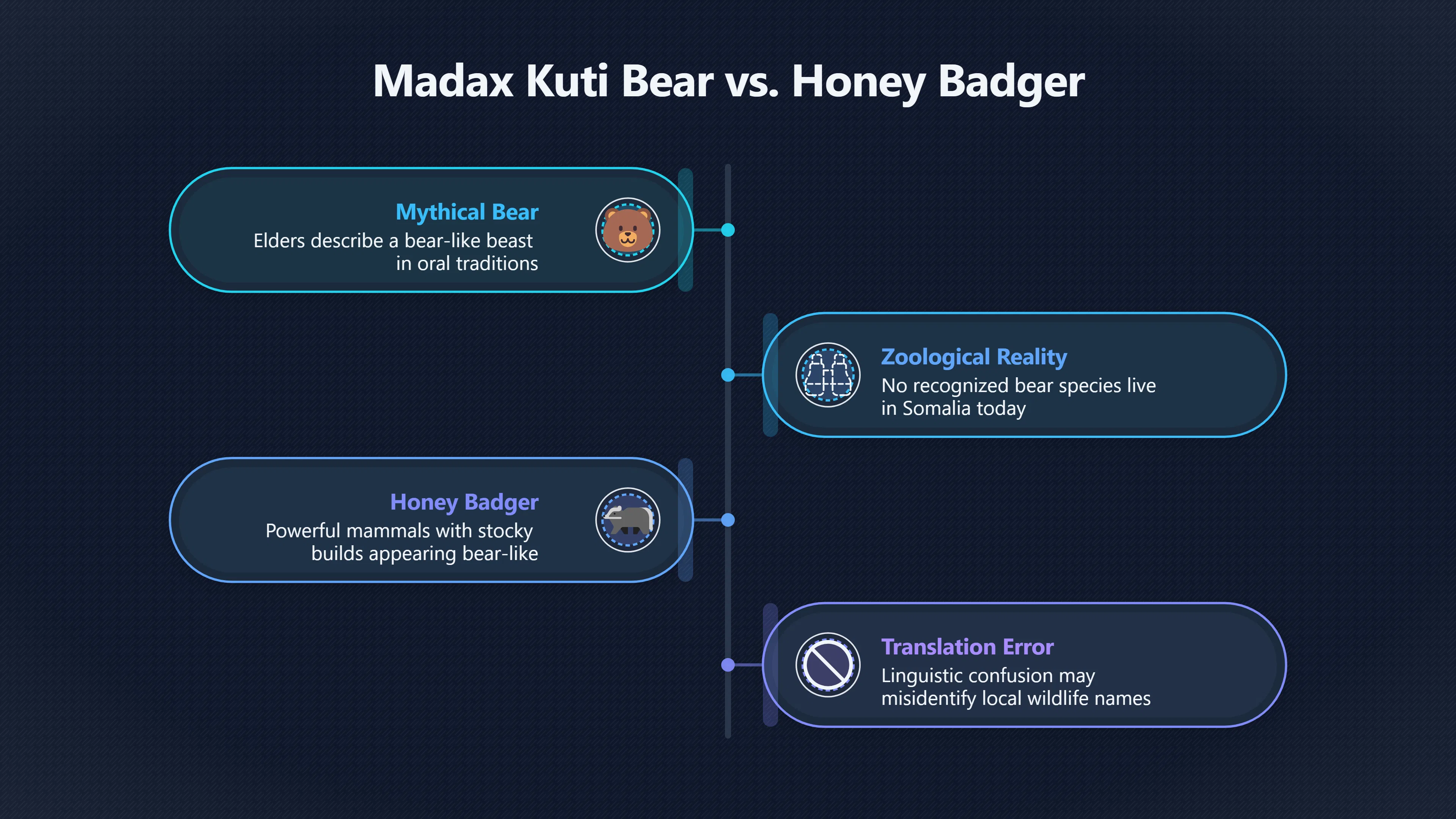
Among the strangest modern Somali mystery-animal discussions is the claim that Somalia once had bears, often linked to a creature called “Madax Kuti”. Online discussions sometimes describe it as a bear-like beast remembered by elders, while others present it as evidence that an unknown bear species survived in the Horn of Africa. The problem is that the supporting evidence is extremely weak.[Reddit]reddit.comWhy do Somalis have stories about bears (madax kuti)…There are no species of bear in Africa today. The only species of bear that…
No recognised zoological survey of Somalia lists native bears. Modern wildlife records document a rich mammal fauna including lions, cheetahs, hyenas, baboons, antelope and elephants, but not bears.[Wikipedia]WikipediaWildlife of SomaliaWildlife of Somalia
Several competing explanations have been offered for the bear story:
- Translation confusion. Some Somali speakers argue that the animal referred to in local stories is actually a honey badger rather than a true bear. Honey badgers are powerful, aggressive mammals with a stocky build that can appear vaguely bear-like to outsiders.[Facebook]facebook.comDid bears exist in British Somaliland?Madaxkuti is not bear in Somali language. It is honey badger. It is told that one bear scap…
- Imported-animal legends. Another popular explanation claims that bears escaped from a ship somewhere along the Red Sea or Gulf of Aden coast and briefly survived in the region. These stories are colourful but lack documentary support.[Facebook]facebook.comDid bears exist in British Somaliland?Madaxkuti is not bear in Somali language. It is honey badger. It is told that one bear scap…
- Folklore inflation. As stories pass between generations, a dangerous or unusual animal can gradually become larger and more exotic than the original creature.
A useful reality check comes from African bear history. The only bear known to have survived into relatively recent historical times in Africa was the Atlas bear of north-western Africa, thousands of kilometres from Somalia. It disappeared in the nineteenth century and there is no evidence that bears naturally inhabited the Somali Peninsula.[Wikipedia]WikipediaList of African species extinct in the HoloceneList of African species extinct in the Holocene
For that reason, the Madax Kuti story is best understood as a folklore puzzle rather than a genuine zoological mystery. The creature’s identity remains unclear, but the available evidence does not support the existence of a hidden Somali bear population.
Why Dragon Stories Appear in Somali Tradition
Somalia does possess dragon-like folklore, although these creatures belong firmly to mythology rather than eyewitness cryptozoology. The best-known example is the Masduula, a giant serpent often translated or described as a dragon.
Unlike European dragons with wings and fire-breathing habits, Somali dragon traditions usually portray the creature as an enormous serpent that acquires supernatural characteristics. Modern retellings describe a snake that becomes increasingly powerful with age, eventually transforming into a dragon-like being associated with treasure, magical powers or extraordinary intelligence.[Reddit]reddit.comThe Masduula, a Somali Dragon that consumes its Serpentsnake/dragon in Somali myth. It takes only three failed hunts for it… r/dragons - One African Dragon: The Masduulaa, a Somali Serpent…
These stories fit a wider pattern found across Africa, the Middle East and the Horn of Africa, where giant serpents often occupy the same cultural role that dragons occupy in Europe. Instead of representing an unknown animal, they serve as symbols of danger, power, age and hidden knowledge.
What is striking is how little evidence exists for a specifically Somali “dragon sighting” tradition. Most references to the Masduula come from folklore collections, oral storytelling and recent online retellings rather than newspaper archives documenting alleged encounters.[Scribd]scribd.comSomali Folk Tales Collection | PDF | Horn Of AfricaThe document is a collection of Somali folk tales compiled and translated by Ahm…
As a result, the Masduula is better classified as a legendary creature than a cryptid. Its importance lies in storytelling and mythology, not in claims that a biological dragon survives somewhere in the Somali countryside.
Giant Serpents and Enormous Reptiles
Giant-serpent stories are much more deeply rooted in Somali tradition than bear stories. Across many cultures, large snakes naturally become the basis for tales about monsters, and Somalia provides plenty of opportunities for such stories to develop.
The country contains a variety of snakes and large reptiles, and historically many rural communities lived in close contact with wildlife. In landscapes where dangerous snakes were real hazards, stories about exceptionally large serpents were an effective way of communicating danger and reinforcing local knowledge.[Wikipedia]WikipediaWildlife of SomaliaWildlife of Somalia
Over time, three factors likely helped giant-serpent legends grow:
Real snakes inspire exaggerated accounts. A large python or other sizeable reptile can appear much larger in memory than it was in reality.
Oral storytelling rewards memorable details. A snake that was merely large in one telling may become enormous in the next.
Folklore absorbs supernatural elements. Once a serpent becomes associated with magical powers, treasure or unusual intelligence, it moves from wildlife story into myth.
Some modern internet discussions blur the distinction between these traditions and reports of unknown giant reptiles. Yet there is no documented body of verified sightings comparable to famous lake-monster traditions elsewhere. The stories are culturally significant, but the evidence remains folkloric rather than zoological.[Scribd]scribd.comSomali Folk Tales Collection | PDF | Horn Of AfricaThe document is a collection of Somali folk tales compiled and translated by Ahm…
Giants, Monster Animals and the Problem of Evidence
Somali folklore also contains stories about giants, including heroic and tyrannical giant figures remembered in traditional narratives. These beings belong to the same imaginative landscape as giant serpents and dragon-like creatures. They are part of a storytelling tradition rather than reports of surviving giant animals.[Wikipedia]WikipediaSomali mythologySomali mythology
The challenge for researchers is that modern online sources often mix together very different categories:
- Traditional folklore.
- Children’s tales and moral stories.
- Mythological creatures.
- Rumours about unusual animals.
- Claims copied from websites without sources.
Once these categories merge, a legendary serpent may be presented as a cryptid, while a misunderstood animal name may become evidence for a lost bear species.
This process helps explain why Somalia occasionally appears in online lists of countries with dragons, bears or giant monsters despite the lack of strong supporting records. The legends are real as folklore, but the evidence for unknown giant animals is remarkably thin.
Wildlife Records, Missing Evidence and Misidentification
The most important fact about Somalia’s bear, dragon and giant-animal claims is that the evidence becomes weaker the closer one looks.
Modern wildlife surveys document a diverse fauna, yet no recognised bear species has been recorded in Somalia. Likewise, there are no verified specimens, photographs, tracks or biological samples supporting the existence of dragons, giant unknown reptiles or other large mystery animals.[Wikipedia]WikipediaWildlife of SomaliaWildlife of Somalia
That does not make the stories unimportant. Folklore often preserves cultural memories, fears and values that cannot be measured through zoology alone. A dragon-like serpent can reveal how people imagine power and danger. A supposed bear may reflect changing memories of unfamiliar wildlife or linguistic confusion. Giants can embody ideas about heroism, tyranny or the distant past.
Viewed through that lens, Somalia’s bear, dragon and giant-animal traditions are most interesting not because they point to undiscovered species, but because they show how stories evolve. Sparse evidence, real animals, oral tradition and modern internet speculation combine to create mystery beasts that feel ancient and mysterious even when the trail of hard evidence quickly disappears.
eBay marketplace picks
Marketplace Samples
Live-tested eBay searches with available results related to this page.


Endnotes
1.
Source: Wikipedia
Title: Wildlife of Somalia
Link:https://en.wikipedia.org/wiki/Wildlife_of_Somalia
2.
Source: Wikipedia
Title: List of African species extinct in the Holocene
Link:https://en.wikipedia.org/wiki/List_of_African_species_extinct_in_the_Holocene
3.
Source: scribd.com
Link:https://www.scribd.com/document/841214448/Axmed-Cartan-Xaange-Ahmed-Artan-Hanghe-Sheekoxariirooyin-soomaaliyeed-Folktales-from-Somalia-Akademiyada-Soomaaliyeed-Cilmiga-iyo-Fanka-Scandi
Source snippet
Somali Folk Tales Collection | PDF | Horn Of AfricaThe document is a collection of Somali folk tales compiled and translated by Ahm...
4.
Source: Wikipedia
Title: Somali mythology
Link:https://en.wikipedia.org/wiki/Somali_mythology
5.
Source: reddit.com
Link:https://www.reddit.com/r/Somalia/comments/mf9p4i/why_do_somalis_have_stories_about_bears_madax/
Source snippet
Why do Somalis have stories about bears (madax kuti)...There are no species of bear in Africa today. The only species of bear that...
6.
Source: Wikipedia
Link:https://en.wikipedia.org/wiki/Somalia
7.
Source: facebook.com
Link:https://www.facebook.com/groups/3909546555818971/posts/24326513700362290/
Source snippet
Did bears exist in British Somaliland?Madaxkuti is not bear in Somali language. It is honey badger. It is told that one bear scap...
8.
Source: reddit.com
Title: The Masduula, a Somali Dragon that consumes its Serpent
Link:https://www.reddit.com/r/Africa/comments/1j53vwz/african_mythological_creature_the_masduula_a/
Source snippet
snake/dragon in Somali myth. It takes only three failed hunts for it... r/dragons - One African Dragon: The Masduulaa, a Somali Serpent...
9.
Source: Wikipedia
Link:https://en.wikipedia.org/wiki/Lotan
10.
Source: Wikipedia
Title: List of dragons in mythology and folklore
Link:https://en.wikipedia.org/wiki/List_of_dragons_in_mythology_and_folklore
Additional References
11.
Source: somalinet.com
Title: SOMAL I MARINE NOMENCULTURE
Link:https://somalinet.com/forums/viewtopic.php?start=30&t=74897
Source snippet
SOMALI MARINE NOMENCULTURE - Page 3most somalis elders would tell you the Madax Kuti or Orgome man eater was able to stand up right and e...
12.
Source: youtube.com
Link:https://www.youtube.com/watch?v=jefAuEpujGI
Source snippet
The Terrifying Hyena Bear of Kenya - Nandi Bear - African Creatures...
13.
Source: youtube.com
Title: The Terrifying Hyena Bear of Kenya
Link:https://www.youtube.com/watch?v=9MwfPOFr67M
Source snippet
The Forgotten AFRICAN DRAGONS: Ancient Serpents of Power and Legend...
14.
Source: youtube.com
Title: The Forgotten AFRICAN DRAGONS: Ancient Serpents of Power and Legend!
Link:https://www.youtube.com/watch?v=U9BG2wgwbcU
Source snippet
The Ninki Nanka | West Africa's Swamp Dragon...
15.
Source: researchgate.net
Link:https://www.researchgate.net/publication/286927475_The_Bantu_Jareer_Somalis_Unearthing_Apartheid_in_the_Horn_of_Africa
16.
Source: burtoniana.org
Link:https://burtoniana.org/books/1856-First%20Footsteps%20in%20East%20Africa/1856-FirstFootstepsVer2.htm
17.
Source: ub.edu
Link:https://www.ub.edu/ipoa/wp-content/uploads/2021/08/20162AuOrBerezkin.pdf
18.
Source: youtube.com
Title: The Ninki Nanka | West Africa’s Swamp Dragon
Link:https://www.youtube.com/watch?v=Wru7DkEfgVU
Source snippet
5 Reasons Why You Absolutely Need To Visit Somalia...
19.
Source: youtube.com
Link:https://www.youtube.com/watch?v=l5aaZvmkzQE
Source snippet
The Giant Serpent from Arabian Mythology | Pantheon...Falak - The Giant Serpent from Arabian Mythology | Pantheon Mythology... Snake, S...
20.
Source: youtube.com
Link:https://www.youtube.com/watch?v=vqSrRDCeBGA
Topic Tree