Why Guatemala Turns Landscapes Into Monsters
Guatemala’s mystery-creature tradition is not built around one nationally dominant “monster” in the way Scotland has Loch Ness.
Page outline Jump by section
Why Guatemala’s monster stories cluster around water, mountains and night roads
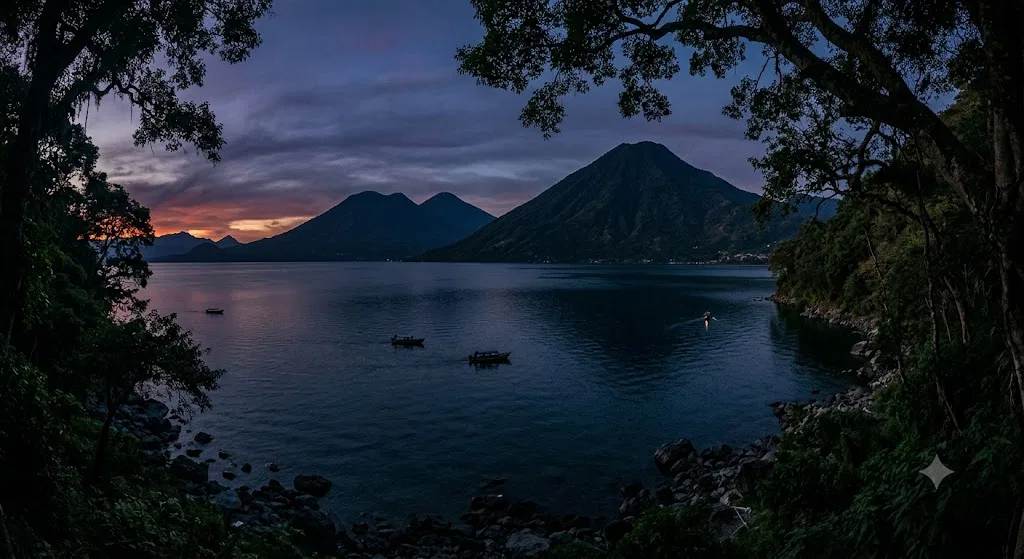
Guatemala is unusually well suited to monster folklore because its terrain already feels dramatic. Lake Atitlán is a deep volcanic lake surrounded by high slopes and volcanoes; travel sources and regional tourism material describe it as one of Central America’s striking lake landscapes, with depths of roughly 340 metres and a setting shaped by volcanic geography.[Wikipedia]WikipediaLake AtitlánLake Atitlán That matters because deep lakes everywhere tend to grow stories about something below the surface. The less visible the bottom is, the easier it becomes for drowned boats, sudden winds or strange waves to be remembered as the work of a creature.
The highlands and forests play a different role. Guatemala’s living wildlife includes large carnivores and secretive forest mammals, including jaguars, pumas, ocelots, margays and coyotes in different parts of the country; recent biological work in the Maya Biosphere Reserve has used trail cameras and DNA analysis to study how wild cats share prey and habitat.[Newsroom]news.oregonstate.eduNewsroom Vertical hunting helps wild cats coexist in Guatemala's forestsNewsroom Vertical hunting helps wild cats coexist in Guatemala's forests In rural settings, a glimpse of an animal at dusk, a half-seen shape near a corral, or a carcass found in the morning can be folded into older ideas about night beings, forest ogres or the chupacabras.
Guatemala’s folklore also has a deep textual and oral background. The Popol Vuh, the K’iche’ Maya creation account recorded in the 16th century, includes heroic and monstrous figures rather than “cryptids” in the modern sense. The Smithsonian’s National Museum of the American Indian describes it as a story of creation, the Hero Twins, and K’iche’ genealogies and land rights; World History Encyclopedia similarly frames it as the creation story of the Quiche Maya of the region now known as Guatemala.[Living Maya Time]maya.nmai.si.eduOpen source on si.edu. That older mythic layer gives Guatemala’s creature lore a different texture from purely modern mystery-animal reports.
The Lake Atitlán monster: a serpent for sudden wind and lost boats
The most lake-monster-like tradition in Guatemala belongs to Lake Atitlán. The creature is usually described in travel and folklore retellings as a serpent or dragon-like being connected with the lake’s depths, sometimes called Chakona or Arcoiris, the “Rainbow”. One accessible diving account summarises the tale as a serpent that lures boats towards the centre of the lake and pulls them down, while a local travel account describes a dragon-like monster living in the deepest waters and being blamed for sunken boats and lost fishermen.[Advanced Diver Magazine]advanceddivermagazine.comOpen source on advanceddivermagazine.com.
This is a classic lake-monster mechanism: a dangerous natural feature becomes a personality. Atitlán has the scale, beauty and sudden weather changes that make such stories feel believable. The local wind known as Xocomil is a major part of the story-world around the lake. Sources aimed at visitors describe it as a strong afternoon wind across Atitlán, while lake-information material links it to local language and everyday lake conditions.[Atitlán Official]atitlangt.comlake atitlans xocomil wind what it is and how to plan your vlake atitlans xocomil wind what it is and how to plan your v When wind arrives quickly over deep water, a practical hazard can become a legend: the lake “gets angry”, boats struggle, and the invisible force below the waves becomes a serpent.
There is no strong zoological case for a large unknown animal in Atitlán. The better reading is that the monster works as a folk explanation for real danger. Atitlán’s depth, volcanic enclosure and afternoon winds are enough to create fear without inventing a living creature; the serpent gives that fear a memorable shape. The story also fits Guatemala’s tourism afterlife: visitors arrive already primed by global lake-monster comparisons, while local lake identity supplies a more specific name, landscape and mood.
The Sisimite: Guatemala’s hairy wild-man at the edge of the forest
The Sisimite, also spelled in several regional ways, is Guatemala’s closest relative to the “wild man” or “Bigfoot-like” creature type. It is usually described as a hairy, humanoid, ape-like being associated with mountains, caves and forested places. The problem for a Guatemala-focused page is that the Sisimite is strongly regional rather than neatly national: it is especially prominent in Honduran and Belizean folklore, but sources also place related forms in Guatemala and neighbouring Central American countries.[Wikipedia]WikipediaOpen source on wikipedia.org.
Typical features include great strength, dark hair, a human-like or ape-like face, and sometimes backward-facing feet. That last detail is important because it makes the creature a folklore puzzle rather than a simple animal claim: backward footprints explain why a hunter or traveller might follow tracks in the wrong direction. Some versions also make the creature afraid of dogs or water, which turns the legend into a survival story with rules.[Wikipedia]WikipediaOpen source on wikipedia.org.
In Guatemala, the Sisimite is best treated as part of a wider Mesoamerican and Central American ogre tradition rather than as a well-documented modern sighting file. It belongs in the same interpretive family as forest beings that police boundaries: do not wander too far, do not enter the bush carelessly, do not ignore elders’ warnings, do not assume the forest is empty. Cryptozoology often tries to turn such figures into possible relict apes. The folklore itself points in a broader direction: the Sisimite is not just an animal to identify, but a story about wilderness, danger, desire, abduction, tracks and escape.
El Cadejo: the night-road dog that behaves more like folklore than zoology
El Cadejo is one of Guatemala’s most recognisable legendary creatures, though it is more supernatural road-beast than cryptid in the strict animal sense. It usually appears as a dog-like being met on lonely roads at night. In common Central American versions there are two forms: a white protector and a black menace. Guatemalan and Salvadoran retellings often connect the white Cadejo with protecting vulnerable night travellers, especially drunk people, from robbery or harm.[Wikipedia]WikipediaOpen source on wikipedia.org.
The Cadejo matters to Guatemala’s creature tradition because it shows how monster stories live in everyday routes rather than remote wilderness. It belongs to alleys, roads, late returns from drinking, and the social risks of being outside after dark. Modern tourism has noticed this: Guatemala City and Antigua legend tours advertise stories of figures such as El Cadejo alongside other famous Guatemalan legends, and even a craft-beer stop named after the creature appears in tourist listings.[Tripadvisor]tripadvisor.ieOpen source on tripadvisor.ie.
As a mystery-animal claim, the Cadejo is weak: the two-colour moral pairing, protective behaviour and punishment logic are signs of folklore rather than biology. As cultural creature lore, however, it is central. It turns the ordinary dog — already a familiar night presence in towns and villages — into a moral companion or threat. That makes it easy to adapt. A dog seen in poor light can become a Cadejo story; a dangerous walk home can be retold as an encounter; a warning against night wandering becomes a creature with eyes, smell and footsteps.
Chupacabras in Guatemala: modern livestock scares with ordinary suspects
The chupacabras is not originally Guatemalan. The modern legend began in Puerto Rico in the mid-1990s and spread widely through the Americas as a media-friendly explanation for dead livestock, especially animals said to have puncture wounds or to be drained of blood.[Wikipedia]WikipediaOpen source on wikipedia.org. In Guatemala, the creature appears less as a single continuous legend and more as a recurring label applied to frightening rural animal deaths.
Guatemalan press reports show how this works. In January 2019, Prensa Libre reported concern in San Andrés Itzapa, Chimaltenango, after two goats were killed; one owner said he thought the attackers might be dogs or coyotes, while neighbours suggested chupacabras because of the wounds and similar stories elsewhere.[Prensa Libre]prensalibre.comPrensa Libre Vecinos de San Andrés Itzapa buscan explicación sobre laPrensa Libre Vecinos de San Andrés Itzapa buscan explicación sobre la In October 2022, the same newspaper reported mysterious sheep deaths in Los Encuentros, Sololá, with residents concerned about a wild animal.[Prensa Libre]prensalibre.comOpen source on prensalibre.com. In June 2023, Prensa Libre covered dead poultry in Tecpán, noting that more than 80 birds had previously been found dead in an April attack and that local hypotheses circulated about the cause.[Prensa Libre]prensalibre.comPrensa Libre Animales de corral muertos: las hipótesis de losPrensa Libre Animales de corral muertos: las hipótesis de los
A more recent fact-checking report from Agencia Ocote in September 2025 is especially useful because it shows the sceptical pattern clearly. After rumours of a chupacabras in Comitancillo, San Marcos, where sheep had been found dead, authorities and experts pointed instead to a coyote or another wild species as a possible cause and warned against linking wildlife to urban legends in ways that could provoke people to hunt animals.[Agencia Ocote]agenciaocote.comAgencia Ocote Autoridades dicen que no hay un «chupacabras» en SanAgencia Ocote Autoridades dicen que no hay un «chupacabras» en San That is the key modern lesson: chupacabras reports often begin with a real economic loss, but the monster explanation can endanger ordinary wildlife.
The biological background makes this explanation plausible. A study of livestock predation in Guatemala’s tropical lowlands found that jaguars, pumas and coyotes all coexist as potential livestock predators in Mesoamerica, with cattle losses to carnivores representing 0.7% of cattle stock in surveyed ranches; jaguars were most often accused, followed by pumas and coyotes.[Cambridge University Press & Assessment]cambridge.orgOpen source on cambridge.org. In smaller corrals, dogs, coyotes, wild cats, disease, panic trampling and scavenging can all confuse the scene before anyone inspects it carefully. The chupacabras is powerful as a story because it arrives after the evidence has already been damaged, scattered or emotionally charged.
Ancient monster-beings: why the Popol Vuh is not a cryptid catalogue
Guatemala’s oldest famous creature stories are not newspaper sightings but mythic narratives. The Popol Vuh contains beings such as Seven Macaw, a proud false celestial bird, and his sons Zipacna and Cabrakan, associated in later summaries with enormous strength, mountains and earthquakes. Allen Christenson’s translation of the Popol Vuh is a major modern English source for this K’iche’ text, while public explainers stress that it preserves creation narrative, heroic adventures and political memory rather than field reports of unknown animals.[mesoweb.com]mesoweb.comOpen source on mesoweb.com.
For a cryptid page, this distinction matters. Seven Macaw or Zipacna should not be treated as “animals that might exist”. They are mythic beings in a sacred narrative world. Yet they still matter because they show how Guatemalan creature imagination has long linked animal form, cosmic disorder and landscape. A giant bird can pretend to be the sun; an earth-shaking being can be tied to mountains; heroic figures defeat monstrous pride before the proper order of the world is established.
That mythic pattern echoes later monster folklore without being the same thing. Lake serpents personify dangerous water. The Sisimite personifies forest danger. The Cadejo personifies the moral uncertainty of the night road. Chupacabras rumours personify the shock of unexplained livestock deaths. Guatemala’s creature tradition is therefore not a straight line from ancient Maya religion to modern cryptids, but a set of recurring habits: landscape becomes character, danger gets a body, and unexplained harm is made narratable.

What evidence exists, and what usually explains it?
The evidence for Guatemalan cryptids is uneven. For the Atitlán monster, the evidence is mainly legend, tourist retelling and environmental context: a deep lake, sudden winds and accounts of boats or fishermen lost to dangerous water. For the Sisimite and Cadejo, the evidence is oral tradition, regional folklore and cultural afterlife, not biological documentation. For the chupacabras, the evidence is stronger in one narrow sense — there are real reported animal deaths — but weaker in the monster sense, because official and expert explanations tend to point towards known predators or other ordinary causes.[advanceddivermagazine.com]advanceddivermagazine.comOpen source on advanceddivermagazine.com.
The most likely explanation changes by creature type:
- Lake monster reports are best read through weather, water depth, boat accidents, waves, floating debris, fish, shadows and the human tendency to narrate dangerous places.
- Hairy wild-man stories fit forest-ogre folklore shared across Central America, with possible reinforcement from misread tracks, animal calls, darkness and cautionary storytelling.
- Cadejo encounters belong to moral and supernatural road folklore, though real dogs, fear, alcohol, poor lighting and memory can help produce convincing personal stories.
- Chupacabras scares usually begin with actual livestock deaths, but known predators such as coyotes, dogs, pumas or jaguars, plus scavenging and rumour, provide more grounded explanations.
This does not make the stories worthless. It makes them useful in a different way. They show what people notice: dangerous winds, vulnerable livestock, night travel, wild edges, and the limits of certainty when evidence is found late.
How Guatemala’s legends keep changing
Guatemala’s monster lore has not stayed frozen in old tales. The Cadejo and other night legends now appear in city tours, pub crawls and heritage storytelling aimed at visitors.[Tripadvisor]tripadvisor.ieOpen source on tripadvisor.ie. The Atitlán serpent has become part of the lake’s mystical travel image, sitting alongside volcano views, Maya village culture and warnings about the afternoon wind. Chupacabras stories, by contrast, move through local news, social media clips and community alarm whenever animals die in strange circumstances.
That change matters because modern media can make a local scare travel faster than the animal that caused it. A few dead sheep in San Marcos, goats in Chimaltenango or poultry in Tecpán can quickly become part of a regional monster pattern, even when the best available explanation is a known predator or unconfirmed wildlife attack.[Prensa Libre]prensalibre.comPrensa Libre Vecinos de San Andrés Itzapa buscan explicación sobre laPrensa Libre Vecinos de San Andrés Itzapa buscan explicación sobre la The legend supplies a ready-made name before veterinary or wildlife evidence catches up.
The most evidence-aware way to enjoy Guatemala’s cryptids is to keep two truths together. First, the country has rich creature traditions that are worth taking seriously as folklore, memory and local identity. Second, none of the major Guatemalan monster stories currently provides strong evidence for an undiscovered large animal. Their real power lies in how precisely they attach strangeness to place: the serpent below Atitlán’s wind-roughened water, the hairy figure at the forest edge, the dog on the dark road, and the imagined blood-drinker at the broken corral.
Amazon book picks
Further Reading
Books and field guides related to Why Guatemala Turns Landscapes Into Monsters. Use these as the next step if you want deeper reading beyond the article.
Popol Vuh
Foundational source for many monster, spirit and mythic themes in Guatemala.
Gods and Symbols of Ancient Mexico and the Maya
Explains the creatures, symbols and supernatural beings of Maya culture.
Maya Cosmos, Three Thousand Years on the Shaman's Path
Provides context for Guatemala's supernatural landscape traditions.
eBay marketplace picks
Marketplace Samples
Live-tested eBay searches with available results related to this page.

Endnotes
1.
Source: Wikipedia
Title: Lake Atitlán
Link:https://en.wikipedia.org/wiki/Lake_Atitl%C3%A1n
2.
Source: Wikipedia
Link:https://en.wikipedia.org/wiki/Sisimito
3.
Source: dokumen.pub
Title: maya folktales from the alta verapaz 9781934536636
Link:https://dokumen.pub/maya-folktales-from-the-alta-verapaz-9781934536636.html
4.
Source: Wikipedia
Link:https://es.wikipedia.org/wiki/Sisimite
5.
Source: Wikipedia
Link:https://en.wikipedia.org/wiki/Cadejo
6.
Source: tripadvisor.ie
Link:https://www.tripadvisor.ie/AttractionProductReview-g292006-d21492050-Guatemala_City_Legends_Tour_Craft_Beers_at_El_Cadejo_Brewery-Guatemala_City_Guatem.html
7.
Source: Wikipedia
Link:https://en.wikipedia.org/wiki/Chupacabra
8.
Source: Wikipedia
Link:https://es.wikipedia.org/wiki/Chupacabras
9.
Source: cambridge.org
Link:https://www.cambridge.org/core/journals/oryx/article/predation-on-livestock-by-large-carnivores-in-the-tropical-lowlands-of-guatemala/3FBFAAE22ECEB0DDB2066A042731D959
10.
Source: mesoweb.com
Link:https://www.mesoweb.com/publications/Christenson/PopolVuh.pdf
11.
Source: Wikipedia
Title: Maya Hero Twins
Link:https://en.wikipedia.org/wiki/Maya_Hero_Twins
12.
Source: Wikipedia
Link:https://en.wikipedia.org/wiki/Guatemala
13.
Source: Wikipedia
Link:https://en.wikipedia.org/wiki/Zipacna
14.
Source: Wikipedia
Title: Popol Vuh
Link:https://en.wikipedia.org/wiki/Popol_Vuh
15.
Source: Wikipedia
Title: El Sombrerón
Link:https://en.wikipedia.org/wiki/El_Sombrer%C3%B3n
16.
Source: Wikipedia
Title: Leyendas de Guatemala
Link:https://en.wikipedia.org/wiki/Leyendas_de_Guatemala
17.
Source: cambridge.org
Link:https://www.cambridge.org/core/journals/oryx/article/habitat-use-activity-patterns-and-human-interactions-with-jaguars-panthera-onca-in-southern-belize/9E77C9A3EDBF89CFD03953852BB26A67
18.
Source: youtube.com
Title: El Cadejo
Link:https://www.youtube.com/watch?v=rlP6C7rcGVQ
Source snippet
Camazotz | Maya Death Bat...
19.
Source: news.oregonstate.edu
Title: Newsroom Vertical hunting helps wild cats coexist in Guatemala’s forests
Link:https://news.oregonstate.edu/news/vertical-hunting-helps-wild-cats-coexist-guatemala%E2%80%99s-forests-study-finds
20.
Source: maya.nmai.si.edu
Link:https://maya.nmai.si.edu/the-maya/creation-story-maya
21.
Source: worldhistory.org
Title: Popol Vuh
Link:https://www.worldhistory.org/Popol_Vuh/
22.
Source: advanceddivermagazine.com
Link:https://advanceddivermagazine.com/articles/atitlan/atitlan.html
23.
Source: atitlangt.com
Title: lake atitlans xocomil wind what it is and how to plan your v
Link:https://atitlangt.com/en/blogs/guias-de-viaje/lake-atitlans-xocomil-wind-what-it-is-and-how-to-plan-your-v
24.
Source: prensalibre.com
Title: Prensa Libre Vecinos de San Andrés Itzapa buscan explicación sobre la
Link:https://www.prensalibre.com/ciudades/chimaltenango/chupacabras-vecinos-de-san-andres-itzapa-buscan-explicacion-sobre-la-muerte-de-dos-cabras-atacadas-por-extraos-animales/
25.
Source: prensalibre.com
Link:https://www.prensalibre.com/ciudades/solola/misteriosa-muerte-de-ovejas-causa-preocupacion-a-pobladores-de-solola-y-esto-dice-el-maga/
26.
Source: prensalibre.com
Title: Prensa Libre Animales de corral muertos: las hipótesis de los
Link:https://www.prensalibre.com/ciudades/chimaltenango/varios-animales-de-corral-son-encontrados-muertos-en-tecpan-y-estas-son-las-hipotesis-de-la-comunidad-respecto-a-las-causas/
27.
Source: prensalibre.com
Link:https://www.prensalibre.com/tema/chupacabras/
28.
Source: agenciaocote.com
Title: Agencia Ocote Autoridades dicen que no hay un «chupacabras» en San
Link:https://www.agenciaocote.com/blog/2025/09/29/no-es-el-chupacabras-autoridades-dicen-que-un-coyote-esta-atacando-ovejas-en-san-marcos/
29.
Source: cryptidz.fandom.com
Link:https://cryptidz.fandom.com/wiki/Chupacabra
30.
Source: cryptidz.fandom.com
Title: El Cadejo
Link:https://cryptidz.fandom.com/wiki/El_Cadejo
31.
Source: heathervoight.com
Title: Seven Macaw
Link:https://heathervoight.com/tag/seven-macaw/
32.
Source: GOV.UK
Link:https://www.gov.uk/foreign-travel-advice/guatemala
33.
Source: pt.scribd.com
Link:https://pt.scribd.com/document/623073026/Legends
34.
Source: tripadvisor.co.uk
Title: MUSE O POPOL VUH
Link:https://www.tripadvisor.co.uk/Attraction_Review-g292006-d307903-Reviews-Museo_Popol_Vuh-Guatemala_City_Guatemala_Department.html
35.
Source: worldbank.org
Link:https://www.worldbank.org/ext/en/country/guatemala
36.
Source: ls3.usac.edu.gt
Link:https://ls3.usac.edu.gt/revindex/articulos/editor5-r293_pi1_pfi16_ra870183.pdf
37.
Source: manzanillosun.com
Title: seven macaw
Link:https://www.manzanillosun.com/seven-macaw/
38.
Source: kids.nationalgeographic.com
Link:https://kids.nationalgeographic.com/geography/countries/article/guatemala
39.
Source: en.wikivoyage.org
Link:https://en.wikivoyage.org/wiki/Guatemala
Additional References
40.
Source: youtube.com
Title: The Legend of El Sombrerón: The Guitar-Playing Goblin
Link:https://www.youtube.com/watch?v=k2YeySOk3Hs
Source snippet
TERROR IN THE MOUNTAINS! THE LEGEND OF THE NAHUAL IN GUATEMALA...
41.
Source: youtube.com
Title: Legends of Guatemala
Link:https://www.youtube.com/watch?v=ALO31p5yiTE
Source snippet
The Legend of El Sombrerón: The Guitar-Playing Goblin...
42.
Source: instagram.com
Link:https://www.instagram.com/p/DBp2O_Ts7yH/?hl=en
43.
Source: reddit.com
Link:https://www.reddit.com/r/bigfoot/comments/r50it7/bigfoot_like_creatures_in_the_mexican_yucat%C3%A1n/
44.
Source: academia.edu
Link:https://www.academia.edu/342224/Panthera_onca_Jaguar_THE_IUCN_RED_LIST_OF_THREATENED_SPECIES
45.
Source: researchgate.net
Link:https://www.researchgate.net/publication/230325443_Public_perceptions_of_jaguars_Panthera_onca_pumas_Puma_concolor_and_coyotes_Canis_latrans_in_El_Salvador
46.
Source: facebook.com
Link:https://www.facebook.com/CorozalDaily/posts/the-legendary-sisimitebelize-yucatec-maya-sisimite-native-to-the-world-of-the-ma/2911652189051137/
47.
Source: facebook.com
Link:https://www.facebook.com/groups/lakeatitlanguatemalatravel/posts/8166487686785836/
48.
Source: aprende.org
Link:https://aprende.org/
49.
Source: amigosdeatitlan.org
Link:https://amigosdeatitlan.org/meet-atitlan/
Topic Tree
Follow this branch
Related pages 192
- Antigua Cryptids
- Maldives Monsters
- Malta Monsters
- Qatar Monsters
- Argentina Monsters
- +187 more in sidebar