Cryptids of Georgia's Wild Places
Georgia’s mystery-creature tradition is less about one famous “national cryptid” and more about a landscape full of old wild beings: hairy forest men, water-serpents, hunting spirits, lake legends and mountain monsters.
Page outline Jump by section
Why Georgia’s monsters belong to mountains, forests and water
Georgia sits between the Greater Caucasus, the Lesser Caucasus and the Black Sea, with a striking mix of alpine valleys, forests, wetlands, rivers and lakes packed into a small country. That geography matters because most Georgian creature traditions are not “haunting” stories in the modern paranormal sense. They are stories about entering the wrong part of the natural world, breaking hunting rules, meeting something in the forest, or facing the danger of water.[Georgia Travel]georgia.travelTravel Georgia Travel: GeorgiaTravel Georgia Travel: Georgia
That makes Georgia different from countries whose cryptid culture centres on a single lake monster or newspaper flap. Here, the old bestiary is dispersed across habitats. The mountains produce wild-man and hunting-spirit traditions. Forests produce goat-men, protectors of animals and harmful night beings. Rivers and lakes produce serpents, dragons and submerged legends. Wetlands such as the Colchic lowlands add another layer: they are biologically rich, misty, reed-filled and full of bird and fish life, but the strongest recorded traditions around them are usually legends of drowned settlements and sacred memory rather than repeated modern monster sightings. UNESCO describes the Colchic Rainforests and Wetlands as a chain of rainforests, bogs and other wet habitats along Georgia’s humid Black Sea coast, ranging from sea level to mountain elevations.[UNESCO World Heritage Centre]whc.unesco.orgOpen source on unesco.org.
The almasty: Georgia’s closest thing to a modern cryptid
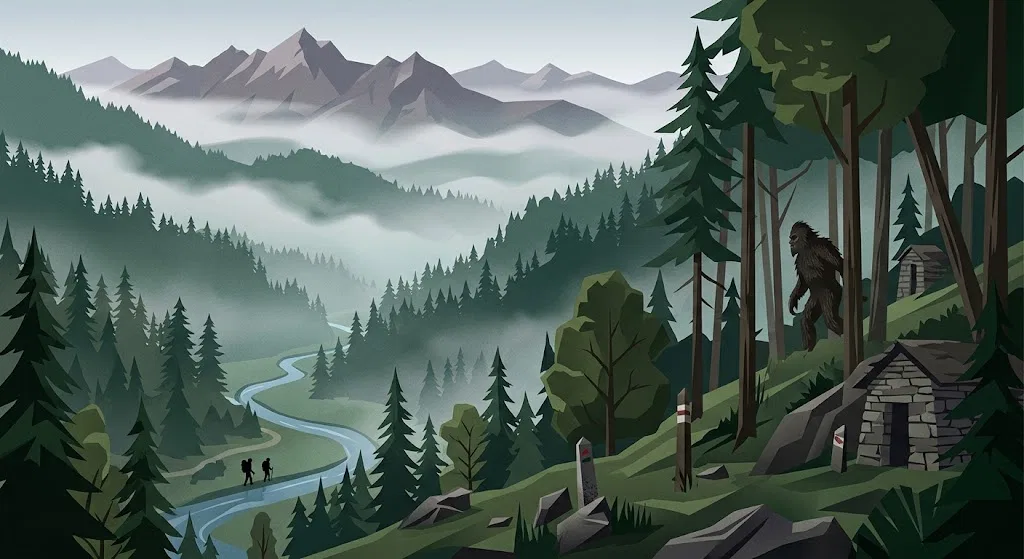
The almasty is the Caucasus version of the wild-man tradition: a reported hairy, human-like creature, often described as powerful, bipedal and living in remote valleys or forests. It is not uniquely Georgian, and many better-known reports come from the North Caucasus. Still, Georgia appears in the wider investigation history because Soviet-era collectors and cryptozoological writers treated the Caucasus as one broad zone of possible sightings.
Marie-Jeanne Koffmann’s much-cited almasty material, later published in English as “The Almasty — Yeti of the Caucasus”, says her search took her through much of the Caucasus, including Georgia, and that she collected many witness accounts of supposed “Men of the Forest”. The material is valuable as folklore and testimony, but it is not zoological proof: it preserves reported encounters, often years after the event, rather than physical specimens that can be independently checked.[Idaho State University]isu.eduOpen source on isu.edu.
One Georgian-linked account in Koffmann’s collection is especially useful because it shows the shape of the story. A Georgian engineer from Tbilisi, B. F. Lobtanidze, wrote in 1960 that during a 1940 outing near Lagodekhi, in eastern Georgia, he and companions saw a large, hairy figure in a tree. The reported creature moved rapidly through branches, dropped to the ground and vanished into brush; the witnesses described it as neither man nor monkey.[Idaho State University]isu.eduOpen source on isu.edu.
That account has the classic strengths and weaknesses of almasty material. It is specific about place, witnesses and behaviour, which makes it memorable. But it is still a retrospective witness story, with no body, photograph, track cast or biological sample tied securely to the incident. When modern genetic work has tested hair samples attributed to “anomalous primates” such as the almasty, the results have not supported an unknown ape or surviving human relative. A 2014 Royal Society study used mitochondrial DNA sequencing on 30 submitted hair samples and found that, apart from two Himalayan samples discussed in the paper, the hairs came from known living mammals rather than mystery primates.[Royal Society Publishing]royalsocietypublishing.orgOpen source on royalsocietypublishing.org.
The most cautious reading is therefore straightforward: Georgia belongs on the almasty map as part of the Caucasus wild-man tradition, but the Georgian evidence is testimony and folklore, not proof of a hidden hominid. In a real landscape that contains brown bears, wolves, lynx, wild goats, chamois and dense mountain cover, unusual glimpses can become powerful stories, especially when seen at distance or under stress. Georgia’s large-carnivore fauna gives ordinary explanations plenty to work with, even when it cannot explain every detail of every report.[Bear Conservation]bearconservation.org.ukBrown bear in South CaucasusBrown bear in South Caucasus
Ochokochi: the forest being hunters did not want to meet
Ochokochi is one of Georgia’s most cryptid-like folklore figures because it sits close to the “wild man of the woods” idea while remaining clearly mythological. It belongs especially to Mingrelian and western Georgian tradition. Descriptions vary, but the figure is usually a forest being combining human and animal traits: hairy, frightening, associated with hunters, and sometimes said to have a horn, bone or axe-like projection on its chest.[Wikipedia]WikipediaGeorgian mythologyGeorgian mythology
The important point is not whether Ochokochi was ever a misidentified animal. The stories work more like a warning about the forest as a moral space. Hunters enter a realm that is not fully theirs. They may meet a creature who punishes, frightens or challenges them. In some tellings, Ochokochi is linked with Tkashi-Mapa, a forest queen or mistress figure, which places him inside a wider Georgian hunting mythology rather than a simple monster tale.[Wikipedia]WikipediaGeorgian mythologyGeorgian mythology
For cryptid readers, Ochokochi is interesting because it overlaps with several international patterns: the hairy wild man, the goat-man, the dangerous forest guardian and the creature seen at the edge of human settlement. But the Georgian version has its own flavour. It is less a “Bigfoot” reported through cameras and road crossings, and more a figure from a hunting culture where wild animals, mountain paths and forest taboos are treated with respect.
Dali and the hunting world behind the monsters
The hunting goddess Dali is not a cryptid, but she helps explain why Georgian creature traditions so often feel different from modern monster reports. In Svan tradition, Dali is the powerful mistress of wild hoofed animals, especially mountain game such as ibex and deer. Kevin Tuite’s study of Dali describes her as one of the best-known figures in Svan poetry and song, a divine patron of high-mountain horned beasts.[mapageweb.umontreal.ca]mapageweb.umontreal.caOpen source on umontreal.ca.
Dali stories show a world in which animals are not just prey. They belong to a supernatural order. Hunters must behave properly, observe taboos and avoid greed. In some traditions, a hunter who takes too much or breaks a rule may be punished. That matters for a country-level cryptid page because many “monster” figures grow from the same logic: the wild is not empty scenery but a place governed by powers and boundaries.[Wikipedia]WikipediaDali (goddessDali (goddess
This also gives a sceptical reader a better frame. Instead of asking, “Was Dali a real being?”, it is more productive to ask what the tradition did. It encoded hunting ethics, fear of cliffs and weather, respect for game animals, and the danger of human arrogance in remote terrain. That does not make the story zoological evidence, but it does make it a serious part of Georgia’s mystery-beast culture.
Gveleshapi and Georgia’s water-serpent tradition
Georgia’s water monsters are best represented by the gveleshapi, usually understood as a dragon or serpent-like being associated with water. In Georgian mythological summaries, the creature is connected with lakes, rivers and water sources, and heroes fight it as a dangerous force. The name itself is often explained as a compound suggesting “snake-whale”, which captures the hybrid nature of the being: serpent, water monster and dragon at once.[Wikipedia]WikipediaGeorgian mythologyGeorgian mythology
For readers used to lake monsters, the gveleshapi is tempting to treat as Georgia’s answer to Nessie. That is only partly right. It is not mainly a modern sighting tradition clustered around one named lake. It is older and broader: a mythic water danger attached to rivers, lakes, floods and heroic combat. The creature belongs to the same family of ideas as dragons, serpent guardians and water spirits across the Caucasus and neighbouring regions.
The sceptical explanation here is not “someone saw a big fish” so much as “water was dangerous, powerful and culturally charged”. Rivers flood. Lakes drown people. Springs and wetlands sustain life but also conceal hazards. A serpent-dragon is a vivid way to personify that double nature. In Georgia, where mountain rivers, Black Sea wetlands and deep lake legends all sit close together, water monsters make cultural sense even without modern zoological evidence.
Lakes with legends, but few true lake monsters
Georgia has lake legends, but they should not be oversold as modern lake-monster cases. Paliastomi Lake, in Kolkheti National Park near the Black Sea, is tied to a legend of a flooded settlement: the story tells of a community covered by water after the ground sank, with only a deacon surviving and saving an icon. Official Georgian tourism material presents this as a local legend of the lake’s origin, not as a repeated monster-sighting record.[Georgia Travel]georgia.travelTravel Paliastomi LakeTravel Paliastomi Lake
Bazaleti Lake, north-west of Tbilisi, has a different kind of legend: a golden cradle and child said to lie beneath the water, along with stories about the lake’s hidden circulation. Again, this is lake folklore rather than a creature flap. It gives the water a mysterious inner life, but not necessarily a beast.[Georgia Travel]georgia.travelTravel Bazaleti LakeTravel Bazaleti Lake
Paliastomi is still important for a mystery-animal map because the real environment is so suggestive. It sits within wetland landscapes known for birds, fish, reeds and waterways. Kolkheti National Park protects a mosaic of peat bogs, wet meadows, lakes, channels and floodplain forests; conservation sources note migratory waterbirds, otters and endemic fish in the park’s wetland system.[Caucasus Nature Fund]caucasus-naturefund.orgOpen source on caucasus-naturefund.org.
That makes Georgia’s lakes useful as atmosphere and folklore, but the evidence points to drowned-place legends, sacred objects, unusual hydrology and rich wetland wildlife rather than a well-attested lake monster tradition.

Real animals that can feed mystery-beast stories
Georgia’s real wildlife is more than enough to produce strange encounters. Brown bears, wolves, lynx and other large mammals live in the Caucasus region, and conservation reports describe Georgia as hosting bear, wolf, lynx, leopard and hyena among its large carnivores, though some are rare, threatened or unevenly distributed.[Bear Conservation]bearconservation.org.ukBrown bear in South CaucasusBrown bear in South Caucasus
Bears are especially important for sceptical interpretation. A bear briefly seen standing, moving through brush or leaving distorted tracks can be turned into something more human-like in memory, particularly in terrain where people already know wild-man stories. The almasty literature itself often wrestles with bear comparisons: witnesses may insist the creature was not a bear, while sceptics point to the difficulty of judging size, posture and movement during a quick encounter. Koffmann’s Georgian-linked Lagodekhi account even shows the witnesses debating whether the figure could be a monkey or something else, which underlines how unusual animal movement can destabilise ordinary categories.[Idaho State University]isu.eduOpen source on isu.edu.
Wild cats create a different kind of ambiguity. The Caucasian leopard is real but extremely rare and fragmented in the wider South Caucasus; WWF has reported leopard work across the region and stresses that the population remains too small and scattered for long-term security without conservation support. A rare leopard, lynx or large feral dog seen briefly could support local rumours of “phantom cats” even where the animal itself is not mysterious.[WWF Panda]wwf.panda.orgwwf newswwf news
None of this proves that all Georgian monster stories are misidentifications. Folklore does not work that simply. But real ecology supplies the raw material: tracks in mud or snow, livestock losses, night cries, glimpsed bodies, tree movement, wetland shapes and animals behaving in ways a frightened witness may not expect.
Why the legends changed over time
Georgia’s creature traditions have moved through several layers. The oldest layer is mythic and ritual: hunting powers, forest beings, serpents, dragons and dangerous water. A later Christian layer reshaped some older figures, often bringing saints and moralised stories into earlier mythic landscapes. Dali traditions, for example, are often discussed in relation to later stories involving Saint George, where older hunting powers are challenged or reframed by Christian figures.[Wikipedia]WikipediaDali (goddessDali (goddess
A modern layer arrived with Soviet and post-Soviet cryptozoology. The almasty became a “Caucasian snowman” candidate, something investigators could interview witnesses about, compare with the yeti, and try to fit into debates about unknown primates or relict human relatives. That changed the genre. A forest encounter that might once have lived as local lore could be recast as possible evidence.[Idaho State University]isu.eduOpen source on isu.edu.
The newest layer is tourism and internet culture. Georgian travel pages now present lake legends, mythological beings and mountain folklore as part of the country’s cultural appeal. This can help preserve stories, but it can also flatten them into a bestiary: “Georgia’s monsters” become a list of names rather than living traditions tied to regions, languages, hunting practices and sacred landscapes. The best reading keeps both sides in view. These stories are entertaining, but they also mark how people made sense of dangerous terrain.
What is most likely true?
The evidence supports three different levels of truth.
As folklore, Georgia’s creature traditions are rich and well-rooted. Ochokochi, Dali, gveleshapi and related forest or water beings belong to a serious Georgian and wider Caucasian mythic landscape. They are not imported Halloween decorations or generic fantasy monsters.
As modern cryptid evidence, the case is much thinner. The almasty provides the closest thing to a witness-based mystery-animal tradition touching Georgia, but the available material is mostly testimony. The stronger scientific tests on alleged anomalous-primate hair samples have pointed to known animals rather than unknown primates.
As environmental storytelling, the legends make perfect sense. Georgia’s mountains, forests, wetlands, rivers and lakes are exactly the kinds of places where humans generate boundary creatures: beings that warn, punish, seduce, guard, drown, mislead or simply remind people that the wild is not fully under human control. That may be the real centre of Georgia’s cryptid history: not a hidden zoo of undiscovered monsters, but a country where the natural world has long been imagined as watchful, dangerous and alive.

Amazon book picks
Further Reading
Books and field guides related to What Monsters Haunt Georgia's Wild Places?. Use these as the next step if you want deeper reading beyond the article.
The Book of Imaginary Beings
Provides broad context for understanding monster traditions and folklore creatures.
Mythology
Rating: 2.5/5 from 14 Google Books ratings
Introduces the mythological framework behind legendary beings and heroic monster tales.
The Lore of Scotland
Demonstrates how landscapes generate local creature traditions similar to Georgia's.
eBay marketplace picks
Marketplace Samples
Live-tested eBay searches with available results related to this page.

Endnotes
1.
Source: georgia.travel
Title: Travel Georgia Travel: Georgia
Link:https://georgia.travel/
2.
Source: mapageweb.umontreal.ca
Link:https://www.mapageweb.umontreal.ca/tuitekj/caucasus/dal.htm
3.
Source: whc.unesco.org
Link:https://whc.unesco.org/en/list/1616/
4.
Source: Wikipedia
Title: Georgian mythology
Link:https://en.wikipedia.org/wiki/Georgian_mythology
5.
Source: Wikipedia
Title: Dali (goddess)
Link:https://en.wikipedia.org/wiki/Dali_%28goddess%29
6.
Source: georgia.travel
Title: Travel Paliastomi Lake
Link:https://georgia.travel/paliastomi-lake
7.
Source: georgia.travel
Title: Travel Bazaleti Lake
Link:https://georgia.travel/bazaleti-lake
8.
Source: Wikipedia
Title: Bazaleti Lake
Link:https://en.wikipedia.org/wiki/Bazaleti_Lake
9.
Source: wwf.panda.org
Title: wwf news
Link:https://wwf.panda.org/wwf_news/?4019441%2FLeopard-Returns-to-Georgia=
10.
Source: uni-giessen.de
Link:https://www.uni-giessen.de/en/faculties/f07/departments/geography/sections/human/researchprojects/bmbf-project-201catlas-plus201d/project-part-a-national-atlas-of-georgia/structure-of-the-national-atlas-of-georgia
11.
Source: caucasus-naturefund.org
Link:https://www.caucasus-naturefund.org/park/kolkheti-national-park/
12.
Source: isu.edu
Link:https://www.isu.edu/media/libraries/rhi/research-papers/Koffmann_1.pdf
13.
Source: royalsocietypublishing.org
Link:https://royalsocietypublishing.org/rspb/article/281/1789/20140161/77194/Genetic-analysis-of-hair-samples-attributed-to
14.
Source: bearconservation.org.uk
Title: Brown bear in South Caucasus
Link:https://www.bearconservation.org.uk/Brown%20bear%20in%20South%20Caucasus.pdf
Additional References
15.
Source: youtube.com
Title: intro to mysterious mythic lands of Caucasus or start to mythtalk
Link:https://www.youtube.com/watch?v=fHiCfVcXeEw
Source snippet
ALMASTY AS SERVANTS OF THE HUMANS: CRYPTIDS OF NORTH CAUCASUS...
16.
Source: pubmed.ncbi.nlm.nih.gov
Link:https://pubmed.ncbi.nlm.nih.gov/24990672/
17.
Source: youtube.com
Title: SECRETS OF CAUCASIAN MYTHOLOGY or ramblelog episode 6
Link:https://www.youtube.com/watch?v=EAu2FIyRE_s
Source snippet
intro to mysterious mythic lands of Caucasus or start to mythtalk...
18.
Source: youtube.com
Title: ALMASTY AS SERVANTS OF THE HUMANS: CRYPTIDS OF NORTH CAUCASUS
Link:https://www.youtube.com/watch?v=NlzZQ9kEQjs
Source snippet
Almasty Documentary | The Russian Bigfoot Mystery...
19.
Source: youtube.com
Title: Almasty Documentary | The Russian Bigfoot Mystery
Link:https://www.youtube.com/watch?v=ghwPG1_pIx4
Source snippet
Georgian Legend of Paskunji (ფასკუნჯი): Story of Egyptian Vulture...
20.
Source: academia.edu
Link:https://www.academia.edu/74029691/Image_of_Dragon_in_Georgian_Mythology
21.
Source: iraj.in
Link:https://www.iraj.in/journal/journal_file/journal_pdf/14-623-158453694697-100.pdf
22.
Source: youtube.com
Title: Georgian Legend of Paskunji (ფასკუნჯი): Story of Egyptian Vulture
Link:https://www.youtube.com/watch?v=aqlq17JcNNU
Source snippet
Georgian mythology creatures monsters...
23.
Source: lciepub.nina.no
Title: 635012242378051580 COE LCs in Caucasus
Link:https://lciepub.nina.no/pdf/635012242378051580_COE_LCs_in_Caucasus.pdf
24.
Source: nationalparks.ge
Title: National Parks Kolkheti National Park
Link:https://www.nationalparks.ge/en/site/kolxetinp
Topic Tree
Follow this branch
Related pages 192
- Antigua Cryptids
- Maldives Monsters
- Malta Monsters
- Qatar Monsters
- Argentina Monsters
- +187 more in sidebar