Within Samoan Monsters
Why Do Samoan Legends Turn People Into Animals?
Samoa's eel, turtle and shark stories link extraordinary animals with sacred pools, named coasts and human transformation.
On this page
- Sina, the giant eel and the first coconut
- The Turtle and Shark tradition at Vaitogi
- Animal shaped spirits and sacred places
Page outline Jump by section
Introduction
Across Samoa, some of the most memorable creature traditions are not stories about unknown monsters lurking in the wild. They are stories about relationships between people, animals and particular places. Eels, turtles and sharks appear not as mysterious species waiting to be discovered, but as sacred beings, transformed humans, ancestral guardians and living reminders of promises made long ago. These legends are attached to named pools, beaches and villages, giving them a stronger connection to real landscapes than many modern cryptid tales.

For readers interested in Samoa’s unusual animal lore, the key question is not whether giant eels or supernatural sharks literally existed. It is why certain animals became so important that they could cross the boundary between human and animal worlds. The answers lie in stories of love, sacrifice, kinship and sacred geography that remain among the best-known traditional narratives in Samoa.[wikipedia.org]WikipediaSina and the EelSina and the Eel
Why Do Samoan Legends Turn People Into Animals?
Many Samoan traditions treat the natural world as a network of relationships rather than a strict division between humans and animals. Historical accounts of Samoan belief recorded that spiritual beings could appear in animal forms and that particular families or communities sometimes maintained special connections with specific creatures. Sharks, birds, reptiles and marine animals could act as protectors, messengers or manifestations of spiritual power.[Academia]academia.eduAcademia(PDF) A hierarchy of symbols: Samoan religious…January 1, 1994 — Samoan religious experience in New Zealand is deeply tied to…
In that cultural setting, transformation stories serve a purpose. They explain why certain places are sacred, why particular animals deserve respect and why communities maintain obligations toward specific stretches of coast or freshwater pools. Rather than functioning as monster reports, these narratives connect living people to their environment and to remembered ancestors.
This helps explain why Samoan animal legends often focus on creatures that are both familiar and impressive. Eels inhabit deep pools and springs, turtles travel between land and sea, and sharks dominate coastal waters. All three animals are capable of seeming almost human in their behaviour, making them ideal figures for stories about transformation and enduring bonds between worlds.
Sina, the Giant Eel and the First Coconut
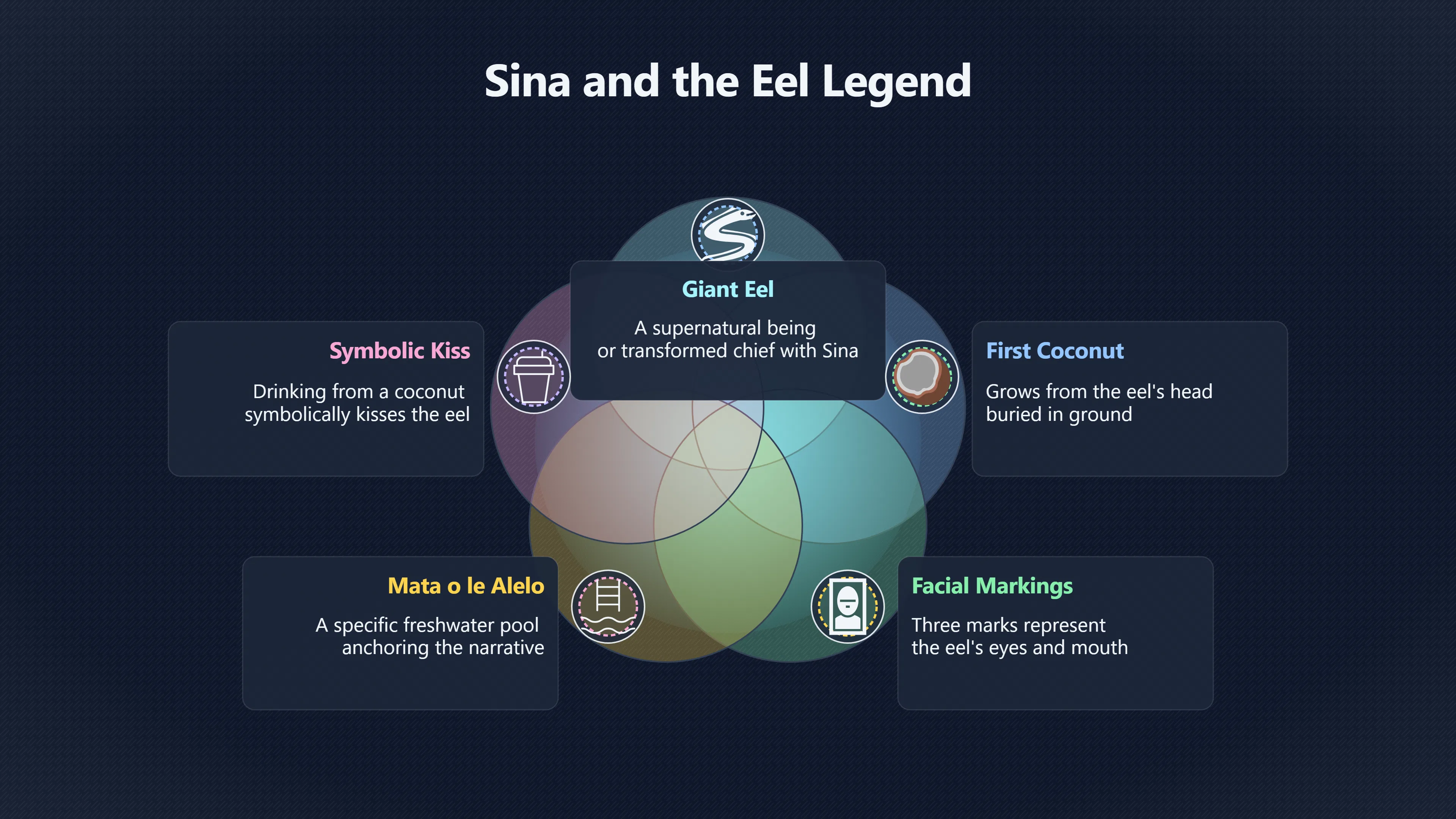
The most famous animal-transformation story in Samoa is the legend of Sina and the eel, often called Sina and Tuna. It is one of the best-known origin stories in Polynesia and explains the appearance of the coconut tree.[wikipedia.org]WikipediaSina and the EelSina and the Eel
Although details vary from island to island and village to village, the central story remains recognisable. A beautiful young woman named Sina becomes connected to an eel that is far more than an ordinary animal. In some versions the eel is a transformed chief or ruler; in others it is a supernatural being attracted by Sina’s beauty. The eel develops a close bond with her and eventually reveals its true nature. Before dying, it asks Sina to bury its head in the ground. From that buried head grows the first coconut tree.[wikipedia.org]WikipediaSina and the EelSina and the Eel
The legend then explains one of the most familiar features of a coconut. The three marks at one end resemble two eyes and a mouth. According to the story, these are the eel’s face preserved in the fruit. Every time someone drinks from a coconut, they symbolically kiss the eel.[wikipedia.org]WikipediaSina and the EelSina and the Eel
What makes the story especially interesting from a mystery-animal perspective is its connection to real locations. A freshwater pool known as Mata o le Alelo at Safune on Savai’i is traditionally associated with the legend and is still identified as part of the story’s landscape. Rather than existing in a vague mythical past, the narrative is anchored to a specific place that visitors can see today.[Wikipedia]WikipediaSina and the EelSina and the Eel
The eel itself occupies a curious position between ordinary wildlife and supernatural being. Eels were familiar animals throughout the Pacific, yet their secretive habits, sudden appearances and ability to inhabit dark pools made them natural candidates for stories about hidden identities and transformation. The legend transforms an everyday creature into a sacred ancestor whose body becomes one of the Pacific’s most useful plants.
The Turtle and Shark Tradition at Vaitogi
If Sina and the eel explain the origin of the coconut, the Turtle and Shark tradition explains an enduring relationship between people and marine animals.
The story is most strongly associated with Vaitogi in American Samoa, where generations have retold a tale about two individuals who transformed into a turtle and a shark. Different versions identify the pair in different ways, but the common theme is devotion and sacrifice. In many retellings, the transformed pair continue to return to the same shoreline, maintaining a connection with the community long after their human lives have ended.[Facebook]facebook.comHome of the legend of the Turtle & Shark, Vaitogi Village…Tutira and Kawariki vowed to meet again before Tutira took on his sh…
Unlike many transformation legends elsewhere in the world, the Turtle and Shark story became linked to observable events. For many years visitors and local residents reported turtles and sharks appearing together near the traditional site when called from shore. The animals’ appearances reinforced the belief that the legendary pair remained present within the landscape. Whether interpreted as coincidence, animal conditioning or cultural continuity, the sightings helped keep the story alive across generations.
From a folklore perspective, the important feature is not proving that specific animals were transformed humans. Rather, the tradition turns ordinary marine creatures into participants in a continuing relationship between a village and its surrounding waters. The legend gives moral meaning to the appearance of animals that would otherwise be viewed simply as wildlife.
Animal-Shaped Spirits and Sacred Places
The eel and the Turtle and Shark are the best-known examples, but they belong to a broader Samoan pattern in which animals and spirits overlap.
Historical descriptions of Samoan belief systems recorded traditions in which spiritual beings could inhabit or appear as animals. Certain locations acquired reputations because of these connections. A pool might be respected because it housed a sacred eel. A stretch of coast might be associated with a shark guardian. A particular creature could represent a protective presence rather than merely an animal living in the area.[Open Research Repository]openresearch-repository.anu.edu.auOpen Research Repository The Samoan Journals of John WilliamsOpen Research RepositoryThe Samoan Journals of John Williams - ANU Open Research18 Jan 2026 — The 1830 and 1832 journals of John Williams…
These traditions create what might be called a sacred geography. The stories are inseparable from the places where they occur. Unlike modern cryptid reports, which often focus on identifying an unknown species, Samoan legends usually emphasise relationships:
- A pool connected to a transformed being.
- A coastline watched over by animal guardians.
- A village linked to a particular marine creature.
- A promise or sacrifice remembered through an animal form.
The result is a landscape where animals are never entirely ordinary. A shark may be a shark, but it may also carry ancestral meaning. An eel may be an eel, yet it may also preserve the memory of a chief, a spirit or a famous act of sacrifice.

Folklore, Mystery Animals and Modern Interpretation
To modern readers interested in cryptids and legendary creatures, Samoan transformation stories occupy an unusual middle ground. They involve extraordinary animals, specific locations and traditions passed down through generations, but they were not originally intended as zoological claims.
The giant eel of Sina’s story is not presented as an undiscovered species. The turtle and shark are not described as biological anomalies. Instead, these legends explain why communities treat certain animals and places with respect. Their power comes from symbolism, memory and local identity rather than physical evidence.[wikipedia.org]WikipediaSina and the EelSina and the Eel
Yet the stories remain compelling for many of the same reasons cryptid traditions endure elsewhere. They blur the boundary between the known and the unknown. They attach wonder to real landscapes. They encourage people to look at familiar animals and imagine that something deeper may be hidden beneath the surface.
In Samoa, the most enduring creature legends are therefore not tales of undiscovered beasts roaming remote wilderness. They are stories in which humans become eels, turtles or sharks, and in doing so remain permanently woven into the islands’ rivers, pools and coastal waters.[wikipedia.org]WikipediaSina and the EelSina and the Eel
Amazon book picks
Further Reading
Books and field guides related to Why Do Samoan Legends Turn People Into Animals?. Use these as the next step if you want deeper reading beyond the article.
Myths and Legends of the Pacific
Includes Pacific stories involving animals, spirits and sacred places.
The Hero with a Thousand Faces
Explores recurring transformation and mythic motifs across cultures.
eBay marketplace picks
Marketplace Samples
Live-tested eBay searches with available results related to this page.

Endnotes
1.
Source: Wikipedia
Title: Sina and the Eel
Link:https://en.wikipedia.org/wiki/Sina_and_the_Eel
2.
Source: Wikipedia
Link:https://en.wikipedia.org/wiki/Samoa
3.
Source: academia.edu
Link:https://www.academia.edu/99141025/A_hierarchy_of_symbols_Samoan_religious_symbolism_in_New_Zealand
Source snippet
Academia(PDF) A hierarchy of symbols: Samoan religious...January 1, 1994 — Samoan religious experience in New Zealand is deeply tied to...
Published: January 1, 1994
4.
Source: facebook.com
Link:https://www.facebook.com/groups/725919078266734/posts/1056350991890206/
Source snippet
Home of the legend of the Turtle & Shark, Vaitogi Village...Tutira and Kawariki vowed to meet again before Tutira took on his sh...
5.
Source: Wikipedia
Link:https://en.wikipedia.org/wiki/Samoans
Source snippet
SamoansSamoans or Samoan people (Samoan: tagata Sāmoa) are the Indigenous Polynesian people of the Samoan Islands, an archipelago in P...
6.
Source: Wikipedia
Link:https://en.wikipedia.org/wiki/Tagaloa
7.
Source: samoa.travel
Link:https://www.samoa.travel/
8.
Source: facebook.com
Link:https://www.facebook.com/100095216137706/posts/sacred-origins-of-the-tangaloa-from-manua-and-tui-tonga-lineages-from-ahoeitu-on/752438901273308/
9.
Source: facebook.com
Link:https://www.facebook.com/samoanscientist/posts/the-story-of-sina-and-the-eelthe-story-of-sina-and-the-eel-teaches-that-food-car/1562233242577788/
10.
Source: nps.gov
Title: National Park Service Sina and Her Eel
Link:https://www.nps.gov/npsa/learn/historyculture/sinatuna.htm
Source snippet
Feb 28, 2015 — This was the first coconut tree**. Notice when you next eat a coconut--look for the eyes and mouth of Tui Fiti on the end...
11.
Source: openresearch-repository.anu.edu.au
Title: Open Research Repository The Samoan Journals of John Williams
Link:https://openresearch-repository.anu.edu.au/bitstreams/151fc1b4-f57c-4010-b05b-299023b8f427/download
Source snippet
Open Research RepositoryThe Samoan Journals of John Williams - ANU Open Research18 Jan 2026 — The 1830 and 1832 journals of John Williams...
12.
Source: samoanewshub.com
Title: sina and the eel
Link:https://samoanewshub.com/2023/04/10/sina-and-the-eel/
Source snippet
Samoa NewsHubSina and the eelApr 10, 2023 — Sina did as he asked, and a coconut tree grew from the spot where the eel's head was buried...
13.
Source: ndl.ethernet.edu.et
Link:https://ndl.ethernet.edu.et/bitstream/123456789/73280/1/30.pdf.pdf
Additional References
14.
Source: ztevetevans.wordpress.com
Link:https://ztevetevans.wordpress.com/2021/07/21/south-sea-island-folktales-sina-and-the-eel/
Source snippet
Under the influence!South Sea Island Folktales: Sina and the EelJul 21, 2021 — According to the legend, whenever Sina took a drink of coc...
15.
Source: visittheusa.com
Link:https://www.visittheusa.com/destinations/american-samoa/
16.
Source: nps.gov
Title: history and the islands of samoa
Link:https://www.nps.gov/npsa/learn/historyculture/history-and-the-islands-of-samoa.htm
17.
Source: nps.gov
Link:https://www.nps.gov/npsa/
18.
Source: 2009-2017.state.gov
Link:https://2009-2017.state.gov/outofdate/bgn/samoa/93209.htm
19.
Source: youtube.com
Link:https://www.youtube.com/watch?v=MU8tt8jMxXU
20.
Source: youtube.com
Link:https://www.youtube.com/watch?v=_ESivyXdxUw
21.
Source: youtube.com
Title: The Legend of Sina and Tuna
Link:https://www.youtube.com/watch?v=vb-tVzHiqtA
22.
Source: ia801404.us.archive.org
Title: 2015.236311.Myths And text
Link:https://ia801404.us.archive.org/24/items/in.ernet.dli.2015.236311/2015.236311.Myths-And_text.pdf
23.
Source: journeys.dartmouth.edu
Title: sina and the eel
Link:https://journeys.dartmouth.edu/folklorearchive/2020/06/03/sina-and-the-eel/
Topic Tree