The Creatures Behind South Korea's Monsters
South Korea’s mystery-creature tradition is real, but the evidence for undiscovered animals is remarkably thin. The country’s nearest equivalent to a modern cryptid is the Jangsan tiger, a pale, voice-mimicking mountain beast associated with Busan.
Page outline Jump by section
Introduction
South Korea’s stronger monster traditions lie elsewhere: in tales of metal-eating legendary beasts, memories of vanished tigers, occasional encounters with genuine wildlife and an influential line of films ranging from Bulgasari to The Host. The useful question is therefore not simply whether a monster exists, but how folklore, eyewitness claims, wildlife mistakes and media inventions became mixed together.
The Jangsan tiger: cryptid or internet legend?
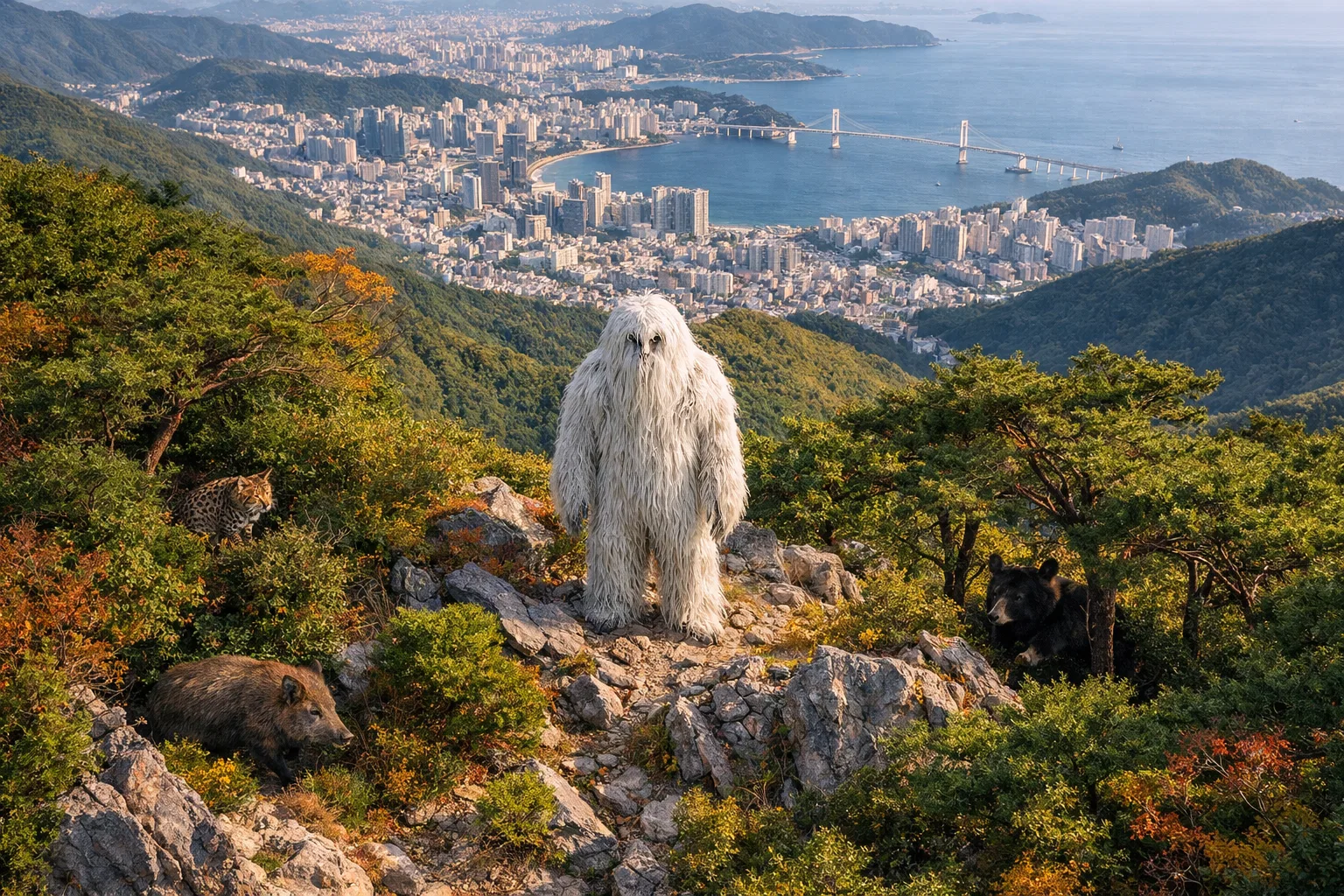
The Jangsan tiger is usually described as a large four-legged creature covered in long white hair. Some versions give it a red face, sharp teeth or a body that looks partly human when glimpsed from a distance. Its most memorable power is mimicry: it supposedly copies a crying child, a woman calling for help, a familiar voice or other enticing sounds to draw people deeper into the forest.
Reports are most strongly associated with Jangsan, a wooded mountain beside the densely populated Haeundae district of Busan. Other retellings place the creature on nearby mountains or in distant parts of South Korea, but these wider claims generally appeared after the legend had become nationally popular.
The strongest academic study of the story reaches an important conclusion: the Jangsan tiger is a product of the new-media age. Research published in the Journal of Korean Oral Literature describes it as an urban horror story that developed through internet sites and smartphone applications. Some of the original websites and even an application that collected reports have since disappeared, leaving what the researcher calls a kind of “ghost archive” made from reposts, summaries and altered versions.[KCI]kci.go.krKCI뉴미디어 시대에 등장한 도시괴담 장산범 연구KCI뉴미디어 시대에 등장한 도시괴담 장산범 연구
That history is very different from the way the creature is often presented on English-language cryptid sites. Those accounts may call it an ancient Korean beast or a traditional mountain spirit, but they rarely supply dated folklore collections, early newspaper reports or named oral-history sources. The scholarly evidence instead suggests a modern story that borrowed older motifs.
How the legend exploded in 2013
The clearest contemporary snapshot comes from a Busan newspaper report dated 1 August 2013. It recorded that hundreds of posts about the creature had appeared across message boards and blogs within two days. A newly released smartphone application had already collected roughly 80 alleged reports. The descriptions circulating online presented a white, hairy beast and claimed repeated appearances on Jangsan and nearby Baegyangsan.[busan.com]busan.com사람 잡아먹는 괴생물체 장산범 괴담 온라인 확산사람 잡아먹는 괴생물체 장산범 괴담 온라인 확산
The same report identified the immediate trigger: a horror webcomic published on a major online portal. The creature then became a trending search term, and users began enlarging and reproducing the story. Haeundae district officials said there was no reason for hikers to worry, although their playful public response helped generate further publicity for the mountain.[busan.com]busan.com사람 잡아먹는 괴생물체 장산범 괴담 온라인 확산사람 잡아먹는 괴생물체 장산범 괴담 온라인 확산
This sequence does not prove that every Jangsan story was invented in 2013. It does show that the legend’s familiar form, national reach and apparent mass of testimony were heavily shaped by a documented media event. Online repetition can make ten retellings of one anecdote look like ten independent encounters.
Why the story feels older than it is
Although modern in its present form, the legend draws power from older Korean storytelling patterns. The academic study found that many versions connect the creature with feminine characteristics and with the idea of being lured or bewitched. Similar patterns already existed in Korean stories about deceptive supernatural beings, including foxes and ghosts.[KCI]kci.go.krKCI뉴미디어 시대에 등장한 도시괴담 장산범 연구KCI뉴미디어 시대에 등장한 도시괴담 장산범 연구
The tiger element also carries deep cultural weight. Tigers once lived across the Korean Peninsula and became enduring figures in art, folk tales and national identity. They could appear as dangerous predators, ridiculous companions or guardians of the mountain world. A modern creature does not need to resemble a real tiger closely to inherit that emotional force.
Jangsan itself is an ideal location for an urban legend. It combines forest, steep ground, military installations, hiking trails and extensive views with immediate proximity to Busan. It feels wild without being remote. A frightening creature can therefore remain just beyond the city lights while still being somewhere that thousands of people recognise and visit.

What evidence exists?
There is no publicly verified physical evidence for the Jangsan tiger. No authenticated body, bone, hair sample, droppings, trackway or environmental DNA has been connected with an unknown large animal. Nor is there a clear sequence of original photographs showing the same creature from several angles.
Most alleged evidence falls into weaker categories:
- anonymous recollections copied between websites;
- distant or blurred photographs without reliable scale;
- stories written long after the supposed event;
- unexplained cries heard in woodland;
- compilations that combine separate and sometimes contradictory descriptions;
- later articles repeating online claims without locating the original witness.
One historical report sometimes drawn into the legend concerns people who said they saw an adult tiger and two young animals near a Jangsan firing range in May 1992. Later news coverage connected that old report with the modern monster story. It is intriguing as a piece of local newspaper history, but it does not establish the white, mimic-voiced creature of the internet legend. The reported animals were described as tigers, and no specimen or lasting evidence appears to have resulted.[Kookje]kookje.co.krKookje장산범 실존했나? 1992년에 호랑이 출몰 신고 접수19 Mar 2019 — 기사를 보면 1992년 5월 8일 정모(당시 36세) 씨와 일행 4명이 장산 사격장 근처에서 길이 2m가량의 호랑이와 새끼 호랑이 2마리를 발견했다고 부산 남…
This is a recurring problem in cryptid history. Once a creature becomes famous, older reports of almost any unusual animal may be absorbed into its biography. A possible tiger sighting, a strange call and a pale shape on a path begin to look like connected evidence only after the legend supplies a common name.
The absence of evidence does not prove that every witness lied. People sincerely misidentify animals, misjudge size or remember frightening moments imperfectly. It does mean that the Jangsan tiger cannot currently be treated as a zoologically supported species.
Ordinary animals in extraordinary conditions
South Korea is highly urbanised, but roughly mountainous terrain and forested national parks allow secretive wildlife to survive surprisingly close to cities. Encounters are often brief, nocturnal or partly obscured, creating good conditions for honest mistakes.
Leopard cats are small spotted wild cats rather than true leopards. They are nocturnal and difficult to observe clearly. The Ministry of Environment reported that unmanned cameras filmed a leopard cat in Bukhansan National Park, on Seoul’s edge, after earlier surveys had doubted that the species could persist there. Tracks or droppings were found before the animal itself was successfully recorded.[me.go.kr]me.go.krThe ecosystem of the area has been well preserved. KNPS shoot the video with 7…Read more…
Asiatic black bears survive through a major restoration effort centred on Jirisan National Park. The national programme released its first six cubs there in 2004 and used tracking, field signs and public-awareness work to rebuild the population. The International Union for Conservation of Nature reported that the project had raised the population from five animals to 64 by 2019.[IUCN]iucn.orgSaving wild Asiatic black bears in Korea | IUCNSaving wild Asiatic black bears in Korea | IUCN…
Wild boar can look much larger than expected when seen at close range, on a slope or under poor lighting. Their raised hair, long heads and fast, uneven movement may create a particularly alarming silhouette. South Korean film has amplified this possibility through Chaw, which turns a real rural animal into a giant man-eating threat.
Raccoon dogs, martens, badgers and domestic dogs may appear unfamiliar when wet, injured or affected by mange. Hair loss changes the apparent shape of the head, limbs and tail. A pale dog moving through vegetation can look oddly long-bodied, while reflected light may make its eyes or coat appear unnatural.
Woodland sounds are equally deceptive. Deer, cats, foxes, birds and people can produce calls whose source is difficult to judge among slopes and trees. Echoes alter direction and distance. A witness who already knows the Jangsan story may interpret an unidentified cry as deliberate imitation rather than ordinary animal communication.
None of these explanations identifies every reported encounter. They show why an unknown observation is not necessarily an unknown animal.
The lost tiger behind the modern monster
The idea of a tiger in South Korean mountains is emotionally plausible because the animal was once genuinely present. Amur tigers historically ranged across the Korean Peninsula, but hunting, habitat loss and systematic predator eradication removed them from South Korea during the twentieth century. Historical work describes extensive killing by trophy hunters and under Japanese colonial pest-control campaigns.[HKW]archiv.hkw.deTigers as the Chronotope of Continual Coloniality in KoreaTigers as the Chronotope of Continual Coloniality in KoreaMarch 15, 2017 — by Y Lee · Cited by 5 — During the late nineteenth- to the…
The exact date of the last wild tiger is not securely settled. A frequently repeated claim identifies 1924 as the last known Korean sighting, but occasional later reports have never established a surviving South Korean population. Recent conservation literature treats the tiger as extirpated from South Korea, meaning locally gone rather than globally extinct.[koreajoongangdaily]koreajoongangdaily.comEven on International Tiger Day, which fell on July 29, no commemorations orThe tiger boom is here, but where are the tigers?August 25, 2025 — 26 Aug 2025 — The last known sighting of a wild tige…
This lost-animal history gives alleged tiger reports a different quality from invented giant monsters. A tiger on Jangsan would not represent a completely unknown type of creature; it would imply survival, escape or return. Yet such a claim would require exceptionally strong evidence. Tigers leave large tracks, kill substantial prey, occupy wide territories and are readily detected by modern camera traps when present in breeding populations.
The restored bears of Jirisan provide a useful comparison. Even scarce, forest-dwelling animals produce DNA, hair, droppings, photographs, tracking records and repeated encounters. A hidden South Korean tiger population should eventually generate a similar trail. None has been demonstrated.
The Han River creature and the making of The Host
South Korea’s most internationally famous monster belongs to cinema rather than cryptozoology. In Bong Joon-ho’s 2006 film The Host, a malformed amphibious predator emerges from Seoul’s Han River, attacks people in a riverside park and carries away a child.
The fictional creature grew from several real ingredients. Bong has recalled seeing something strange hanging or moving near a Han River bridge while he was at school. He later described the sight as a possible creature, but the observation was too distant and fleeting to support identification. It functions best as a personal creative memory rather than a documented zoological case.[Collider]collider.combong joon ho interview parasite snowpiercerbong joon ho interview parasite snowpiercer
A far better recorded influence was the 2000 formaldehyde scandal. A United States military employee ordered hundreds of bottles of the chemical to be poured into a drain connected with the Han River system. Bong directly incorporated the event into the film’s opening scene, where toxic disposal provides the monster’s imagined origin.[Cineaste]cineaste.comThe Han River Horror Show: Interview with Bong Joon-ho — Cineaste MagazineThe Han River Horror Show: Interview with Bong Joon-ho — Cineaste Magazine
The film also turned the creature into political satire. Its monster is accompanied by incompetent authorities, quarantine measures, false claims about a virus and an American-led chemical response. Bong explained that the entertainment and social commentary were designed to work together rather than as separate parts.[Cineaste]cineaste.comThe Han River Horror Show: Interview with Bong Joon-ho — Cineaste MagazineThe Han River Horror Show: Interview with Bong Joon-ho — Cineaste Magazine
The Host matters to South Korean cryptid culture because it demonstrates how a fictional creature can become attached to a real landscape more securely than any alleged unknown animal. The Han River monster does not have a convincing history of independent sightings, but millions of viewers now associate the river with its image. Cinema supplied the shared monster that folklore and eyewitness reports had not.
Folklore beasts are not undiscovered animals
South Korea’s legendary creatures are sometimes placed in modern cryptid lists, but doing so can confuse two very different traditions. A cryptid claim normally proposes that an unrecognised animal may physically inhabit the world. A folklore creature may instead embody danger, greed, political disorder or supernatural power.
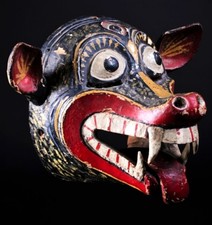
The clearest example is the metal-eating beast known in Korean tradition as the Bulgasari. It is commonly portrayed as a composite animal that feeds on iron and grows stronger or larger as it eats. The National Folk Museum of Korea’s English-language Encyclopedia of Korean Folk Literature includes the metal-eating monster among the country’s legendary beings. Its impossible diet and variable anatomy mark it as folklore, not a plausible hidden species.[ia800409.us.archive.org]ia800409.us.archive.org한국민속문학사전 본문 최종 opt한국민속문학사전 본문 최종 opt
The creature crossed into cinema in 1962. The Korean Film Council identifies Bulgasari as South Korea’s first monster film and one of its earliest productions to use special effects. The story followed a murdered martial artist who returns as an iron-eating monster to take revenge. The film was poorly received and its prints were lost, making it a sought-after missing work in Korean film history.[Korean Film Archive]koreanfilm.or.krKorean Film Archive Ko-pick: The Evolution of Creatures in K-ContentKorean Film Archive Ko-pick: The Evolution of Creatures in K-Content
A North Korean adaptation made in 1985 is often better known internationally, but it should not be mistaken for the origin of the creature. Nor should the folkloric beast be described as a historical animal merely because some modern artwork gives it a consistent body.
Other supernatural Korean figures require the same care. Dragons, shape-changing foxes, goblin-like beings and spirits may resemble cryptids in illustrations, but their traditional stories do not generally claim that ordinary zoologists could capture and classify them. Their value lies in folklore, ritual and cultural symbolism.
South Korea’s monster-film afterlife
South Korea developed a cinematic monster tradition decades before the Jangsan tiger became an internet phenomenon. These films created a visual language for interpreting strange animals and gave particular landscapes their own imagined beasts.
After the lost Bulgasari, The Big Monster Wangmagwi and Yongary, Monster from the Deep both appeared in 1967. Wangmagwi sent an alien-controlled giant through Seoul and is now the oldest surviving South Korean monster film. Yongary was a South Korean-Japanese co-production that drew openly on the techniques of Japanese giant-monster cinema, using miniature sets, a creature suit and pyrotechnics.[Korean Film Archive]koreanfilm.or.krKorean Film Archive Ko-pick: The Evolution of Creatures in K-ContentKorean Film Archive Ko-pick: The Evolution of Creatures in K-Content
Later productions relocated monsters to settings that reflected changing concerns:
- Yonggary revived the giant reptile for the digital-effects era.
- The Host placed pollution, institutional failure and family struggle beside the Han River.
- D-War transformed dragon mythology into an international action spectacle.
- Chaw exaggerated wild-boar encounters into rural monster horror.
- Sector 7 used an offshore oil platform and an engineered sea creature.
- Monstrum centred on a supposed beast whose rumour could be manipulated for political ends.
These are fictional works, but they affect real-world storytelling. Once a culture has familiar images of pale mountain predators, mutant river animals and oversized boars, ambiguous experiences can be narrated through those forms. Film does not necessarily cause a witness to see something, but it can influence what the witness thinks the something was.
The Jangsan legend’s own growth shows this exchange in action. Academic research found that webcomics and film sharply increased the number of online documents about the creature. The monster moved from scattered digital storytelling to illustrated narrative, cinema and reference-style web pages that increasingly treated its invented characteristics as settled facts.[KCI]kci.go.krKCI뉴미디어 시대에 등장한 도시괴담 장산범 연구KCI뉴미디어 시대에 등장한 도시괴담 장산범 연구
What South Korea does not have
South Korea is sometimes credited with cryptids that do not properly belong within its borders. The most common example is the alleged monster of Heaven Lake on Mount Paektu. Reports describe dark or serpentine forms in the high volcanic lake, but the lake lies on the border between North Korea and China. It is culturally important across the Korean Peninsula, yet it is not a South Korean location.
South Korea also lacks a well-established national lake-monster tradition. Reservoirs and rivers produce occasional photographs of unexplained shapes, but no single creature has accumulated a dependable chronology comparable with famous lake monsters elsewhere. Floating debris, large fish, water birds, otters, wakes and perspective errors remain sufficient explanations for many brief observations.
There is similarly little strong evidence for a native ape-like creature, recurrent sea serpent, phantom big cat or winged cryptid. English-language lists sometimes assign such beings to South Korea by repeating unsourced social-media posts or by treating a one-off strange sighting as an established legend. Without names, dates, original reports and independent corroboration, those entries should not be given the same standing as the well-documented history of the Jangsan urban legend.
This scarcity is itself informative. South Korea’s country-level monster tradition is not a catalogue of competing zoological mysteries. It is concentrated around one major internet legend, a few ambiguous animal reports, older supernatural folklore and a particularly rich screen history.
How to judge a South Korean creature claim
A credible mystery-animal case should be traceable beyond a repost. The first question is not whether a photograph looks frightening, but where it came from and what survives from the original incident.
Useful evidence would include:
- a named witness and a precise date and location;
- an original, uncropped image or video with metadata;
- several frames showing continuous movement;
- measurements or recognisable objects that establish scale;
- tracks photographed with a ruler and recorded before contamination;
- hair, tissue, droppings or environmental DNA collected under documented conditions;
- independent witnesses interviewed separately;
- repeated camera-trap records from suitable habitat;
- expert examination of a carcass or other physical remains.
The distinction between a mystery and a legend becomes clearer when these tests are applied. A genuine animal investigation accumulates observations that can be checked. An urban legend accumulates variations: new powers, altered appearances, more dramatic locations and stories that become detached from their first tellers.
By that standard, South Korea’s best-known cases divide cleanly. The Jangsan tiger is a well-documented cultural phenomenon but a poorly supported animal claim. The 1992 Jangsan tiger report is an unresolved historical anecdote rather than evidence for the later mimic legend. The Bulgasari is a folklore beast. The Han River monster is a deliberate cinematic creation built partly from a real pollution scandal. Bears, boar and leopard cats are documented wildlife capable of producing surprising encounters.
Why these creatures still matter
South Korea’s monster tradition is most interesting precisely because it shows how different kinds of “reality” overlap. The animals themselves may be fictional, misidentified or unproven, while their cultural effects are entirely real.
The Jangsan tiger turned a familiar Busan mountain into a national horror location. Its rapid spread preserved the structure of oral storytelling inside websites, applications and webcomics, even as those platforms disappeared. The creature’s supposed ability to imitate human voices also expresses a distinctly modern fear: not merely that something dangerous is hiding nearby, but that it can copy the signals people normally trust.
The Han River monster transformed environmental anxiety and political distrust into a creature that could be seen, chased and fought. Bulgasari carried an older impossible beast into South Korea’s first monster film. Giant reptiles and boars then placed urban development, nuclear power, industrial danger and rural unease inside popular entertainment.
South Korea therefore offers fewer persuasive cryptozoological cases than many online lists suggest, but a richer story about how monsters are constructed. Its mystery beasts live at the meeting point of lost wildlife, mountain geography, digital folklore and film. The evidence does not support an unknown population of white voice-mimicking predators. It does support something almost as fascinating: a modern legend whose birth, spread and transformation can be watched in unusually clear detail.
Amazon book picks
Further Reading
Books and field guides related to What Really Lurks Behind South Korea's Monsters?. Use these as the next step if you want deeper reading beyond the article.
The Mythical Creatures Bible
Offers broader context for monster beliefs across cultures.
Korea: the Impossible Country
Provides cultural context for how folklore and media interact in contemporary Korea.
eBay marketplace picks
Marketplace Samples
Live-tested eBay searches with available results related to this page.


Endnotes
1.
Source: busan.com
Title: 사람 잡아먹는 괴생물체 장산범 괴담 온라인 확산
Link:https://www.busan.com/view/busan/view.php?code=20130801000115
2.
Source: me.go.kr
Link:https://me.go.kr/eng/web/board/read.do%3Bjsessionid%3Dc8SHVBXy6UNTACiYLi97eu2HOunG6Ef-97VYvf6a.mehome1?boardCategoryId=&boardId=348746&boardMasterId=522&decorator=&maxIndexPages=10&maxPageItems=10&menuId=461&orgCd=&pagerOffset=1080&searchKey=&searchValue=
Source snippet
The ecosystem of the area has been well preserved. KNPS shoot the video with 7...Read more...
3.
Source: iucn.org
Title: Saving wild Asiatic black bears in Korea | IUCN
Link:https://iucn.org/news/asia/201905/saving-wild-asiatic-black-bears-korea
Source snippet
Saving wild Asiatic black bears in Korea | IUCN...
4.
Source: archiv.hkw.de
Title: Tigers as the Chronotope of Continual Coloniality in Korea
Link:https://archiv.hkw.de/de/tigers_publication/taxidermy_of_time_tigers_as_the_chronotope_of_continual_coloniality_in_korea__yongwoo_lee/taxidermy_of_time_tigers_as_the_chronotope_of_continual_coloniality_in_korea__yongwoo_lee.php
Source snippet
Tigers as the Chronotope of Continual Coloniality in KoreaMarch 15, 2017 — by Y Lee · Cited by 5 — During the late nineteenth- to the...
Published: March 15, 2017
5.
Source: koreajoongangdaily.com
Title: Even on International Tiger Day, which fell on July 29, no commemorations or
Link:https://www.koreajoongangdaily.com/lifestyle/the-tiger-boom-is-here-but-where-are-the-tigers/12435612
Source snippet
The tiger boom is here, but where are the tigers?August 25, 2025 — 26 Aug 2025 — The last known sighting of a wild tige...
Published: August 25, 2025
6.
Source: collider.com
Title: bong joon ho interview parasite snowpiercer
Link:https://collider.com/bong-joon-ho-interview-parasite-snowpiercer/
7.
Source: cineaste.com
Title: The Han River Horror Show: Interview with Bong Joon-ho — Cineaste Magazine
Link:https://www.cineaste.com/spring2007/interview-with-bong-joon-ho
8.
Source: ia800409.us.archive.org
Title: 한국민속문학사전 본문 최종 opt
Link:https://ia800409.us.archive.org/5/items/opt_20230726/%ED%95%9C%EA%B5%AD%EB%AF%BC%EC%86%8D%EB%AC%B8%ED%95%99%EC%82%AC%EC%A0%84-%EB%B3%B8%EB%AC%B8-%EC%B5%9C%EC%A2%85_opt.pdf
9.
Source: me.go.kr
Link:https://www.me.go.kr/eng/web/board/read.do%3Bjsessionid%3DVCuK0IJDE75kAbGd7e3tkSvHB91cygFSV968k69L.mehome1?boardCategoryId=&boardId=6&boardMasterId=523&decorator=&maxIndexPages=10&maxPageItems=10&menuId=458&orgCd=&pagerOffset=0&searchKey=&searchValue=
10.
Source: shapes.inc
Title: A I Chat with Jangsan Beom
Link:https://shapes.inc/jangsanbeom
11.
Source: kci.go.kr
Title: KCI뉴미디어 시대에 등장한 도시괴담 장산범 연구
Link:https://www.kci.go.kr/kciportal/ci/sereArticleSearch/ciSereArtiView.kci?sereArticleSearchBean.artiId=ART002335450
12.
Source: kookje.co.kr
Link:https://www.kookje.co.kr/news2011/asp/newsbody.asp?code=0500&key=20190319.99099007200
Source snippet
Kookje장산범 실존했나? 1992년에 호랑이 출몰 신고 접수19 Mar 2019 — 기사를 보면 1992년 5월 8일 정모(당시 36세) 씨와 일행 4명이 장산 사격장 근처에서 길이 2m가량의 호랑이와 새끼 호랑이 2마리를 발견했다고 부산 남...
13.
Source: koreanfilm.or.kr
Title: Korean Film Archive Ko-pick: The Evolution of Creatures in K-Content
Link:https://www.koreanfilm.or.kr/eng/news/ko_pick.jsp?blbdComCd=601029&mode=VIEW&seq=41
14.
Source: scribd.com
Link:https://www.scribd.com/document/659683598/01043
15.
Source: cine21.com
Link:https://cine21.com/news/view/?mag_id=88029
16.
Source: koreajoongangdaily.joins.com
Link:https://koreajoongangdaily.joins.com/2006/07/16/features/That-river-creature-is-his-baby-Meet-the-maker-of-Host/2751906.html
Additional References
17.
Source: ksilbo.co.kr
Title: article View
Link:https://www.ksilbo.co.kr/news/articleView.html?idxno=603470
Source snippet
경상일보'장산범' 둘러싼 각종 괴담들…1992년 부산 장산 일대 목격담?12 Jul 2017 — 또 '장산범'이 주로 목격된 장소는 부산 해운대구 장산 일대라고 입을 모았다. 장산 일대에 범과 관련된 공식 보고는 1992년 5월 한 매체의 기사를...
18.
Source: youtube.com
Link:https://www.youtube.com/watch?v=SoPIeSGmrxA
Source snippet
Exploring 10 Demons & Spirits of Korean Folklore...
19.
Source: youtube.com
Title: Dark & Mysterious Monsters from South Korean Legends
Link:https://www.youtube.com/watch?v=7UFjRzJQz7g
Source snippet
Lost Cinema: Bulgasari (1962), The South Korean Kaiju Mystery...
20.
Source: youtube.com
Title: Exploring 10 Demons & Spirits of Korean Folklore
Link:https://www.youtube.com/watch?v=MxPci7C9Bfw
Source snippet
Why Korea's Monsters Aren't Meant to Scare You | Monstrum...
21.
Source: instagram.com
Link:https://www.instagram.com/reel/C-BCRHquoQI/
22.
Source: mcee.go.kr
Link:https://mcee.go.kr/eng/web/board/read.do%3Bjsessionid%3Dg4rgpoYRrcZQKbdeXnnl3DolGKdbqZPgVi4icnif.mehome2?boardCategoryId=&boardId=109&boardMasterId=522&decorator=&maxIndexPages=10&maxPageItems=10&menuId=461&orgCd=&pagerOffset=2070&searchKey=&searchValue=
23.
Source: facebook.com
Link:https://www.facebook.com/WWF/posts/asiatic-black-bears-are-experiencing-a-dramatic-revival-after-their-return-to-th/10158752735551305/
24.
Source: facebook.com
Link:https://www.facebook.com/groups/974887653305617/posts/2035713053889733/
25.
Source: facebook.com
Link:https://www.facebook.com/groups/396051421627169/posts/1645661193332846/
26.
Source: reddit.com
Link:https://www.reddit.com/r/korea/comments/1gzyfse/how_do_koreans_feel_about_the_extinction_of_wild/
Topic Tree
Follow this branch
Related pages 192
- Antigua Cryptids
- Maldives Monsters
- Malta Monsters
- Qatar Monsters
- Argentina Monsters
- +187 more in sidebar