Cryptids of Belgium's Rivers and Streets
Belgium does not have one famous national “monster” in the way Scotland has the Loch Ness Monster.
Page outline Jump by section
What Belgium’s “cryptids” really are
The most useful way to read Belgian mystery-creature stories is to separate four things that are often mixed together: old folklore, local cautionary tales, modern cryptozoology lists, and real wildlife returning to places where people had stopped expecting it. Belgium’s legendary animals are not usually presented in old sources as undiscovered species. They are spirits, bogeys, giants, tricksters, river-haunters and moral warnings. Collections such as William Elliot Griffis’s Belgian Fairy Tales and Jean de Boschère’s Beasts & Men show how Belgian and Flemish storytelling has long used animals, giants, fairies and human-animal behaviour as imaginative material rather than field evidence for unknown fauna.[Project Gutenberg]gutenberg.orgOpen source on gutenberg.org.[Project Gutenberg]gutenberg.orgProject Gutenberg Beasts & Men by Jean de Boschère | Project GutenbergProject Gutenberg Beasts & Men by Jean de Boschère | Project Gutenberg
That matters because a reader searching for “Belgian cryptids” may expect lake monsters, ape-men or surviving prehistoric reptiles. Belgium has far thinner material on those fronts than countries with large wilderness areas, remote lakes or long-running newspaper monster flaps. Its strongest creature traditions are instead tied to human-scale geography: children near water, travellers on dark roads, drunkards walking home, villagers explaining winter cold, and towns turning a local bogey into civic folklore. The 1891 Walloon collection Contes populaires du pays wallon also points to a rich regional tale tradition rather than a single national monster canon.[Google Books]books.google.comBooks Contes populaires du pays wallonBooks Contes populaires du pays wallon
Belgium’s modern wildlife context adds another layer. Wolves have genuinely returned after more than a century, and a lynx photographed in the Ardennes in 2020 was treated by Belgian wildlife groups as hard evidence after decades of unconfirmed reports. Those are not cryptids once confirmed; they are reminders that “impossible animal” stories can sometimes sit beside real ecological change.[Environment]environment.ec.europa.euEnvironment PRACTICAL SUPPORTEnvironment PRACTICAL SUPPORT[The Brussels Times]brusselstimes.comOpen source on brusselstimes.com.
The Kludde: Belgium’s best-known night beast
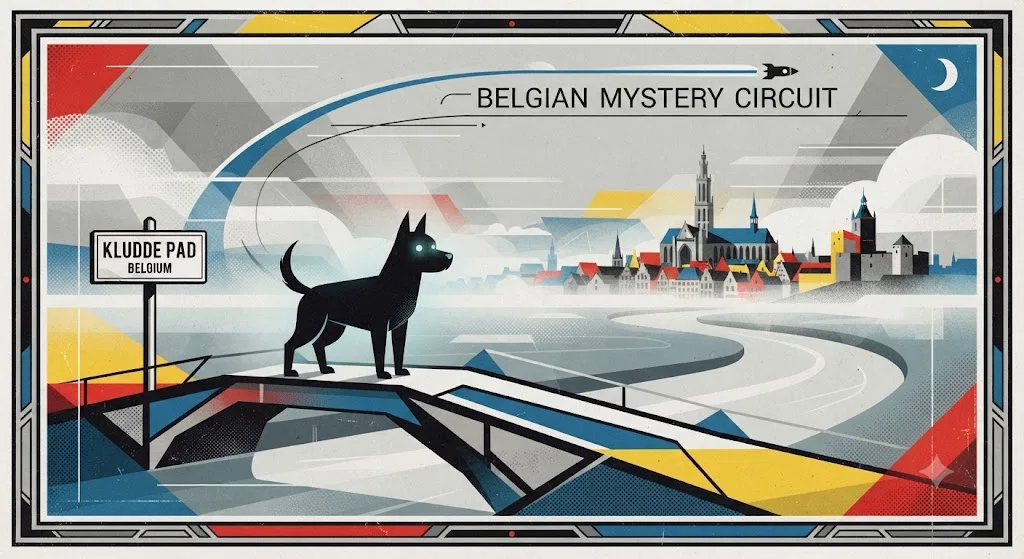
The Kludde is the closest Belgium has to a classic folkloric cryptid: animal-shaped, frightening, nocturnal, associated with water and lonely travel, and flexible enough to survive in many retellings. The Brussels Times describes it as a creature of East Flanders and wider Belgium, also known by names such as Kleure, Klerre, Kledde and Waterkledde. In that modern summary, it is a child-threatening water monster, lurking in reeds, under bridges and in hollow trees.[The Brussels Times]brusselstimes.comOpen source on brusselstimes.com.
Specialist folklore summaries give the Kludde a wider Low Countries range. A Book of Creatures places its first notable written record in 1840 at Ternat, by the Baron of Saint-Genois, and links it with Brabant and Flanders, including Merchtem, Dendermonde and the Dendre. In Ostend it is treated as a water-spirit type, while in flatter countryside it may blur into werewolf tradition.[A Book of Creatures]abookofcreatures.comA Book of Creatures Kludde | A Book of CreaturesA Book of Creatures Kludde | A Book of Creatures
What makes the Kludde feel “cryptid-like” is its changing body. It can be a great black dog with a rattling chain, a hungry-looking horse, a sheep, a cat, a bat, a frog or even a tree. The constant detail in one account is a pair of blue flames moving ahead of it as eyes. That is not zoological evidence, but it is exactly the kind of visual hook that keeps a creature alive: a sound in the dark, a shape near a bridge, a glimmer in mist, and a story ready to explain it.[A Book of Creatures]abookofcreatures.comA Book of Creatures Kludde | A Book of CreaturesA Book of Creatures Kludde | A Book of Creatures
The most plausible reading is that Kludde stories worked as water-safety, travel-safety and night-safety folklore. Bridges, reeds and riverbanks are dangerous places for children and solitary walkers. Turning those dangers into a monster makes the warning memorable. In that sense the Kludde belongs beside other European black dogs, nixies, kelpies and water bogeys, but its Belgian identity comes from specific Flemish and Brabant place associations rather than from any single “sighting case”.

Lange Wapper: Antwerp’s giant, trickster and tourist monster
If Kludde is Belgium’s night animal, Lange Wapper is its urban giant. The figure is especially attached to Antwerp, where a bronze statue stands near Het Steen, the medieval fortress on the Scheldt. Atlas Obscura describes the statue as a 1963 work by Albert Poels and summarises the legend as a 16th-century Wilrijk tale: a strange child becomes a helpful boy, receives shapeshifting powers from an old woman he saves, and later turns into the long-legged giant known as Lange Wapper.[Atlas Obscura]atlasobscura.comAtlas Obscura Lange Wapper Statue in AntwerpAtlas Obscura Lange Wapper Statue in Antwerp
The giant’s behaviour is more prankster-bogey than animal mystery. He frightens drunkards, cheats children in games, changes size, and in some tales is repelled by images of the Virgin Mary. A Book of Creatures preserves a darker version in which Antwerp’s countryside is cleared of demons and goblins, but one creature hides in the water and later settles in the city’s canals. From there, Lange Wapper becomes a shapeshifter with no fixed size, sometimes tall enough to peer into windows.[A Book of Creatures]abookofcreatures.comA Book of Creatures Belgium | A Book of CreaturesA Book of Creatures Belgium | A Book of Creatures
For a country-level cryptid page, Lange Wapper is important because he shows how Belgian monster lore often becomes civic memory. He is not a “reported animal” in the modern sense. He is a creature of place: Antwerp’s riverfront, old streets, public sculpture, tourist walks and children’s tales. The legend has also proved adaptable because it speaks to ordinary urban anxieties: drunkenness, night streets, children wandering, windows watched from outside, and the feeling that old cities have personalities after dark.
Wallonia, the Ardennes and the water-bogey pattern
Belgian creature folklore is not only Flemish. In Wallonia and the Ardennes, monsters often cling to rivers, caves, cold weather and rural child-warning traditions. The Traîcousse, also called Trécouche, is a good example. A Book of Creatures locates it in the waterways of the south-western Ardennes and the Semois, including Bohan in Belgium, and describes it as a water bogey used to warn children away from rivers. Its form is given as crab-like, scaled, many-legged and predatory, with a tendency to drag victims under.[A Book of Creatures]abookofcreatures.comA Book of Creatures Belgium | A Book of CreaturesA Book of Creatures Belgium | A Book of Creatures
Another Walloon example is Colôrobètch, the red-beaked winter bogey. In some places it is a monstrous sparrow, pigeon or rooster-like figure associated with frostbite and children being outside in the cold without protection. In Andenne, the same broader figure becomes a nocturnal water bogey that drags children into the Meuse.[A Book of Creatures]abookofcreatures.comA Book of Creatures Belgium | A Book of CreaturesA Book of Creatures Belgium | A Book of Creatures
These stories are not random. They turn local hazards into characters. Fast water, deep pools, winter exposure and cracked skin become easier to teach when they are given teeth, claws, beaks or a lurking presence. Belgium’s geography helps explain the pattern: the Meuse, Semois, Dendre and Scheldt are not just scenery in these tales; they are danger zones, borders, routes and memory-lines.
The Ardennes also gives Belgian monster tradition its cave-and-forest texture. Wallonia’s tourism authority describes the Caves of Han near Rochefort as a major cave attraction with galleries, underground spaces, stalagmites and the Lesse nearby. That official tourism context is not evidence for cave monsters, but it explains why subterranean and riverine folklore feels at home in southern Belgium: the landscape itself invites stories about hidden places beneath ordinary ground.[Visit Wallonia]visitwallonia.comVisit Wallonia Explore the famous cave of the Domaine des Grottes de HanVisit Wallonia Explore the famous cave of the Domaine des Grottes de Han
The “Maasie” and Belgium’s thin modern mystery-animal file
Belgium’s most cryptozoological modern animal claim is much thinner than its folklore. Cryptid Wiki records the “Maasie” as a crocodile-like creature reportedly seen on 6 August 1979 in the Meuse near Ombret-Rawsa, Amay, Liège. The account describes a roughly 90 cm crocodilian animal seen once and not confirmed again.[Cryptid Wiki]cryptidz.fandom.comCryptid Wiki Maasie | Cryptid Wiki | FandomCryptid Wiki Maasie | Cryptid Wiki | Fandom
This is exactly the sort of case that needs careful handling. The same source itself notes that a prehistoric-survivor idea is not plausible and that an escaped or discarded pet crocodile is a more realistic explanation. Belgium’s climate, especially cold winters, would make a long-term hidden crocodile population very unlikely, and a single small crocodilian report does not amount to evidence for a breeding mystery species.[Cryptid Wiki]cryptidz.fandom.comCryptid Wiki Maasie | Cryptid Wiki | FandomCryptid Wiki Maasie | Cryptid Wiki | Fandom
The case is still worth mentioning because it shows how modern cryptid lists can attach a monster aura to a brief out-of-place animal report. A crocodile in the Meuse would be startling; it does not need to be a lake monster. Escaped exotic pets, mistaken size estimates, brief sightings and later retellings can turn a small incident into a named creature.
Big cats, wolves and lynx: when “mystery beasts” meet real ecology
Belgium’s best modern lesson for cryptid readers is that not every surprising animal report is fantasy, but confirmation matters. The lynx is the clearest example. In September 2020, The Brussels Times reported that a wildlife camera photo from the Ardennes was hailed as the first concrete proof that the lynx had returned to Belgium after nearly two centuries. The same report noted that there had been more than 25 years of earlier lynx reports that could not be conclusively confirmed.[The Brussels Times]brusselstimes.comOpen source on brusselstimes.com.
That pattern is important: decades of sightings were not enough on their own, but a camera-trap image changed the status of the claim. It moved the animal from rumour or possibility into documented wildlife presence. The report also suggested the Belgian lynx might be connected to reintroduction and recovery projects in Germany, where lynx had already re-established in some areas.[The Brussels Times]brusselstimes.comOpen source on brusselstimes.com.
Wolves tell a similar but better-documented recolonisation story. The European Commission notes that Belgium is one of the latest countries to experience wolf recolonisation, with a radio-collared female recorded in 2018 after travelling from Germany through the Netherlands into Flanders, and another wolf recorded in Wallonia later that year. Reproduction followed in Flanders in 2020 and in Wallonia in 2021, alongside livestock concerns and public tension.[Environment]environment.ec.europa.euEnvironment PRACTICAL SUPPORTEnvironment PRACTICAL SUPPORT
Across Europe, this is part of a wider large-carnivore recovery. European Commission data says wolves now occur in all 34 monitored European countries or regions, with Belgium and Luxembourg specifically named as comeback areas since 2016. The same European overview estimates around 23,000 wolves and about 9,400 lynx in Europe in 2023, while noting that some range changes also reflect monitoring differences.[Environment]environment.ec.europa.euEnvironment Large carnivore populations across EuropeEnvironment Large carnivore populations across Europe
For Belgian cryptid history, the point is not that wolves or lynx are monsters. It is that public expectations lag behind ecological change. An animal absent for generations can feel impossible when it returns. That creates the same social conditions that feed mystery-beast stories: surprise, fear, blurry photographs, conflicting expertise, and arguments over whether witnesses saw what they think they saw.
Why Belgium has fewer lake monsters than some neighbours
Belgium’s monster tradition is rich, but it is not especially lake-monster-rich. The country has rivers, canals, wetlands, polders, caves and forested uplands, but it lacks the combination that helps sustain famous lake-monster legends: a large, deep, culturally iconic body of water with repeated sightings, tourist branding, boat-based observation points and a long press record.
Instead, Belgian water monsters tend to be small-scale and functional. Kludde lurks around reeds, bridges and hollow trees. Traîcousse lives in dangerous river water. Colôrobètch can become a Meuse child-snatcher. The focus is not “what unknown animal inhabits this lake?” but “why should you stay away from this risky place?” That makes Belgian water lore closer to cautionary folklore than to classic modern cryptozoology.[The Brussels Times]brusselstimes.comOpen source on brusselstimes.com.[A Book of Creatures]abookofcreatures.comA Book of Creatures Belgium | A Book of CreaturesA Book of Creatures Belgium | A Book of Creatures
This also explains why Belgium’s creature stories are often intensely local. A town, bridge, river bend, cave, district or winter custom matters more than a national monster brand. For readers, that is part of the charm: Belgium’s monsters are less like celebrities and more like neighbours with bad habits.
How to read Belgian monster reports without flattening the mystery
The fairest approach is neither to debunk everything into nothing nor to pretend that folklore is field biology. Belgium’s creature traditions sit on a spectrum.
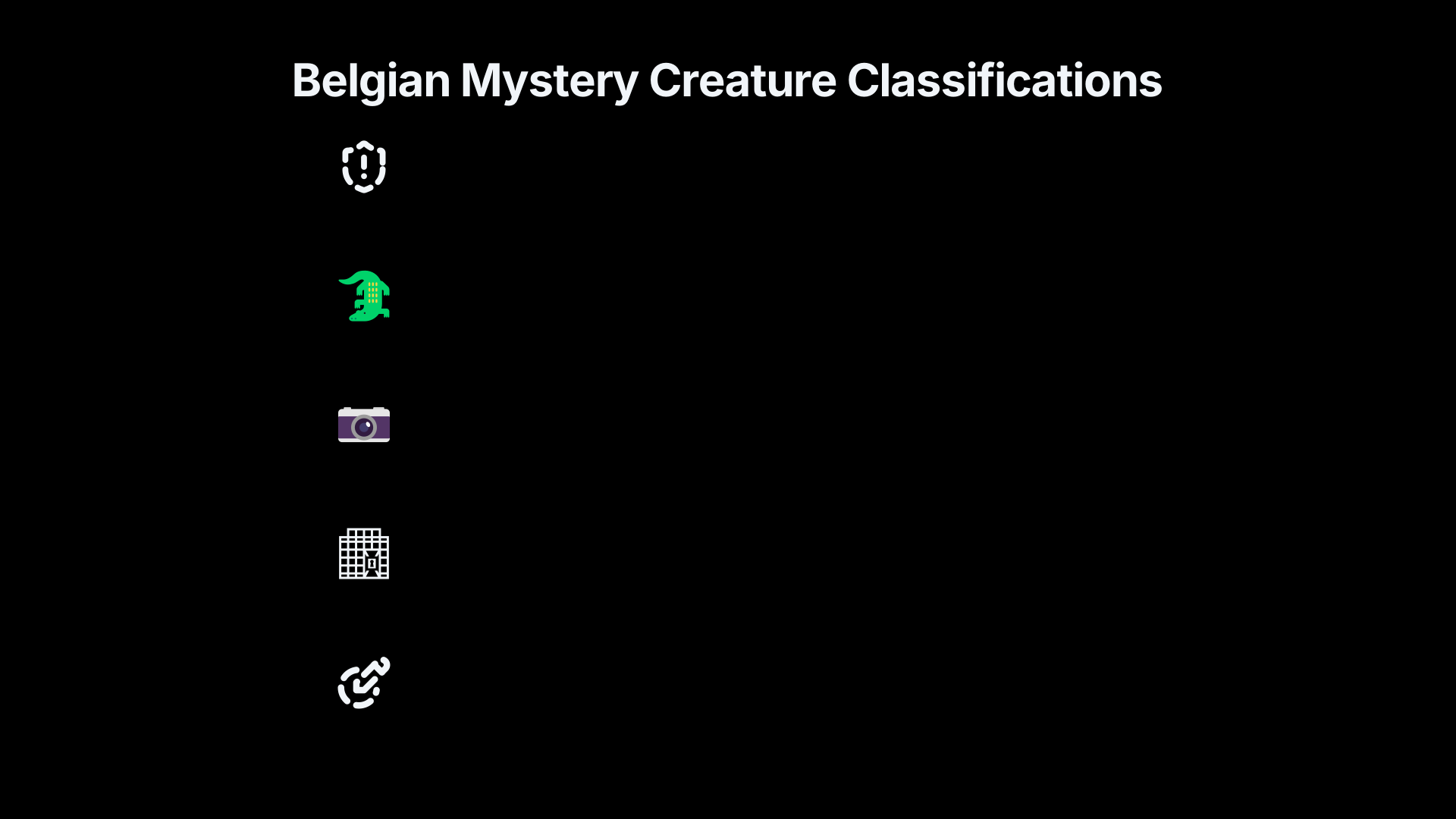
At one end are clear folklore beings: Lange Wapper, Kludde, Traîcousse and Walloon bogeys. They are culturally real because they belong to places, stories and public memory, but they are not supported as unknown animal species. In the middle are out-of-place animal scares, such as the Maasie, where the most likely explanation is a brief encounter with an escaped or released exotic animal rather than a hidden population. At the other end are formerly absent real animals, such as wolves and lynx, where modern monitoring can turn old-style “sightings” into confirmed records.[Atlas Obscura]atlasobscura.comAtlas Obscura Lange Wapper Statue in AntwerpAtlas Obscura Lange Wapper Statue in Antwerp[Cryptid Wiki]cryptidz.fandom.comCryptid Wiki Maasie | Cryptid Wiki | FandomCryptid Wiki Maasie | Cryptid Wiki | Fandom[Environment]environment.ec.europa.euEnvironment PRACTICAL SUPPORTEnvironment PRACTICAL SUPPORT[The Brussels Times]brusselstimes.comOpen source on brusselstimes.com.
A useful credibility test for Belgian mystery beasts is simple:
- Is the creature tied to a named tradition? If so, it may be best read as folklore rather than a zoological claim.
- Is there repeated, independent evidence? A single sighting rarely supports much beyond “someone reported something”.
- Could it be known wildlife returning? Lynx and wolves show why this question matters.
- Could it be an escaped pet or captive animal? A one-off crocodilian report in a river fits that pattern better than a monster lineage.
- Does the story explain a local danger? Water bogeys and winter monsters often preserve practical warnings in memorable form.
Belgium’s cryptid landscape is therefore quieter than some, but not empty. Its monsters live in the overlap between river safety, city humour, regional folklore, ecological surprise and the human habit of giving a shape to noises in the dark.
Amazon book picks
Further Reading
Books and field guides related to What Monsters Haunt Belgium's Rivers and Streets?. Use these as the next step if you want deeper reading beyond the article.
The Element Encyclopedia of Magical Creatures
Covers many European legendary beings relevant to Belgian lore.
The Book of Imaginary Beings
Places local monsters within a wider tradition of fantastic beings.
eBay marketplace picks
Marketplace Samples
Live-tested eBay searches with available results related to this page.
Endnotes
1.
Source: gutenberg.org
Link:https://www.gutenberg.org/ebooks/67256
2.
Source: gutenberg.org
Title: Project Gutenberg Beasts & Men by Jean de Boschère | Project Gutenberg
Link:https://www.gutenberg.org/ebooks/46960
3.
Source: books.google.com
Title: Books Contes populaires du pays wallon
Link:https://books.google.com/books/about/Contes_populaires_du_pays_wallon.html?id=AURHAAAAcAAJ
4.
Source: play.google.com
Title: comby Auguste Gittée
Link:https://play.google.com/store/books/details/Auguste_Gitt%C3%A9e_Contes_populaires_du_pays_wallon?id=AURHAAAAcAAJ
5.
Source: books.google.com
Title: Belgian Fairy Tales
Link:https://books.google.com/books/about/Belgian_Fairy_Tales.html?id=O6v7DAAAQBAJ
6.
Source: books.google.com
Title: Beasts Men
Link:https://books.google.com/books/about/Beasts_Men.html?id=GM9zEAAAQBAJ
7.
Source: books.google.de
Title: de Le folklore au pays Wallon
Link:https://books.google.de/books?hl=de&id=uUNHAAAAcAAJ&source=gbs_navlinks_s
8.
Source: youtube.com
Title: The Tale of the Lange Wapper at Het Steen | Antwerp, Belgium
Link:http://www.youtube.com/watch?v=8t_3bnOBifU
Source snippet
Kludde - Shapeshifting Demon-Dog | Belgian Mythology...
9.
Source: youtube.com
Link:http://www.youtube.com/watch?v=OSlDjLXjZ64
Source snippet
Antwerp folklore Lange Wapper 🇧🇪 Exploring Antwerp’s Grote Markt | Legends of Brabo & Lange Wapper. Belgium Daniela explores...
10.
Source: environment.ec.europa.eu
Title: Environment PRACTICAL SUPPORT
Link:https://environment.ec.europa.eu/news/practical-support-wolf-fencing-team-belgium-2025-07-16_en
11.
Source: brusselstimes.com
Link:https://www.brusselstimes.com/129847/new-photo-gives-indisputable-proof-that-the-lynx-has-returned-to-belgium
12.
Source: brusselstimes.com
Link:https://www.brusselstimes.com/667722/loch-ness-monster-remains-elusive-but-what-about-belgiums-mythical-creatures
13.
Source: abookofcreatures.com
Title: A Book of Creatures Kludde | A Book of Creatures
Link:https://abookofcreatures.com/2019/06/07/kludde/
14.
Source: atlasobscura.com
Title: Atlas Obscura Lange Wapper Statue in Antwerp
Link:https://www.atlasobscura.com/places/lange-wapper-statue
15.
Source: abookofcreatures.com
Title: A Book of Creatures Belgium | A Book of Creatures
Link:https://abookofcreatures.com/category/belgium/
16.
Source: visitwallonia.com
Title: Visit Wallonia Explore the famous cave of the Domaine des Grottes de Han
Link:https://visitwallonia.com/en-gb/content/explore-famous-cave-domaine-des-grottes-de-han
17.
Source: cryptidz.fandom.com
Title: Cryptid Wiki Maasie | Cryptid Wiki | Fandom
Link:https://cryptidz.fandom.com/wiki/Maasie
18.
Source: environment.ec.europa.eu
Title: Environment Large carnivore populations across Europe
Link:https://environment.ec.europa.eu/topics/nature-and-biodiversity/habitats-directive/large-carnivores/large-carnivore-populations-across-europe_en
19.
Source: dutch-folklore.fandom.com
Link:https://dutch-folklore.fandom.com/wiki/Kludde
20.
Source: cryptidarchives.fandom.com
Title: List of sea serpent sightings in the Pacific Ocean (1848–1891)
Link:https://cryptidarchives.fandom.com/wiki/List_of_sea_serpent_sightings_in_the_Pacific_Ocean_%281848%E2%80%931891%29
21.
Source: mythus.fandom.com
Link:https://mythus.fandom.com/wiki/Kludde
22.
Source: mythus.fandom.com
Link:https://mythus.fandom.com/wiki/Nykr
23.
Source: cryptidz.fandom.com
Link:https://cryptidz.fandom.com/wiki/Deogen
24.
Source: brusselstimes.com
Title: wallonias incredible goyet caves reopen to the public
Link:https://www.brusselstimes.com/232098/wallonias-incredible-goyet-caves-reopen-to-the-public
25.
Source: brusselstimes.com
Title: new wolf sighting confirmed in belgium
Link:https://www.brusselstimes.com/95903/new-wolf-sighting-confirmed-in-belgium
26.
Source: facebook.com
Link:https://www.facebook.com/groups/650077265028226/posts/25853516424257629/
27.
Source: facebook.com
Link:https://www.facebook.com/groups/992045138136536/posts/1863737647633943/
28.
Source: Wikipedia
Title: Lange Wapper
Link:https://en.wikipedia.org/wiki/Lange_Wapper
29.
Source: catalog.hathitrust.org
Link:https://catalog.hathitrust.org/Record/006936391
30.
Source: pantheon.org
Link:https://pantheon.org/articles/k/kludde.html
Additional References
31.
Source: youtube.com
Title: Exploring Antwerp’s Grote Markt | Legends of Brabo & Lange Wapper
Link:http://www.youtube.com/watch?v=q8eqntqcB_g
Source snippet
The Kludde: Belgian Shape-shifting Boogeyman | Spook Stop...
32.
Source: youtube.com
Title: The Kludde: Belgian Shape-shifting Boogeyman | Spook Stop
Link:http://www.youtube.com/watch?v=VUeJ_DfAw4s
Source snippet
Lange Wapper: The Mischievous Giant of Antwerp...
33.
Source: youtube.com
Title: Lange Wapper: The Mischievous Giant of Antwerp!
Link:http://www.youtube.com/watch?v=lJ5TyA4PWT0
Source snippet
The Tale of the Lange Wapper at Het Steen | Antwerp, Belgium...
34.
Source: academia.edu
Link:https://www.academia.edu/9109204/_Productive_Sites_in_the_Polders_Griffin_brooches_and_Other_Early_Medieval_Metalwork_from_the_Belgian_Coastal_Plain
35.
Source: researchgate.net
Link:https://www.researchgate.net/publication/303635030_Neanderthal_and_animal_karstic_occupations_from_southern_Belgium_and_south-eastern_France_Regional_or_common_features
36.
Source: instagram.com
Link:https://www.instagram.com/p/DXhoHCvme4n/
37.
Source: facebook.com
Link:https://www.facebook.com/nywolforg/posts/a-wild-moment-in-the-heart-of-belgium-a-female-wolf-was-recently-spotted-taking-/1168871798618776/
38.
Source: reddit.com
Link:https://www.reddit.com/r/belgium/comments/1176g4k/about_belgian_mythical_creatures/
39.
Source: mythcloud.eu
Link:https://www.mythcloud.eu/compendium/beasts-men-folk-tales-collected-in-flanders-and-illustrated
40.
Source: reddit.com
Link:https://www.reddit.com/r/belgium/comments/xdznxm/belgian_folklore_monsters/
Topic Tree
Follow this branch
Related pages 192
- Antigua Cryptids
- Maldives Monsters
- Malta Monsters
- Qatar Monsters
- Argentina Monsters
- +187 more in sidebar