Within Trinidad Monsters
Could Real Wildlife Explain the Monster Stories?
Dark forests, strange calls and fleeting animals can make ordinary wildlife feel uncanny, especially when local legends already shape expectations.
On this page
- Forests, Rivers and Lonely Roads
- Howler Monkeys, Ocelots and Bats
- Why Darkness Changes What Witnesses Perceive
Page outline Jump by section
Introduction
Many of Trinidad and Tobago’s monster stories begin with a perfectly ordinary experience: a strange sound in the dark, a glimpse of movement at the edge of a forest track, or an animal seen only for a few seconds before it disappears. In a country where dense rainforest, caves, wetlands and mountain valleys meet a rich tradition of folklore, real wildlife often provides the raw material from which uncanny stories grow. The result is not necessarily a hoax or a mistake. Rather, witnesses interpret unusual sights and sounds through local expectations, especially when visibility is poor and the environment itself feels mysterious.
For readers interested in Trinidad and Tobago’s creature traditions, one of the most useful questions is not “Was there a monster?” but “What animal could someone have encountered?” Looking at the islands’ wildlife helps explain why reports of strange beings continue to emerge even in places that have been studied by biologists for decades.[Wikipedia]WikipediaTrinidad and TobagoTrinidad and Tobago
Forests, Rivers and Lonely Roads
Trinidad is unusually rich in wildlife for a Caribbean island because of its close geological relationship with South America. Forests contain monkeys, wild cats, deer, peccaries, bats, snakes and many species of birds, while rivers and wetlands support caimans, otters and other elusive animals. Many of these species are naturally shy and active at dawn, dusk or night, exactly the conditions under which misidentifications become most likely.[Wikipedia]WikipediaOpen source on wikipedia.org.
Folklore adds another layer. A hunter who already knows stories about Papa Bois, the guardian of the forest, may pay special attention to an unexplained noise. Someone driving a remote road after dark may be primed to interpret a fleeting silhouette as something stranger than an ordinary animal. This does not mean witnesses are inventing experiences. Instead, the encounter is filtered through a cultural landscape as well as a physical one.
Remote valleys in the Northern Range, forested areas around Chaguaramas, cave systems such as Tamana and isolated rural roads all provide settings where sound carries oddly, visibility changes rapidly and wildlife can appear unexpectedly. These are precisely the environments in which legends tend to thrive.[chaguaramas.com]chaguaramas.comChaguaramas Fauna AnimalsThe howler monkey call can be heard up to 3 miles (4.8km) away. Primarily a plant and meat eater, the…
Howler Monkeys, Ocelots and Bats
The animal that sounds bigger than it is
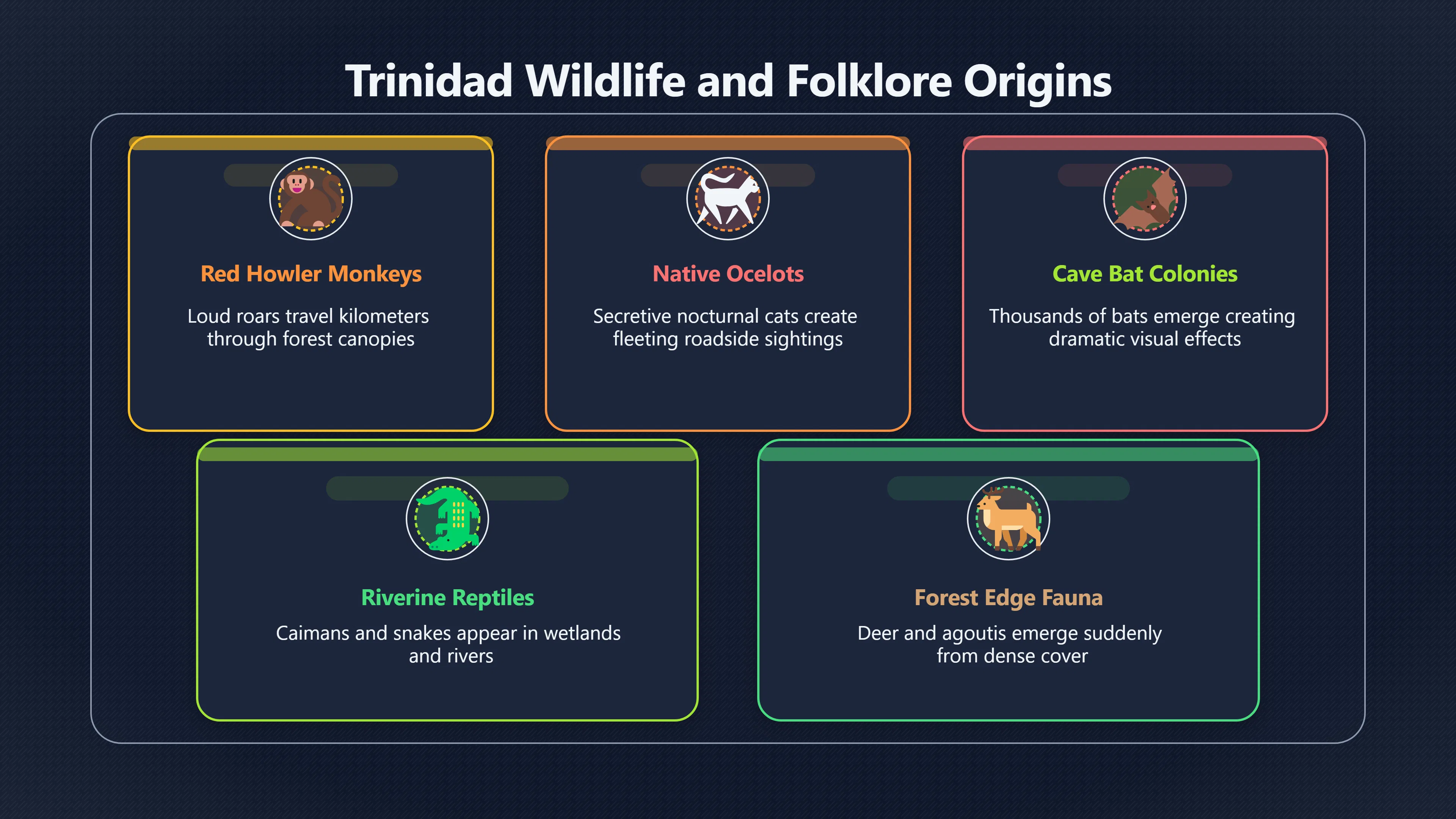
Few creatures in Trinidad are better suited to inspire mystery than the red howler monkey. Its call can travel for several kilometres and is often described by visitors as a deep roar or growl coming from unseen parts of the forest canopy. People hearing it for the first time sometimes assume they are listening to a much larger animal.[chaguaramas.com]chaguaramas.comChaguaramas Fauna AnimalsThe howler monkey call can be heard up to 3 miles (4.8km) away. Primarily a plant and meat eater, the…
Because the monkeys spend much of their time high in trees, a witness may hear the sound without ever seeing its source. In poor weather or fading light, the experience can feel remarkably eerie. Stories about hidden forest beings become easier to understand when one real animal can make an entire valley seem occupied by something enormous.[Chaguaramas]chaguaramas.comChaguaramas Fauna AnimalsThe howler monkey call can be heard up to 3 miles (4.8km) away. Primarily a plant and meat eater, the…
The shadow-cat problem
Trinidad’s only native wild cat is the ocelot. Although not large by international standards, it is secretive, mostly nocturnal and rarely seen clearly. A brief encounter on a roadside or forest path can easily leave a witness uncertain about what they saw.[Instagram]instagram.comOpen source on instagram.com.
Reports of mysterious “jungle panthers” or unusually large cats often appear in many countries where medium-sized wild cats exist. Trinidad’s ocelot provides a straightforward explanation for some local stories involving glowing eyes, silent movement and unexpected feline encounters. A person who catches only a glimpse may remember an animal larger and stranger than it really was.[Instagram]instagram.comOpen source on instagram.com.
When bats become monsters
Trinidad hosts an extraordinary diversity of bats, with roughly seventy species recorded and major cave colonies in places such as Tamana Cave. Large numbers emerging at dusk can create dramatic visual effects, especially for anyone unfamiliar with the behaviour.[Wildlife Worldwide]wildlifeworldwide.comWildlife WorldwideTamana CavesEleven species of bat – out of a total of the 67 species found on Trinidad – live in the caves, including f…
A single bat passing close to a person can appear much larger than it really is because the brain struggles to judge size and distance in darkness. In caves, echoes, fluttering wings and sudden movement can create a powerful sense of presence. Accounts of giant flying creatures do not require a genuinely unknown animal when ordinary bats already provide such unusual experiences.[wildlifeworldwide.com]wildlifeworldwide.comWildlife WorldwideTamana CavesEleven species of bat – out of a total of the 67 species found on Trinidad – live in the caves, including f…

Why Darkness Changes What Witnesses Perceive
Scientists who study perception have long noted that humans are poor at estimating size, distance and speed under low-light conditions. Forest environments amplify these problems.
A few factors are especially important:
- Limited visibility: Dense vegetation often reveals only part of an animal.
- Sound distortion: Valleys, hillsides and forest canopies can make noises seem closer, louder or farther away than they really are.
- Movement bias: The brain tends to focus on motion, filling in missing details from expectation.
- Stress and surprise: Sudden encounters encourage rapid interpretation rather than careful observation.
These effects help explain why a witness may confidently report features that were never actually visible. A dark animal crossing a road can seem much larger than it is. A distant call may appear to come from a nearby creature. A familiar animal seen under unfamiliar conditions can feel entirely unknown.
The same mechanisms appear worldwide in reports of mystery animals, but they are especially relevant in Trinidad because of the island’s dense forests and active nocturnal wildlife.[Wikipedia]WikipediaOpen source on wikipedia.org.
The Role of Rivers, Wetlands and Forest Edges
Not all unusual encounters occur deep in the rainforest. Wetlands, riverbanks and forest edges often generate their own confusion.
Reflections from water can distort the apparent shape of animals. Reptiles such as caimans may reveal only their eyes above the surface. Large snakes are uncommon sightings but memorable ones, particularly because Trinidad supports species including boa constrictors and anacondas. A witness who sees only part of an animal may mentally reconstruct something much larger.[Wikipedia]WikipediaTrinidad and TobagoTrinidad and Tobago
Forest edges are also places where wildlife and people meet most frequently. Deer, agoutis, monkeys and other animals may emerge suddenly from cover before disappearing again. Such fleeting encounters provide exactly the kind of incomplete information from which enduring stories can develop.[Wikipedia]WikipediaBiota of Trinidad and TobagoBiota of Trinidad and Tobago
Why Misidentifications Matter to the Folklore
Explaining an encounter through wildlife does not diminish the cultural importance of the story. In many cases, the opposite is true. Folklore survives because it remains connected to real places and real experiences.
A traveller who hears howler monkeys roaring through a valley can understand why generations of people imagined powerful beings in the forest. Someone emerging from a cave filled with thousands of bats can appreciate how tales of strange winged creatures gained credibility. A glimpse of an ocelot at night shows how easily an ordinary predator can become an extraordinary one in memory.
For Trinidad and Tobago’s monster traditions, wildlife misidentifications are therefore not merely sceptical debunkings. They are part of the mechanism by which legends stay alive. Real animals provide the sounds, shapes and surprises; folklore supplies the meaning. Together they create encounters that feel far stranger than either element would on its own.
Amazon book picks
Further Reading
Books and field guides related to Could Real Wildlife Explain the Monster Stories?. Use these as the next step if you want deeper reading beyond the article.
Abominable Science!
Discusses misidentification and evidence issues in creature reports.
Why Big Fierce Animals are Rare
Explains ecological limits that affect claims of hidden large animals.
eBay marketplace picks
Marketplace Samples
Live-tested eBay searches with available results related to this page.


Endnotes
1.
Source: Wikipedia
Title: Trinidad and Tobago
Link:https://en.wikipedia.org/wiki/Trinidad_and_Tobago
2.
Source: Wikipedia
Link:https://en.wikipedia.org/wiki/Trinidad
3.
Source: Wikipedia
Title: Biota of Trinidad and Tobago
Link:https://en.wikipedia.org/wiki/Biota_of_Trinidad_and_Tobago
4.
Source: chaguaramas.com
Link:https://chaguaramas.com/chaguaramas-fauna-animals
Source snippet
Chaguaramas Fauna AnimalsThe howler monkey call can be heard up to 3 miles (4.8km) away. Primarily a plant and meat eater, the...
5.
Source: facebook.com
Link:https://www.facebook.com/HuntersSearchandRescueTeam/posts/listen-to-the-howler-monkeys-interesting-encounters-biche-while-on-searches-hunt/238109488877583/
Source snippet
LISTEN TO THE HOWLER MONKEYS: INTERESTING...The Howlers are said to be the loudest land animal and can be heard at distances of...
6.
Source: instagram.com
Link:https://www.instagram.com/reel/DZxpoOJgcpi/
7.
Source: facebook.com
Link:https://www.facebook.com/emcgy/posts/caught-in-action-in-the-saxacalli-rainforest-a-red-rumped-agouti%F0%9D%98%8B%F0%9D%98%A2%F0%9D%98%B4%F0%9D%98%BA%F0%9D%98%B1%F0%9D%98%B3%F0%9D%98%B0%F0%9D%98%A4%F0%9D%98%B5%F0%9D%98%A2-%F0%9D%98%AD%F0%9D%98%A6%F0%9D%98%B1%F0%9D%98%B0%F0%9D%98%B3/1347333023849449/
8.
Source: facebook.com
Link:https://www.facebook.com/groups/191766699268/posts/10161079630439269/
9.
Source: facebook.com
Link:https://www.facebook.com/groups/269202760462518/posts/592001278182663/
10.
Source: facebook.com
Link:https://www.facebook.com/groups/191766699268/posts/10160053853204269/
11.
Source: instagram.com
Link:https://www.instagram.com/reel/DVRiTNCgm6E/
12.
Source: instagram.com
Link:https://www.instagram.com/reel/DYaH1PIxc40/
13.
Source: instagram.com
Link:https://www.instagram.com/reel/DOvyalHEmaO/?hl=en
14.
Source: instagram.com
Link:https://www.instagram.com/p/C-Q4V0SuaHl/?hl=en
15.
Source: wildlifeworldwide.com
Link:https://www.wildlifeworldwide.com/locations/tamana-caves
Source snippet
Wildlife WorldwideTamana CavesEleven species of bat – out of a total of the 67 species found on Trinidad – live in the caves, including f...
16.
Source: merlintuttle.org
Title: teresas first cave experience
Link:https://www.merlintuttle.org/teresas-first-cave-experience/
Source snippet
Merlin Tuttle's Bat ConservationTeresa's first cave experience5 May 2016 — My first trip into a major bat cave. Tamana Cave shelters tens...
Published: May 2016
Additional References
17.
Source: sta.uwi.edu
Link:https://sta.uwi.edu/fst/lifesciences/sites/default/files/lifesciences/images/Alouatta%20macconnellii%20-%20Red%20Howler%20Monkey.pdf
Source snippet
America from Bolivia, Peru, Ecuador, Colombia and Venezuela to Trinidad and Tobago.Read more...
18.
Source: youtube.com
Title: Inside Mt. Tamana Bat Cave | 3 Million Bats, Limestone Caves & Hidden History
Link:https://www.youtube.com/watch?v=Zo59oC2s5UU
Source snippet
Papa Bois: The Forest Guardian Trinidad Never Forgot...
19.
Source: youtube.com
Title: Papa Bois: The Forest Guardian Trinidad Never Forgot
Link:https://www.youtube.com/watch?v=xwq76xnfUO4
Source snippet
Wild Animals of Trinidad Part 02 (Red-Romped Agouti)...
20.
Source: youtube.com
Title: Wild Animals of Trinidad Part 01
Link:https://www.youtube.com/watch?v=AnheEqrqBs8
Source snippet
Inside Mt. Tamana Bat Cave | 3 Million Bats, Limestone Caves & Hidden History...
21.
Source: wildliferescuett.org
Link:https://www.wildliferescuett.org/wildlife-guide/
Source snippet
El Socorro Wildlife CenterAmazing Animals of Trinidad & TobagoThe Guyanan red howler (Alouatta macconnelli) is a species of New World mon...
22.
Source: youtube.com
Link:https://www.youtube.com/watch?v=9ObpzeW7WO4
23.
Source: youtube.com
Link:https://www.youtube.com/watch?v=GKndmVrhxOc
24.
Source: budgetpixel.com
Title: ultimate list of mythical creatures from trinidad and tobago folklore
Link:https://budgetpixel.com/blog/ultimate-list-of-mythical-creatures-from-trinidad-and-tobago-folklore
25.
Source: youtube.com
Title: Islands of Survival: Wildlife of the Caribbean | Full Documentary
Link:https://www.youtube.com/watch?v=FTPiRBC_gWs
Source snippet
Wild Animals of Trinidad Part 01...
26.
Source: socialbat.org
Title: Carter Lab The story of “How I almost died in Trinidad”
Link:https://socialbat.org/2013/07/07/the-story-of-how-i-almost-died-in-trinidad/
Topic Tree