Cryptid Reports from Australia's Strange Animal Legends
Australia’s mystery-creature tradition is not one tidy monster story. It is a layered mix of First Nations water beings, colonial newspaper “unknown animal” scares, bush tall tales, vanished real animals, oversized feral-cat reports and tourism folklore.
Page outline Jump by section
Why Australia produces such distinctive monster stories
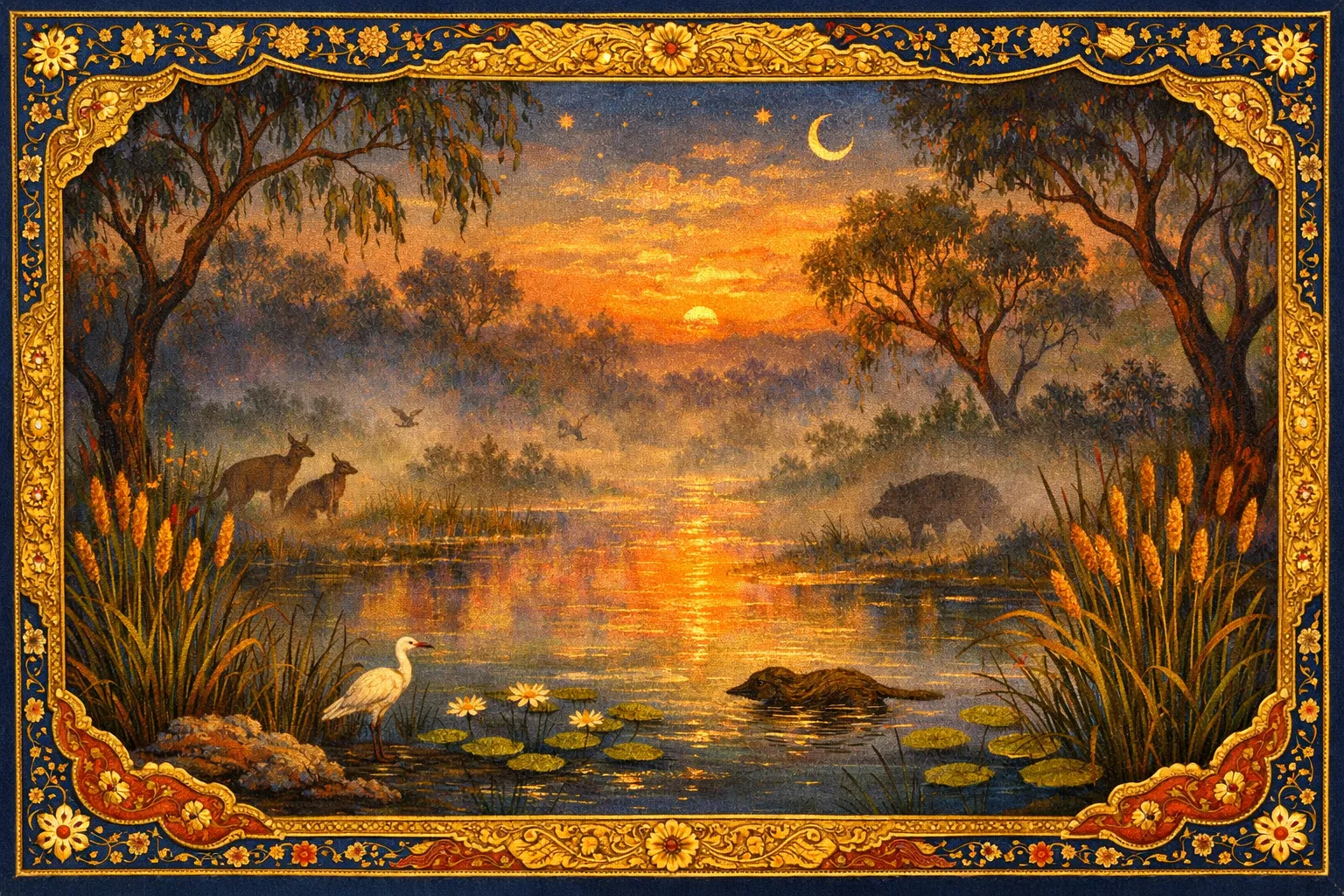
Australia is unusually good territory for mystery-animal legends because its real wildlife already feels strange to outsiders. A continent with platypuses, huge monitors, crocodiles, cassowaries, tree-climbing marsupials and extinct giant wombat relatives leaves room in the imagination for animals that seem half familiar and half impossible. Early European colonists often encountered Indigenous stories through fragmentary translation, then filtered them through their own expectations of dragons, sea serpents, apes and “missing links”. That is one reason Australian cryptid history often has two lives at once: a local or Indigenous story-world on one side, and a colonial newspaper or museum curiosity on the other.[Wikipedia]WikipediaOpen source on wikipedia.org.
The country’s geography also matters. Many reports cluster around places where visibility is poor and interpretation is difficult: billabongs, reed beds, night roads, eucalypt forest, mountain gullies, remote Tasmanian bush and long coastlines. Australia also has a real history of species loss and introduced animals. The thylacine really did exist and was driven to extinction; feral cats really are widespread and ecologically damaging; exotic animals really have been imported, displayed and sometimes lost or released. That does not prove panthers, yowies or surviving thylacines, but it explains why Australian monster stories often feel more biologically possible than pure fantasy.[nma.gov.au]nma.gov.auextinction of thylacineextinction of thylacine
The bunyip: waterhole warning, colonial sensation and national icon
The bunyip is Australia’s best-known water monster: a creature of swamps, lagoons, rivers, billabongs and deep waterholes. In popular retellings it may look like a seal, dog, bird, reptile, starfish-like water being or something too vague to draw. That shapeshifting quality is not a flaw in the legend; it is central to its history. “Bunyip” became an English-language umbrella term for many different Aboriginal water-being traditions, local names and settler rumours, rather than a single creature with a fixed zoological description.[Wikipedia]WikipediaOpen source on wikipedia.org.
The famous colonial moment came in the 1840s. A supposed bunyip skull from the Murrumbidgee River region was displayed at the Australian Museum in Sydney, drawing public attention before experts identified such specimens as deformed foetal skulls of domestic animals rather than an unknown beast. The episode matters because it shows how quickly folklore, science, spectacle and newspaper appetite could fuse. A strange skull became a museum attraction; a museum attraction encouraged more “sightings”; and a local water-being tradition was recast as a possible new species awaiting capture.[Wikipedia]WikipediaOpen source on wikipedia.org.
The bunyip also survives as a public-facing heritage creature. At Murray Bridge in South Australia, the mechanical Bunyip or Mulyawonk attraction has been part of local tourism since 1972, emerging from a river cave to roar at visitors. Tourism sources connect this display with Ngarrindjeri Mulyawonk storytelling, where the river creature functions as a warning about water danger and respect for fish and waterways. The modern attraction is playful, but it points back to a more serious pattern: many water-monster stories teach children not to approach dangerous water, not to overfish, and not to treat Country as merely a resource.[Murray Bridge Council]murraybridge.sa.gov.auMurray Bridge Council The Bunyip | Murray Bridge TourismMurray Bridge Council The Bunyip | Murray Bridge Tourism
Sceptical explanations for bunyip reports are varied because the descriptions are varied. Some may involve seals travelling far up rivers, large eels, crocodile rumours outside crocodile country, booming bittern calls, distorted night sounds, floating logs, decomposed carcasses or simply the colonial habit of turning a warning story into a natural-history puzzle. The sensible reading is not “the bunyip was just one misidentified animal”. It is that the bunyip became a meeting point for Indigenous story, environmental caution, settler fear and the Victorian-era hunt for marvels.[Folklore Thursday]folklorethursday.combunyip australias mysterious man eating swamp beastbunyip australias mysterious man eating swamp beast
The yowie: Australia’s hairy forest giant
The yowie is often described as Australia’s answer to Bigfoot: a large, hairy, humanlike or apelike figure reported in bushland, especially in New South Wales and Queensland. Modern accounts usually involve fleeting sightings on roads or tracks, heavy footfalls, strange vocalisations, snapped branches, foul smells, footprints or the feeling of being watched. Believers treat these signs as traces of an elusive primate-like being; sceptics point to hoaxes, misidentifications, folklore borrowing, unreliable distance judgement in the bush, and the absence of bones, bodies, clear DNA or unambiguous photographs.[ABC News]abc.net.auABC News Why yowie hunters are keen to prove existence of mythicalABC News Why yowie hunters are keen to prove existence of mythical
Historically, the yowie is tangled with words such as “Yahoo”, “hairy man” and “Australian ape”. Nineteenth-century newspapers carried reports of alleged “indigenous apes”, including Henry James McCooey’s 1882 claim that he had seen a tailless, dark-haired animal on the New South Wales south coast between Batemans Bay and Ulladulla. The report was framed in the natural-history language of the period, even including an offer to capture one for the Australian Museum, but it never produced a specimen. That makes it a useful early anchor: not proof, but evidence that Australia’s hairy-man tradition had entered colonial print culture well before the modern Bigfoot boom.[Wikipedia]WikipediaOpen source on wikipedia.org.
Modern yowie culture is sustained by witness archives, podcasts, social-media groups and local “hotspot” reputations. Reports are often said to be strongest in forested eastern Australia, with the Blue Mountains, the Gold Coast hinterland, the Sunshine Coast hinterland and parts of rural New South Wales appearing repeatedly in popular accounts. A 2024 newspaper summary of yowie claims, drawing on Australian Yowie Research figures, reported that its sighting database was dominated by New South Wales and Queensland, with Victoria a smaller but active reporting region. Such figures are not scientific population data, but they show how the legend maps itself onto the eastern bush rather than the open desert.[Herald Sun]heraldsun.com.auHerald Sun Where Victorians claim to have seen 'freaking huge' yowiesHerald Sun Where Victorians claim to have seen 'freaking huge' yowies
The biggest problem for the yowie as a zoological claim is ecological. Australia has no known native non-human apes, and a breeding population of large primate-like animals would need food, habitat, genetic diversity and physical traces. The longer the claim continues without a body, fossil, roadkill, verified DNA sample or clear trail-camera evidence, the more likely it becomes that the yowie is a folklore-and-misidentification complex rather than an undiscovered animal. Yet as a legend, it remains powerful because it gives the Australian bush a watcher: something almost human, just beyond the firelight, hard to prove and harder to forget.[Skeptical Inquirer]skepticalinquirer.orgOpen source on skepticalinquirer.org.
The thylacine: the real animal that became a cryptid
The thylacine is different from most cryptids because it was a documented animal. The Tasmanian tiger was the largest carnivorous marsupial of recent times, once present in Australia and New Guinea, and later surviving in Tasmania. The Australian Museum states that it disappeared from mainland Australia at least 2,000 years ago, probably under pressure from dingoes and humans, while its Tasmanian extinction was hastened mainly by direct human persecution as an alleged pest.[The Australian Museum]australian.museumThe Australian Museum ThylacineThe Australian Museum Thylacine
The last known captive thylacine died at Hobart Zoo in September 1936, and the National Museum of Australia notes that the last known shooting of a wild thylacine occurred in 1930, with wild sightings already extremely rare by the middle of that decade. Its extinction became official later, but the cultural wound remained open: the animal was photographed, filmed and remembered within living memory, then apparently gone. That makes every later sighting more emotionally charged than a normal monster report.[National Museum of Australia]nma.gov.auextinction of thylacineextinction of thylacine
Post-1936 sightings have been reported for decades, mostly from Tasmania but also from mainland Australia. A 2023 scientific study compiled later possible sightings and used uncertainty modelling to ask when and where the thylacine most likely vanished. The authors argued that, contrary to the simplest 1936 cut-off, the species may have persisted in remote Tasmania until later in the twentieth century, perhaps into the 1980s. That is not the same as proving it survives today. It does, however, make the thylacine a rare cryptid case where some late sightings may reflect a real remnant population shortly after official disappearance.[ScienceDirect]sciencedirect.comOpen source on sciencedirect.com.
The thylacine’s cryptid afterlife is now shaped by trail cameras, documentaries, de-extinction projects and social media claims. Recent media continue to cover searchers who believe they have filmed or glimpsed the animal, while mainstream museums and conservation sources still treat the species as extinct. The fairest position is careful: historical thylacines are fact; extinction through human action is fact; some post-1936 sightings may be worth historical analysis; but no current evidence has established a living thylacine population.[Herald Sun]heraldsun.com.auOpen source on com.au.
Phantom big cats: panthers in the Blue Mountains and beyond
Australia’s phantom-cat tradition is one of its most persistent modern mystery-animal stories. Witnesses report large black or tan cats, often described as panthers or pumas, crossing roads, stalking paddocks or leaving oversized prints. The best-known cluster is the Blue Mountains, Hawkesbury and Lithgow region west of Sydney, where the “Lithgow panther” or “Blue Mountains panther” has generated hundreds of reports, local investigations and repeated media coverage.[ABC News]abc.net.aucould the lithgow panther actually existcould the lithgow panther actually exist
This case is more complicated than a simple campfire tale because government-commissioned reviews have taken it seriously enough to examine witness statements, photographs, tracks and alleged scat or hair. A 2013 NSW Department of Primary Industries review described the Hawkesbury area as a recent “hot-spot” for large-cat reports, but concluded that the evidence did not demonstrate a free-ranging population of big cats. Earlier interpretations were more open to the possibility, which is one reason the legend has acquired a secondary story about official reluctance, amended reports and local frustration.[NSW DPI]dpi.nsw.gov.auOpen source on nsw.gov.au.
The main explanations fall into four groups. First, large feral domestic cats are real in Australia, and feral cats are widespread enough to provide a plausible source for many “black panther” sightings, especially at distance or in poor light. Second, dogs, foxes, shadows, perspective errors and brief road encounters can distort size. Third, a few individual exotic cats could historically have escaped from private owners, circuses or wildlife collections, though that is different from proving a breeding population. Fourth, some reports may be hoaxes or embellished stories that grow as they circulate.[sciencedirect.com]sciencedirect.comOpen source on sciencedirect.com.
The big-cat legend remains compelling because it sits close to ecological reality. Australia does have introduced predators. Feral cats do kill huge numbers of native animals and are recognised by the Australian Government as a major threat to native species. The mystery is whether any reports require something larger than an unusually big feral cat. So far, the answer from official evidence reviews is cautious: interesting reports, no conclusive panther.[DCCEEW]dcceew.gov.auferal catsferal cats
Sea serpents, coast monsters and the problem of seeing at water level
Australia’s sea-serpent material is less nationally iconic than the bunyip or yowie, but coastal and maritime monster reports appear in historic newspapers. Trove records, for example, show Australian papers discussing sea-serpent claims as part of a wider nineteenth- and early twentieth-century debate over whether long-necked or serpentine marine animals might still be unknown to science. These reports sat in an international tradition, not a uniquely Australian one, but Australia’s long coastline gave local newspapers plenty of room to reprint, adapt and localise the theme.[Trove]trove.nla.gov.auOpen source on nla.gov.au.
One Queensland example sometimes mentioned in local legend is the Moha Moha or Hervey Bay sea monster, associated with accounts from the Fraser Coast and Sandy Cape area. Recent regional reporting treats it as part of Queensland’s monster folklore rather than established zoology, alongside bunyips, yowies and black-cat claims. The important point is that sea-monster reports usually arise under difficult viewing conditions: floating carcasses, whales, large rays, oarfish-like forms, seals, crocodiles in northern waters, wave patterns and multiple animals surfacing in a line can all create a creature that seems longer or stranger than it is.[The Courier-Mail]couriermail.com.auOpen source on com.au.
Sea-serpent stories also changed as science changed. Research on nineteenth-century sea-serpent reports argues that fossil discoveries of ancient marine reptiles influenced how people imagined and described sea monsters, with long necks and plesiosaur-like shapes becoming more culturally available. In Australia, that matters because newspapers were part of a global print network: a sailor’s sighting off one coast could be interpreted through museum fossils, popular science columns and imported monster imagery.[St Andrews News]news.st-andrews.ac.ukSt Andrews News Sea serpent sightings influenced by ancient marine reptileSt Andrews News Sea serpent sightings influenced by ancient marine reptile
Drop bears and hoaxes: when the monster is the joke
The drop bear is not a serious zoological claim. It is a comic Australian hoax about a predatory koala-like animal that drops from trees onto unsuspecting walkers, especially tourists. Its role in Australian cryptid culture is still important because it shows how monster folklore can function as social play: locals test outsiders, exaggerate the dangers of the bush, and turn Australia’s already fearsome wildlife reputation into a joke.[ABC News]abc.net.auABC News Where did the urban legend of the dangerous AustralianABC News Where did the urban legend of the dangerous Australian
The Australian Museum has leaned into the joke with a mock-serious “Drop Bear” fact file, complete with a pseudo-scientific name and fabricated behavioural details. Australian Geographic has also published April Fools’ drop-bear material, including claims about tourists being more at risk. These pieces work because readers recognise the format of real natural-history writing while also sensing the absurdity. The drop bear is a hoax, but it is a revealing hoax: it depends on Australia’s global image as a place where the animals might genuinely be trying to kill you.[The Australian Museum]australian.museumdrop beardrop bear
Unlike the bunyip or some yowie traditions, the drop bear does not need respectful handling as a sacred or local cultural being. Its modern identity is prank folklore. It belongs near jackalopes, hoop snakes and other tall-tale animals: creatures everyone “knows” about, nobody can produce, and many people enjoy explaining with a straight face.[Wikipedia]WikipediaDrop bearDrop bear

What counts as evidence in Australian cryptid cases?
Australian cryptid claims tend to offer four kinds of evidence: witness testimony, old newspaper reports, physical traces and cultural continuity. Each can be valuable, but none is automatically proof of an unknown animal. A witness may be honest and still misjudge size, distance or species. A newspaper may preserve an early report while also exaggerating it. A footprint may be a dog, kangaroo, wombat, human carving, eroded track or enlarged domestic-cat print. A story may be ancient and meaningful without being a literal animal field guide.[NSW DPI]dpi.nsw.gov.auOpen source on nsw.gov.au.
The strongest evidence for a hidden animal would be physical and repeatable: a body, bones, verified DNA, clear photographs from multiple angles, reliable trail-camera sequences, or ecological signs that independent experts can examine. This is why the thylacine sits in a special category. Its historical evidence is overwhelming because specimens, photographs and film exist; its modern survival evidence remains unconfirmed because no comparable contemporary proof has appeared.[The Australian Museum]australian.museumThe Australian Museum ThylacineThe Australian Museum Thylacine
The same standard weakens the yowie and panther cases. Yowie reports are numerous but lack decisive biological evidence. Big-cat reports are more biologically plausible because introduced cats exist and exotic cats have been present in captivity, but the evidence still has to distinguish a panther or puma from a large feral domestic cat. Government and scientific reviews have generally landed on “not proven”, even when they treat some reports as sincere or interesting.[abc.net.au]abc.net.auABC News Why yowie hunters are keen to prove existence of mythicalABC News Why yowie hunters are keen to prove existence of mythical
How the legends keep changing
Australian monster stories do not stay frozen. The bunyip moved from local water-being traditions into colonial museums, children’s books, tourist attractions and environmental caution. The yowie moved from “Yahoo” and “hairy man” tales into Bigfoot-style witness databases and night-vision investigations. The thylacine moved from hunted animal to extinction icon to cryptid to candidate for controversial de-extinction research. Phantom cats moved from rural rumour to official reviews, viral videos and social-media mapping. The drop bear moved from prank to institutional parody.[sa.gov.au]murraybridge.sa.gov.auMurray Bridge Council The Bunyip | Murray Bridge TourismMurray Bridge Council The Bunyip | Murray Bridge Tourism
That change is part of the subject, not a distraction from it. Cryptids survive when they can adapt to new media and new anxieties. In nineteenth-century Australia, the question was often “what unknown animals might this continent contain?” In the twentieth century, it became “what have we lost, and could it still be hiding?” In the twenty-first century, it is often “why, when everyone carries a camera, do the pictures remain blurry?” Each era gets the monster it is prepared to see.[wikipedia.org]WikipediaOpen source on wikipedia.org.
The clearest way to read Australia’s cryptids
Australia’s cryptids are best understood as a spectrum. At one end are deliberate jokes, such as the drop bear. At the other is the thylacine, a real extinct animal whose possible late survival can be studied historically, even if present-day survival remains unproven. Between them sit the bunyip, yowie, phantom cats and sea serpents: stories built from folklore, landscape, witness experience, media repetition and occasional plausible animal confusion.[wikipedia.org]WikipediaDrop bearDrop bear
The most rewarding approach is neither gullible nor dismissive. The bunyip should not be flattened into “just a seal”, because that ignores its cultural and environmental role. The yowie should not be treated as confirmed wildlife, because the biological evidence is missing. The Lithgow panther should not be mocked away, because large feral cats and sincere reports exist; but it should not be upgraded into a breeding panther population without conclusive proof. The thylacine should be mourned as a real extinction before it is chased as a mystery.[themurrayriver.com]themurrayriver.comOpen source on themurrayriver.com.
That balance is what makes Australia such a rich country for cryptid history. Its monsters are not simply things people claim to have seen. They are ways of talking about dangerous water, deep bush, colonial misunderstanding, ecological damage, species loss and national humour. The creatures may remain unproven, extinct, misidentified or invented, but the stories themselves are very real parts of Australia’s cultural landscape.
Amazon book picks
Further Reading
Books and field guides related to What Lurks in Australia's Strange Animal Legends?. Use these as the next step if you want deeper reading beyond the article.
Field Guide To Bigfoot, Yeti, & Other Mystery Primates Worldwide
Covers mystery-creature traditions and provides context for Australian legends.
eBay marketplace picks
Marketplace Samples
Live-tested eBay searches with available results related to this page.


Endnotes
1.
Source: australian.museum
Title: The Australian Museum Thylacine
Link:https://australian.museum/learn/australia-over-time/extinct-animals/the-thylacine/
2.
Source: dpi.nsw.gov.au
Link:https://www.dpi.nsw.gov.au/__data/assets/pdf_file/0011/477992/large-free-ranging-felines-in-new-south-wales-a-review.pdf
3.
Source: Wikipedia
Link:https://en.wikipedia.org/wiki/Bunyip
4.
Source: dcceew.gov.au
Title: feral cats
Link:https://www.dcceew.gov.au/environment/invasive-species/feral-animals-australia/feral-cats
5.
Source: Wikipedia
Link:https://en.wikipedia.org/wiki/Yowie
6.
Source: Wikipedia
Link:https://en.wikipedia.org/wiki/Thylacine
7.
Source: sciencedirect.com
Link:https://www.sciencedirect.com/science/article/pii/S0048969723014948
8.
Source: sciencedirect.com
Link:https://www.sciencedirect.com/science/article/abs/pii/S0006320716309223
9.
Source: Wikipedia
Title: Drop bear
Link:https://en.wikipedia.org/wiki/Drop_bear
10.
Source: australian.museum
Title: drop bear
Link:https://australian.museum/learn/animals/mammals/drop-bear/
11.
Source: Wikipedia
Link:https://en.wikipedia.org/wiki/Australia
12.
Source: Wikipedia
Link:https://en.wikipedia.org/wiki/Diprotodon
13.
Source: Wikipedia
Title: List of cryptids
Link:https://en.wikipedia.org/wiki/List_of_cryptids
14.
Source: Wikipedia
Title: National Party of Australia
Link:https://en.wikipedia.org/wiki/National_Party_of_Australia
15.
Source: Wikipedia
Title: Australian Town and Country Journal
Link:https://en.wikipedia.org/wiki/Australian_Town_and_Country_Journal
16.
Source: Wikipedia
Title: Blue Mountains panther
Link:https://en.wikipedia.org/wiki/Blue_Mountains_panther
17.
Source: Wikipedia
Title: Cats in Australia
Link:https://en.wikipedia.org/wiki/Cats_in_Australia
18.
Source: australian.museum
Link:https://australian.museum/publications/birds-storybox/first-nations-storytelling/
19.
Source: australian.museum
Link:https://australian.museum/learn/science/
20.
Source: australian.museum
Title: feral cats on list as new zealand toughens conservation
Link:https://australian.museum/aap/feral-cats-on-list-as-new-zealand-toughens-conservation/
21.
Source: newspapers.com
Link:https://www.newspapers.com/paper/the-australian-town-and-country-journal/33233/?locale=en-GB
22.
Source: youtube.com
Link:http://www.youtube.com/watch?v=q9NcMr027BM
Source snippet
The hunt for Australia's mythical half-ape, half-human, the Yowie (1976) | RetroFocus...
23.
Source: nma.gov.au
Link:https://www.nma.gov.au/whats-on/fairfax-discovery-centre/expansion/bunyips-and-billabongs
24.
Source: nma.gov.au
Title: extinction of thylacine
Link:https://www.nma.gov.au/defining-moments/resources/extinction-of-thylacine
25.
Source: abc.net.au
Title: could the lithgow panther actually exist
Link:https://www.abc.net.au/news/2018-06-13/could-the-lithgow-panther-actually-exist/9116232
26.
Source: murraybridge.sa.gov.au
Title: Murray Bridge Council The Bunyip | Murray Bridge Tourism
Link:https://www.murraybridge.sa.gov.au/tourism/things-to-see-and-do/family-activities-and-attractions/bunyip
27.
Source: themurrayriver.com
Link:https://www.themurrayriver.com/listings/bertha-the-bunyip/
28.
Source: folklorethursday.com
Title: bunyip australias mysterious man eating swamp beast
Link:https://folklorethursday.com/legends/bunyip-australias-mysterious-man-eating-swamp-beast/
29.
Source: abc.net.au
Title: ABC News Why yowie hunters are keen to prove existence of mythical
Link:https://www.abc.net.au/news/2018-11-03/why-yowie-hunters-keen-to-prove-mythical-beasts-existence/10391712
30.
Source: skepticalinquirer.org
Link:https://skepticalinquirer.org/2016/05/searching-for-the-yowie-the-down-under-bigfoot/
31.
Source: heraldsun.com.au
Title: Herald Sun Where Victorians claim to have seen ‘freaking huge’ yowies
Link:https://www.heraldsun.com.au/news/victoria/see-interactive-map-of-where-victorians-claim-to-have-had-incredible-encounters-with-yowies/news-story/45a708c341bbf7faa27a6664aeae31d0
32.
Source: couriermail.com.au
Link:https://www.couriermail.com.au/news/queensland/bundaberg/urban-myths-and-legends-of-qld-to-keep-you-up-at-night/news-story/5b0e89aa89c2537f0de3e84c53ba9d8f
33.
Source: heraldsun.com.au
Link:https://www.heraldsun.com.au/news/tasmania/mystery-sightings-and-a-man-who-wont-give-up-quest-for-the-thylacine-comes-to-the-big-screen/news-story/1b21d83c2083c4445f283ce2fb00dc01
34.
Source: trove.nla.gov.au
Link:https://trove.nla.gov.au/newspaper/article/11066057
35.
Source: trove.nla.gov.au
Link:https://trove.nla.gov.au/newspaper/article/17065362
36.
Source: news.st-andrews.ac.uk
Title: St Andrews News Sea serpent sightings influenced by ancient marine reptile
Link:https://news.st-andrews.ac.uk/archive/sea-serpent-sightings-influenced-by-ancient-marine-reptile-fossil-finds/
37.
Source: abc.net.au
Title: ABC News Where did the urban legend of the dangerous Australian
Link:https://www.abc.net.au/news/2020-01-18/where-did-the-drop-bear-myth-originate/11874020
38.
Source: cryptidz.fandom.com
Link:https://cryptidz.fandom.com/wiki/Australia
39.
Source: cryptidz.fandom.com
Link:https://cryptidz.fandom.com/wiki/Bunyip
40.
Source: non-aliencreatures.fandom.com
Link:https://non-aliencreatures.fandom.com/wiki/Bunyip
41.
Source: mythus.fandom.com
Link:https://mythus.fandom.com/wiki/Yowie
42.
Source: cryptidz.fandom.com
Title: Blue Mountains Panther
Link:https://cryptidz.fandom.com/wiki/Blue_Mountains_Panther
43.
Source: learnearnandreturn.wordpress.com
Link:https://learnearnandreturn.wordpress.com/2011/04/25/bunyips/
44.
Source: darrahsteffenwrites.wordpress.com
Link:https://darrahsteffenwrites.wordpress.com/2021/07/19/bunyip/
45.
Source: trove.nla.gov.au
Link:https://trove.nla.gov.au/newspaper/title/52
46.
Source: trove.nla.gov.au
Link:https://trove.nla.gov.au/newspaper/article/34238514
47.
Source: trove.nla.gov.au
Link:https://trove.nla.gov.au/newspaper/article/89617148
49.
Source: youtube.com
Title: Drop Bears
Link:https://www.youtube.com/watch?v=302JxDodT9U
50.
Source: mdba.gov.au
Title: river monster keeps first nations message alive
Link:https://www.mdba.gov.au/news-and-events/newsroom/river-monster-keeps-first-nations-message-alive
51.
Source: abc.net.au
Title: the real story behind australias urban legends
Link:https://www.abc.net.au/news/2021-08-01/the-real-story-behind-australias-urban-legends/100332654
52.
Source: abc.net.au
Title: The Hunt
Link:https://www.abc.net.au/contentsales/programsandgenres/hunt/13883770
53.
Source: nma.gov.au
Link:https://www.nma.gov.au/about/publications/the-bunyip-and-the-stars
54.
Source: nma.gov.au
Title: finding thylacine
Link:https://www.nma.gov.au/explore/blog/finding-thylacine
55.
Source: samuseum.sa.gov.au
Link:https://www.samuseum.sa.gov.au/
56.
Source: abcnews.com
Link:https://abcnews.com/International/sightings-tasmanian-tiger-thought-extinct-80-years-reported/story?id=66345508
57.
Source: caliber.az
Title: Drop bear
Link:https://caliber.az/en/post/drop-bear-australia-s-favorite-fictional-creature-to-trick-unwary-tourists
58.
Source: naa.gov.au
Link:https://www.naa.gov.au/
59.
Source: visit.museum.wa.gov.au
Title: wa and uk researchers discover new species extinct australian mammal
Link:https://visit.museum.wa.gov.au/learn/news-stories/wa-and-uk-researchers-discover-new-species-extinct-australian-mammal
60.
Source: library.gov.au
Title: australian newspapers research guide
Link:https://www.library.gov.au/research/research-guides-0/australian-newspapers-research-guide
61.
Source: federation.gov.au
Link:https://federation.gov.au/national-cabinet
Additional References
62.
Source: news.com.au
Link:https://www.news.com.au/technology/science/animals/big-cat-expert-reveals-truth-behind-viral-panther-footage/news-story/effff50e19177f17f12bb3f8a53c3417
Source snippet
Historian Dr. David Waldron and multiple government reports have acknowledged the plausibility of large feline predators in the wild, tho...
63.
Source: youtube.com
Link:http://www.youtube.com/watch?v=baO8K1Fsaxw
Source snippet
The Bunyip Australian folklore explanation Bunyip - The Fearsome Monster of the Australian Billabongs See U in History / Mythology...
64.
Source: youtube.com
Link:http://www.youtube.com/watch?v=R1xQH4vO_nY
Source snippet
Why We're Not Sure How (And If) the Tasmanian Tiger Went Extinct...
65.
Source: youtube.com
Title: The Drop Bear: Australia’s Deadliest Myth
Link:http://www.youtube.com/watch?v=Yoy0ntdnl-s
Source snippet
Secrets of the Tasmanian Tiger (Full Episode) | Lost Beasts Unearthed | Nat Geo Animals...
66.
Source: youtube.com
Title: Why We’re Not Sure How (And If) the Tasmanian Tiger Went Extinct
Link:http://www.youtube.com/watch?v=jXYyMFUKpIs
Source snippet
The Drop Bear: Australia's Deadliest Myth...
67.
Source: facebook.com
Link:https://www.facebook.com/abcnews.au/videos/giant-cat-spotted-on-cctv/869741711066336/
68.
Source: recentlyextinctspecies.com
Link:https://recentlyextinctspecies.com/thylacine-archive/a-catalogue-system-for-thylacine-sighting-reports
69.
Source: reddit.com
Link:https://www.reddit.com/r/Naturewasmetal/comments/ipy2u3/a_thylacine_tasmanian_tiger_reconstruction/
70.
Source: reddit.com
Link:https://www.reddit.com/r/AskAnAustralian/comments/1gu7dcm/australian_cryptids/
71.
Source: australianhumanitiesreview.org
Link:https://australianhumanitiesreview.org/2018/12/02/the-bunyip-as-uncanny-rupture-fabulous-animals-innocuous-quadrupeds-and-the-australian-anthropocene/
Topic Tree
Follow this branch
Related pages 192
- Antigua Cryptids
- Maldives Monsters
- Malta Monsters
- Qatar Monsters
- Argentina Monsters
- +187 more in sidebar