Within Guatemala Monsters
When Night Roads Become Monster Country
Guatemala's dog spirits and livestock scares show how ordinary night roads, corrals and predators can become monster stories.
On this page
- El Cadejo as protector and menace
- Chupacabras as a label for livestock deaths
- Dogs, predators and fear after dark
Page outline Jump by section
Introduction
In Guatemala, some of the most persistent creature stories do not come from deep forests or remote lakes. They come from the places people actually travel after dark: dirt roads, village lanes, railway tracks, cattle pastures and livestock corrals. Two figures dominate these night-time scares. One is the Cadejo, a supernatural dog spirit said to follow travellers on lonely roads. The other is the Chupacabras, a modern monster label attached to unexplained livestock deaths. Together they show how ordinary dangers—stray dogs, predators, darkness, alcohol, fear and uncertainty about what killed an animal—can become memorable monster stories. At the same time, these legends reveal genuine concerns in rural Guatemala about personal safety, lost travellers and protecting valuable livestock.[Wikipedia]WikipediaOpen source on wikipedia.org.
When Night Roads Become Monster Country
Guatemalan creature folklore often centres on movement through the landscape rather than hidden wilderness. Traditional accounts place the Cadejo on roads, paths and routes used by people returning home late at night. The creature is usually described as a large dog-like being with glowing eyes that appears behind travellers and silently follows them. In many versions there are two Cadejos: a protective white one and a dangerous black one. The details vary from region to region, but the basic setting remains remarkably consistent—people alone after dark, uncertain of what may be following them.[Wikipedia]WikipediaOpen source on wikipedia.org.
This setting matters. Before modern lighting, many rural journeys involved genuine risks. Travellers could become lost, robbed, injured or attacked by animals. A mysterious shape on a road at night required explanation. The Cadejo provided one.
Unlike many monster traditions, the Cadejo is not always an enemy. In parts of Guatemala it functions almost like a supernatural escort, protecting vulnerable travellers and especially those who have drunk too much to travel safely. Stories describe it guiding people home or preventing them from falling into greater danger. Other versions portray a darker counterpart that seeks to frighten, mislead or harm those who wander at night.[Wikipedia]WikipediaOpen source on wikipedia.org.
El Cadejo as Protector and Menace
The most interesting feature of the Cadejo tradition is its ambiguity. Many monster stories draw a simple line between good and evil. The Cadejo often blurs it.
In the version most widely known across Guatemala and neighbouring countries:
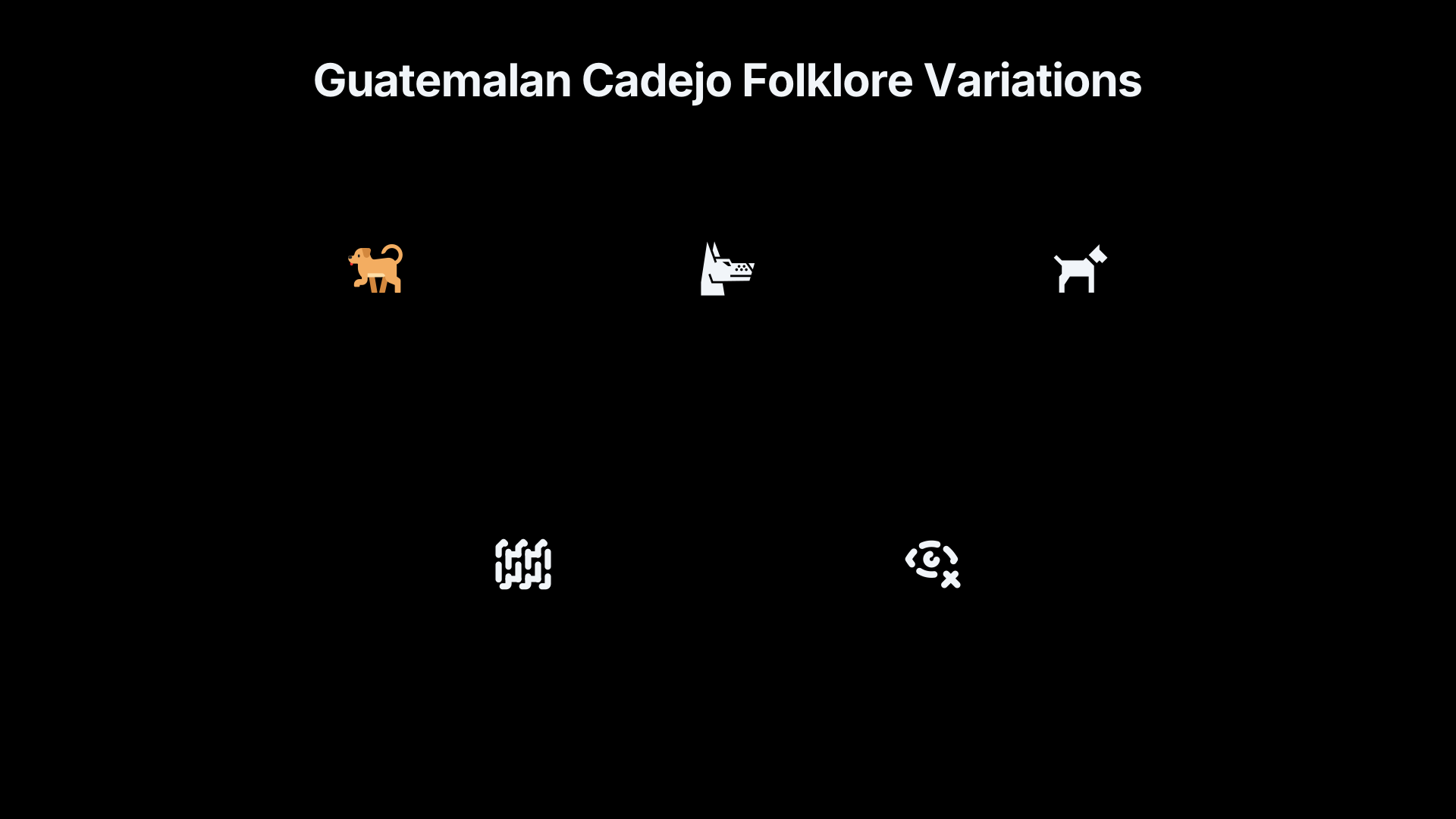
- The white Cadejo protects travellers.[cryptidz.fandom.com]cryptidz.fandom.comEl CadejoCadejo | Cryptid Wiki - FandomThere is a good white cadejo and an evil black cadejo. Both are spirits that appear at night to travelers… * The black Cadejo threatens or tempts them.[cryptidz.fandom.com]cryptidz.fandom.comEl CadejoCadejo | Cryptid Wiki - FandomThere is a good white cadejo and an evil black cadejo. Both are spirits that appear at night to travelers…
- Both appear primarily on lonely roads after dark.
- Encounters often happen when someone is tired, intoxicated or travelling alone.[Wikipedia]WikipediaOpen source on wikipedia.org.
Some Guatemalan traditions even reverse these roles, portraying the dark dog as the true protector and the white one as the deceiver. That reversal turns the legend into a moral lesson about appearances and misplaced trust.[Wikipedia]WikipediaOpen source on wikipedia.org.
The folklore also serves a practical social purpose. Parents and elders could use Cadejo stories to discourage dangerous night-time wandering, excessive drinking or travelling alone. A frightening supernatural dog was easier to remember than a lecture about road safety.
Many reported encounters share features familiar from ordinary night-time perception. Witnesses describe glowing eyes, large silhouettes, heavy breathing, hoof-like sounds or a feeling of being followed. Such experiences can arise when visibility is poor and the brain struggles to identify an animal or object in darkness. Real dogs, shadows and unfamiliar sounds become easier to interpret through the lens of an existing legend.[Wikipedia]WikipediaOpen source on wikipedia.org.
Why Dog Spirits Feel Plausible After Dark
The Cadejo remains believable to many listeners because it is built from familiar elements rather than impossible ones. Guatemala has abundant domestic dogs, free-roaming village dogs and wild carnivores in some regions. A large animal glimpsed briefly on a dark road does not need to be extraordinary to feel threatening.[Rainforest Trust]rainforesttrust.orgRainforest TrustCritical Protection for Mesoamerican WildlifeIn a Central American region known for high biodiversity, Guatemala's wild e…
Several factors help transform ordinary encounters into supernatural stories:
Limited visibility. At night, size and distance are notoriously difficult to judge.
Expectation. Someone who already knows the Cadejo legend may interpret an unusual sighting through that framework.
Isolation. People travelling alone are more likely to focus on ambiguous sounds and movements.
Memory. Stories often become more dramatic when retold over years or generations.
The result is a legend that survives not because people constantly see the same creature, but because the experience it explains—feeling watched on a dark road—is nearly universal.
Chupacabras as a Label for Livestock Deaths
If the Cadejo belongs to roads and travellers, the Chupacabras belongs to corrals and livestock pens.
Unlike the Cadejo, the Chupacabras is not an old Guatemalan folk spirit. The modern legend emerged in Puerto Rico during the mid-1990s and spread rapidly across Latin America through newspapers, television and word of mouth. Reports focused on goats, chickens, sheep and other animals found dead under unusual circumstances. Witnesses often claimed the bodies showed puncture wounds and little obvious blood loss, leading to stories of a mysterious predator that drank blood.[Wikipedia]Wikipedianimal carcasses. Chupacabra…
As the story spread through Central America, “chupacabras” became less a description of a specific creature and more a label for unexplained livestock deaths. When farmers found animals dead without a clear culprit, the name was readily available.
In Guatemala, the legend gained traction because livestock losses are economically important. A missing goat or dead calf is not merely a curiosity. It affects household income and food security. When evidence at a kill site is incomplete, rumours can spread quickly.
What Usually Lies Behind the Scares?
The most convincing explanations for alleged Chupacabras incidents generally involve ordinary causes rather than unknown creatures.
Common explanations include:
- Attacks by dogs or packs of dogs.
- Coyotes and other natural predators.
- Scavenging that alters carcasses after death.
- Disease and parasites.
- Misinterpretation of wounds caused by known animals.
- Exaggerated or inaccurate retellings of events.[Wikipedia]Wikipedianimal carcasses. Chupacabra…
A recurring feature of Chupacabras reports is the belief that animals were completely drained of blood. Veterinary investigations in many countries have repeatedly noted that carcasses often retain blood internally even when witnesses assume otherwise. Blood can pool inside the body, seep into the ground or become less visible after scavenging, creating the impression of a bloodless corpse when no supernatural explanation is required.[Wikipedia]Wikipedianimal carcasses. Chupacabra…
The legend thrives because the aftermath of a predator attack can be confusing. Farmers usually discover the scene hours later. Tracks may be disturbed. Scavengers may already have fed on the carcass. What remains is a puzzle, and monster stories are one possible answer.
Dogs, Predators and Fear After Dark
The Cadejo and the Chupacabras appear very different, but they often emerge from the same underlying conditions.
Both flourish where people encounter uncertainty after sunset. The Cadejo explains the feeling of being followed on a lonely road. The Chupacabras explains the mystery of a dead animal discovered at dawn. Neither story requires remote wilderness. A village lane, railway embankment or cattle pen can be enough.
The overlap becomes especially clear in rural communities where free-roaming dogs are common. A large dog seen near livestock one night may become part of a predator story. A frightening encounter on a road may become part of a Cadejo story. The same animal can inspire very different interpretations depending on the circumstances.
This helps explain why these legends endure even as modern communications spread sceptical explanations. They are not simply stories about monsters. They are stories about vulnerability: walking home alone, protecting livestock, travelling in darkness and trying to understand events that happen beyond the reach of easy observation.
Why These Legends Persist in Guatemala
The enduring popularity of both legends says less about unknown creatures than about how communities interpret risk.
The Cadejo survives because it turns ordinary night-time anxiety into a memorable character. It gives shape to fears about isolation, temptation and personal safety. The Chupacabras survives because livestock deaths are real events that demand explanations, and unexplained losses naturally attract dramatic narratives.[Wikipedia]WikipediaOpen source on wikipedia.org.
Together they form a distinctive part of Guatemala’s creature tradition. Rather than inhabiting distant wilderness, these night beasts occupy everyday spaces: roads, alleys, farms and corrals. Their stories remind us that monster folklore often grows strongest not where people know the least, but where uncertainty meets something familiar—a dog in the darkness, a dead animal in a field, or the unsettling feeling that something is following just out of sight.[Wikipedia]WikipediaOpen source on wikipedia.org.

Amazon book picks
Further Reading
Books and field guides related to When Night Roads Become Monster Country. Use these as the next step if you want deeper reading beyond the article.
Tracking the Chupacabra
Directly addresses one of the page's central monster traditions.
The Encyclopedia of Vampires, Werewolves, and Other Monsters
Covers creature traditions comparable to the Cadejo and Chupacabras.
The Book of Imaginary Beings
Broadens interest from local legends to world folklore creatures.
Endnotes
1.
Source: Wikipedia
Link:https://en.wikipedia.org/wiki/Cadejo
2.
Source: Wikipedia
Link:https://en.wikipedia.org/wiki/Chupacabra
Source snippet
nimal carcasses. Chupacabra...
3.
Source: Wikipedia
Link:https://es.wikipedia.org/wiki/Cadejo
4.
Source: Wikipedia
Title: El (deity)
Link:https://en.wikipedia.org/wiki/El_%28deity%29
Source snippet
El (deity)El is often described as the father of the gods and the creator of humanity. El had many epithets, including "Bull El," "El...
5.
Source: rainforesttrust.org
Link:https://www.rainforesttrust.org/urgent-projects/critical-protection-for-mesoamerican-wildlife/
Source snippet
Rainforest TrustCritical Protection for Mesoamerican WildlifeIn a Central American region known for high biodiversity, Guatemala's wild e...
6.
Source: cryptidz.fandom.com
Title: El Cadejo
Link:https://cryptidz.fandom.com/wiki/El_Cadejo
Source snippet
Cadejo | Cryptid Wiki - FandomThere is a good white cadejo and an evil black cadejo. Both are spirits that appear at night to travelers...
7.
Source: monster.fandom.com
Link:https://monster.fandom.com/wiki/Cadejo
Source snippet
Monster Wiki - FandomEl Cadejo is a legendary animal from the Mesoamerican region, being well known in rural and even urban areas of Mexi...
8.
Source: mythus.fandom.com
Link:https://mythus.fandom.com/wiki/Cadejo
Source snippet
Myth and Folklore Wiki - FandomThe cadejo or cadejos is a supernatural spirit that appears as a dog-shaped creature with blue eyes when i...
9.
Source: van-helsing-own-story.fandom.com
Link:https://van-helsing-own-story.fandom.com/wiki/Black_Dog
Source snippet
Dog | Van Helsing Own Story Wiki - FandomIn Guatemala, El Salvador, Honduras, Costa Rica, and Nicaragua, the dog-like creature is known a...
10.
Source: instagram.com
Link:https://www.instagram.com/reel/C_yUDrDy_bk/?hl=en
Source snippet
that protects those who wander in the dark. It silently follows...
Additional References
11.
Source: reachtheworld.org
Link:https://www.reachtheworld.org/jeffreys-journey-el-salvador/traditions/mysterious-legend-dog-red-eyes
Source snippet
The Mysterious Legend of the Dog with Red EyesMost every person in the Maya-Quiché culture had their own Cadejo blanco (white dog), which...
12.
Source: reddit.com
Link:https://www.reddit.com/r/FolkloreAndMythology/comments/kfomei/the_legend_of_el_cadejo/
Source snippet
The legend of El Cadejo: r/FolkloreAndMythologyThe legend of el cadejo could have grown when indigineous people saw the Spanish use a bi...
13.
Source: earthsight.org.uk
Link:https://www.earthsight.org.uk/news/idm/illicit-cattle-ranching-drives-decline-central-amaricas-three-biggest-forest-blocks
Source snippet
Illicit cattle ranching drives 23 percent decline in Central...7 Aug 2017 — The three largest forest blocks in Central America have shru...
14.
Source: dialogue.earth
Title: guatemala becomes the deadliest country for environmental defenders
Link:https://dialogue.earth/en/justice/guatemala-becomes-the-deadliest-country-for-environmental-defenders/
Source snippet
Guatemala becomes the deadliest country for...17 Sept 2025 — New Global Witness report shows over 80% of all environment-related killing...
15.
Source: plenglish.com
Title: guatemala reports 10 cases of cattle screwworm in humans
Link:https://www.plenglish.com/news/2025/06/05/guatemala-reports-10-cases-of-cattle-screwworm-in-humans/
Source snippet
5 Jun 2025 — Guatemala today adds 10 cases of cutaneous myiasis in humans by the cattle screwworm, according to the latest information fr...
16.
Source: facebook.com
Link:https://www.facebook.com/61574974992206/photos/el-cadejothe-phantom-dog-of-central-american-folkloreel-cadejo-is-a-well-known-f/122156995106832499/
Source snippet
pernatural dog- like spirit encountered on lonely roads, village...Read more...
17.
Source: thelinknewspaper.ca
Link:https://thelinknewspaper.ca/article/a-legacy-of-love-and-spirits
Source snippet
A Legacy of Love and Spirits | Opinions31 Oct 2023 — El cadejo, a supernatural spirit resembling a dog, is a prominent figure in Salvador...
18.
Source: apps.fas.usda.gov
Title: Download Report By File Name
Link:https://apps.fas.usda.gov/newgainapi/api/Report/DownloadReportByFileName?fileName=Preliminary+Assessment+of+Eta+and+Iota+Tropical+Depressions+Impact+on+Guatemalan+Agriculture_Guatemala+City_Guatemala
Source snippet
Name:Preliminary Assessment of Eta and Iota...7 Dec 2020 — Hurricanes Eta and Iota both passed through Central America within a two-week...
19.
Source: latintimes.com
Title: Latin Times Was The ‘Chupacabra’ Caught?
Link:https://www.latintimes.com/was-chupacabra-caught-5-fast-facts-about-mythic-blood-sucking-animal-163649
Source snippet
5 Fast Facts About Mythic...3 Apr 2014 — The first reported attack of the Cupacabra occurred in March 1995 in Puerto Rico. Eight sheep w...
Published: March 1995
20.
Source: reddit.com
Link:https://www.reddit.com/r/mythology/comments/10gmjpv/the_cadejos_according_to_costa_rican_folklore/
Source snippet
ejos, who protects and frightens men, and of a white Cadejos...
Topic Tree