Within Tajikistan Mysteries
Could Bears and Shadows Explain the Pamir Legend?
Brown bears, poor visibility and older wild-man traditions offer plausible ways for strange mountain encounters to grow into legend.
On this page
- Golub yavan and Local Wild Man Traditions
- How Bears and Terrain Distort Encounters
- Why Expectations Change What Witnesses Remember
Page outline Jump by section
Introduction
Could bears and shadows explain the Pamir wild-man legend? In many cases, they probably can. Tajikistan’s famous stories of a mysterious mountain hominid developed in one of the most difficult landscapes on Earth for accurate observation: a vast region of high plateaux, deep valleys, shifting weather and sparse human settlement. The Pamirs are also home to real brown bears, including populations of Himalayan brown bears in parts of the wider mountain system. When brief encounters occur at long range, in poor light or on steep slopes, ordinary wildlife can appear surprisingly strange. Combined with older local traditions about wild mountain beings, these conditions offer a grounded explanation for many reports without requiring an undiscovered ape-like species.[Wikipedia]WikipediaTajik National ParkTajik National Park
The significance of this explanation is not that every story was necessarily a bear. Rather, it shows how folklore, expectation and difficult viewing conditions can transform ordinary encounters into extraordinary memories. In the Pamirs, the legend may tell us as much about how people interpret remote landscapes as it does about any unknown creature.[ResearchGate]The influence of twentieth-century fascination with yetis and other ape-man legends. ResearchGate+2riowang.blogspot.comOpen source on researchgate.net.
Golub-yavan and Older Wild-Man Traditions
One reason the Pamir wild-man story proved so durable is that it did not emerge from a vacuum. Before Soviet investigators began discussing a possible “snowman” in the 1950s, local traditions already included tales of wild humanlike beings living beyond settled areas. Geobotanist Kirill Staniukovich reported hearing accounts of a creature known as Golub-yavan from local residents, and later researchers noted that wild-man traditions across Central Asia formed part of a broader folklore landscape stretching across mountain regions.[riowang.blogspot.com]riowang.blogspot.coma language hunter legend hunterA language hunter, a legend hunter7 Mar 2013 — Kirill Stanyukovich, a renowned geobotanist and scifi writer, reported that the locals tol…
Importantly, folklore creatures do not have to correspond to real animals. In many cultures, wild-man figures occupy a symbolic space between humanity and wilderness. They represent the unknown parts of the landscape, places where ordinary social rules no longer apply. The Pamirs, with their isolated valleys and formidable peaks, provide an ideal setting for such traditions.[ResearchGate]The influence of twentieth-century fascination with yetis and other ape-man legends. ResearchGate+2riowang.blogspot.comOpen source on researchgate.net.
When Soviet interest in the Himalayan yeti grew during the mid-twentieth century, these local stories acquired a new interpretation. Older tales that may once have functioned as folklore became viewed through the lens of zoology and exploration. A mountain spirit, legendary wanderer or cautionary tale could suddenly be discussed as a possible surviving prehistoric hominid.[riowang.blogspot.com]riowang.blogspot.coma language hunter legend hunterA language hunter, a legend hunter7 Mar 2013 — Kirill Stanyukovich, a renowned geobotanist and scifi writer, reported that the locals tol…
How Bears and Terrain Distort Encounters
The most straightforward sceptical explanation for many wild-man reports is simple misidentification. Brown bears are genuine inhabitants of the Pamir region and adjacent mountain systems. Although generally elusive and rarely seen, they are large, powerful animals capable of producing impressions that differ dramatically from their true appearance.[Wikipedia]WikipediaTajik National ParkTajik National Park
Several factors make this especially relevant in the Pamirs:
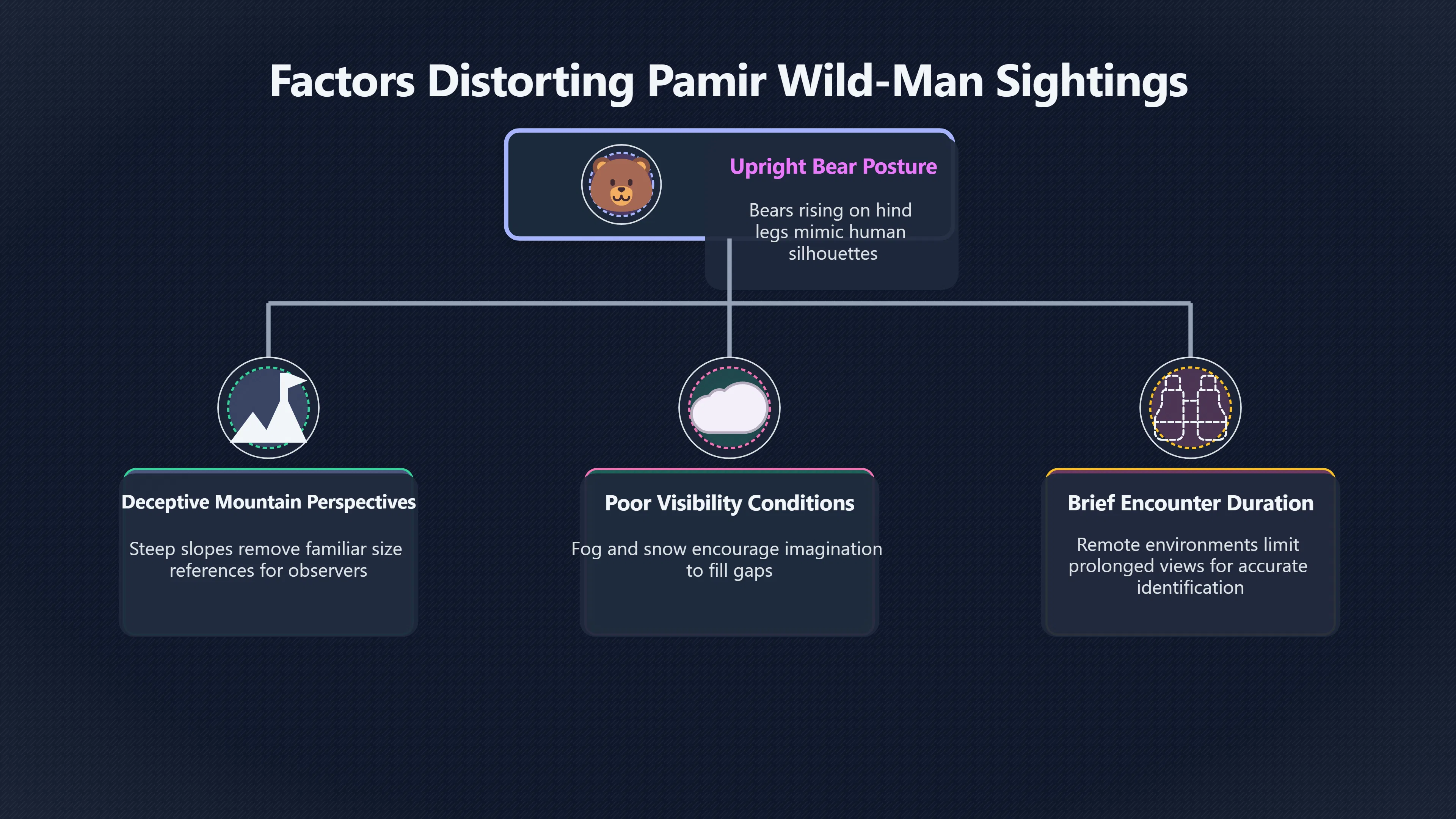
- Bears can stand upright. A bear briefly rising onto its hind legs to investigate a scent or scan its surroundings can create a distinctly human silhouette, particularly at a distance.[Wikipedia]WikipediaBrown bearBrown bear
- Mountain perspectives are deceptive. Steep slopes remove familiar size references. A bear on higher ground may appear taller than it really is, while a partially hidden animal can seem oddly shaped.[Bergwandelen.com]bergwandelen.comThis is one of the many tributaries of the legendary Oxus River, that.Read moreOf all its mountain ranges, THE PAMIRS is Asia's best-kept…December 4, 2020 — It's a gradual ascent along the Langar River, that merge…
- Poor visibility alters perception. Snow, fog, dusk, glare and blowing dust reduce detail and encourage observers to fill gaps with expectation and imagination.[Wikipedia]WikipediaPamir alpine desert and tundraPamir alpine desert and tundra
- Encounters are often brief. In remote mountain environments, observers rarely get prolonged, close-range views that allow careful identification.[Takali.org]takali.orgTajikistan Mountain AdviceTajikistan Mountain Advice
This does not mean every witness simply mistook a bear for a person. Human perception is more complicated than that. A witness may accurately remember seeing “something unusual” while being mistaken about what produced that impression. The distinction matters because many cryptid traditions begin with sincere observations rather than deliberate inventions.

Why the Pamirs Encourage Mystery
The geography of eastern Tajikistan naturally encourages stories about hidden creatures. Vast portions of the region remain sparsely populated, and travel can involve crossing long stretches of rugged terrain where human presence is limited. The remoteness that once encouraged speculation about unknown animals is real, even if the evidence for such animals remains weak.[Wikipedia]WikipediaTajik National ParkTajik National Park
Remote environments also produce a psychological effect. In a city, an unusual glimpse is often quickly checked against familiar explanations. In a lonely mountain valley, uncertainty can persist. An observer may have no opportunity to compare notes, return to the location immediately or verify what was seen. Stories therefore acquire room to grow.[Trek Tajikistan]trektajikistan.comTrek TajikistanPamir Mountains in TajikistanThe secluded mountain range is the highest region of Tajikistan and offers amazing trekking r…
This helps explain why wild-man traditions often cluster in mountainous regions around the world. The Pamir legend shares features with other Central Asian and Himalayan traditions in which isolation, difficult terrain and limited observation conditions create fertile ground for mystery-animal narratives.[Wikipedia]WikipediaAlmas (folkloreAlmas (folklore
Why Expectations Change What Witnesses Remember
Perhaps the most interesting explanation is not bears alone but bears combined with expectation.
Psychologists have long recognised that people do not record experiences like cameras. Memories are reconstructed using both sensory information and prior beliefs. Once the idea of a Pamir wild man became widely discussed, witnesses who encountered something ambiguous had a ready-made explanation available. A fleeting glimpse of a dark figure on a slope might be remembered differently after hearing local stories or reading newspaper reports about a mysterious mountain creature.
The history of the Pamir legend reflects this process. Older folklore traditions existed first, then Soviet interest in the yeti provided a scientific-looking framework, and later retellings increasingly linked local stories to the global image of an ape-like “snowman”. Over time, the legend absorbed influences from folklore, media coverage and cryptozoological enthusiasm.[riowang.blogspot.com]riowang.blogspot.coma language hunter legend hunterA language hunter, a legend hunter7 Mar 2013 — Kirill Stanyukovich, a renowned geobotanist and scifi writer, reported that the locals tol…
This does not imply dishonesty on the part of witnesses. On the contrary, sincere witnesses can become more convinced of extraordinary explanations precisely because the original experience felt real and emotionally significant.

A Stronger Explanation Than an Unknown Ape?
The key challenge for the wild-man hypothesis is the absence of physical evidence. Decades of interest produced stories, sightings and rumours but no confirmed body, skeletal remains, clear photographs, genetic samples or breeding population. By contrast, the existence of bears in the region is well established, and the environmental conditions that encourage misidentification are obvious and observable.[Wikipedia]WikipediaTajik National ParkTajik National Park
As a result, many historians and sceptical researchers view the Pamir wild-man tradition as a blend of three elements:
- Genuine local folklore about wild mountain beings.
- Misidentified wildlife, particularly bears seen under difficult conditions.
- The influence of twentieth-century fascination with yetis and other ape-man legends. ResearchGate+2riowang.blogspot.com
That combination helps explain why the legend remains fascinating even without proving that an unknown creature exists. The Pamir story survives because it sits at the meeting point of real wilderness, human perception and the enduring appeal of mysteries hidden among the highest mountains of Central Asia. Wikipedia
Amazon book picks
Further Reading
Books and field guides related to Could Bears and Shadows Explain the Pamir Legend?. Use these as the next step if you want deeper reading beyond the article.
Bear Attacks
Explains how real bear encounters can be misinterpreted in remote terrain.
Carnivores of the World
Provides background on large mammals that may inspire legends.
eBay marketplace picks
Marketplace Samples
Live-tested eBay searches with available results related to this page.

Endnotes
1.
Source: Wikipedia
Title: Tajik National Park
Link:https://en.wikipedia.org/wiki/Tajik_National_Park
2.
Source: Wikipedia
Title: Pamir alpine desert and tundra
Link:https://en.wikipedia.org/wiki/Pamir_alpine_desert_and_tundra
4.
Source: riowang.blogspot.com
Title: a language hunter legend hunter
Link:https://riowang.blogspot.com/2013/03/a-language-hunter-legend-hunter.html
Source snippet
A language hunter, a legend hunter7 Mar 2013 — Kirill Stanyukovich, a renowned geobotanist and scifi writer, reported that the locals tol...
5.
Source: pamirs.org
Link:https://pamirs.org/wp-content/uploads/2018/02/Legends-of-the-Pamirs.pdf
Source snippet
Legends of the PamirsAccording to legend they grew from the staffs of Sho Nosir Khusraw and Sho Tolib Sarmast which they planted th...
6.
Source: Wikipedia
Title: Brown bear
Link:https://en.wikipedia.org/wiki/Brown_bear
7.
Source: bergwandelen.com
Title: This is one of the many tributaries of the legendary Oxus River, that.Read more
Link:https://bergwandelen.com/wp-content/uploads/2022/03/062-065-067-071-Trekking-Pamirs-rev3.pdf
Source snippet
Of all its mountain ranges, THE PAMIRS is Asia's best-kept...December 4, 2020 — It's a gradual ascent along the Langar River, that merge...
Published: December 4, 2020
8.
Source: takali.org
Title: Tajikistan Mountain Advice
Link:https://www.takali.org/mountain-advice
9.
Source: Wikipedia
Title: Almas (folklore)
Link:https://en.wikipedia.org/wiki/Almas_%28folklore%29
10.
Source: Wikipedia
Link:https://en.wikipedia.org/wiki/Yeti
11.
Source: trektajikistan.com
Link:https://trektajikistan.com/about/pamir-mountains/
Source snippet
Trek TajikistanPamir Mountains in TajikistanThe secluded mountain range is the highest region of Tajikistan and offers amazing trekking r...
Additional References
12.
Source: en.nabu.de
Title: Naturschutzbund Deutschland e.V.Between Tajikistan and Kyrgyzstan
Link:https://en.nabu.de/topics/protected-areas/tajikistan.html
Source snippet
Naturschutzbund Deutschland e.V.Between Tajikistan and Kyrgyzstan - NABU beyond bordersIn the Pamir-Alai region, the border area b...
13.
Source: facebook.com
Link:https://www.facebook.com/pamirtimes/posts/a-brown-bear-was-spotted-roaming-the-rugged-terrain-of-khunjerab-national-park-o/1191858532981139/
14.
Source: reddit.com
Link:https://www.reddit.com/r/Tajikistan/comments/1igmjzo/about_the_golub_yavan_the_tajik_wildman/
15.
Source: facebook.com
Link:https://www.facebook.com/groups/770144831964626/posts/1318018040510633/
16.
Source: instagram.com
Link:https://www.instagram.com/reel/DQGu14miuwv/
17.
Source: uppervoid.com
Link:https://www.uppervoid.com/pages/pamir-path?srsltid=AfmBOoqH6pObBctfi6uROhJgDjszX66jvDQUobZY7J5-gDbSPu9iY3dH
18.
Source: reddit.com
Link:https://www.reddit.com/r/Cryptozoology/comments/18navmx/the_golubyavan_is_a_cryptid_hominidape_reported/
19.
Source: instagram.com
Link:https://www.instagram.com/reel/DaVNJnkJP56/
20.
Source: camcaproject.org
Link:https://camcaproject.org/species/tian-shan-brown-bear/
21.
Source: youtube.com
Title: Abominable Snowman (yeti) likely just bear
Link:https://www.youtube.com/watch?v=XVkE6-L31To
Source snippet
Tajikistan conservation: Wildlife parks face human threats...
Topic Tree