Within Peru Cryptids
What Was Seen at Lake Titicaca?
A 1910 account preserved striking reports of a large furry lake animal, but no body, photograph or verified specimen ever followed.
On this page
- Bandelier's record of the 1895 sightings
- What witnesses claimed about size and appearance
- Known animals, folklore and the missing physical evidence
Page outline Jump by section
Introduction
The best-known Lake Titicaca monster story is surprisingly narrow in scope. Unlike Loch Ness, which accumulated thousands of reports over decades, the Titicaca case rests largely on accounts recorded by the American archaeologist and ethnographer Adolph F. Bandelier in 1910. He described stories of a large, furry, seal-like animal reportedly seen near the Strait of Tiquina, the narrow channel linking the lake’s two main basins. The reports are intriguing because they came from multiple local informants and were said to date back to the 1890s. Yet no specimen, photograph, skeleton or verified physical trace ever emerged. As a result, the Titicaca beast remains one of Peru’s most interesting but weakest-evidenced mystery-animal traditions: memorable enough to survive in cryptozoological literature, but supported almost entirely by testimony rather than tangible proof.[Cryptid Archives]cryptidarchives.fandom.comCryptid Archives Lake Titicaca monsterCryptid ArchivesLake Titicaca monster - Encyclopaedia of CryptozoologyAccording to Adolph Bandelier, who felt that the animal resembled a…

Bandelier’s Record of the 1895 Sightings
The core source for the Lake Titicaca beast story is Bandelier’s book The Islands of Titicaca and Koati, published in 1910. While documenting the archaeology and traditions of the lake region, he recorded accounts of an unusual animal reportedly seen in the vicinity of the Strait of Tiquina. According to his summary, local people and European residents alike spoke of a large aquatic creature that occasionally surfaced in the lake.[Cryptid Archives]cryptidarchives.fandom.comCryptid Archives Lake Titicaca monsterCryptid ArchivesLake Titicaca monster - Encyclopaedia of CryptozoologyAccording to Adolph Bandelier, who felt that the animal resembled a…
Bandelier did not claim to have seen the animal himself. His information was second-hand, gathered from witnesses and local reports. That distinction matters because the entire case depends on recollections rather than direct observation by the recorder. Even in cryptozoological discussions, the Titicaca beast is usually treated as a historical report rather than an ongoing mystery supported by modern sightings.[Cryptid Archives]cryptidarchives.fandom.comCryptid Archives Lake Titicaca monsterCryptid ArchivesLake Titicaca monster - Encyclopaedia of CryptozoologyAccording to Adolph Bandelier, who felt that the animal resembled a…
The sightings were associated particularly with the Tiquina Narrows, a notable geographical bottleneck within the lake system. Because animals moving through the lake would naturally be concentrated there, it is an understandable place for unusual observations to become attached to local folklore.[Wikipedia]WikipediaLake TiticacaLake Titicaca
What Witnesses Claimed About Size and Appearance
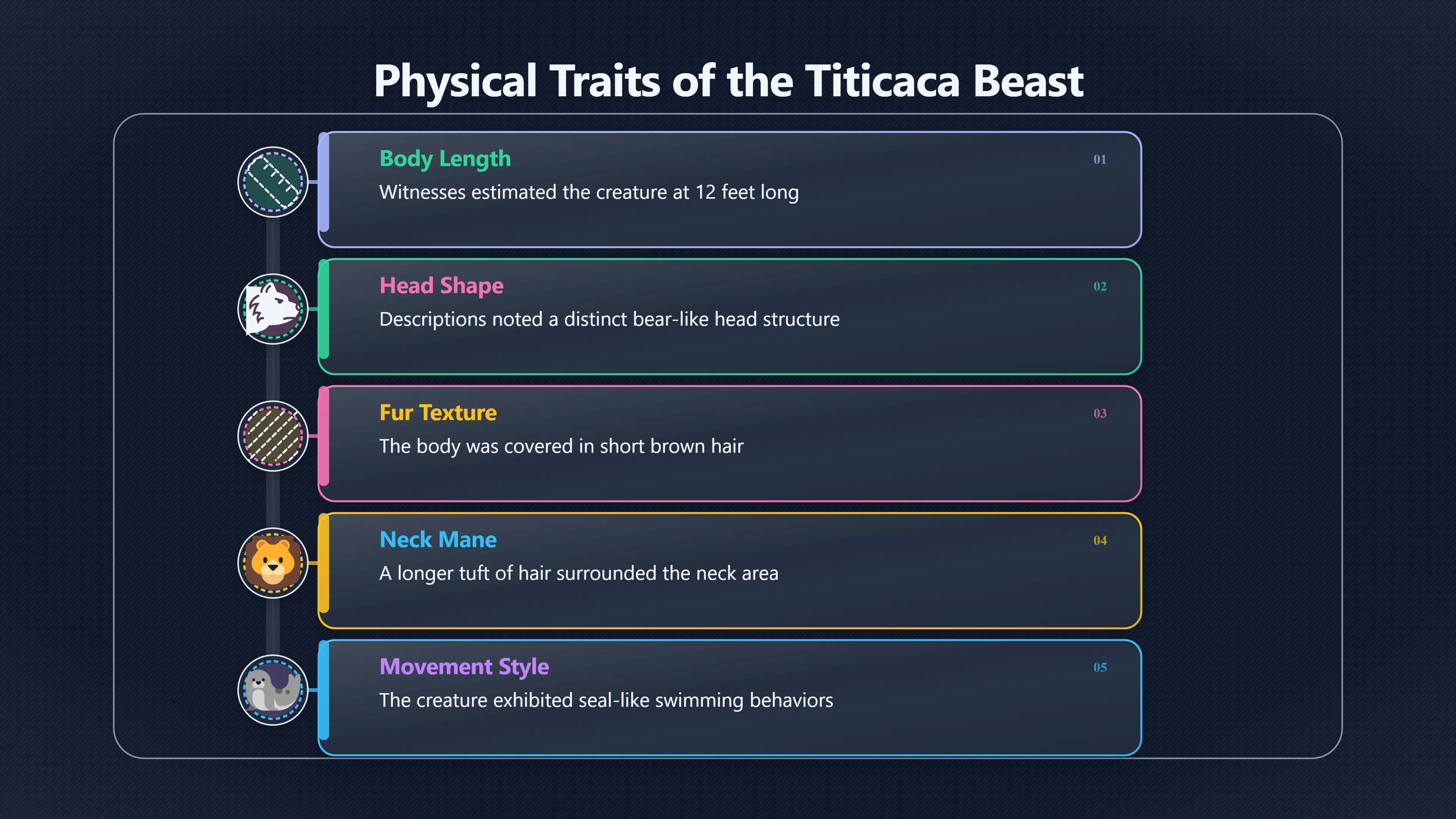
Descriptions preserved by Bandelier were unusually detailed for a lake-monster report. The creature was generally said to be around 12 feet (roughly 3.5 metres) long. Witnesses reportedly described a bear-like head, a body covered with short brown hair, and a longer tuft or mane-like patch of hair around the neck or shoulders. The animal was often characterised as seal-like in its movements and overall shape.[Cryptid Archives]cryptidarchives.fandom.comCryptid Archives Lake Titicaca monsterCryptid ArchivesLake Titicaca monster - Encyclopaedia of CryptozoologyAccording to Adolph Bandelier, who felt that the animal resembled a…
These details are important because they differ from the classic long-necked lake-monster image popularised elsewhere. The Titicaca creature was not usually portrayed as a giant serpent or prehistoric reptile. Instead, it was described as a mammal-like animal with fur and a rounded head.[Cryptid Archives]cryptidarchives.fandom.comCryptid Archives Lake Titicaca monsterCryptid ArchivesLake Titicaca monster - Encyclopaedia of CryptozoologyAccording to Adolph Bandelier, who felt that the animal resembled a…
Some later writers compared the reported animal to a freshwater seal or even a manatee-like creature. Bandelier himself appears to have considered a resemblance to a manatee more plausible than a giant reptile. However, neither seals nor manatees are known inhabitants of Lake Titicaca, which lies more than 3,800 metres above sea level in the Andes.[Cryptid Archives]cryptidarchives.fandom.comCryptid Archives Lake Titicaca monsterCryptid ArchivesLake Titicaca monster - Encyclopaedia of CryptozoologyAccording to Adolph Bandelier, who felt that the animal resembled a…

Why the Reports Attracted Attention
The reports gained attention because Lake Titicaca already possessed an aura of mystery. The lake has long been regarded as a sacred landscape and occupies an important place in Andean history and mythology. Archaeological discoveries have repeatedly revealed ritual offerings and ceremonial activity beneath its waters, reinforcing its reputation as a place where stories and history intertwine.[UNESCO Courier]courier.unesco.orgInside the box was a miniature shell figurine of a llama.Read moreUNESCO CourierTiticaca: The sacred lake reveals its secrets17 Jun 2021 — The Inca stone offering box found in Lake Titicaca in 2014 emerg…
Against that backdrop, accounts of an unexplained lake animal were easy to remember and retell. The idea of a hidden aquatic creature also fit a broader international pattern in which large lakes become associated with monster traditions, regardless of whether strong evidence exists. The Titicaca story therefore benefited from the lake’s cultural importance as much as from the original witness reports.[UNESCO Courier]courier.unesco.orgInside the box was a miniature shell figurine of a llama.Read moreUNESCO CourierTiticaca: The sacred lake reveals its secrets17 Jun 2021 — The Inca stone offering box found in Lake Titicaca in 2014 emerg…
Known Animals, Folklore and the Missing Physical Evidence
The biggest difficulty for believers is the complete absence of physical evidence. No carcass has been recovered. No bones have been identified. No museum specimen exists. No verified photograph has ever entered the record. More than a century after Bandelier published the accounts, the evidential situation remains essentially unchanged.[Cryptid Archives]cryptidarchives.fandom.comCryptid Archives Lake Titicaca monsterCryptid ArchivesLake Titicaca monster - Encyclopaedia of CryptozoologyAccording to Adolph Bandelier, who felt that the animal resembled a…
Lake Titicaca is home to a distinctive ecosystem containing hundreds of aquatic species, including endemic fish, birds and the famous Titicaca water frog. Yet extensive biological study of the lake has never revealed a large unknown aquatic mammal matching the descriptions in the reports.[Wikipedia]WikipediaLake TiticacaLake Titicaca
Several ordinary explanations have been proposed:
- Misidentified animals. Large swimming mammals seen briefly at a distance can be difficult to identify, especially under poor viewing conditions.
- Exaggerated observations. Size estimates over open water are notoriously unreliable.
- Folklore shaping memory. Once unusual stories circulate, later observations may be interpreted through the existing legend.
- Rare or transient animals. Some writers have speculated about stray marine mammals reaching inland waters in the distant past, although no evidence supports a surviving population in Lake Titicaca.[Cryptid Archives]cryptidarchives.fandom.comCryptid Archives Lake Titicaca monsterCryptid ArchivesLake Titicaca monster - Encyclopaedia of CryptozoologyAccording to Adolph Bandelier, who felt that the animal resembled a…
The seal comparison remains the most frequently repeated element of the story because it fits the reported fur, head shape and swimming behaviour. Yet it also raises a major biological problem: a breeding population of large aquatic mammals in one of the world’s most studied high-altitude lakes would be expected to leave bones, carcasses, photographs or other traces. None have been found.[Cryptid Archives]cryptidarchives.fandom.comCryptid Archives Lake Titicaca monsterCryptid ArchivesLake Titicaca monster - Encyclopaedia of CryptozoologyAccording to Adolph Bandelier, who felt that the animal resembled a…
How Strong Is the Evidence Today?
Measured purely as evidence, the Lake Titicaca beast case is weak. It relies on a small cluster of historical testimonies recorded by a respected researcher but not personally witnessed by him. The descriptions are vivid enough to be memorable, and the reports came from more than a single storyteller, which prevents them from being dismissed as a simple invention. Yet the lack of corroborating physical evidence keeps the case firmly in the realm of unresolved anecdote.[Cryptid Archives]cryptidarchives.fandom.comCryptid Archives Lake Titicaca monsterCryptid ArchivesLake Titicaca monster - Encyclopaedia of CryptozoologyAccording to Adolph Bandelier, who felt that the animal resembled a…
What makes the Titicaca beast noteworthy is not the strength of the evidence but the specificity of the claims. Witnesses did not describe a vague monster lurking beneath the waves. They described a furry, seal-like animal of a particular size in a particular part of the lake. More than a century later, that combination of detail and missing evidence remains the central puzzle. The story survives because it sits in the narrow space between folklore and zoology: concrete enough to sound like an animal report, yet unsupported enough to resist confirmation.[Cryptid Archives]cryptidarchives.fandom.comCryptid Archives Lake Titicaca monsterCryptid ArchivesLake Titicaca monster - Encyclopaedia of CryptozoologyAccording to Adolph Bandelier, who felt that the animal resembled a…
Amazon book picks
Further Reading
Books and field guides related to What Was Seen at Lake Titicaca?. Use these as the next step if you want deeper reading beyond the article.
Field Guide To Bigfoot, Yeti, & Other Mystery Primates Worldwide
Broad survey of mystery-animal traditions.
The Islands of Titicaca and Koati
Contains the foundational Lake Titicaca beast accounts.
eBay marketplace picks
Marketplace Samples
Live-tested eBay searches with available results related to this page.



Endnotes
1.
Source: Wikipedia
Title: Lake Titicaca
Link:https://en.wikipedia.org/wiki/Lake_Titicaca
2.
Source: whc.unesco.org
Link:https://whc.unesco.org/en/tentativelists/1817/
Source snippet
UNESCO World Heritage CentreSacred Titicaca LakeLake Titicaca is the biggest aquatic mass within the Southern Continent. It is also the h...
3.
Source: courier.unesco.org
Title: Inside the box was a miniature shell figurine of a llama.Read more
Link:https://courier.unesco.org/en/articles/titicaca-sacred-lake-reveals-its-secrets
Source snippet
UNESCO CourierTiticaca: The sacred lake reveals its secrets17 Jun 2021 — The Inca stone offering box found in Lake Titicaca in 2014 emerg...
4.
Source: cryptidarchives.fandom.com
Title: Cryptid Archives Lake Titicaca monster
Link:https://cryptidarchives.fandom.com/wiki/Lake_Titicaca_monster
Source snippet
Cryptid ArchivesLake Titicaca monster - Encyclopaedia of CryptozoologyAccording to Adolph Bandelier, who felt that the animal resembled a...
5.
Source: 7wonders.org
Title: Lake Titicaca
Link:https://7wonders.org/south-america/peru/puno/lake-titicaca/
Additional References
6.
Source: facebook.com
Link:https://www.facebook.com/groups/1002571683091379/posts/7912870262061452/
Source snippet
Lake Titicaca monster described as a 12' long creatureYet sightings continue to be made. Some feel that they are a kind of large, undisco...
7.
Source: architecturecoffeeandink.com
Title: He credited it to being a seal, or a similar creature, ed to be unable to find
Link:https://architecturecoffeeandink.com/2022/07/10/17-the-mystery-of-lake-titicaca/
Source snippet
Architecture, Coffee, & Ink#17 The Mystery of Lake Titicaca - Architecture, Coffee, & Ink10 Jul 2022 — It is believed to be the emergent...
8.
Source: traffic.org
Link:https://www.traffic.org/what-we-do/thematic-issues/promoting-sustainable-trade/titicaca-water-frog/
Source snippet
Titicaca Water Frog: worshipped, traded and consumed in...A large frog, Telmatobius culeatus, which may reach 60cm, inhabits the shallow...
9.
Source: livescience.com
Title: 65126 lake titicaca offerings
Link:https://www.livescience.com/65126-lake-titicaca-offerings.html
Source snippet
Live ScienceOfferings to Supernatural Deities Discovered in Lake...1 Apr 2019 — A team of archaeological divers has uncovered dazzling t...
10.
Source: youtube.com
Title: The Undersea World of Jacques Cousteau
Link:https://www.youtube.com/watch?v=SVzoPrvytdg
Source snippet
I met the rarest creature in Lake Titicaca...
11.
Source: youtube.com
Title: I met the rarest creature in Lake Titicaca
Link:https://www.youtube.com/watch?v=LC3TbjVf9Bs
Source snippet
Marine Archaeologists Found Massive Underwater Structures in Lake Titicaca...
12.
Source: reddit.com
Link:https://www.reddit.com/r/Cryptozoology/comments/1rwxd2i/an_alleged_freshwater_seahorse_caught_alive_in/
13.
Source: travels-bolivia.com
Link:https://www.travels-bolivia.com/discover-bolivia/regions/altiplano/lake-titicaca/
14.
Source: youtube.com
Title: Marine Archaeologists Found Massive Underwater Structures in Lake Titicaca
Link:https://www.youtube.com/watch?v=VahXtLpJ508
Source snippet
The Hidden Gold of Lake Titicaca...
15.
Source: youtube.com
Link:https://www.youtube.com/watch?v=LbWhZKYAfhQ
Topic Tree