Within New Zealand Cryptids
Could New Zealand Really Have a Hidden Otter?
Reports of an otter-like South Island animal remain intriguing, but no physical evidence has established an unknown living mammal.
On this page
- Early sightings in Dusky Sound
- Claims from lakes, rivers and fiords
- Known animals and other sceptical explanations
Page outline Jump by section
Introduction
Among New Zealand’s mystery-animal stories, the waitoreke occupies a unique place. Unlike taniwha, sea serpents or other legendary creatures, the waitoreke is usually described as an ordinary animal: a small, brown, otter-like mammal living around rivers, lakes and fiords of the South Island. That apparent ordinariness is exactly what has kept the debate alive. If witnesses really saw such an animal, it would represent a remarkable zoological puzzle in a country whose only native land mammals are bats. Yet after more than two centuries of reports, no specimen, verified photograph, bone assemblage or DNA evidence has confirmed the existence of a living New Zealand otter.[New Zealand Ecological Society]newzealandecology.orgNew Zealand Ecological Society- A REASSESSMENTAugust 24, 2004 — The waitoreke, or supposed South Island otter, has remained a mystery for…
The waitoreke therefore sits at the boundary between folklore and natural history. It is one of New Zealand’s strongest classic cryptid claims precisely because it is not described as supernatural. The question is simple: did observers repeatedly glimpse an unknown semi-aquatic mammal, or were they interpreting familiar animals through expectation, distance and difficult viewing conditions?[New Zealand Ecological Society]newzealandecology.orgNew Zealand Ecological Society- A REASSESSMENTAugust 24, 2004 — The waitoreke, or supposed South Island otter, has remained a mystery for…
Early Sightings in Dusky Sound
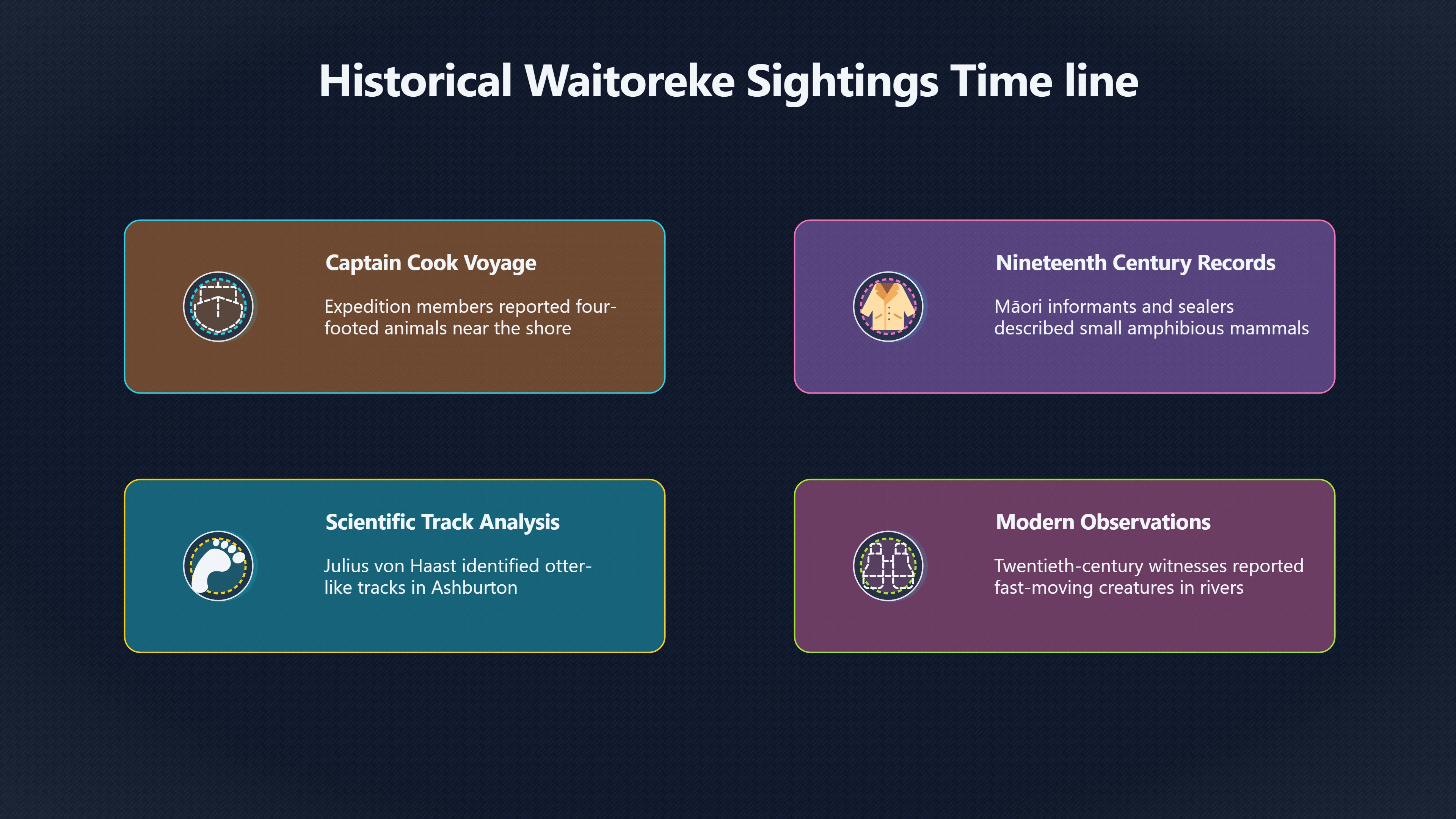
The story begins in the far south-west of the South Island, particularly around Dusky Sound in Fiordland. One of the earliest references often linked to the mystery comes from Captain James Cook’s voyage in the 1770s. Cook recorded that members of his expedition reported seeing a four-footed animal near the shore, although descriptions differed and no firm identification was made. Later writers would point back to this observation as a possible early waitoreke encounter.[Cruise Milford Sound]cruisemilfordnz.comCruise Milford SoundFiordland's WaitorekeRead about the history of Fiordland's Waitoreke… There have been sporadic reports of the wait…
During the nineteenth century, Māori informants, sealers, whalers and settlers contributed additional accounts. Several reports described a small amphibious mammal with brown fur, short legs and a thick tail. Some witnesses compared it to an otter, others to a muskrat or beaver. Reverend Richard Taylor recorded stories from people who claimed to have seen such animals around Dusky Bay and nearby waterways. A recurring theme was an animal that entered water quickly and was difficult to pursue.[Wikipedia]WikipediaOpen source on wikipedia.org.
What makes these early accounts notable is that they were recorded before the modern cryptid movement existed. Witnesses were not searching for a legendary monster. They believed they had encountered an unusual but entirely natural mammal. That distinction helps explain why later researchers treated the waitoreke more seriously than many folklore creatures.[New Zealand Ecological Society]newzealandecology.orgNew Zealand Ecological Society- A REASSESSMENTAugust 24, 2004 — The waitoreke, or supposed South Island otter, has remained a mystery for…
Claims from Lakes, Rivers and Fiords
As the nineteenth century progressed, reports expanded beyond Dusky Sound. Sightings were eventually claimed from Fiordland, Southland, Otago and parts of Canterbury. The pattern remained remarkably consistent: a small brown animal seen briefly near freshwater or sheltered coastal waters.[New Zealand Ecological Society]newzealandecology.orgNew Zealand Ecological Society- A REASSESSMENTAugust 24, 2004 — The waitoreke, or supposed South Island otter, has remained a mystery for…
Several of the most frequently cited reports include:
- Julius von Haast, one of New Zealand’s best-known nineteenth-century scientists, reported finding tracks in the Ashburton region that he believed resembled those of an otter. He also relayed accounts from settlers who described a dark-brown animal roughly the size of a rabbit near waterways.[Wikipedia]WikipediaOpen source on wikipedia.org.
- Southland fisherman A. E. Tapper claimed multiple sightings between the late nineteenth and early twentieth centuries. He described a brown, seal-headed creature around the size of a rabbit or possum.[Strange Animals Podcast]strangeanimalspodcast.blubrry.netepisode 272 the waitorekeA fisherman named A.E. Tapper spotted what might have been a waitoreke six times…Read more…
- Twentieth-century observers continued to report brief encounters around remote lakes and rivers, particularly in southern districts. These sightings generally involved a fast-moving animal disappearing into water before it could be examined closely.[Otago Daily Times Online News]odt.co.nzOtago Daily Times Online NewsOtter-ly absorbed by water creatureDecember 10, 2013 — 10 Dec 2013 — 11 people who have seen something small…
One reason the mystery endured is that many descriptions share common features despite being separated by decades. Witnesses frequently mention brown fur, a low body, short legs, aquatic habits and movements reminiscent of an otter. Supporters argue that such consistency hints at a real animal behind the reports. Sceptics counter that people who see an unfamiliar creature near water often reach for the same comparison.[New Zealand Ecological Society]newzealandecology.orgNew Zealand Ecological Society- A REASSESSMENTAugust 24, 2004 — The waitoreke, or supposed South Island otter, has remained a mystery for…
Why the Waitoreke Seemed Plausible
Unlike giant monsters or impossible beasts, the waitoreke fits comfortably within the range of known mammals. Otters, water rats, muskrats and similar semi-aquatic species exist elsewhere in the world. New Zealand’s rivers, lakes and fiords could theoretically support such an animal.[New Zealand Ecological Society]newzealandecology.orgNew Zealand Ecological Society- A REASSESSMENTAugust 24, 2004 — The waitoreke, or supposed South Island otter, has remained a mystery for…
This apparent plausibility encouraged generations of investigators. During the twentieth century, some researchers proposed that the waitoreke might represent:
- An undiscovered native mammal.
- A surviving remnant of an ancient lineage.
- An introduced species that established itself unnoticed.
- A marsupial related to Australian forms.
- A monotreme-like animal, drawing comparisons with the platypus.[New Zealand Ecological Society]newzealandecology.orgNew Zealand Ecological Society- A REASSESSMENTAugust 24, 2004 — The waitoreke, or supposed South Island otter, has remained a mystery for…
The attraction of these ideas was strengthened by New Zealand’s unusual natural history. Although modern New Zealand lacks native land mammals apart from bats, fossil discoveries have shown that mammals were present in the distant past. That fact does not support the existence of a modern waitoreke, but it helped keep speculation alive.[Wikipedia]WikipediaOpen source on wikipedia.org.

The Missing Physical Evidence
The central problem for the waitoreke hypothesis is the absence of physical proof.
Over more than 200 years, investigators have not produced a verified body, skull, skeleton, preserved skin, hair sample, genetic trace or clear modern photograph that can withstand scientific scrutiny. Claims of pelts and tracks have repeatedly surfaced, but none has provided conclusive evidence of an unknown living species.[New Zealand Ecological Society]newzealandecology.orgNew Zealand Ecological Society- A REASSESSMENTAugust 24, 2004 — The waitoreke, or supposed South Island otter, has remained a mystery for…
One frequently discussed example involves a pelt reportedly obtained by Julius von Haast. Later assessments suggested it may have resembled the skin of an Australian quoll rather than an unknown New Zealand mammal. Even if authentic, it would not prove the existence of a surviving waitoreke population.[Wikipedia]WikipediaOpen source on wikipedia.org.
This absence matters because New Zealand has one of the world’s most intensively studied conservation environments. Large-scale wildlife surveys, pest-control programmes, camera monitoring and ecological research have transformed knowledge of remote regions. A breeding population of unknown semi-aquatic mammals would be expected to leave stronger traces than occasional eyewitness reports.[New Zealand Ecological Society]newzealandecology.orgNew Zealand Ecological Society- A REASSESSMENTAugust 24, 2004 — The waitoreke, or supposed South Island otter, has remained a mystery for…
Known Animals and Other Sceptical Explanations
Most modern explanations focus on misidentification rather than deliberate hoaxing.
Remote waterways create ideal conditions for mistakes. Brief glimpses, poor light, moving water and unexpected behaviour can make familiar animals appear unusual. Potential candidates include:
- Seals travelling inland or entering rivers.
- Swimming possums.
- Mustelids such as stoats and ferrets.
- Large rats.
- Dogs viewed at a distance.
- Escaped or transient introduced animals.[Wikipedia]WikipediaOpen source on wikipedia.org.
Some nineteenth-century descriptions contain features that do not fit otters particularly well. Reports differ on tail shape, body size and behaviour. Certain accounts describe structures resembling beaver dams, while others depict a sleek animal more like a seal. Such inconsistencies suggest multiple sources rather than a single undiscovered species.[Wikipedia]WikipediaOpen source on wikipedia.org.
Another factor is expectation. Once stories of a mysterious water mammal became established, later observers may have interpreted ambiguous sightings through that existing narrative. This process is common in cryptid traditions worldwide, where local legends influence how unusual encounters are remembered and reported.[New Zealand Ecological Society]newzealandecology.orgNew Zealand Ecological Society- A REASSESSMENTAugust 24, 2004 — The waitoreke, or supposed South Island otter, has remained a mystery for…
Why reports of Waitoreke persisted
The waitoreke survives in New Zealand folklore because it occupies a tantalising middle ground. The descriptions are modest, the locations are real and some witnesses were experienced outdoors people rather than sensationalists. The reports therefore feel more grounded than many monster legends.[New Zealand Ecological Society]newzealandecology.orgNew Zealand Ecological Society- A REASSESSMENTAugust 24, 2004 — The waitoreke, or supposed South Island otter, has remained a mystery for…
Yet the evidence never quite reaches the level required to establish a new species. Every line of inquiry eventually returns to the same obstacle: stories without specimens. That is why most zoologists regard the waitoreke as an unresolved collection of sightings rather than proof of a hidden mammal.[New Zealand Ecological Society]newzealandecology.orgNew Zealand Ecological Society- A REASSESSMENTAugust 24, 2004 — The waitoreke, or supposed South Island otter, has remained a mystery for…
For cryptid enthusiasts, however, the waitoreke remains one of New Zealand’s most intriguing mysteries. It asks a surprisingly down-to-earth question. Not whether dragons lurk beneath a lake or whether giants roam the bush, but whether generations of people repeatedly glimpsed an ordinary animal that somehow slipped through the cracks of recorded natural history.[New Zealand Ecological Society]newzealandecology.orgNew Zealand Ecological Society- A REASSESSMENTAugust 24, 2004 — The waitoreke, or supposed South Island otter, has remained a mystery for…
Amazon book picks
Further Reading
Books and field guides related to Could New Zealand Really Have a Hidden Otter?. Use these as the next step if you want deeper reading beyond the article.
Still in Search of Prehistoric Survivors
Explores claims of hidden or surviving animals similar to waitoreke debates.
Abominable Science!
Directly addresses how reports of unknown animals are investigated.
The Field Guide to Bigfoot and Other Mystery Primates
Introduces investigative approaches used in mystery-animal cases.
eBay marketplace picks
Marketplace Samples
Live-tested eBay searches with available results related to this page.


Endnotes
1.
Source: newzealandecology.org
Link:https://newzealandecology.org/nzje/2629/pdf
Source snippet
New Zealand Ecological Society- A REASSESSMENTAugust 24, 2004 — The waitoreke, or supposed South Island otter, has remained a mystery for...
Published: August 24, 2004
2.
Source: Wikipedia
Link:https://en.wikipedia.org/wiki/Waitoreke
3.
Source: cruisemilfordnz.com
Link:https://www.cruisemilfordnz.com/milford-sound-history/fiordlands-waitoreke/
Source snippet
Cruise Milford SoundFiordland's WaitorekeRead about the history of Fiordland's Waitoreke... There have been sporadic reports of the wait...
4.
Source: strangeanimalspodcast.blubrry.net
Title: episode 272 the waitoreke
Link:https://strangeanimalspodcast.blubrry.net/2022/04/18/episode-272-the-waitoreke/
Source snippet
A fisherman named A.E. Tapper spotted what might have been a waitoreke six times...Read more...
5.
Source: odt.co.nz
Link:https://www.odt.co.nz/regions/southland/otter-ly-absorbed-water-creature
Source snippet
Otago Daily Times Online NewsOtter-ly absorbed by water creatureDecember 10, 2013 — 10 Dec 2013 — 11 people who have seen something small...
Published: December 10, 2013
6.
Source: cryptidz.fandom.com
Link:https://cryptidz.fandom.com/wiki/Waitoreke
7.
Source: cryptidarchives.fandom.com
Link:https://cryptidarchives.fandom.com/wiki/Waitoreke
8.
Source: youtube.com
Title: The Mystery of New Zealand’s only Native Land Mammal
Link:https://www.youtube.com/watch?v=lxNP_uuge3g
Source snippet
Waitoreke...
9.
Source: youtube.com
Link:https://www.youtube.com/watch?v=__4i2irvqhI
Source snippet
50 CRYPTIDS IN THE WORLD...
Additional References
10.
Source: youtube.com
Link:https://www.youtube.com/watch?v=Vps6zkydv90
Source snippet
Myth of New Zealand OttersAre there Otters in New Zealand? Two of those being Kaureke. Discuss the evidence. Go over the locations and ex...
11.
Source: youtube.com
Link:https://www.youtube.com/watch?v=fu7jQ0d_l0c
Source snippet
Waitoreke: New Zealand's Otter-like CryptidIn New Zealand folklore, the waitoreke is an otter/beaver-like creature. It is usually describ...
12.
Source: reddit.com
Title: two photographs from 1971 of an otterlike animal
Link:https://www.reddit.com/r/Cryptozoology/comments/1epd39y/two_photographs_from_1971_of_an_otterlike_animal/
Source snippet
Two photographs from 1971 of an otter-like animal...New Zealand has no known native land mammals except some bats, but there have been d...
13.
Source: reddit.com
Title: the waitoreke new zealands otterlike cryptid
Link:https://www.reddit.com/r/Cryptozoology/comments/ulv573/the_waitoreke_new_zealands_otterlike_cryptid/
Source snippet
The Waitoreke: New Zealand's Otter-Like Cryptid: r...Two photographs from 1971 of an otter-like animal hesitantly identified as the wai...
14.
Source: kidsrestorethekepler.org.nz
Link:https://www.kidsrestorethekepler.org.nz/local/details?id=30
15.
Source: facebook.com
Link:https://www.facebook.com/groups/aotearoanzhistory/posts/1342599124229113/
16.
Source: facebook.com
Link:https://www.facebook.com/TheFolklorePodcast/posts/from-the-folklore-of-new-zealand-the-waitoreke-is-a-small-otter-like-creature-wi/1454274073380175/
17.
Source: youtube.com
Title: On the hunt of the elusive New Zealand otter
Link:https://www.youtube.com/watch?v=qgGmIeA_AMI
Source snippet
The Mystery of New Zealand's only Native Land Mammal...
18.
Source: open.spotify.com
Title: 0t PFc35Gx Dm8z Bnm J2b Aju
Link:https://open.spotify.com/episode/0tPFc35GxDm8zBnmJ2bAju
19.
Source: youtube.com
Title: 50 CRYPTIDS IN THE WORLD
Link:https://www.youtube.com/watch?v=2KNT-NWtWyY
Topic Tree