Strange Creature Lore from Niger's Stories
Niger does not have a well-documented modern cryptid equivalent to Scotland’s Loch Ness Monster or the Himalayan Yeti. Searches of historical collections, wildlife records and accessible newspaper archives reveal no sustained Nigerien “monster flap” supported by repeated dated sightings, photographs, specimens or organised expeditions.
Page outline Jump by section
Introduction
That distinction matters. Niger’s creatures are chiefly figures in oral tradition, epic and ritual life, not unrecognised animals awaiting scientific discovery. The most notable are the Hira, an apparently invulnerable buffalo fought by a legendary hunter; the enormous Hausa bogey commonly called Dodo; the tiny but formidable Zankallala; and Songhay water beings linked to the Niger River. Their stories draw much of their force from a landscape where real lions, crocodiles, hippopotamuses, manatees and other large animals can still make an encounter feel extraordinary.[archive.org]archive.orgHira vient •'Hsuile: ce dernier est un buffle redou- table et invulnérable quiInternet ArchiveFull text of "Revue d'ethnographie et de sociologie"Dupuis-Yakouba, Les Goic on chasseurs du Niger, avec une préface de M…
Why Niger has no single national cryptid
The first difficulty in discussing Nigerien cryptids is that modern country borders do not match the territories in which older stories travelled. Hausa-speaking communities extend across Niger and northern Nigeria, while Songhay traditions follow the Niger River through several present-day states. A creature described as “Hausa” or “Songhay” therefore cannot always be assigned neatly to one country.
This is especially important because internet searches frequently confuse Niger, the landlocked republic, with Nigeria, its much more populous southern neighbour. Viral stories about strange animals in Nigeria are routinely indexed beside material about Niger, even when there is no geographical connection. Claims should therefore be checked for an identifiable Nigerien location, date and source before being treated as part of Niger’s mystery-animal history.
The surviving record also reflects who collected and published oral literature. Some of the best-known creature tales associated with the wider Niger River world were written down by European scholars in the colonial period. A tale’s publication date is not its beginning; it merely marks the point at which one version entered print. Oral stories could change substantially between narrators, settlements and generations.
For Niger, it is consequently more accurate to speak of several overlapping creature traditions than of a single national monster. They include heroic beasts from hunting epics, frightening beings used in cautionary tales and river spirits embedded in broader religious understandings of land and water.
The Hira: an unstoppable buffalo of heroic legend
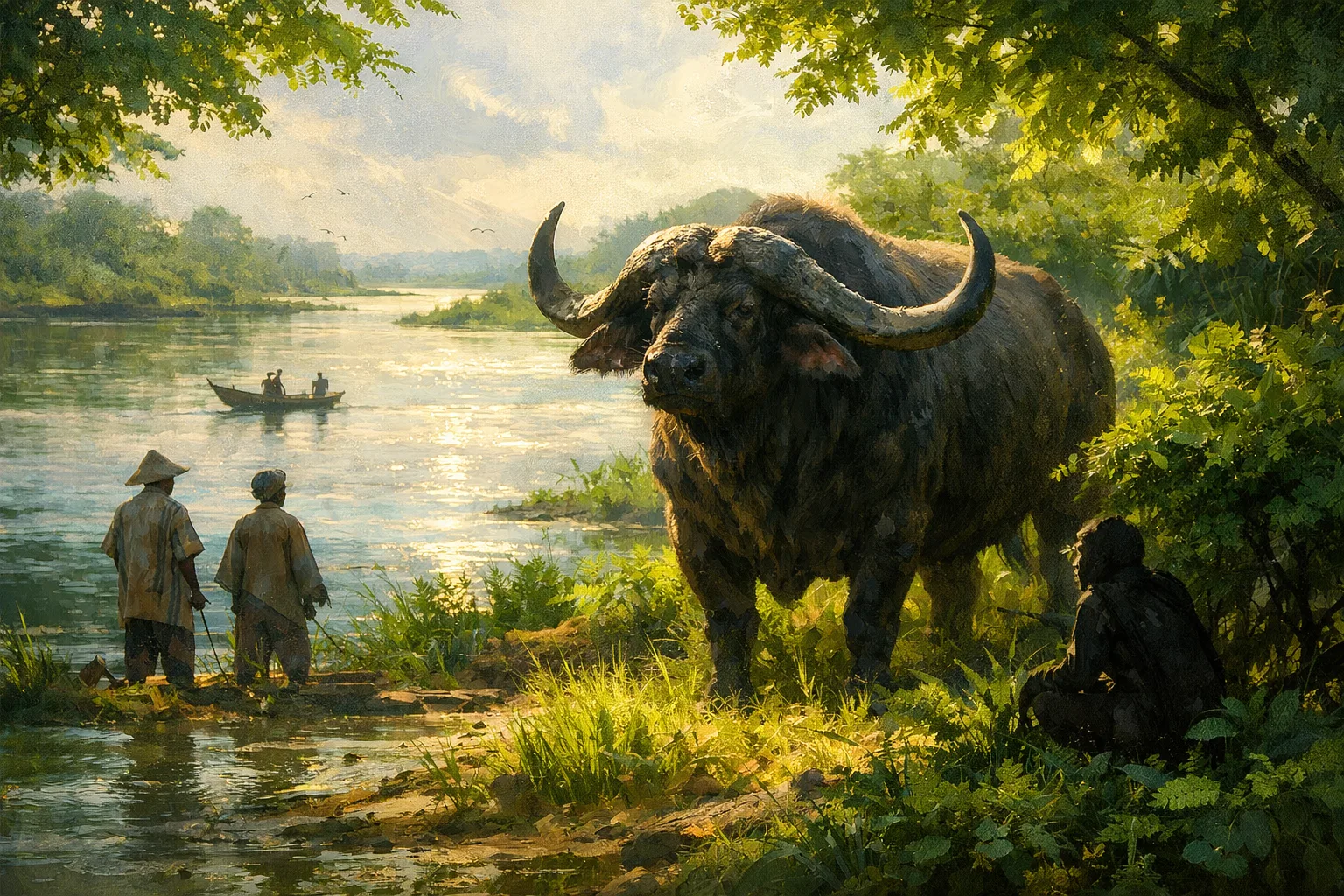
The Hira is the clearest large-animal monster in the Songhay epic tradition. It is described not as an unknown zoological species but as an exceptionally dangerous buffalo, endowed with such strength or magical protection that ordinary hunters cannot overcome it. Its principal adversary is the culture hero Moussa Gname, a hunter whose own life and abilities are supernatural.
A major printed source is Les Gow ou Chasseurs du Niger, published by Auguste Dupuis-Yakouba in 1911 from traditions collected around the Middle Niger. A contemporary scholarly review summarised the Hira as a fearsome and invulnerable buffalo that defeats several hunters before Moussa and his heroic companion confront it. That early record is valuable because it demonstrates that the creature was not invented by a recent cryptid website, although the documented version belongs to the wider Songhay river world rather than exclusively to the modern Republic of Niger.[Internet Archive]archive.orgHira vient •'Hsuile: ce dernier est un buffle redou- table et invulnérable quiInternet ArchiveFull text of "Revue d'ethnographie et de sociologie"Dupuis-Yakouba, Les Goic on chasseurs du Niger, avec une préface de M…
The story varies in retelling. In one widely repeated version, the Hira ravages the countryside and proves resistant to conventional weapons. Moussa’s victory depends on supernatural instruction and assistance rather than superior firepower. Another episode involves trickery, transformation and hairs taken from the beast’s tail, which deprive it of resistance.
Read as folklore, the Hira combines two recognisable realities. African buffalo are genuinely large, aggressive animals capable of injuring or killing hunters, while hunting epics naturally magnify dangerous quarry into opponents worthy of a culture hero. The creature’s invulnerability converts a risky animal encounter into a moral and magical contest.
There is no persuasive evidence that the Hira represents a surviving prehistoric bovid or an unidentified species. No authenticated hide, horn, bone, photograph or modern field report has been connected to it. The evidence establishes the Hira as a legendary beast, not as a zoological puzzle.
Its relevance to Niger nevertheless remains substantial. Songhay communities and traditions are an important part of the country’s cultural landscape, particularly along the Niger River. The Hira belongs to that transnational narrative inheritance even though the best-known written collection was made farther west.
Dodo and Zankallala: monsters from Hausa storytelling
The bush-dwelling Dodo
The Dodo of Hausa folklore has no relationship to the extinct bird from Mauritius. In translated tales, the name may refer to a monster, ogre, frightening spirit or bogey. Descriptions vary, but the being is commonly imagined as large, hairy, man-eating and associated with wild places, water, trees or the dangerous ground beyond the settlement.
One Oxford reference entry explicitly identifies Dodo traditions with Hausa communities in both Niger and Nigeria, describing the figure as an evil or fear-inspiring being with a wider mythic role. Early collections of Hausa tales also contain multiple stories involving Dodo characters, showing that the name functions more like a category of supernatural monster than a single animal with a fixed appearance.[oxfordreference.com]oxfordreference.comOpen source on oxfordreference.com.
That flexibility is important when evaluating modern cryptid descriptions. Websites sometimes present Dodo as though witnesses consistently reported a shaggy giant in forests and swamps. The source material is less tidy. In different stories, a Dodo can be an ogre, a spirit, a guardian, a husband, an enemy or even a comparatively helpful figure. A study of monsters in African oral narratives notes this ambiguity, including a Hausa story in which one Dodo protects a maiden from other monsters.[open.bu.edu]open.bu.eduAhmad in which dodo (which he translates as “monster”) protects a maiden from other dodos (including his own monster children)…
Dodo therefore belongs more naturally beside the ogres and bogeys of world folklore than beside claimed undiscovered apes. Its changing form serves the needs of the story. It marks dangerous territory, tests a hero, frightens children away from hazardous places or embodies uncontrolled appetite and violence.
Real animals may have helped supply its imagery. Lions, hyenas, pythons and crocodiles can attack people, while darkness and dense vegetation make familiar wildlife difficult to identify. Yet there is no sound evidence that Dodo stories began as reports of one particular unknown species. Claims that the figure preserves memories of giant snakes or an undiscovered humanoid remain speculation.
The tiny creature feared by monsters
Zankallala provides a playful reversal of the usual monster formula. He is portrayed as extremely small—sometimes no larger than two fists—yet more powerful than creatures many times his size. In popular summaries of Hausa tales, he rides a jerboa, uses a snake as a staff, wears scorpions as spurs and carries a swarm of bees like a hat. Birds accompany him and proclaim his strength.[A Book of Creatures]abookofcreatures.comA Book of Creatures ZankallalaA Book of Creatures Zankallala
His best-known adventure pits him against Dodo. Rather than surviving through size or brute force, Zankallala overwhelms the larger monster through supernatural confidence and an absurd collection of dangerous animal companions. Early Hausa tale collections include “How the Zankallala killed Dodo”, confirming that the pairing predates its modern life on monster websites.[Wikimedia Commons]upload.wikimedia.orgWikimedia CommonsHausa folk-tales… Dodo. 87. How the Zankallala killed Dodo. 88. The Wrestlers and the Devil. 89. The Two Girls and the…
Zankallala is not a cryptid claim in any scientific sense. Nobody is seriously proposing an undiscovered fist-sized humanoid mounted on a desert rodent. His value lies in showing how animal features are assembled for comic and symbolic effect. Snakes, scorpions and bees are each small but capable of inflicting pain; the tale concentrates their menace into an apparently insignificant hero.
The story also warns against treating every traditional monster as an early eyewitness description. Some creatures were designed to be impossible. Their contradictions, exaggerations and transformations are part of the entertainment.
What lives beneath the Niger River?
The Niger River is the country’s most natural setting for mystery-animal stories. Water conceals bodies, distorts distance and produces brief glimpses of backs, heads and wakes. It is also economically and spiritually important, supporting fishing, farming, transport and settlement.
Songhay traditions include numerous spirits associated with land and water. Paul Stoller’s ethnographic work among the Songhay of Niger documents a complex spirit world expressed through possession ceremonies, history and relationships with place. Within wider Songhay mythology, river-dwelling beings are sometimes grouped under the name zin, while a figure often called Zin Kibaru is described in reference works as a blind water spirit that commands fish.[uchicago.edu]press.uchicago.eduUniversity of Chicago PressFusion of the WorldsThe book Fusion of the Worlds: An Ethnography of Possession among the Songhay of Niger, Pa…
These beings should not automatically be converted into “river cryptids”. In their original setting they are spiritual personalities, not simply large animals hiding underwater. Stories about control of fish, dangerous river zones or encounters with unseen powers belong to a cultural understanding of the river that is broader than zoology.
Later retellings can blur that distinction by describing a water spirit as a serpent, mermaid or physical monster. Such imagery may be vivid, but it does not by itself establish a tradition of repeated sightings. Reliable reports would require identifiable witnesses, locations, dates and consistent descriptions. That evidence is presently lacking for a distinct Nigerien river monster.
Real fauna provide ample material for startling observations. The transnational W–Arly–Pendjari conservation complex, which includes W National Park in Niger, contains major terrestrial and aquatic habitats. UNESCO lists African manatees, lions, leopards, cheetahs and elephants among its notable mammals. Crocodiles, hippopotamuses, large fish, monitor lizards and partly submerged mammals can all create surprising shapes or movements, especially in muddy water or poor light.[UNESCO World Heritage Centre]whc.unesco.orgUNESCO World Heritage CentreW-Arly-Pendjari ComplexThis transnational extension (Benin, Burkina Faso) to the W National Park of Niger…
A manatee is particularly capable of inspiring an odd report. It may surface only briefly, exposing a rounded back or snout before disappearing. Hippopotamuses can travel or feed after dark, and crocodiles often reveal little more than eyes, nostrils and a wake. Such encounters need no imaginary species, but they help explain why rivers so readily acquire stories about hidden inhabitants.
Desert monsters and mistaken wildlife
Most of Niger lies within the Sahara or Sahel, environments that can make perception unreliable. Heat shimmer alters outlines and apparent distances. Dust, darkness and sparse landmarks make scale difficult to judge. A jackal, hyena, antelope or camel seen briefly at an unfamiliar angle may appear much stranger than it would in full daylight.
The country also retains wildlife that can seem almost legendary to visitors. The W–Arly–Pendjari region preserves some of West Africa’s remaining large mammals, while the wider Nigerien landscape includes rare desert-adapted species. Their scarcity can itself encourage mystery: an animal that has vanished from one district may be treated as impossible there even though small populations survive elsewhere.
Large cats offer a useful example. Lions and leopards are documented in the W complex, so not every story of an oversized or unidentified cat needs a paranormal explanation. At the same time, an isolated report far outside known habitat would require careful verification. Tracks can be confused with those of dogs or hyenas, while estimates of an animal’s size commonly increase when the observer is frightened.[UNESCO World Heritage Centre]whc.unesco.orgUNESCO World Heritage CentreW-Arly-Pendjari ComplexThis transnational extension (Benin, Burkina Faso) to the W National Park of Niger…
The same principle applies to reptilian “monsters”. A large Nile crocodile is an extraordinary animal without being an unknown one. Distance, partial concealment and retelling can transform a genuine encounter into a creature of impossible length. The legend may then grow each time the story is repeated, especially if no photograph or measured carcass exists to provide scale.
Environmental change further complicates memory. Hunting, habitat loss, drought and competition for water have reduced many large-animal populations across the Sahara and Sahel. Stories about enormous beasts may preserve memories of species that were formerly more common locally, rather than evidence that an unidentified survivor remains. IUCN assessments of the region describe severe historical depletion of large wildlife through hunting and pressure on grazing and water resources.[IUCN Portals]portals.iucn.orgOpen source on iucn.org.
Sightings, newspapers and physical evidence
Niger’s documented creature tradition is strikingly different from famous modern cryptid cases. There is no established sequence comparable to the 1930s Loch Ness reports: no recognised first newspaper sighting, no widely circulated photograph, no named group of investigators and no large tourism industry built around a supposed animal.
Accessible searches instead produce folklore collections, ethnographies and modern creature catalogues. The strongest historical anchor is the publication of oral narratives such as the Hira cycle and Hausa monster tales. Those sources demonstrate that the traditions exist, but they are not field evidence for unknown animals.
Modern cryptid websites often remove this context. They may assign a creature to “Niger” because a tale belongs to Hausa or Songhay culture, even when the original collection came from another present-day country. Others repeat descriptions without identifying the narrator, collection date or page in the primary source. These summaries are useful for discovering names, but not sufficient for establishing zoological claims.
A credible contemporary case would need several forms of corroboration:
- a precise Nigerien location and date;
- independent witnesses whose accounts were recorded separately;
- photographs or video with recoverable original files;
- tracks, hair, tissue or other material with a documented chain of custody;
- comparison with known local wildlife;
- investigation by qualified zoologists or wildlife authorities.
No famous Nigerien monster case currently meets that standard. The absence of such evidence does not prove that every unusual observation has been explained. It means there is no solid basis for proposing a hidden population of giant, ape-like, serpentine or otherwise unknown animals.
How the legends have changed
Niger’s creature stories have moved through several stages. They began in oral performance, where variation was expected and a narrator could adapt a tale to an audience. Colonial-era collectors then fixed particular versions in print. Academic studies later interpreted the stories as parts of epic, religion, social history or performance.
The internet has introduced another transformation. Creatures once understood as characters in Hausa or Songhay narrative are increasingly placed on global cryptid lists. The Hira becomes an “unknown buffalo”, Dodo becomes a possible hairy hominid and water spirits become lake or river monsters. This packaging makes the stories legible to international monster enthusiasts, but it can flatten their original meanings.
The change is clearest with Zankallala. In oral narrative he is a deliberately extravagant figure whose animal equipment forms part of the joke. Online illustration and creature catalogues give him a standardised appearance, making him resemble a species entry even though his defining features are openly magical.
There is little evidence that Niger has commercialised these beings as major tourist attractions. Wildlife tourism and conservation landscapes are far more visible than cryptid tourism. W National Park is promoted for its documented ecological importance, not as the home of an unidentified monster. UNESCO describes the wider complex as one of the most important remaining refuges for West African savannah wildlife.[UNESCO World Heritage Centre]whc.unesco.orgUNESCO World Heritage CentreW-Arly-Pendjari ComplexThis transnational extension (Benin, Burkina Faso) to the W National Park of Niger…
That absence of commercial branding may help preserve the stories’ local complexity. They have not been forced into a single mascot with an official silhouette, souvenir industry and carefully maintained sighting narrative.
What is folklore, and what could be an animal?
The main Nigerien cases fall into distinct categories.
The Hira is a legendary animal. Its buffalo form reflects real dangerous wildlife, but its invulnerability and magical defeat place it within heroic epic.
Dodo is a flexible monster or spirit figure. Its appearance and behaviour vary too widely for it to represent a consistent eyewitness tradition.
Zankallala is an openly fantastic folktale character. His miniature size, animal mount and living weapons are narrative invention rather than zoological description.
Songhay river beings are primarily spiritual entities. Treating them as undiscovered aquatic animals strips away their religious and cultural setting.
Unusual modern observations are most likely to involve known wildlife, visual error or retelling. Crocodiles, hippopotamuses, manatees, large fish, hyenas and big cats provide plausible starting points, depending on location and habitat.
Niger’s most interesting “cryptid” story is therefore not a hunt for one elusive beast. It is the meeting of oral literature, dangerous wildlife and modern monster culture. The country’s traditions show how a real buffalo can become an invulnerable adversary, how a frightening wilderness can acquire a man-eating guardian and how the hidden life of a great river can be expressed through spirits rather than species.

A legend-rich country, not a cryptid hotspot
Niger has a genuine and engaging mystery-creature heritage, but it is better supported as folklore than as cryptozoology. The Hira, Dodo, Zankallala and Songhay water beings are culturally meaningful figures preserved through stories, performance and ethnographic record. None is backed by the type of physical or documentary evidence required to recognise an unknown animal.
That does not make the traditions less interesting. Their value lies in what they reveal about hunting, fear, courage, water, wilderness and the animals with which people share the landscape. The most evidence-aware reading allows both sides to remain visible: Niger’s creatures can be strange, memorable and locally significant without being presented as confirmed inhabitants of the natural world.
Amazon book picks
Further Reading
Books and field guides related to What Strange Creatures Haunt Niger's Stories?. Use these as the next step if you want deeper reading beyond the article.
African Myths of Origin
Helps place Nigerien creature stories within wider African oral traditions.
A treasury of African folklore
Provides strong context for West African monster, spirit and hero traditions.
West African Folk Tales
Includes storytelling traditions from the broader Hausa and West African world.
A Book of Creatures
Connects readers with legendary beings similar to those discussed on the page.
eBay marketplace picks
Marketplace Samples
Live-tested eBay searches with available results related to this page.
Endnotes
1.
Source: archive.org
Title: Hira vient •’Hsuile: ce dernier est un buffle redou- table et invulnérable qui
Link:https://archive.org/stream/revuedethnograph34pari/revuedethnograph34pari_djvu.txt
Source snippet
Internet ArchiveFull text of "Revue d'ethnographie et de sociologie"Dupuis-Yakouba, Les Goic on chasseurs du Niger, avec une préface de M...
2.
Source: whc.unesco.org
Link:https://whc.unesco.org/en/list/749/
Source snippet
UNESCO World Heritage CentreW-Arly-Pendjari ComplexThis transnational extension (Benin, Burkina Faso) to the W National Park of Niger...
3.
Source: Wikipedia
Title: Hira (mythical monster)
Link:https://en.wikipedia.org/wiki/Hira_%28mythical_monster%29
4.
Source: upload.wikimedia.org
Link:https://upload.wikimedia.org/wikipedia/commons/8/80/Hausa_folk-tales.pdf
Source snippet
Wikimedia CommonsHausa folk-tales... Dodo. 87. How the Zankallala killed Dodo. 88. The Wrestlers and the Devil. 89. The Two Girls and the...
5.
Source: archive.org
Link:https://archive.org/stream/cu31924026919518/cu31924026919518_djvu.txt
Source snippet
Internet ArchiveFull text of "Hausa folk-tales... Zankallala, Kura na tsoron zankallala, Dodo na tsoron zankallala.” Suna waka, suna fadi...
6.
Source: open.bu.edu
Link:https://open.bu.edu/bitstreams/c57df790-754c-446c-a079-bdaa098d47d1/download
Source snippet
Ahmad in which dodo (which he translates as “monster”) protects a maiden from other dodos (including his own monster children)...
7.
Source: bibliovault.org
Link:https://www.bibliovault.org/BV.book.epl?ISBN=9780226775456
8.
Source: Wikipedia
Title: Zin Kibaru
Link:https://en.wikipedia.org/wiki/Zin_Kibaru
9.
Source: whc.unesco.org
Link:https://whc.unesco.org/en/news/1685
10.
Source: whc.unesco.org
Title: World Heritage Centre W-Arly-Pendjari Complex
Link:https://whc.unesco.org/en/list/749/gallery/
11.
Source: whc.unesco.org
Link:https://whc.unesco.org/en/documents/135524
12.
Source: portals.iucn.org
Link:https://portals.iucn.org/library/sites/library/files/documents/SSC-OP-054-Supp.pdf
13.
Source: portals.iucn.org
Title: SSC OP 054
Link:https://portals.iucn.org/library/sites/library/files/documents/SSC-OP-054.pdf
14.
Source: whc.unesco.org
Link:https://whc.unesco.org/document/208529
15.
Source: Wikipedia
Title: List of cryptids
Link:https://en.wikipedia.org/wiki/List_of_cryptids
16.
Source: Wikipedia
Title: Lake Débo
Link:https://en.wikipedia.org/wiki/Lake_D%C3%A9bo
17.
Source: Wikipedia
Title: West African mythology
Link:https://en.wikipedia.org/wiki/West_African_mythology
18.
Source: Wikipedia
Title: Moussa Gname
Link:https://en.wikipedia.org/wiki/Moussa_Gname
19.
Source: Wikipedia
Title: Zin (water spirits)
Link:https://en.wikipedia.org/wiki/Zin_%28water_spirits%29
20.
Source: Wikipedia
Title: Category:Songhai mythology
Link:https://en.wikipedia.org/wiki/Category%3ASonghai_mythology
21.
Source: Wikipedia
Title: River Monsters
Link:https://en.wikipedia.org/wiki/River_Monsters
22.
Source: whc.unesco.org
Link:https://whc.unesco.org/en/tentativelists/6360/
23.
Source: whc.unesco.org
Link:https://whc.unesco.org/document/123017
24.
Source: whc.unesco.org
Link:https://whc.unesco.org/archive/advisory_body_evaluation/475.pdf
25.
Source: whc.unesco.org
Link:https://whc.unesco.org/document/104455%26type%3Ddoc
26.
Source: whc.unesco.org
Link:https://whc.unesco.org/en/tentativelists/6276/
27.
Source: whc.unesco.org
Link:https://whc.unesco.org/document/106675
28.
Source: whc.unesco.org
Link:https://whc.unesco.org/document/104459
29.
Source: whc.unesco.org
Link:https://whc.unesco.org/archive/brief99.pdf
30.
Source: whc.unesco.org
Link:https://whc.unesco.org/archive/2017/whc17-41com-18-en.pdf
31.
Source: whc.unesco.org
Link:https://whc.unesco.org/ar/list/749
32.
Source: whc.unesco.org
Link:https://whc.unesco.org/document/159773
33.
Source: whc.unesco.org
Link:https://whc.unesco.org/en/tentativelists/6515/
34.
Source: whc.unesco.org
Link:https://whc.unesco.org/en/tentativelists/6518/
35.
Source: whc.unesco.org
Link:https://whc.unesco.org/en/news/2222
36.
Source: portals.iucn.org
Title: NS 022
Link:https://portals.iucn.org/library/sites/library/files/documents/NS-022.pdf
37.
Source: portals.iucn.org
Title: op 017
Link:https://portals.iucn.org/library/sites/library/files/documents/op-017.pdf
38.
Source: portals.iucn.org
Link:https://portals.iucn.org/library/sites/library/files/documents/2018-014-En.pdf
39.
Source: portals.iucn.org
Link:https://portals.iucn.org/library/sites/library/files/documents/2024-039-En.pdf
40.
Source: portals.iucn.org
Link:https://portals.iucn.org/library/efiles/documents/2009-074-En.pdf
41.
Source: portals.iucn.org
Link:https://portals.iucn.org/library/sites/library/files/documents/NS-SP-018.pdf
42.
Source: portals.iucn.org
Link:https://portals.iucn.org/library/sites/library/files/documents/1977-001_06.pdf
43.
Source: portals.iucn.org
Title: SSC Species 003 En
Link:https://portals.iucn.org/library/sites/library/files/documents/SSC-Species-003-En.pdf
44.
Source: ia801501.us.archive.org
Title: 2015.129455.The Serpent And The Crescent text
Link:https://ia801501.us.archive.org/9/items/in.ernet.dli.2015.129455/2015.129455.The-Serpent-And-The-Crescent_text.pdf
45.
Source: archive.org
Link:https://archive.org/stream/Cryptozoology_201608/Cryptozoology_djvu.txt
46.
Source: archive.org
Link:https://archive.org/stream/talonsdepursan01corb/talonsdepursan01corb_djvu.txt
47.
Source: archive.org
Link:https://archive.org/stream/chambersedinburg1218cham/chambersedinburg1218cham_djvu.txt
48.
Source: archive.org
Link:https://archive.org/stream/historicalresea04rankgoog/historicalresea04rankgoog_djvu.txt
49.
Source: archive.org
Title: paramountaroundw00unse 0 djvu.txt
Link:https://archive.org/stream/paramountaroundw00unse_0/paramountaroundw00unse_0_djvu.txt
50.
Source: archive.org
Link:https://archive.org/stream/bub_gb_QRWdQm3opioC/bub_gb_QRWdQm3opioC_djvu.txt
51.
Source: archive.org
Link:https://archive.org/stream/revueceltique44pari/revueceltique44pari_djvu.txt
52.
Source: archive.org
Link:https://archive.org/stream/londonliteraryg01unkngoog/londonliteraryg01unkngoog_djvu.txt
53.
Source: archive.org
Link:https://archive.org/stream/in.ernet.dli.2015.83494/2015.83494.The-Encyclopaedia-Britannica-14th-Edition-Vol-16_djvu.txt
54.
Source: archive.org
Link:https://archive.org/stream/unitedservicema10barngoog/unitedservicema10barngoog_djvu.txt
55.
Source: press.uchicago.edu
Link:https://press.uchicago.edu/ucp/books/book/chicago/F/bo3631801.html
Source snippet
University of Chicago PressFusion of the WorldsThe book Fusion of the Worlds: An Ethnography of Possession among the Songhay of Niger, Pa...
56.
Source: oxfordreference.com
Link:https://www.oxfordreference.com/display/10.1093/oi/authority.20110803095724711?d=%2F10.1093%2Foi%2Fauthority.20110803095724711&p=emailAcnzsBZkgx9%2F6&print=
57.
Source: abookofcreatures.com
Title: A Book of Creatures Zankallala
Link:https://abookofcreatures.com/2021/05/07/zankallala/
58.
Source: abookofcreatures.com
Link:https://abookofcreatures.com/category/niger/
59.
Source: abookofcreatures.com
Link:https://abookofcreatures.com/tag/african-folklore/
60.
Source: abookofcreatures.com
Link:https://abookofcreatures.com/2015/07/22/dodo/
61.
Source: abookofcreatures.com
Link:https://abookofcreatures.com/category/d/page/2/
62.
Source: cryptidz.fandom.com
Link:https://cryptidz.fandom.com/wiki/Zankallala
63.
Source: press.uchicago.edu
Link:https://press.uchicago.edu/ucp/books/virtualCatalog/vc52.html
64.
Source: press.uchicago.edu
Link:https://press.uchicago.edu/ucp/books/subject/su2/su2_1.html
65.
Source: press.uchicago.edu
Link:https://press.uchicago.edu/ucp/books/subject/su1.html
66.
Source: press.uchicago.edu
Title: Fall2014 UChicagoPress
Link:https://press.uchicago.edu/dam/jcr%3Aa27f43ef-e942-48a9-a248-fd743fd03e42/Fall2014_UChicagoPress.pdf
67.
Source: press.uchicago.edu
Title: Fall2014 UCP InternationalEdition
Link:https://press.uchicago.edu/dam/jcr%3Abab9ad4d-b13e-4413-9c83-545f01bf3eb6/Fall2014_UCP_InternationalEdition.pdf
68.
Source: science.howstuffworks.com
Link:https://science.howstuffworks.com/science-vs-myth/strange-creatures/cryptids.htm
69.
Source: sciencefocus.com
Link:https://www.sciencefocus.com/nature/monsters
70.
Source: nigeria.birdmap.africa
Link:https://nigeria.birdmap.africa/species/3970
71.
Source: mapmyths.com
Title: niger river
Link:https://mapmyths.com/blog/niger-river/
72.
Source: brickthology.com
Link:https://brickthology.com/tag/cryptid/
Additional References
73.
Source: youtube.com
Link:http://www.youtube.com/watch?v=uyeRYD3lWtk
Source snippet
Top 20 African Mythical Creatures: The Heart of African Legends...
74.
Source: youtube.com
Title: Chapter 23: Faran Barey and the River Spirits | The Hunter’s Vigil
Link:http://www.youtube.com/watch?v=EMw92GOoKes
Source snippet
Are There Mermaids in Africa? Complete List of African Merfolk Part 11: The Water People...
75.
Source: youtube.com
Title: Episode 25: Monster Tales
Link:http://www.youtube.com/watch?v=MKETEtFDMjA
Source snippet
Chapter 23: Faran Barey and the River Spirits | The Hunter’s Vigil...
76.
Source: youtube.com
Title: Monsters from African Mythology
Link:http://www.youtube.com/watch?v=AAhCDfGzGuQ
Source snippet
Episode 25: Monster Tales - Zankallala, Ebigane and Bulgu Legendary Africa · 447 views...
77.
Source: facebook.com
Link:https://www.facebook.com/legitngdaily/posts/im-scared-a-nigerian-man-cried-out-after-discovering-a-strange-looking-creature-/722021156634902/
78.
Source: facebook.com
Link:https://www.facebook.com/WTAM1100/posts/a-very-strange-video-out-of-nigeria-shows-what-appears-to-be-some-kind-of-humano/6507042512656985/
79.
Source: mythlok.com
Link:https://mythlok.com/dodo/
80.
Source: physionet.org
Link:https://physionet.org/files/deid/1.1/dict/sno_edited.txt?download=
81.
Source: amazon.com
Link:https://www.amazon.com/Fusion-WorldsAn-Ethnography-Possession-Songhay/dp/B0031RR5NY?tag=searcht-20
82.
Source: dokumen.pub
Link:https://dokumen.pub/fusion-of-the-worlds-an-ethnography-of-possession-among-the-songhay-of-niger-9780226775494.html
Topic Tree
Follow this branch
Related pages 192
- Antigua Cryptids
- Maldives Monsters
- Malta Monsters
- Qatar Monsters
- Argentina Monsters
- +187 more in sidebar