Within Saint Lucia Mysteries
Was the St Lucia Thing a Real Monster?
Photographs turned Saint Lucia's reef monster into a credible giant-worm case, while leaving its exact species and greatest size uncertain.
On this page
- How the Anse Chastanet reports began
- What the photographs actually showed
- Why the largest size claims remain unverified
Page outline Jump by section
Introduction
The most intriguing piece of cryptid-style evidence from Saint Lucia is not a lake monster, sea serpent or mysterious ape. It is a creature known locally as the “St Lucia Thing” — an enormous, elusive reef worm reported by divers around Anse Chastanet near Soufrière. What makes the case unusual is that it moved beyond rumour. Divers eventually obtained photographs of the animal, showing that at least part of the legend was based on a real marine creature rather than pure folklore. The photographs did not prove every dramatic claim made about the Thing, but they transformed the story from a monster tale into a question of identification, size and biology.[Underwater Journal]underwaterjournal.comUnderwater Journal Close Encounter with the StLucia ThingAugust 25, 2007 — 25 Aug 2007 — St. Lucia's has a somewhat legendary resident sea monster called the Thing. Capturing a few im…
The evidence therefore occupies a middle ground rarely seen in cryptid history. Witnesses described something extraordinary, photographs confirmed that an unusually large worm existed, yet the largest reported dimensions remain unverified. The result is a case where the evidence is stronger than many monster legends but weaker than a fully documented zoological discovery.[Underwater Journal]underwaterjournal.comUnderwater Journal Close Encounter with the StLucia ThingAugust 25, 2007 — 25 Aug 2007 — St. Lucia's has a somewhat legendary resident sea monster called the Thing. Capturing a few im…
How the Anse Chastanet reports began
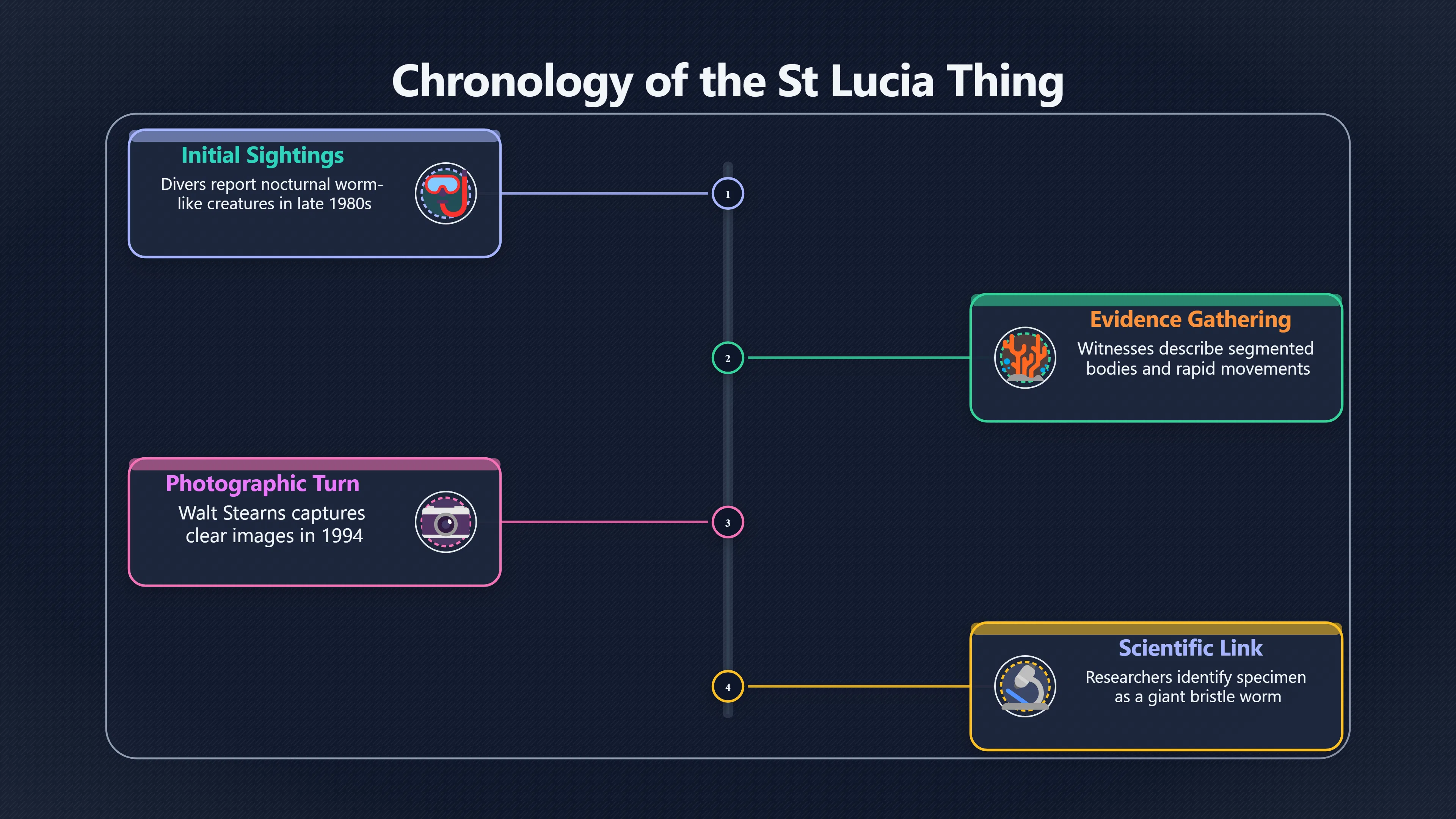
Accounts of the Thing circulated among divers and dive staff around Anse Chastanet during the late 1980s and early 1990s. Witnesses described a nocturnal, worm-like animal emerging from crevices in the reef after dark. It was said to be exceptionally sensitive to dive lights and capable of disappearing into the reef almost instantly when illuminated.[Underwater Journal]underwaterjournal.comUnderwater Journal Close Encounter with the StLucia ThingAugust 25, 2007 — 25 Aug 2007 — St. Lucia's has a somewhat legendary resident sea monster called the Thing. Capturing a few im…
The most dramatic reports claimed lengths of roughly 10 to 15 feet and a body as thick as a human arm. Such descriptions made the creature sound more like a sea monster than an ordinary reef invertebrate. Yet the reports shared several consistent features:
- The animal appeared only at night.
- It lived within holes and cracks in the reef.
- It moved quickly when disturbed.
- Witnesses described a segmented body rather than a snake-like one.
- Sightings clustered around the same reef system near Anse Chastanet.[underwaterjournal.com]underwaterjournal.comUnderwater Journal Close Encounter with the StLucia ThingAugust 25, 2007 — 25 Aug 2007 — St. Lucia's has a somewhat legendary resident sea monster called the Thing. Capturing a few im…
At this stage the evidence consisted almost entirely of eyewitness testimony. There were stories, recollections and at least one poor-quality image, but nothing that could firmly establish what the creature was. Like many cryptid cases, the legend grew partly because people knew something unusual existed but lacked clear documentation.[Underwater Journal]underwaterjournal.comUnderwater Journal Close Encounter with the StLucia ThingAugust 25, 2007 — 25 Aug 2007 — St. Lucia's has a somewhat legendary resident sea monster called the Thing. Capturing a few im…
What the photographs actually showed
The turning point came when underwater photographer Walt Stearns deliberately searched for the animal during night dives in 1994. After repeated attempts, he located and photographed a specimen. These images remain the strongest evidence in the entire case.[Underwater Journal]underwaterjournal.comUnderwater Journal Close Encounter with the StLucia ThingAugust 25, 2007 — 25 Aug 2007 — St. Lucia's has a somewhat legendary resident sea monster called the Thing. Capturing a few im…
The photographs revealed several important details.
First, the Thing was unquestionably a real animal. The images showed a large segmented worm moving among coral structures rather than an optical illusion, hoax or misremembered encounter.[Underwater Journal]underwaterjournal.comUnderwater Journal Close Encounter with the StLucia ThingAugust 25, 2007 — 25 Aug 2007 — St. Lucia's has a somewhat legendary resident sea monster called the Thing. Capturing a few im…
Second, the visible anatomy pointed strongly toward a polychaete annelid, commonly known as a bristle worm. Features visible in the photographs included:
- A segmented body.
- Repeated side appendages.
- Bristles or setae along the body.
- Gill-like structures associated with the segments.[Underwater Journal]underwaterjournal.comUnderwater Journal Close Encounter with the StLucia ThingAugust 25, 2007 — 25 Aug 2007 — St. Lucia's has a somewhat legendary resident sea monster called the Thing. Capturing a few im…
Third, the photographed individual was impressive but not gigantic. Stearns estimated the specimen at roughly four feet long and about wrist thickness. That size is large enough to surprise divers yet substantially smaller than the most dramatic eyewitness estimates.[Underwater Journal]underwaterjournal.comUnderwater Journal Close Encounter with the StLucia ThingAugust 25, 2007 — 25 Aug 2007 — St. Lucia's has a somewhat legendary resident sea monster called the Thing. Capturing a few im…
The photographs therefore accomplished two things simultaneously. They confirmed the creature’s existence while also reducing the likelihood that it was an unknown giant monster. The evidence pointed toward an unusually large reef worm rather than an undiscovered marine beast.[Underwater Journal]underwaterjournal.comUnderwater Journal Close Encounter with the StLucia ThingAugust 25, 2007 — 25 Aug 2007 — St. Lucia's has a somewhat legendary resident sea monster called the Thing. Capturing a few im…
Why scientists and divers linked it to giant bristle worms
Once clear photographs became available, attention shifted from proving the animal existed to determining its species.
The most commonly suggested identification has been a giant eunicid worm, often associated with Eunice roussaei. This is a recognised species listed in marine taxonomic databases and belongs to a group of large predatory or scavenging reef worms known for their impressive size and secretive habits.[World Register of Marine Species]marinespecies.orgWorld Register of Marine SpeciesEunice roussaei Quatrefages, 186626 Mar 2008 — Eunice roussaei Quatrefages, 1866 · Biota · Animalia (King…
This explanation fits several features reported by witnesses:
- Eunicid worms live hidden within reef structures.
- Many are primarily nocturnal.[instagram.com]instagram.comSource details in endnotes.
- Only part of the body may be visible at any one time.
- Large individuals can appear surprisingly massive when emerging from holes.
- Rapid withdrawal into a burrow is normal behaviour.[Underwater Journal]underwaterjournal.comUnderwater Journal Close Encounter with the StLucia ThingAugust 25, 2007 — 25 Aug 2007 — St. Lucia's has a somewhat legendary resident sea monster called the Thing. Capturing a few im…
The identification was persuasive because it explained the creature’s behaviour as well as its appearance. Divers encountering only a portion of a large worm at night could easily perceive a much larger animal extending deeper into the reef.[Underwater Journal]underwaterjournal.comUnderwater Journal Close Encounter with the StLucia ThingAugust 25, 2007 — 25 Aug 2007 — St. Lucia's has a somewhat legendary resident sea monster called the Thing. Capturing a few im…
Importantly, however, the photographs did not provide the kind of specimen-based evidence that would settle the species question beyond doubt. The identification remained informed and plausible rather than absolutely conclusive.[Underwater Journal]underwaterjournal.comUnderwater Journal Close Encounter with the StLucia ThingAugust 25, 2007 — 25 Aug 2007 — St. Lucia's has a somewhat legendary resident sea monster called the Thing. Capturing a few im…
Why the largest size claims remain unverified
The biggest unresolved question is not whether the Thing existed. It is whether the largest reported Things existed.
Witnesses described worms reaching 10 to 15 feet in length, but the best-known photographs documented a substantially smaller individual. No widely published photographs, measurements or collected specimens have verified the most dramatic dimensions.[Underwater Journal]underwaterjournal.comUnderwater Journal Close Encounter with the StLucia ThingAugust 25, 2007 — 25 Aug 2007 — St. Lucia's has a somewhat legendary resident sea monster called the Thing. Capturing a few im…
Several factors could explain the discrepancy.
Reef animals are difficult to measure
Large worms often remain partly hidden inside reef crevices. Divers may see only a section of the body while the rest disappears into rock or coral. Estimating total length under such conditions is extremely difficult.[Underwater Journal]underwaterjournal.comUnderwater Journal Close Encounter with the StLucia ThingAugust 25, 2007 — 25 Aug 2007 — St. Lucia's has a somewhat legendary resident sea monster called the Thing. Capturing a few im…
Night diving can distort perception
Most encounters reportedly occurred after dark using artificial light. Distance, scale and body proportions are harder to judge during night dives than in daylight. A thick four-foot worm may appear much larger when only part of it is illuminated.[Underwater Journal]underwaterjournal.comUnderwater Journal Close Encounter with the StLucia ThingAugust 25, 2007 — 25 Aug 2007 — St. Lucia's has a somewhat legendary resident sea monster called the Thing. Capturing a few im…
Larger individuals are biologically possible
The eunicid family includes genuinely large worms. Because some species can reach remarkable lengths, reports of unusually large specimens cannot be dismissed outright. However, possibility is not proof. The Saint Lucian reports still lack direct documentation of the largest claimed sizes.[ResearchGate]researchgate.netOn the presence of a giant bristle worm (Eunice roussaei…The presence of a giant “polychaete” annelid of the genus Eunice…
As a result, the strongest evidence supports the existence of a large reef worm, while the most spectacular measurements remain anecdotal.
What the evidence ultimately proves
The St Lucia Thing is unusual because its evidence does not fit neatly into either sceptical dismissal or cryptid confirmation.
The case demonstrates that:
- Divers were observing a real animal.
- Photographs confirmed the animal was a large segmented marine worm.
- A giant bristle worm explanation fits the observed anatomy and behaviour.
- The exact species identification remains less certain than the animal’s general type.
- The largest reported sizes have never been verified with comparable photographic or specimen evidence.[underwaterjournal.com]underwaterjournal.comUnderwater Journal Close Encounter with the StLucia ThingAugust 25, 2007 — 25 Aug 2007 — St. Lucia's has a somewhat legendary resident sea monster called the Thing. Capturing a few im…
In cryptid history, many legends collapse once clear evidence appears. The St Lucia Thing followed a different path. The photographs solved part of the mystery while leaving another part intact. They showed that the “monster” was real, but they also showed that the strongest evidence points toward an extraordinary reef worm rather than an unknown sea beast. That balance between confirmation and uncertainty is precisely what keeps the story memorable within Saint Lucia’s small but distinctive mystery-animal tradition.[Underwater Journal]underwaterjournal.comUnderwater Journal Close Encounter with the StLucia ThingAugust 25, 2007 — 25 Aug 2007 — St. Lucia's has a somewhat legendary resident sea monster called the Thing. Capturing a few im…
Amazon book picks
Further Reading
Books and field guides related to Was the St Lucia Thing a Real Monster?. Use these as the next step if you want deeper reading beyond the article.
Abominable Science!
Matches the page's focus on evidence, identification and mystery-animal claims.
Field Guide To Bigfoot, Yeti, & Other Mystery Primates Worldwide
Explores how unusual sightings are documented and debated.
Caribbean Folklore
Helps readers compare folklore creatures with documented animal cases.
eBay marketplace picks
Marketplace Samples
Live-tested eBay searches with available results related to this page.

Endnotes
1.
Source: caradonna.com
Title: shooting the saint lucia sea monster
Link:https://www.caradonna.com/blog/shooting-the-saint-lucia-sea-monster
Source snippet
24 Jul 2018 — known photographs of one of the Caribbean's storied sea monsters. Anse Chastanet Resort on the island of Saint Lucia, worm...
2.
Source: researchgate.net
Link:https://www.researchgate.net/publication/360831342_On_the_presence_of_a_giant_bristle_worm_Eunice_roussaei_IN_NW_Iberian_Peninsula_Comments_on_its_taxonomy_and_reproductive_cycle
Source snippet
On the presence of a giant bristle worm (Eunice roussaei...The presence of a giant “polychaete” annelid of the genus Eunice...
3.
Source: underwaterjournal.com
Title: Underwater Journal Close Encounter with the St
Link:https://www.underwaterjournal.com/close-encounter-with-the-st-lucia-thing/
Source snippet
Lucia ThingAugust 25, 2007 — 25 Aug 2007 — St. Lucia's has a somewhat legendary resident sea monster called the Thing. Capturing a few im...
Published: August 25, 2007
4.
Source: marinespecies.org
Link:https://www.marinespecies.org/aphia.php?id=327785&p=taxdetails
Source snippet
World Register of Marine SpeciesEunice roussaei Quatrefages, 186626 Mar 2008 — Eunice roussaei Quatrefages, 1866 · Biota · Animalia (King...
5.
Source: underwaterjournal.com
Title: the thing of st lucia
Link:https://www.underwaterjournal.com/tag/the-thing-of-st-lucia/
Source snippet
the Thing of St. Lucia Archives25 Aug 2007 — Back in the late 1980's to early 1990's, St. Lucia's has a somewhat legendary resident sea m...
6.
Source: underwaterjournal.com
Link:https://www.underwaterjournal.com/author/walt-stearns/
7.
Source: itsmth.fandom.com
Title: The Thing
Link:https://itsmth.fandom.com/wiki/The_Thing
Additional References
8.
Source: smmainc.com
Title: Soufriere Marine Management Association Dive Sites
Link:https://smmainc.com/dive-sites/
Source snippet
Indeed. The Thing is one of St Lucia's most fascinating organisms and most people – locals or tourists – have never even heard of it. The...
9.
Source: youtube.com
Title: Why Are Bobbit Worms So Dangerous?
Link:http://www.youtube.com/watch?v=0CJ6kU6SiPg
Source snippet
Monster 'Bobbit' worm (Eunice aphroditois) discovered at Maidenhead Aquatics @ Woking...
10.
Source: facebook.com
Link:https://www.facebook.com/caribbeanreeflife/posts/bobbit-worm-aka-the-thing-eunice-spthe-part-we-could-see-was-almost-1m-long/3500782393354422/
11.
Source: facebook.com
Link:https://www.facebook.com/groups/wetpixeluw/posts/10157345246096017/
12.
Source: instagram.com
Link:https://www.instagram.com/reel/CsOUbQ1guKq/
13.
Source: youtube.com
Link:http://www.youtube.com/watch?v=refnOdW49rw
Source snippet
Huge Bristle Worm || ViralHog...
14.
Source: youtube.com
Title: The Internet’s Most Misunderstood Worm
Link:http://www.youtube.com/watch?v=9TvdlluTblE
Source snippet
World's Best Diving and Resorts: Anse Chastanet in St. Lucia...
15.
Source: youtube.com
Title: World’s Best Diving and Resorts: Anse Chastanet in St. Lucia
Link:http://www.youtube.com/watch?v=0WwyfPZAPvI
Source snippet
Why Are Bobbit Worms So Dangerous?...
16.
Source: youtube.com
Title: Huge Bristle Worm || Viral Hog
Link:http://www.youtube.com/watch?v=qwouhQJZqGM
Source snippet
Serpent star Briankauf · 53 views...
17.
Source: waltstearns.com
Title: Photo Galleries Archives
Link:https://waltstearns.com/category/photo-galleries/
Topic Tree