Within Tanzania Cryptids
Who Reported Tanzania's Little Hairy People?
The Agogwe survives through a few colonial-era sightings of small hairy human-like beings rather than physical evidence.
On this page
- The earliest Agogwe witness stories
- Colonial records and reliability
- Primate, folklore and misidentification theories
Page outline Jump by section
Introduction
The Agogwe is one of Tanzania’s strangest mystery-animal traditions, but it is also one of the thinnest. Unlike the Mngwa mystery cat, which was linked to livestock killings and predator scares, the Agogwe rests almost entirely on a handful of eyewitness stories from the colonial period. Witnesses described small, upright, hairy beings that looked vaguely human but were only around four to five feet tall. No specimen, skeleton, photograph or verified track record has ever emerged. What keeps the story alive is not physical evidence but the unusual consistency of several reports and the way local people appeared to recognise the creatures immediately when foreign observers did not.[Wikipedia]WikipediaOpen source on wikipedia.org.
For readers interested in Tanzania’s cryptid history, the Agogwe occupies an unusual place between folklore, possible misidentification and the enduring human fascination with “wild people” said to inhabit remote landscapes. The story survives because of a few memorable encounters rather than any convincing proof.
The Earliest Agogwe Witness Stories
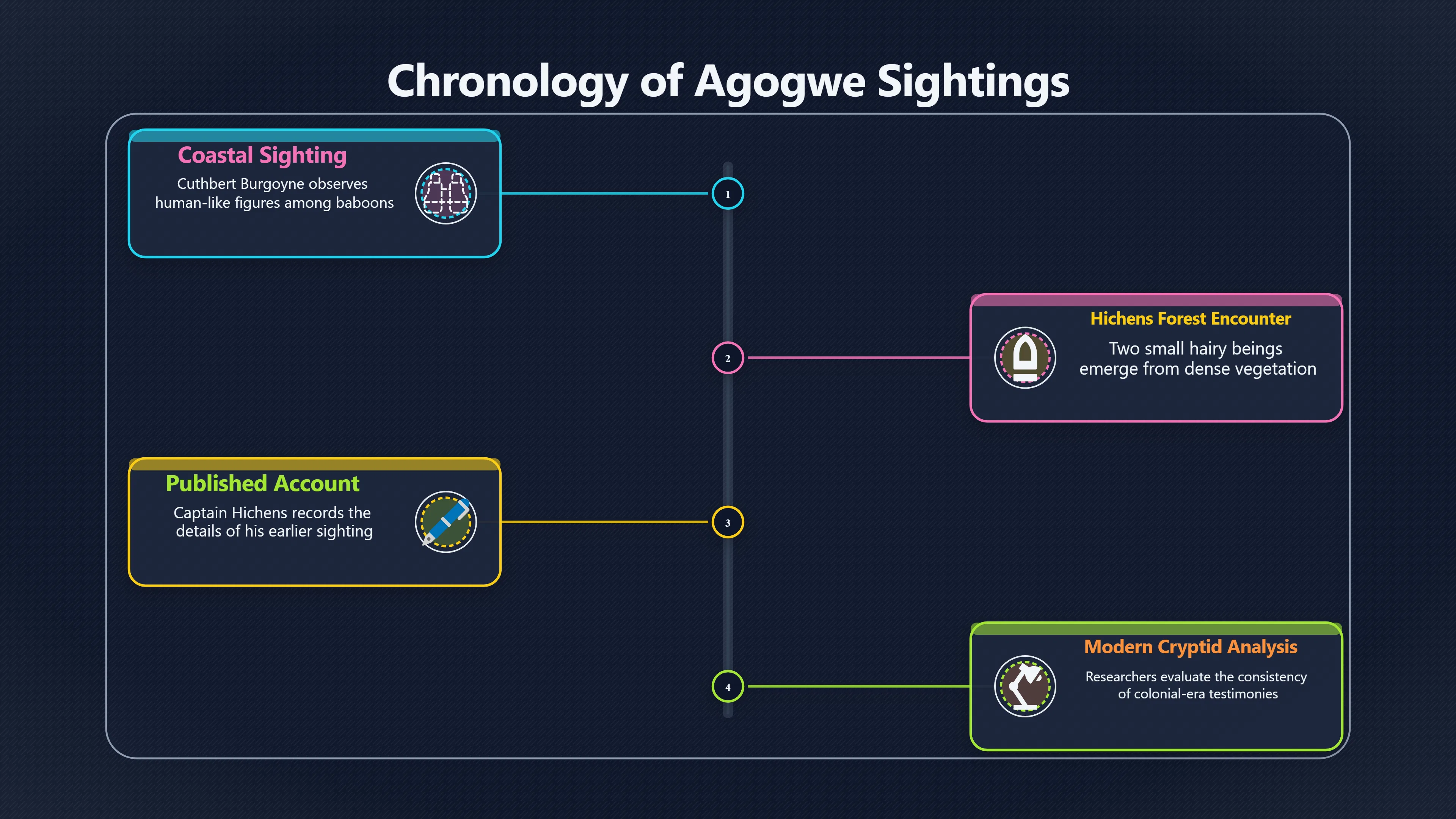
The best-known Agogwe account comes from Captain William Hichens, a British colonial administrator and hunter in what was then Tanganyika. Writing in 1937 about an incident that had occurred years earlier in the forests near the Wembere plains, Hichens described seeing two small creatures emerge briefly from dense vegetation before disappearing again. He said they were roughly four feet tall, walked upright and were covered in reddish-brown hair.[Wikipedia]WikipediaOpen source on wikipedia.org.
What made the account memorable was the reaction of the local hunter accompanying him. According to Hichens, the man immediately identified the beings as Agogwe and treated the sighting with a mixture of fear and astonishment. The implication was that the creatures were already known in local tradition rather than being invented by a European observer. Later retellings added claims that Agogwe were rarely seen and were regarded as elusive inhabitants of remote bush country.[notesandrecords.blogspot.com]notesandrecords.blogspot.comlittle furry men and womenLITTLE FURRY MEN (AND WOMEN)27 Feb 2011 — He identified them as 'agogwe', rarely encountered beings which, according to what villagers la…
A second frequently cited report came from Cuthbert Burgoyne, who wrote to the journal Discovery after Hichens’ article appeared. Burgoyne claimed that in 1927, while travelling along the East African coast, he observed through binoculars what appeared to be two small human-like figures moving among baboons. He stressed that they did not resemble any monkey he knew, though the distance prevented a detailed identification. He also repeated a story from a hunter who supposedly saw a family group consisting of two adults and a child.[Wikipedia]WikipediaOpen source on wikipedia.org.
These accounts form the core of the Agogwe tradition. Nearly every later discussion traces back to them.
Why Did People Associate Them With Tanzania?
The Agogwe became linked with Tanzania because the most influential report came from the interior of Tanganyika and because local people reportedly used the name before it appeared in English-language mystery-animal literature. The creature was not presented as a supernatural spirit or monster. Instead, witnesses described it as a rare, flesh-and-blood inhabitant of the bush.[Cryptid Archives]cryptidarchives.fandom.comCryptid Archives Agogwe | Encyclopaedia of CryptozoologyCryptid ArchivesAgogwe | Encyclopaedia of Cryptozoology - FandomThe agogwe (or ngogwe) was a cryptohominid reported from Tanzania and lin…
This distinction mattered. Colonial East Africa was already known for extraordinary wildlife, and European hunters often entered landscapes they did not fully understand. Stories of unusual animals circulated easily among hunters, administrators and travellers. A sighting that might have been dismissed elsewhere could become part of a wider tradition in a region already associated with unexplored wilderness.
Some later writers attempted to connect the Agogwe with similar reports from Kenya, Mozambique, Zimbabwe and Central Africa. These comparisons created a broader “little hairy people” tradition across parts of Africa, though the evidence remains scattered and largely anecdotal.[Cryptid Archives]cryptidarchives.fandom.comCryptid Archives Agogwe | Encyclopaedia of CryptozoologyCryptid ArchivesAgogwe | Encyclopaedia of Cryptozoology - FandomThe agogwe (or ngogwe) was a cryptohominid reported from Tanzania and lin…
Colonial Records and Their Reliability
The Agogwe story depends heavily on retrospective testimony. Hichens did not publish his account immediately after the event; he described it many years later. Burgoyne’s report was also based on a sighting recalled after the fact. That gap between observation and publication is important because memories can change and details can become sharpened by retelling.[Wikipedia]WikipediaOpen source on wikipedia.org.
Another limitation is the absence of supporting evidence. Neither witness obtained photographs, tracks, hair samples or remains. No zoological expedition subsequently documented a population of small unknown primates matching the descriptions. Even modern supporters of the mystery acknowledge that the Agogwe survives almost entirely through eyewitness testimony.[Wikipedia]WikipediaOpen source on wikipedia.org.
There is also the question of publication context. The accounts appeared during an era when stories of hidden tribes, lost species and unexplored wilderness attracted considerable public interest. That does not mean the witnesses were dishonest, but it does mean extraordinary claims received attention even when evidence was limited.
Still, the reports have retained some interest because neither witness described a giant monster or dramatic attack. The encounters were brief, understated and focused on appearance rather than sensational behaviour. To some readers, that restraint makes the stories seem more sincere, even if they remain unverified.
Could the Witnesses Have Seen an Unknown Primate?
The most ambitious explanation proposed by cryptozoologists is that the Agogwe represented a surviving species of primitive hominin or an unknown ape. Some writers have compared the descriptions to early human relatives such as australopithecines because of the reported upright posture and small body size.[Wikipedia]WikipediaOpen source on wikipedia.org.
The problem is that there is no fossil or biological evidence suggesting that such creatures survived into modern times in Tanzania. Australopithecines disappeared millions of years ago, and no verified remains indicate a surviving population. Mainstream palaeoanthropology therefore regards this explanation as extremely unlikely.[Wikipedia]WikipediaOpen source on wikipedia.org.
Even many mystery-animal researchers treat the idea cautiously because it relies on a chain of assumptions unsupported by physical evidence.
Primate, Folklore and Misidentification Theories
More conventional explanations focus on misidentification.
East Africa contains several primate species that can occasionally appear surprisingly human-like when glimpsed briefly. Baboons, vervet monkeys and other primates can stand upright for short periods, especially when moving through vegetation or feeding. Poor visibility, distance and surprise can make size and posture difficult to judge accurately. Burgoyne himself observed his creatures among baboons, making primate confusion a possibility.[Wikipedia]WikipediaOpen source on wikipedia.org.
Folklore may also have played a role. Around the world, many cultures preserve stories of small wild people living beyond settled areas. Once such traditions exist, unusual sightings can be interpreted through an established narrative. If local communities already recognised the concept of hairy little forest dwellers, a fleeting encounter with an unfamiliar animal could reinforce rather than challenge the tradition.[notesandrecords.blogspot.com]notesandrecords.blogspot.comlittle furry men and womenLITTLE FURRY MEN (AND WOMEN)27 Feb 2011 — He identified them as 'agogwe', rarely encountered beings which, according to what villagers la…
Another possibility is that the stories combined observation and folklore. A witness may genuinely have seen something unusual, while cultural expectations helped shape how the sighting was remembered and explained afterwards.

Why the Agogwe Still Appears in Cryptid Discussions
The Agogwe remains part of Tanzania’s cryptid landscape largely because it occupies a narrow space between complete invention and convincing zoology. The reports are too few to establish a real species, yet they are detailed enough to continue provoking curiosity.[Wikipedia]WikipediaOpen source on wikipedia.org.
Unlike many monster legends, the Agogwe was not described as enormous, supernatural or destructive. The witnesses claimed to see something small, shy and fleeting. That modesty gives the story a distinctive flavour. Readers are left with a simple mystery: did a few observers misidentify known animals under unusual circumstances, or were they describing a local tradition that had already blurred the line between folklore and natural history?
More than a century after the first alleged encounter, there is still no physical evidence that Tanzania’s little hairy people ever existed. Yet the handful of colonial-era sightings continue to be retold because they capture a recurring theme in cryptid history: the possibility that an ordinary-looking glimpse in the wilderness can grow into a legend that outlives every witness who claimed to see it.[Wikipedia]WikipediaOpen source on wikipedia.org.
Amazon book picks
Further Reading
Books and field guides related to Who Reported Tanzania's Little Hairy People?. Use these as the next step if you want deeper reading beyond the article.
Field Guide To Bigfoot, Yeti, & Other Mystery Primates Worldwide
The Agogwe is commonly discussed alongside other alleged wild-man reports.
Mysterious Creatures
Places Agogwe-style accounts within wider cryptozoological literature.
eBay marketplace picks
Marketplace Samples
Live-tested eBay searches with available results related to this page.



Endnotes
1.
Source: Wikipedia
Link:https://en.wikipedia.org/wiki/Agogwe
2.
Source: notesandrecords.blogspot.com
Title: little furry men and women
Link:https://notesandrecords.blogspot.com/2011/02/little-furry-men-and-women.html
Source snippet
LITTLE FURRY MEN (AND WOMEN)27 Feb 2011 — He identified them as 'agogwe', rarely encountered beings which, according to what villagers la...
3.
Source: Wikipedia
Link:https://es.wikipedia.org/wiki/Agogwe
4.
Source: cryptidarchives.fandom.com
Title: Cryptid Archives Agogwe | Encyclopaedia of Cryptozoology
Link:https://cryptidarchives.fandom.com/wiki/Agogwe
Source snippet
Cryptid ArchivesAgogwe | Encyclopaedia of Cryptozoology - FandomThe agogwe (or ngogwe) was a cryptohominid reported from Tanzania and lin...
Additional References
5.
Source: academia.edu
Link:https://www.academia.edu/38895911/Little_furry_men_and_women_
Source snippet
Little furry men (and women)He's written extensively about indigenous religion and ritual, and more recently ethnozoology and cry...
6.
Source: youtube.com
Title: Agogwe Explained | African Mythology And Folklore Ep.3
Link:https://www.youtube.com/watch?v=5gNL9H_OImY
Source snippet
A Journey Through East African Legendary Creatures...
7.
Source: youtube.com
Title: A Journey Through East African Legendary Creatures
Link:https://www.youtube.com/watch?v=DPrREnyFxUk
Source snippet
10 African Cryptids Explained...
8.
Source: youtube.com
Title: 10 African Cryptids Explained
Link:https://www.youtube.com/watch?v=Um8s7pOvOAs
Source snippet
WILDEST African Cryptids...
9.
Source: youtube.com
Title: Agogwe: Ape Man of East Africa
Link:https://www.youtube.com/watch?v=f59WT1b4Iv0
Source snippet
Music...
10.
Source: youtube.com
Title: WILDEST African Cryptids
Link:https://www.youtube.com/watch?v=b7T_VFXDpJo
Topic Tree