Cryptids of Djibouti's Strange Landscapes
Djibouti is not a country with a crowded public record of lake monsters, Bigfoot-style beasts or famous newspaper “monster flaps”. Its most useful cryptid-adjacent story is older and stranger: the legend that Djibouti’s very name may preserve the defeat of Bouti, an ogress or monstrous female figure feared in local tradition.
Page outline Jump by section
Introduction
That does not make Bouti a “cryptid” in the modern animal-hunting sense. She belongs more comfortably to folklore, origin legend and literary afterlife than to zoological mystery. Around her, however, Djibouti offers exactly the sort of landscape that invites monster stories: salt lakes, volcanic ground, steaming chimneys, dark gulfs, whale sharks, hyenas, baboons, rare antelopes and an oral culture in which poetry and storytelling have long helped preserve community memory.[Every Culture]everyculture.comEvery Culture DjiboutiansEvery Culture Djiboutians
The main creature: Bouti, the ogress behind the name
The clearest Djibouti-linked monster tradition in accessible sources is Bouti. In the US State Department’s 1998 “Post of the Month” feature, Bouti is presented as an ogress feared by Djibouti’s nomadic people: a shape-changing being who could endure even as a small remaining piece of herself. The same account says nomads believed they had killed Bouti and named the place of her death “Djibouti”.[State.gov]1997-2001.state.govOpen source on state.gov.
A modern literary route keeps the same idea alive. Discussion of Abdourahman A. Waberi’s short-story collection Le Pays sans ombre notes a story called “The Primal Ogress”, in which the country’s name is explained as “Jabouti”: “Jab”, defeat, plus “Bouti”, the ogress. The same reading presents Bouti as a devouring, almost origin-mother figure rather than a hidden animal waiting to be photographed.[Talking About Books]talking-about-books.comTalking About Books Le Pays sans ombre: Abdourahman A. WaberiTalking About Books Le Pays sans ombre: Abdourahman A. Waberi
That distinction matters. Bouti is not like the Loch Ness Monster, where people argue about sonar traces, photographs and misidentified animals. She is closer to a founding monster: a being whose defeat helps explain a place, a name and a cultural memory. In cryptid terms, she sits on the border between monster folklore and national origin legend.
There are also competing name explanations. A recent book description for The Role of Commercial Emporia in the World-System gives several suggested derivations: “Djab-bouti” as the defeat of the ogress for Somali tradition, “ja-buta” as lycanthropy for Afar, and “jaa-bawti” as “my boat arrives” for Arabic.[Google Books]books.google.comOpen source on google.com. This does not prove any one etymology beyond doubt. It shows that the ogress explanation is part of a wider cluster of folk-etymological stories rather than a settled linguistic fact.
Why Djibouti’s landscape feels monster-ready
Djibouti’s monster folklore cannot be separated from its terrain. The country is small, arid and geologically dramatic, with desert plains, volcanic areas, salt flats, coastal waters and isolated highland pockets. A Convention on Biological Diversity country profile describes sparse vegetation of thorn scrub and palms, while also noting threatened species such as sharks, green turtles, spotted hyenas and Grevy’s zebra.[Convention on Biological Diversity]cbd.intConvention on Biological Diversity DjiboutiConvention on Biological Diversity Djibouti
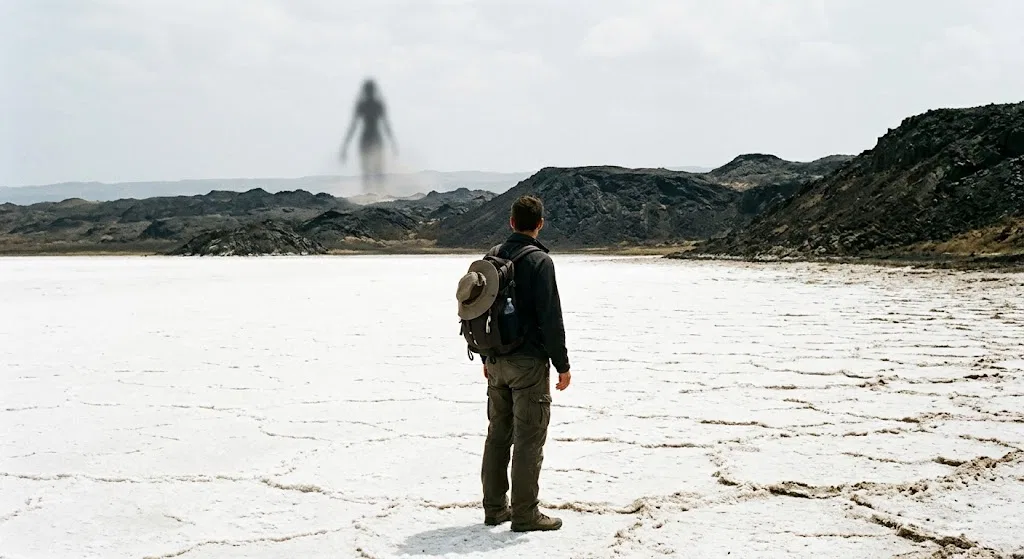
Lake Assal is especially easy to read as a “monster landscape”, even when no famous lake monster is attached to it. It lies about 155 metres below sea level and is one of the most saline bodies of water on Earth, with salt flats, brine and geothermal influence rather than the deep freshwater ecology usually associated with lake-monster claims.[Wikipedia]WikipediaLake Assal (DjiboutiLake Assal (Djibouti In practical terms, that makes a large unknown aquatic animal unlikely there. In storytelling terms, the white salt crust, heat shimmer and extreme isolation are exactly the kind of setting where a strange tale can feel believable.
Lake Abbé, on the Ethiopia-Djibouti border, adds a different kind of strangeness. Recent travel reporting describes its exposed limestone chimneys, steaming pools, flamingos, pelicans and hyena tracks, while noting that changes to the Awash River system reduced the lake and exposed formations that had once developed underwater.[The Times]thetimes.co.ukThe Times This is Africa's most under-the-radar beach destinationThe best time to visit is between November and March, avoiding the extreme heat from May to September when temperatures can soar to 42°C… These features are not evidence of a monster, but they help explain why Djibouti’s natural sites are often described in otherworldly language.
The sea gives Djibouti its strongest “giant creature” reality check. The Gulf of Tadjoura and nearby waters are known for seasonal whale shark aggregations. Scientific work has described Djibouti as an important seasonal site for whale sharks in the Gulf of Aden, and a 2007 study identified juvenile whale sharks in the Gulf of Tadjoura, many only around three to four metres long.[ADS]ui.adsabs.harvard.eduADSThe ecology of the whale shark in DjiboutiADSThe ecology of the whale shark in Djibouti To an unprepared observer, a huge spotted shark at the surface can look like a sea monster. To a biologist, it is a vulnerable, plankton-feeding fish with a documented seasonal pattern.
Where mystery-beast reports would most plausibly arise
There is no strong public record of recurring Djiboutian cryptid hotspots comparable to Loch Ness, Lake Champlain or Congo Basin dinosaur stories. Still, several areas would naturally attract anomalous-animal claims because of visibility, terrain and wildlife.
The Gulf of Tadjoura and Ghoubbet area is the most plausible source for “sea monster” impressions. Whale sharks appear seasonally, and a 2025 study on immature whale sharks in Djibouti links coastal aggregations between October and February to increased zooplankton biomass caused by monsoon variability.[Siena Air]usiena-air.unisi.itSiena Air Environmental Drivers of Immature Whale Shark SurfaceSiena Air Environmental Drivers of Immature Whale Shark Surface A snorkeller, sailor or fisherman seeing a large fin, spotted back or slow-moving surface shape in poor light might reach first for folklore rather than taxonomy.
Lake Assal is visually dramatic but biologically poor as a lake-monster candidate. Its hypersalinity, evaporation-driven chemistry and salt extraction history make it a place of geological awe rather than a likely refuge for large hidden animals.[Wikipedia]WikipediaLake Assal (DjiboutiLake Assal (Djibouti Reports from such a place would be more likely to involve mirage, heat distortion, unusual salt formations or misread movement at the shore than an unknown aquatic creature.
The Day Forest and Goda Massif area offers a different mystery-beast setting. Djibouti Nature describes the Day Forest ecosystem as dry tropical Afromontane mixed woodland in the Goda Massif, between roughly 1,200 and 1,750 metres elevation, and notes its importance for birds and conservation.[djiboutinature.org]djiboutinature.orgnotes on day forestnotes on day forest In a country dominated by arid landscapes, a cooler highland forest can become a natural home for rumours about hidden animals, phantom cats or strange cries, even when the better explanation is known wildlife.
Southern Djibouti’s rocky slopes matter for another reason: the beira antelope. The beira is a small, wary Horn of Africa antelope whose occurrence in Djibouti was confirmed only in 1993, according to species accounts summarising the scientific literature.[Wikipedia]WikipediaBeira (antelopeBeira (antelope That is not a cryptid discovery in the dramatic sense, but it is a useful reminder: in difficult terrain, even real animals can remain poorly known to outsiders for a long time.

Folklore, not field zoology
Djibouti’s strongest monster material is oral and symbolic. Sources on Djiboutian culture emphasise Somali Issa and Afar traditions, oral poetry, storytelling and religious life, rather than a catalogue of named mystery animals. One cultural profile notes that Somali oral poetry records community history, customs and current events, while also describing Issa origin traditions centred on a revered ancestor whose shrine is in Djibouti.[Every Culture]everyculture.comEvery Culture DjiboutiansEvery Culture Djiboutians
That helps explain why Bouti survives differently from a modern cryptid. She is not mainly preserved through expedition reports, blurry photographs or tourist brochures. She appears through name stories, literary treatment and the broader habit of using oral narrative to explain danger, origin and social order.
The ogress pattern is also familiar across many cultures. A devouring female monster can represent famine, social fear, uncontrolled power, dangerous appetite or the threat outside the safe settlement. In Djibouti’s case, modern references to Bouti often frame her as an ancient ogress, a defeated terror or a primal figure attached to national beginnings.[Talking About Books]talking-about-books.comTalking About Books Le Pays sans ombre: Abdourahman A. WaberiTalking About Books Le Pays sans ombre: Abdourahman A. Waberi
What might explain Djibouti’s strange-animal stories
Djibouti’s likely “monster” explanations are more interesting than a simple debunking, because they show how environment and folklore overlap.
Whale sharks can look monstrous without being monsters. Djibouti’s whale sharks are real, scientifically recorded and seasonally visible. Their size, surface-feeding behaviour and unfamiliar silhouette could easily generate sea-serpent-style impressions for visitors or casual observers, especially in choppy water.[seaturtle.org]seaturtle.orgOpen source on seaturtle.org.
Hyenas and other predators can become night beasts. Djibouti’s threatened-species profile includes spotted hyena, while travel reporting around Lake Abbé mentions hyena tracks in a remote, steaming landscape.[Convention on Biological Diversity]cbd.intConvention on Biological Diversity DjiboutiConvention on Biological Diversity Djibouti A nocturnal scavenger heard before it is seen is exactly the sort of animal that can become larger, stranger and more malicious in retelling.
Rare or elusive animals can feel legendary. The beira antelope’s confirmed Djiboutian record came late in the modern scientific literature, and its rocky habitat and wary behaviour make it hard to observe casually.[Wikipedia]WikipediaBeira (antelopeBeira (antelope This is the quiet side of cryptozoology: not monsters, but ordinary-looking animals that remain obscure because their habitat is remote, hot or politically difficult to survey.
Geology does some of the haunting. Lake Assal’s salt crusts and Lake Abbé’s chimneys create forms that seem designed for myth. A strange white plain, a steaming pool or a tower in the dawn light does not need a creature to feel uncanny.[Wikipedia]WikipediaLake Assal (DjiboutiLake Assal (Djibouti
Why there are few famous Djiboutian cryptids
The thinness of Djibouti’s public cryptid record is not surprising. Modern cryptid fame usually depends on a loop of newspapers, tourism, repeat witnesses, photographs, local branding and later internet retellings. Djibouti’s best-known international images are instead geopolitical, geological and marine: ports, military bases, salt lakes, volcanic landscapes and whale sharks.
There is also a habitat issue. Classic lake monsters usually need large, dark, deep freshwater lakes with enough fish to make an unknown animal seem at least superficially possible. Djibouti’s most famous lake, Assal, is hypersaline and extreme; Abbé is shallow, shrinking and shared across a harsh borderland environment.[Wikipedia]WikipediaLake Assal (DjiboutiLake Assal (Djibouti These places are spectacular, but they are not ideal homes for a Nessie-type legend.
The country’s real animals already supply many of the impressions that monster stories often use: large sharks, hyenas, jackals, baboons, gazelles, rare birds, turtles and desert-adapted mammals. The CBD profile notes Djibouti’s bird and fish diversity alongside threatened marine and terrestrial species, while other conservation-oriented sources highlight the special value of Day Forest.[Convention on Biological Diversity]cbd.intConvention on Biological Diversity DjiboutiConvention on Biological Diversity Djibouti In other words, the boundary between “strange creature” and “poorly known wildlife” is already vivid without inventing an undiscovered beast.
How to read Djibouti’s monster tradition fairly
The fairest reading is that Djibouti has a powerful monster-name legend rather than a strong modern cryptid tradition. Bouti is the centrepiece: a shape-changing ogress whose defeat is used in one popular explanation of the country’s name. That explanation is culturally memorable but not linguistically settled, since other proposed derivations exist.[State.gov]1997-2001.state.govOpen source on state.gov.
For readers interested in cryptids by country, Djibouti is valuable because it shows a different pattern. Some countries are built around repeated animal claims: lake monsters, ape-men, phantom cats, surviving dinosaurs. Djibouti’s case is more about how a monster can attach itself to a place-name, how oral tradition and literature keep the figure alive, and how an extreme landscape can make even ordinary wildlife feel mythic.
So the question is not “What hidden animal is Djibouti concealing?” The better question is: “What kind of monster does Djibouti remember?” The answer, on the current evidence, is Bouti the ogress — part feared being, part origin figure, part literary symbol — surrounded by a real country of salt, heat, dark water and animals strange enough to need no exaggeration.

Amazon book picks
Further Reading
Books and field guides related to What Monsters Haunt Djibouti's Strange Landscapes?. Use these as the next step if you want deeper reading beyond the article.
African Myths of Origin
Origin legends and place-naming stories closely match the Bouti tradition.

The Penguin Book of Dragons
Provides a strong folklore framework for understanding monster traditions like Bouti.
eBay marketplace picks
Marketplace Samples
Live-tested eBay searches with available results related to this page.
Endnotes
1.
Source: 1997-2001.state.gov
Link:https://1997-2001.state.gov/publications/statemag/statemag_dec98/pomtxt.html
2.
Source: cbd.int
Title: Convention on Biological Diversity Djibouti
Link:https://www.cbd.int/countries/profile/?country=dj
3.
Source: talking-about-books.com
Title: Talking About Books Le Pays sans ombre: Abdourahman A. Waberi
Link:https://talking-about-books.com/2023/10/28/le-pays-sans-ombre-abdourahman-a-waberi/
4.
Source: books.google.com
Link:https://books.google.com/books/about/The_Role_of_Commercial_Emporia_in_the_Wo.html?id=rLwpEQAAQBAJ
5.
Source: Wikipedia
Title: Lake Assal (Djibouti)
Link:https://en.wikipedia.org/wiki/Lake_Assal_%28Djibouti%29
6.
Source: ui.adsabs.harvard.edu
Title: ADSThe ecology of the whale shark in Djibouti
Link:https://ui.adsabs.harvard.edu/abs/2020AqEco..54..535B/abstract
7.
Source: seaturtle.org
Link:https://www.seaturtle.org/PDF/RowatD_2007_EnvironBiolFish.pdf
8.
Source: djiboutinature.org
Title: notes on day forest
Link:https://djiboutinature.org/notes-on-day-forest/
9.
Source: Wikipedia
Title: Beira (antelope)
Link:https://en.wikipedia.org/wiki/Beira_%28antelope%29
10.
Source: Wikipedia
Link:https://en.wikipedia.org/wiki/Lake_Abbe
11.
Source: Wikipedia
Title: Culture of Djibouti
Link:https://en.wikipedia.org/wiki/Culture_of_Djibouti
12.
Source: Wikipedia
Title: Somali mythology
Link:https://en.wikipedia.org/wiki/Somali_mythology
13.
Source: Wikipedia
Title: List of cryptids
Link:https://en.wikipedia.org/wiki/List_of_cryptids
14.
Source: Wikipedia
Title: Ghoubbet el Kharab
Link:https://en.wikipedia.org/wiki/Ghoubbet-el-Kharab
15.
Source: Wikipedia
Link:https://en.wikipedia.org/wiki/Djibouti
16.
Source: Wikipedia
Title: Wildlife of Djibouti
Link:https://en.wikipedia.org/wiki/Wildlife_of_Djibouti
17.
Source: Wikipedia
Title: List of mammals of Djibouti
Link:https://en.wikipedia.org/wiki/List_of_mammals_of_Djibouti
18.
Source: Wikipedia
Title: History of France–United Kingdom relations
Link:https://en.wikipedia.org/wiki/History_of_France%E2%80%93United_Kingdom_relations
19.
Source: Wikipedia
Title: Sea snake
Link:https://en.wikipedia.org/wiki/Sea_snake
20.
Source: play.google.com
Title: The Role of Commercial Emporia in the World System
Link:https://play.google.com/store/books/details/The_Role_of_Commercial_Emporia_in_the_World_System?hl=gsw&id=TsApEQAAQBAJ
21.
Source: djiboutinature.org
Link:https://djiboutinature.org/tag/day-forest/
22.
Source: djiboutinature.org
Link:https://djiboutinature.org/tag/mammals/
23.
Source: everyculture.com
Title: Every Culture Djiboutians
Link:https://www.everyculture.com/wc/Costa-Rica-to-Georgia/Djiboutians.html
24.
Source: thetimes.co.uk
Title: The Times This is Africa’s most under-the-radar beach destination
Link:https://www.thetimes.co.uk/article/djibouti-adventure-holiday-ksmfb6lmz
Source snippet
The best time to visit is between November and March, avoiding the extreme heat from May to September when temperatures can soar to 42°C...
25.
Source: usiena-air.unisi.it
Title: Siena Air Environmental Drivers of Immature Whale Shark Surface
Link:https://usiena-air.unisi.it/bitstream/11365/1313424/1/6%20-%20Gibuti%20environmental%20driver%20conservation-05-00068.pdf
26.
Source: steppestravel.com
Link:https://www.steppestravel.com/holiday-ideas/djibouti-salt-lakes-and-whale-sharks/
27.
Source: tripadvisor.com
Title: Lake Assal
Link:https://www.tripadvisor.com/Attraction_Review-g293787-d311338-Reviews-Lake_Assal-Djibouti.html
28.
Source: rahhalah.com
Link:https://www.rahhalah.com/trip/djibouti-landscapes-whale-sharks-spring/?srsltid=AfmBOopRWqU-ZfpBILnSvHQ3NCWgyp_mualhon6Jx1ID4gRlxcfKyCiy
29.
Source: rahhalah.com
Link:https://www.rahhalah.com/trip/djibouti-landscapes-whale-sharks-spring/?srsltid=AfmBOopkZQzvrYVaFmqEYXvVrNhJKdEzERnRxU3rvaUSupvEXnVD5RnT
30.
Source: thescribsandnibs.com
Title: whale sharks in djibouti
Link:https://thescribsandnibs.com/africa/djibouti/whale-sharks-in-djibouti/
31.
Source: datazone.birdlife.org
Link:https://datazone.birdlife.org/country/factsheet/djibouti
32.
Source: theanimalmap.com
Link:https://theanimalmap.com/en/countries/djibouti
33.
Source: mptf.undp.org
Link:https://mptf.undp.org/sites/default/files/documents/40000/djibouti.pdf
34.
Source: the-running-ginger.blog
Link:https://the-running-ginger.blog/djibouti/
35.
Source: brilliantmaps.com
Title: cryptids by country
Link:https://brilliantmaps.com/cryptids-by-country/
Additional References
36.
Source: govinfo.gov
Link:https://www.govinfo.gov/content/pkg/GOVPUB-D301-PURL-gpo68286/pdf/GOVPUB-D301-PURL-gpo68286.pdf
37.
Source: youtube.com
Title: Real Life In DJIBOUTI, The HOTTEST AND STRANGEST Country on EARTH
Link:https://www.youtube.com/watch?v=1QoejKXXQgo
Source snippet
Exploring Africa's Hidden Country (Djibouti)...
38.
Source: youtube.com
Title: Exploring the Mystical Beauty of Lake Abhe
Link:https://www.youtube.com/watch?v=NIBTgYCKscQ
Source snippet
Real Life In DJIBOUTI, The HOTTEST AND STRANGEST Country on EARTH...
39.
Source: youtube.com
Title: Djibouti Adventure: Desert Landscapes & Unique Wildlife
Link:https://www.youtube.com/watch?v=6BSe3tJWbco
Source snippet
Exploring the Mystical Beauty of Lake Abhe...
40.
Source: instagram.com
Link:https://www.instagram.com/reel/DIRMt0LtrSK/
41.
Source: macrobians.com
Link:https://macrobians.com/tour-packages/2-days-lake-abbe-lake-assal-private-tour/
42.
Source: facebook.com
Link:https://www.facebook.com/Jawarmd/posts/a-good-read-on-history-of-the-afar-nation/10104463270651633/
43.
Source: instagram.com
Link:https://www.instagram.com/p/DT7fiWXCF4L/
44.
Source: researchgate.net
Link:https://www.researchgate.net/publication/225462229_Aggregations_of_juvenile_whale_sharks_Rhincodon_typus_in_the_Gulf_of_Tadjoura_Djibouti
45.
Source: animalia.bio
Link:https://animalia.bio/djibouti-animals?__cf_chl_rt_tk=vyxk_tkpa6j3ekh9dcn9vimvcyxlpmqg.hyioh6dn6s-1781381004-1.0.1.1-bt_ol5sgq3xicdaqc5qu6_eanznbffku657dpqqras0
Topic Tree
Follow this branch
Related pages 192
- Antigua Cryptids
- Maldives Monsters
- Malta Monsters
- Qatar Monsters
- Argentina Monsters
- +187 more in sidebar