Within Panama Monsters
What Haunts Panama's Rivers and Roads?
The Tulivieja, Cadejo, Chivato and Silampa turn rivers, roads and familiar animals into warnings about danger and conduct.
On this page
- The Tulivieja beside rivers and lonely paths
- Cadejos, demonic goats and growing white shapes
- Why folklore creatures are not undiscovered animals
Page outline Jump by section
Introduction
Panama’s older monster traditions are very different from modern cryptid stories about unknown animals. Instead of hidden jungle beasts, many of the country’s best-known supernatural creatures haunt rivers, roads, forests and lonely paths. They are part ghost, part monster and part moral lesson. Their stories were shaped by rural life, dangerous landscapes and generations of oral storytelling, warning listeners about wandering alone at night, neglecting children, drunkenness, infidelity or reckless behaviour.[Wikipedia]WikipediaOpen source on wikipedia.org.
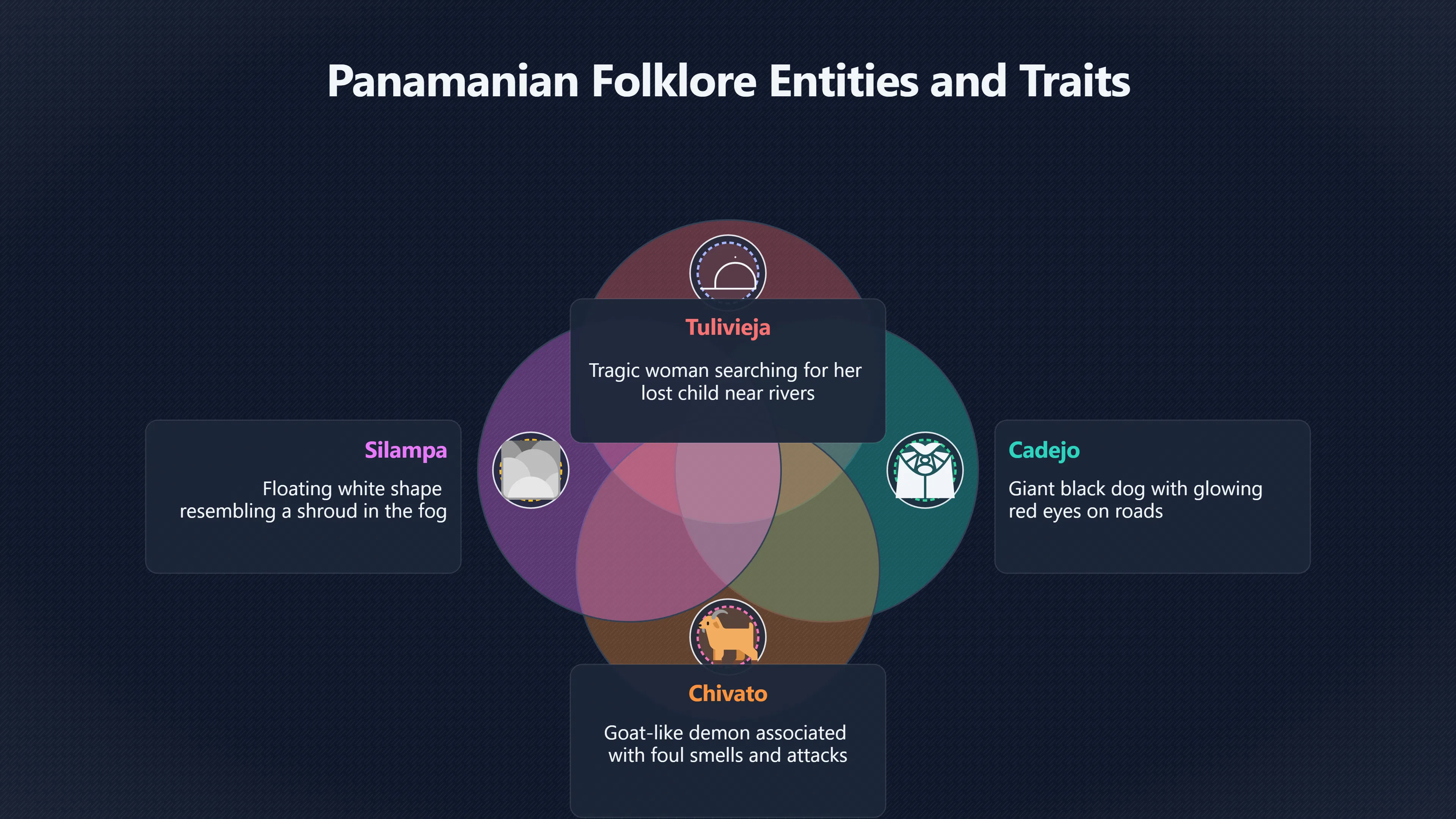
Among the most enduring figures are the Tulivieja, the Cadejo, the Chivato and the Silampa. Each occupies a different corner of Panama’s folklore, yet all blur the line between familiar animals and supernatural terror. They are remembered not as undiscovered species but as legendary beings whose appearances explain fears associated with rivers, mist, darkness and isolated roads.[Wikipedia]WikipediaOpen source on wikipedia.org.
What Haunts Panama’s Rivers and Roads?
The Tulivieja beside rivers and lonely paths
The Tulivieja is one of the most famous figures in Panamanian folklore. Although descriptions vary by region, she is usually portrayed as a tragic woman condemned to wander riverbanks, streams and remote countryside after causing the death or abandonment of her child. In many versions she endlessly searches for the child she lost, crying out through the night.[wikipedia.org]WikipediaOpen source on wikipedia.org.
What makes the Tulivieja especially memorable is her shifting appearance. Witnesses in folklore accounts may first see a lonely woman near a river, only for her to transform into something monstrous. Some traditions describe claws instead of hands, animal-like legs, wings, tangled hair and distorted features. Other versions emphasise her broad hat, from which her name is derived, and portray her as a frightening hybrid of woman and beast.[Wikipedia]WikipediaOpen source on wikipedia.org.
The story functions on several levels. It is a warning about dangerous waterways, especially for children. It also reflects themes found across Latin American folklore: guilt, motherhood, abandonment and punishment. In Panama’s Indigenous traditions, related figures such as Tepesa are woven into local cultural narratives, giving the legend roots deeper than the colonial period alone.[Wikipedia]WikipediaOpen source on wikipedia.org.
Unlike a cryptid report, the Tulivieja is not presented as a hidden animal. She belongs to the realm of cautionary folklore. Her territory is symbolic as much as physical: rivers become places where grief, danger and memory take monstrous form.[Wikipedia]WikipediaOpen source on wikipedia.org.
Cadejos, demonic goats and growing white shapes
Panama’s roads and trails are also haunted by animal-like spirits.
The Cadejo appears as a huge black dog with glowing red eyes. Across Central America the legend takes several forms, but Panamanian traditions often describe a single black Cadejo, sometimes called the Perro Prieto. It is associated with lonely roads, late-night travellers and encounters after midnight. Some stories portray it as a demonic presence smelling of sulphur and linked to the devil, while others give it a more ambiguous role as a supernatural guardian that escorts people home safely.[Wikipedia]WikipediaOpen source on wikipedia.org.
The Cadejo’s importance lies in its setting. Rural roads were genuinely hazardous, especially before modern lighting and transport. A giant spectral dog following travellers transformed those real dangers into a memorable story. In some regions the Cadejo punishes drunkards, womanisers or people who ignore social expectations, turning the creature into a supernatural enforcer of community values.[Wikipedia]WikipediaOpen source on wikipedia.org.
The Chivato occupies a similar space. Folklore commonly portrays it as a goat-like demon or devilish creature associated with attacks, foul smells and nighttime fear. Some versions connect it with black dogs and infernal imagery, blurring the distinction between animal monster and demonic apparition. The creature often appears in stories designed to discourage wandering into dangerous places after dark.[Scribd]scribd.comOpen source on scribd.com.
Then there is the Silampa, one of Panama’s strangest legendary beings. Rather than appearing as a recognisable animal, it is often described as a floating white shape resembling a sheet or shroud drifting through fog. According to the legend, it can grow to extraordinary size as it approaches. Some accounts depict it as a ghostly woman in white; others portray it as a predatory entity lurking in mist-covered fields and roads.[Wikipedia]WikipediaOpen source on wikipedia.org.
The Silampa is particularly revealing because its appearance closely matches natural conditions that can distort perception. Fog, moonlight and distance can make ordinary objects seem enormous or alive. The legend captures the unsettling experience of seeing something white emerge from mist with no clear shape or scale.[Wikipedia]WikipediaOpen source on wikipedia.org.
Why these stories survived
These creatures endured because they addressed real anxieties in rural Panama.
Rivers could flood suddenly. Forests and fields became disorienting after sunset. Travel between settlements often required long walks along isolated paths. In such environments, stories about monstrous women, spectral dogs and looming white apparitions provided memorable ways to teach caution.[Wikipedia]WikipediaOpen source on wikipedia.org.
The legends also served social purposes:
- The Tulivieja warned against neglecting children and straying into dangerous waterways.
- The Cadejo discouraged reckless behaviour and late-night wandering.
- The Chivato reinforced fears of temptation, sin and forbidden places.
- The Silampa reminded listeners that the landscape itself could deceive and endanger travellers.[Wikipedia]WikipediaOpen source on wikipedia.org.
As Panama urbanised, these stories did not disappear. Instead, they moved into schoolbooks, folklore collections, festivals, films and online discussions, becoming markers of cultural identity as well as sources of fear.[Al Día News]aldianews.companamas devil wheelsAl Día NewsThe first Panamanian horror movie30 Oct 2019 — The La Tulivieja myth, also called La Tepesa, tells that there was a Spanish ma…
Why folklore creatures are not undiscovered animals
From a cryptozoological perspective, Panama’s night spirits occupy a different category from mystery-animal reports. There is no physical evidence suggesting breeding populations of giant spectral dogs, shape-shifting river women or enormous white entities. The stories are transmitted through folklore, oral tradition and cultural memory rather than through repeated zoological observations.[Wikipedia]WikipediaOpen source on wikipedia.org.
That does not make them unimportant. In many ways, they reveal more about Panama’s history than a hypothetical unknown species would. They preserve Indigenous influences, colonial-era moral lessons and local experiences of a landscape that could be both beautiful and dangerous. The Tulivieja, Cadejo, Chivato and Silampa remain compelling because they transform ordinary features of the countryside—rivers, roads, dogs, goats, fog and darkness—into unforgettable monsters.[Wikipedia]WikipediaOpen source on wikipedia.org.
Amazon book picks
Further Reading
Books and field guides related to What Haunts Panama's Rivers and Roads?. Use these as the next step if you want deeper reading beyond the article.
The Mythology Book
Useful for understanding supernatural folklore figures like Tulivieja and Cadejo.
The Power of Myth
Rating: 4.5/5 from 14 Google Books ratings
Explores why supernatural stories persist across cultures.
eBay marketplace picks
Marketplace Samples
Live-tested eBay searches with available results related to this page.


Endnotes
1.
Source: Wikipedia
Link:https://en.wikipedia.org/wiki/Tulevieja
2.
Source: Wikipedia
Link:https://en.wikipedia.org/wiki/Cadejo
3.
Source: Wikipedia
Link:https://es.wikipedia.org/wiki/Silampa
4.
Source: Wikipedia
Link:https://es.wikipedia.org/wiki/Tulevieja
5.
Source: Wikipedia
Link:https://es.wikipedia.org/wiki/Cadejo
6.
Source: scribd.com
Link:https://www.scribd.com/document/970711572/Myths-and-Legends-Angely-2-from-Panama
7.
Source: Wikipedia
Title: Los Angeles
Link:https://en.wikipedia.org/wiki/Los_Angeles
8.
Source: Wikipedia
Link:https://en.wikipedia.org/wiki/Panama
9.
Source: es.scribd.com
Title: Myths and Legends Angely 2 from Panama
Link:https://es.scribd.com/document/970711572/Myths-and-Legends-Angely-2-from-Panama
10.
Source: aldianews.com
Title: panamas devil wheels
Link:https://aldianews.com/en/culture/screen/panamas-devil-wheels
Source snippet
Al Día NewsThe first Panamanian horror movie30 Oct 2019 — The La Tulivieja myth, also called La Tepesa, tells that there was a Spanish ma...
11.
Source: van-helsing-own-story.fandom.com
Link:https://van-helsing-own-story.fandom.com/wiki/Tulevieja
Additional References
12.
Source: monster.fandom.com
Title: Monster Wiki Tulevieja
Link:https://monster.fandom.com/wiki/Tulevieja
Source snippet
Monster WikiTulevieja - Monster Wiki - FandomThe Tulevieja or Tulivieja is a legendary character from Costa Rica and Panama; which is wri...
13.
Source: thelostandfoundhostel.com
Link:https://www.thelostandfoundhostel.com/blog/2026/5/9/the-strange-and-fascinating-superstitions-of-panama
Source snippet
The Lost and Found HostelThe Strange and Fascinating Superstitions of Panama9 May 2026 — La Tulivieja is often described as a ghostly wan...
Published: May 2026
14.
Source: youtube.com
Title: The Terrifying Creatures of Latin America
Link:https://www.youtube.com/watch?v=-50HUPG0qdU
Source snippet
Creatures and Monsters of Central and South American Folklore...
15.
Source: youtube.com
Title: Panama & Puerto Rico’s Spooky Urban Legends: Dead Crawling Out!
Link:https://www.youtube.com/watch?v=IXsgL5dfL4Q
Source snippet
The Terrifying Creatures of Latin America - Nightmares from Folklore...
16.
Source: pallaslife.com
Title: Pallas Understanding Panamanian Folklore and Legends
Link:https://pallaslife.com/knowledge/understanding-panamanian-folklore-and-legends/
Source snippet
This tale emphasizes themes of grief and the...Read more...
17.
Source: youtube.com
Title: The Haunting Legend of El Terrón: Panama’s Night Monster Revealed
Link:https://www.youtube.com/watch?v=h-GbK9gNRps
Source snippet
Panama & Puerto Rico's Spooky Urban Legends: Dead Crawling Out...
18.
Source: folklore.usc.edu
Title: la tulivieja a panamanian demonmonster
Link:https://folklore.usc.edu/la-tulivieja-a-panamanian-demonmonster/
Source snippet
The legend is that she still hounds the river looking for her...Read more...
19.
Source: youtube.com
Title: THE LEGEND OF EL CADEJO (Central American Folklore)
Link:https://www.youtube.com/watch?v=r6rs3xu1nzQ
Source snippet
Mitos y Leyendas Captados en Camara - El silbon mysterioustopics · 1.3M views...
20.
Source: youtube.com
Title: Creatures and Monsters of Central and South American Folklore
Link:https://www.youtube.com/watch?v=H5CrJSd-eeU
Source snippet
THE LEGEND OF EL CADEJO (Central American Folklore)...
21.
Source: facebook.com
Link:https://www.facebook.com/groups/904889201264040/posts/1463660975386857/
Topic Tree