Within Nauru Creatures
Could a Large Cryptid Hide on Nauru?
Nauru's tiny size, altered interior and lack of native land mammals leave little ecological room for a large undiscovered beast.
On this page
- Island size and the problem of concealment
- Known wildlife and likely misidentifications
- How phosphate mining changed the habitat
Page outline Jump by section
Introduction
Could a large unknown animal really hide on Nauru? Of all the countries sometimes mentioned in cryptid discussions, Nauru is one of the least favourable places for a hidden population of large land creatures. The island covers only about 21 square kilometres, making it one of the world’s smallest sovereign states, and much of its interior has been dramatically altered by more than a century of phosphate mining. At the same time, Nauru has no native land mammals and only a limited range of terrestrial wildlife. Taken together, these factors leave very little ecological or geographical space for a sizeable undiscovered animal.[DFAT]dfat.gov.aunauru country briefNauru country briefNauru is an island republic in the Pacific Ocean, 42 kilometres south of the equator and 4000 kilometres northeast…
That does not mean unusual sightings are impossible. People can misidentify animals, remember stories differently over time, or interpret unfamiliar movements in poor conditions. But when examining claims about hidden beasts on Nauru, the island’s physical reality is one of the strongest sceptical arguments.
Island Size and the Problem of Concealment
The biggest challenge for any hypothetical Nauruan cryptid is simple: there is nowhere obvious for it to hide.
Nauru’s total land area is roughly 21 square kilometres. A person can drive around the island in a short time, and the inhabited coastal belt forms a near-continuous ring around much of the shoreline. Unlike large islands that contain extensive forests, mountain ranges, swamps, or remote valleys, Nauru offers very limited unexplored terrain.[DFAT]dfat.gov.aunauru country briefNauru country briefNauru is an island republic in the Pacific Ocean, 42 kilometres south of the equator and 4000 kilometres northeast…
Large animals also require more than hiding places. They need:
- Enough food to support a breeding population.
- Access to water and shelter.
- Sufficient territory to avoid inbreeding.
- A population large enough to remain viable across generations.
Even if a single unknown animal somehow existed, a long-term species would require multiple individuals. On a small island with a human population of around 13,000 people, repeated encounters, carcasses, tracks, or other physical evidence would be expected. Yet there is no well-documented tradition of recurring reports resembling the classic Bigfoot, phantom-cat, or giant-reptile stories found elsewhere.[DFAT]dfat.gov.aunauru country briefNauru country briefNauru is an island republic in the Pacific Ocean, 42 kilometres south of the equator and 4000 kilometres northeast…
This is one reason Nauru’s creature traditions are generally rooted in mythology and sea lore rather than reports of hidden terrestrial animals.
Known Wildlife and Likely Misidentifications
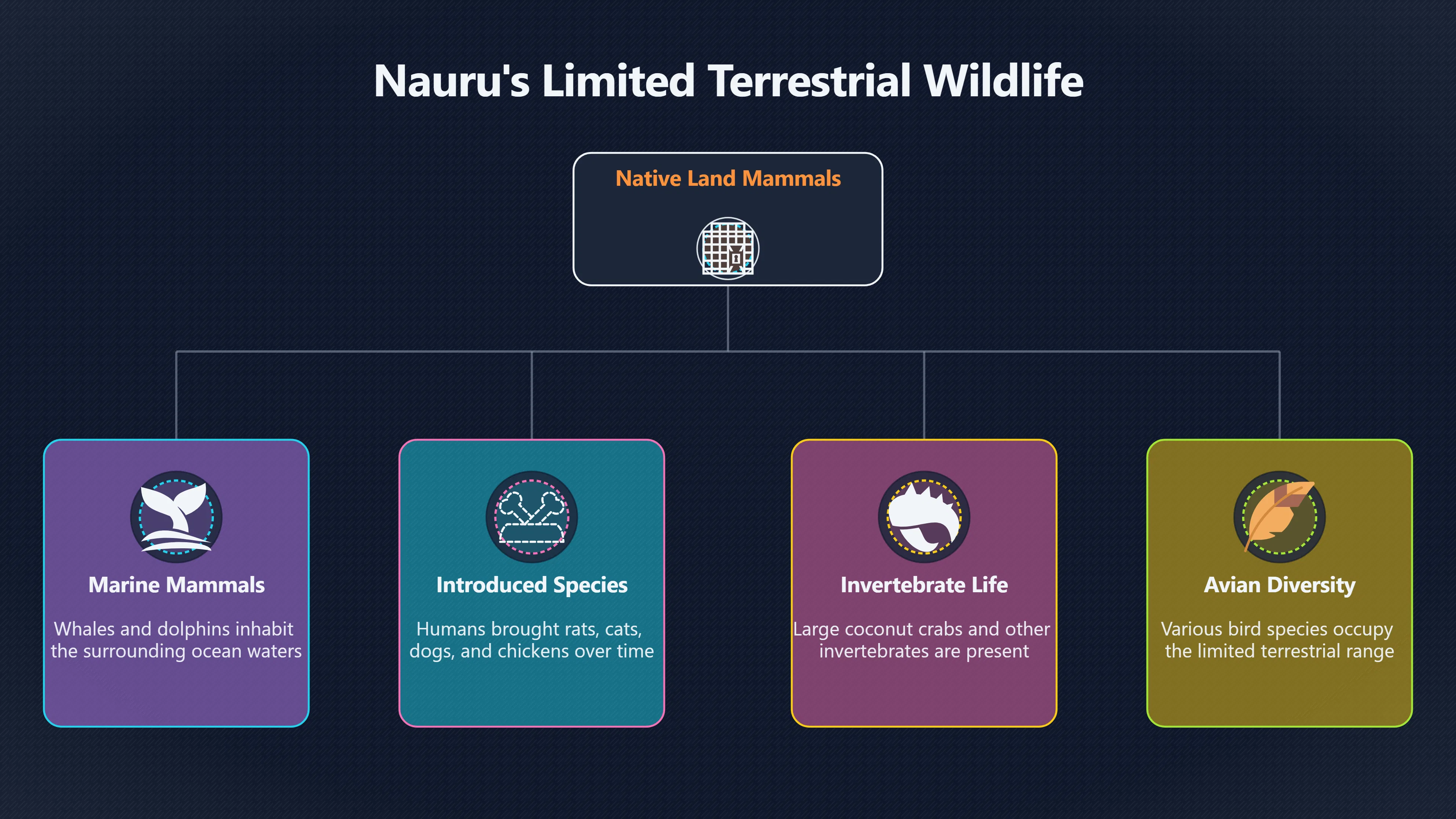
Nauru’s wildlife community is relatively limited compared with larger Pacific islands. The island has birds, insects, land crabs, reptiles, and various introduced animals, but no native land mammals. The mammals naturally associated with Nauru are marine species such as whales and dolphins found in surrounding ocean waters.[Wikipedia]WikipediaOpen source on wikipedia.org.
This matters because many famous cryptid traditions begin with real animals that are unusual, rare, or poorly seen. In places with large native mammals, witnesses may mistake bears, big cats, moose, wild pigs, or other animals for something mysterious. Nauru lacks that pool of large terrestrial wildlife.[Wikipedia]WikipediaOpen source on wikipedia.org.
Potential sources of confusion are therefore more modest:
- Introduced dogs roaming at a distance.
- Feral or semi-feral cats seen in poor light.
- Large seabirds viewed briefly.
- Coconut crabs or other sizeable invertebrates observed unexpectedly.
- Marine animals glimpsed offshore and interpreted from unusual angles.
Because there are so few candidate species, most reported mysteries are easier to narrow down than in countries with extensive forests and diverse mammal populations.
An additional factor is that isolated islands often receive introduced animals through human activity. Rats, cats, dogs, pigs, and chickens have all been brought to Nauru over time. A rare or unexpected sighting of one of these animals can appear more mysterious than it would in a richer ecosystem.[Wikipedia]WikipediaOpen source on wikipedia.org.
How Phosphate Mining Changed the Habitat
If Nauru once possessed more opportunities for concealment, phosphate mining greatly reduced them.
The island’s phosphate deposits were heavily exploited throughout the twentieth century. Mining removed vegetation, stripped topsoil, and exposed extensive limestone pinnacles across the interior. Researchers and official sources frequently estimate that roughly 80 per cent of the island has been affected by mining, leaving large areas difficult to use for agriculture, settlement, or natural habitat.[nih.gov]pmc.ncbi.nlm.nih.govPMCMining, land restoration and sustainable developmentby MJ Clifford · 2018 · Cited by 24 — 80% of Nauru has been mined for phosphate, leaving pinnacles of limestone that occur alongside p…
For cryptid speculation, this has two important consequences.
First, habitat suitable for large animals became scarcer. Dense vegetation and continuous natural ecosystems are usually what allow large creatures to remain elusive. Nauru’s altered interior instead became one of the most intensively transformed landscapes in the Pacific.[Wikipedia]WikipediaEffects of mining in NauruEffects of mining in Nauru
Second, mining brought people into areas that might otherwise have remained less visited. Roads, machinery, workers, surveys, and decades of industrial activity increased human presence across the island. A hidden population of large animals would have had fewer opportunities to remain undetected during this period.[Wikipedia]WikipediaPhosphate mining in Banaba and NauruPhosphate mining in Banaba and Nauru
Modern descriptions of Nauru often emphasise the dramatic limestone pinnacles left behind by extraction. While these formations can look rugged and unusual, they do not create vast wilderness zones comparable to the forests, mountains, or wetlands that feature in many cryptid legends.[PMC#ThinkLandscape]pmc.ncbi.nlm.nih.govPMCMining, land restoration and sustainable developmentby MJ Clifford · 2018 · Cited by 24 — 80% of Nauru has been mined for phosphate, leaving pinnacles of limestone that occur alongside p…
Why Sea Mysteries Are More Plausible Than Land Cryptids
Although a large hidden land animal is difficult to imagine on Nauru, the surrounding ocean presents a different situation.
The Pacific Ocean contains enormous areas that are difficult to observe continuously. Marine animals can appear unexpectedly, disappear beneath the surface, and be seen only briefly. Around the world, sea-serpent stories and reports of unusual marine creatures often emerge from these conditions.
That does not mean such reports prove the existence of unknown monsters. However, from a purely practical standpoint, the sea offers far more room for mystery than Nauru’s land area. This helps explain why Nauruan folklore and traditional stories are more naturally connected with the ocean than with secret beasts roaming the island interior.
The Bottom Line
When sceptics evaluate cryptid claims, they often ask whether the environment could realistically support the creature being proposed. In Nauru’s case, the answer is usually no.
The island is extremely small, lacks native land mammals, supports limited terrestrial wildlife, and has undergone major environmental transformation through phosphate mining. Any large undiscovered animal would need food, habitat, breeding numbers, and long-term concealment, yet the available evidence points in the opposite direction.[dfat.gov.au]dfat.gov.aunauru country briefNauru country briefNauru is an island republic in the Pacific Ocean, 42 kilometres south of the equator and 4000 kilometres northeast…
For that reason, Nauru is best understood as a place of mythic beings, sea stories, and cultural traditions rather than a likely refuge for a hidden population of large terrestrial cryptids.
Amazon book picks
Further Reading
Books and field guides related to Could a Large Cryptid Hide on Nauru?. Use these as the next step if you want deeper reading beyond the article.
The Song Of The Dodo
Highly relevant to the ecological limits of small islands like Nauru.
Why Evolution is True
Provides biological context for evaluating claims of undiscovered large animals.
eBay marketplace picks
Marketplace Samples
Live-tested eBay searches with available results related to this page.

Endnotes
1.
Source: dfat.gov.au
Title: nauru country brief
Link:https://www.dfat.gov.au/geo/nauru/nauru-country-brief
Source snippet
Nauru country briefNauru is an island republic in the Pacific Ocean, 42 kilometres south of the equator and 4000 kilometres northeast...
2.
Source: Wikipedia
Link:https://en.wikipedia.org/wiki/Nauru
3.
Source: Wikipedia
Title: List of mammals of Nauru
Link:https://en.wikipedia.org/wiki/List_of_mammals_of_Nauru
4.
Source: pmc.ncbi.nlm.nih.gov
Title: PMCMining, land restoration and sustainable development
Link:https://pmc.ncbi.nlm.nih.gov/articles/PMC6411803/
Source snippet
by MJ Clifford · 2018 · Cited by 24 — 80% of Nauru has been mined for phosphate, leaving pinnacles of limestone that occur alongside p...
5.
Source: Wikipedia
Title: Effects of mining in Nauru
Link:https://en.wikipedia.org/wiki/Effects_of_mining_in_Nauru
6.
Source: Wikipedia
Title: Phosphate mining in Banaba and Nauru
Link:https://en.wikipedia.org/wiki/Phosphate_mining_in_Banaba_and_Nauru
7.
Source: Wikipedia
Title: Mammals of New Zealand
Link:https://en.wikipedia.org/wiki/Mammals_of_New_Zealand
8.
Source: Wikipedia
Title: Endangered species
Link:https://en.wikipedia.org/wiki/Endangered_species
9.
Source: cove.army.gov.au
Link:https://cove.army.gov.au/article/kyr-nauru-economy
Source snippet
The CoveKYR: Nauru - Economy - The Cove - Australian Army18 Sept 2025 — The destruction wrought by phosphate mining has rendered the isla...
10.
Source: cove.army.gov.au
Title: army.gov.au KY R: Nauru
Link:https://cove.army.gov.au/article/kyr-nauru-information
11.
Source: environment.nsw.gov.au
Title: nsw.gov.au Land mammals | Native animals
Link:https://www.environment.nsw.gov.au/topics/animals-and-plants/native-animals/native-animal-facts/land-mammals
12.
Source: earth.northwestern.edu
Link:https://www.earth.northwestern.edu/people/emile/nauru.html
13.
Source: uluru.gov.au
Link:https://uluru.gov.au/static/70ba5340256eeba9433145f2ac9b4119/fs-mammals2309.pdf
Additional References
14.
Source: thinklandscape.globallandscapesforum.org
Link:https://thinklandscape.globallandscapesforum.org/97630/how-phosphate-mining-ruined-nauru/
Source snippet
#ThinkLandscapeHow phosphate mining ruined Nauru - ThinkLandscape23 Sept 2025 — At just 21 square kilometers, Nauru is the world's third...
15.
Source: researchgate.net
Link:https://www.researchgate.net/publication/306104744_The_mined-out_phosphate_lands_of_Nauru_equatorial_western_Pacific
Source snippet
The mined-out phosphate lands of Nauru, equatorial...In 1993, Nauru won an out-of-court settlement of A$135 million from Aus...
16.
Source: youtube.com
Link:https://www.youtube.com/watch?v=1u_o4JutMB8
Source snippet
Nauru's Unique Flora and Fauna: Discover the Island's Natural Wonders...
17.
Source: youtube.com
Title: NAURU: THE COUNTRY THAT ATE ITS OWN ISLAND | Documentary
Link:https://www.youtube.com/watch?v=8JSg7jh2a48
Source snippet
Nauru: The World's Smallest Island That Lost Everything | From Richest Nation to Forgotten Land...
18.
Source: icj-web.leman.un-icc.cloud
Link:https://icj-web.leman.un-icc.cloud/sites/default/files/case-related/80/6655.pdf
Source snippet
International Court of JusticeInternational Court of Justice Certain Phosphate Lands in...land surface of Nauru is finite, but without r...
19.
Source: usgs.gov
Link:https://www.usgs.gov/faqs/what-are-differences-between-endangered-threatened-imperiled-and-risk-species
20.
Source: youtube.com
Title: Why Islands Turn Animals Into Giants
Link:https://www.youtube.com/watch?v=g9cm2R7EIM4
Source snippet
Discover Nauru – The Pacific's Smallest Island Republic | Encyclopedia of the World...
21.
Source: youtube.com
Link:https://www.youtube.com/watch?v=tZiWF-xPpas
Source snippet
Why Islands Turn Animals Into Giants...
22.
Source: reddit.com
Link:https://www.reddit.com/r/geography/comments/1kraw9v/how_is_life_in_nauru/
23.
Source: tiritirimatangi.org.nz
Link:https://www.tiritirimatangi.org.nz/blog/mammals-part-3-mammals-in-pre-human-new-zealand/
Topic Tree