Within Mongolian Monsters
Could the Mongolian Death Worm Be Real?
The Gobi's most famous monster grew from second-hand reports into a modern legend of venom, electricity and creatures beneath the sand.
On this page
- What early accounts actually said
- Expeditions, sightings and missing evidence
- Snakes, sand boas and other explanations
Page outline Jump by section
Introduction
The Mongolian death worm is the most famous monster associated with the Gobi Desert and arguably the best-known cryptid in all of Mongolia. Descriptions usually portray a thick, red, worm-like creature living beneath desert sands and capable of killing people or livestock through venom, corrosive fluids, or even electrical discharges. Despite decades of fascination, no specimen, verified photograph, body, DNA sample, or scientifically documented encounter has ever been produced. What keeps the legend alive is not evidence of an undiscovered animal, but the unusual combination of consistent local stories, dramatic desert landscapes, and repeated expeditions that failed to find conclusive proof.[Wikipedia]WikipediaMongolian death wormMongolian death worm
The death worm occupies an unusual place between folklore and modern cryptozoology. Unlike many internet-age monsters, the story was already being recorded by explorers in the early twentieth century. Yet from the beginning, reports were largely second-hand, creating a mystery that has grown more elaborate with each retelling.[Wikipedia]WikipediaMongolian death wormMongolian death worm
What early accounts actually said
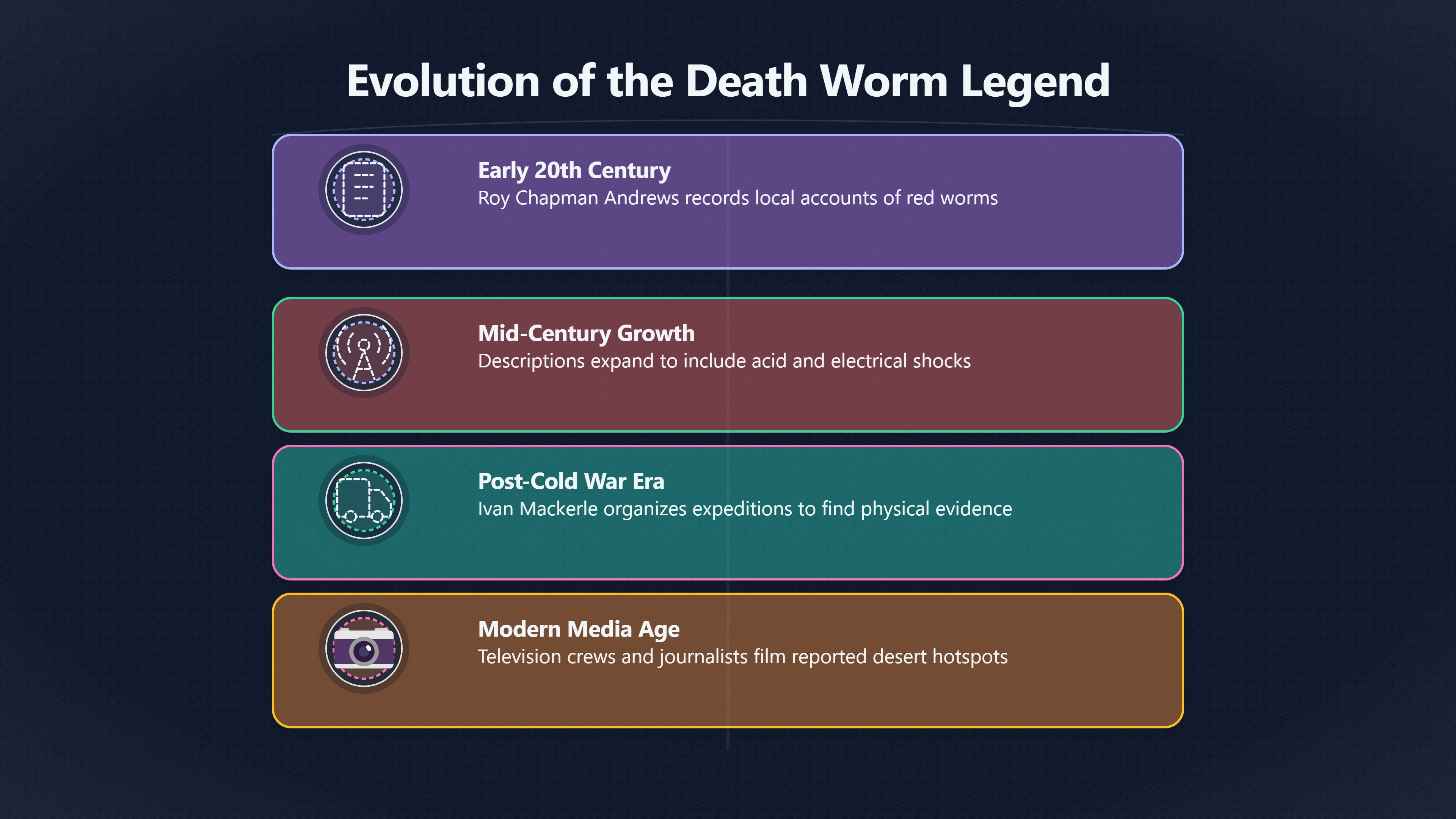
The death worm entered Western literature through the writings of American explorer and palaeontologist Roy Chapman Andrews, who led major expeditions into Mongolia during the 1920s. Andrews reported hearing detailed descriptions from Mongolian officials and noted that belief in the creature was widespread. The animal was described as roughly two feet long, thick-bodied, red in colour, lacking obvious limbs, and extremely dangerous to touch. At the same time, Andrews emphasised that nobody present had personally shown him convincing evidence and that he regarded the creature as probably mythical.[Wikipedia]WikipediaMongolian death wormMongolian death worm
Several elements of these early descriptions are important because they differ from many modern versions of the legend:
- The creature was usually described as sausage-shaped rather than giant.
- Poisonous contact was emphasised more than spectacular attacks.
- The reports came from belief and tradition rather than claimed scientific observation.
- The animal was associated with the most remote sandy parts of the western Gobi.[Wikipedia]WikipediaMongolian death wormMongolian death worm
Over time, additional abilities appeared in popular accounts. Stories began describing the worm as spraying venom, secreting corrosive acid, travelling beneath the sand like a submarine, and killing victims with electrical shocks. These details helped transform a local desert monster into one of cryptozoology’s most dramatic creatures.[Wikipedia]WikipediaMongolian death wormMongolian death worm
Why the legend became linked so strongly with Mongolia
Many monster traditions are attached to forests, lakes, or mountains. The death worm is unusual because it is tied almost entirely to the Gobi Desert. The desert’s vast distances, sparse population, and harsh conditions create an ideal setting for stories about hidden creatures.
The legend also benefited from timing. Andrews’s expeditions made the Gobi internationally famous through discoveries of dinosaur fossils and dinosaur eggs. As news of those scientific finds spread, so did interest in the strange stories he recorded. A landscape capable of hiding prehistoric fossils seemed, to many readers, like a place where an unknown animal might also survive.[Wikipedia]WikipediaRoy Chapman AndrewsRoy Chapman Andrews
The creature’s local name is often translated as “large intestine worm”, a reference to its reported appearance. That vivid image helped distinguish it from ordinary snakes and made the legend memorable to foreign audiences.[Wikipedia]WikipediaMongolian death wormMongolian death worm
Expeditions, sightings and missing evidence
One reason the death worm remains famous is that people repeatedly went looking for it. The most prominent searches were conducted by Czech explorer Ivan Mackerle, who organised expeditions into the Gobi after Mongolia became more accessible to foreign researchers following the end of the Cold War. Mackerle gathered witness stories and attempted to locate the creature in areas where reports clustered.[Wikipedia]WikipediaIvan MackerleIvan Mackerle
His searches became famous for their inventive methods. Inspired partly by the fictional sandworms of Dune, he used mechanical devices designed to send vibrations through the ground in the hope of attracting a hidden burrowing animal. Despite multiple expeditions, no physical evidence emerged.[Wikipedia]WikipediaIvan MackerleIvan Mackerle
Other investigators followed. Journalists, television crews, and cryptozoological organisations mounted searches throughout the 1990s and 2000s. Programmes devoted to unexplained mysteries travelled to the Gobi, interviewed witnesses, and explored reported hotspots. These efforts produced compelling television but not the specimen, photograph, trackway, or biological material needed to demonstrate the existence of an unknown species.[Wikipedia]WikipediaMongolian death wormMongolian death worm
This absence of evidence matters because the claimed abilities of the worm are extraordinary. An animal capable of routinely killing large mammals through venom, acid, or electricity would be expected to leave carcasses, injuries, repeatable encounters, or biological traces. None have been verified.[skeptoid.com]skeptoid.comOlgoi-Khorkhoi: The Mongolian Death Worm8 Jan 2013 — Mongolian tradition holds that a strange and deadly worm lives beneath the sands of…
Why eyewitness testimony remains difficult to assess
Supporters of the legend often point to the consistency of witness descriptions. Reports commonly mention a red, thick-bodied animal, an underground lifestyle, and dangerous properties. Consistency can be meaningful, but it is not necessarily proof of a real species.
Several factors complicate the evidence:
- Most reports are second-hand rather than direct observations.
- Many sightings were recorded years after the alleged encounter.
- Witnesses often knew the existing legend before reporting what they saw.
- Descriptions vary significantly when details such as size, behaviour, and abilities are compared.[Wikipedia]WikipediaMongolian death wormMongolian death worm
This pattern is common in folklore. Once a well-known story exists, genuine observations of unfamiliar animals can become interpreted through the lens of that story. A brief glimpse of a snake or burrowing reptile may later be remembered as an encounter with the famous death worm.
Snakes, sand boas and other explanations
The most widely discussed explanation is misidentification of known desert reptiles. The leading candidate is the Tartar sand boa, a thick-bodied snake found in parts of Central Asia. Its blunt head, cylindrical shape, and tendency to burrow can make it appear surprisingly worm-like, especially when only part of the body is visible.[Wikipedia]WikipediaMongolian death wormMongolian death worm
A frequently cited detail comes from an investigation in which a specimen of a Tartar sand boa was shown to people who claimed familiarity with the death worm. Some reportedly identified it as the same creature. While not definitive, this suggests that at least some sightings may involve known snakes rather than an undiscovered monster.[Wikipedia]WikipediaMongolian death wormMongolian death worm
Other proposed explanations include:
- Worm lizards (amphisbaenians): limbless burrowing reptiles whose appearance can seem highly unusual to observers.[Wikipedia]WikipediaMongolian death wormMongolian death worm
- Exaggerated snake encounters: ordinary snakes becoming more dangerous in retelling.[skeptoid.com]skeptoid.comOlgoi-Khorkhoi: The Mongolian Death Worm8 Jan 2013 — Mongolian tradition holds that a strange and deadly worm lives beneath the sands of…
- Folklore built around real animals: traditional stories preserving memories of unusual desert wildlife while adding supernatural traits.[skeptoid.com]skeptoid.comOlgoi-Khorkhoi: The Mongolian Death Worm8 Jan 2013 — Mongolian tradition holds that a strange and deadly worm lives beneath the sands of…
The more dramatic claims present greater problems. No known worm, snake, or reptile can generate lethal electrical discharges comparable to electric fish, and there is no evidence that any large Gobi animal possesses such an ability. Similarly, stories of instant death from contact or long-range venom spraying lack documented cases.[skeptoid.com]skeptoid.comOlgoi-Khorkhoi: The Mongolian Death Worm8 Jan 2013 — Mongolian tradition holds that a strange and deadly worm lives beneath the sands of…
Could the Mongolian Death Worm be real?
If the question is whether a giant, electrically charged desert worm matching the most sensational versions of the legend exists, the available evidence points strongly toward no. Decades of searches have failed to produce the kind of physical proof expected for a large vertebrate living in a region visited by scientists, herders, and travellers.[Wikipedia]WikipediaMongolian death wormMongolian death worm
A more interesting question is whether the legend contains a kernel of reality. It is entirely possible that unusual encounters with sand boas, burrowing reptiles, or other desert animals contributed to the original stories. Over generations, those encounters may have been combined with local folklore and amplified by modern media until a dangerous but ordinary animal became a near-supernatural monster.[Wikipedia]WikipediaMongolian death wormMongolian death worm
That combination of genuine landscape, repeated testimony, and missing evidence explains why the Mongolian death worm remains one of the world’s most enduring cryptid legends. The mystery survives not because the proof is strong, but because the gap between the story and the evidence is so striking.[Wikipedia]WikipediaMongolian death wormMongolian death worm
Amazon book picks
Further Reading
Books and field guides related to Could the Mongolian Death Worm Be Real?. Use these as the next step if you want deeper reading beyond the article.
Roy Chapman Andrews, Dragon Hunter ... With 31 Illustrations
Andrews helped introduce the death worm story to Western readers.
eBay marketplace picks
Marketplace Samples
Live-tested eBay searches with available results related to this page.




Endnotes
1.
Source: Wikipedia
Title: Mongolian death worm
Link:https://en.wikipedia.org/wiki/Mongolian_death_worm
2.
Source: skeptoid.com
Link:https://skeptoid.com/episodes/344
Source snippet
Olgoi-Khorkhoi: The Mongolian Death Worm8 Jan 2013 — Mongolian tradition holds that a strange and deadly worm lives beneath the sands of...
3.
Source: Wikipedia
Title: Roy Chapman Andrews
Link:https://en.wikipedia.org/wiki/Roy_Chapman_Andrews
4.
Source: Wikipedia
Title: Ivan Mackerle
Link:https://en.wikipedia.org/wiki/Ivan_Mackerle
5.
Source: Wikipedia
Link:https://en.wikipedia.org/wiki/Mongolia
6.
Source: Wikipedia
Title: Mongolian language
Link:https://en.wikipedia.org/wiki/Mongolian_language
7.
Source: youtube.com
Title: The Mongolian Death Worm
Link:https://www.youtube.com/watch?v=MsNHmf5jksA
Source snippet
Mongolian Death Worm - This is Why You Never Want to Come Across It...
8.
Source: youtube.com
Title: Mongolian Death Worm
Link:https://www.youtube.com/watch?v=JtX_NgnA1SQ
Source snippet
The Mongolian Death Worm Explained...
9.
Source: critter.science
Title: the mongolian death worm
Link:https://critter.science/the-mongolian-death-worm/
Source snippet
31 Oct 2022 — 4.) In the book The New Conquest of Central Asia, Andrews again mentions the death worm, yet doesn't seem to believe its ex...
10.
Source: dictionary.cambridge.org
Link:https://dictionary.cambridge.org/vi/dictionary/english/mongolian
11.
Source: paranormalarabia.com
Title: the mongolian death worm
Link:https://www.paranormalarabia.com/en/investigations/2025/10/the-mongolian-death-worm
12.
Source: celcar.indiana.edu
Link:https://celcar.indiana.edu/materials/language-portal/mongolian.html
13.
Source: cryptidz.fandom.com
Title: Mongolian Death Worm
Link:https://cryptidz.fandom.com/wiki/Mongolian_Death_Worm
14.
Source: scribd.com
Title: Mongolian death worm
Link:https://www.scribd.com/document/688124674/Mongolian-death-worm
15.
Source: mythoi.substack.com
Title: the death worm
Link:https://mythoi.substack.com/p/the-death-worm
16.
Source: a-z-animals.com
Title: the mongolian death worm
Link:https://a-z-animals.com/articles/the-mongolian-death-worm/
17.
Source: merriam-webster.com
Link:https://www.merriam-webster.com/dictionary/Mongolian
Additional References
18.
Source: reddit.com
Link:https://www.reddit.com/r/UnresolvedMysteries/comments/5nr4h1/cryptid_corner_the_mongolian_death_worm/
Source snippet
Cryptid Corner: The Mongolian Death Worm"It is shaped like a sausage about two feet long, has no head nor leg and it is so poisonou...
19.
Source: discoveryuk.com
Title: It’s postulated that the death
Link:https://www.discoveryuk.com/mysteries/desert-legend-the-truth-behind-the-mongolian-death-worm/
Source snippet
Discovery UKDesert Legend: The Truth Behind the Mongolian Death Worm3 Feb 2025 — Several theories suggest the Mongolian worm might actual...
20.
Source: facebook.com
Link:https://www.facebook.com/theanimalrescuesite/posts/for-decades-cryptozoologists-have-searched-for-the-mongolian-death-worm-a-five-f/1585605786257770/
21.
Source: instagram.com
Link:https://www.instagram.com/reel/DDkRpfgPSag/?hl=en
22.
Source: reddit.com
Link:https://www.reddit.com/r/Cryptozoology/comments/1bdselx/the_mongolian_death_worm_the_elusive_worm_of_the/
23.
Source: facebook.com
Link:https://www.facebook.com/100084193171166/posts/under-the-sands-of-asias-gobi-desert-the-mongolian-death-worm-waits-for-its-favo/689314990551601/
24.
Source: youtube.com
Title: How Mongolian Death Worm Could Have Evolved
Link:https://www.youtube.com/watch?v=xp9SDxVbnFQ
Source snippet
Mongolian Death Worm: The Lethal Desert Monster of the Gobi...
25.
Source: youtube.com
Link:https://www.youtube.com/watch?v=vx_xR1xoDrY
26.
Source: youtube.com
Link:https://www.youtube.com/watch?v=K8SkziGtQ6Q
27.
Source: youtube.com
Title: The Mongolian Death Worm Explained
Link:https://www.youtube.com/watch?v=UXe9Halfvo4
Source snippet
How Mongolian Death Worm Could Have Evolved...
Topic Tree