Where Czech Monsters Become Local Legends
The Czech Republic does not have a Loch Ness-style national monster with a long chain of alleged modern sightings. Its creature tradition is more interesting in another way: it is a country where old water spirits, dragon legends, mountain guardians, Jewish clay-men, wartime urban phantoms and occasional mystery-animal scares sit side by side.
Page outline Jump by section
Introduction
The clearest pattern is local rather than national. Brno has a “dragon” that is visibly a crocodile; Trutnov turns its dragon into civic ritual; ponds and rivers belong to the water goblin; Prague has the Golem and the springing figure Pérák; mountain regions have Krakonoš and real large carnivores such as lynx and wolves returning to landscapes where they had been exterminated or reduced. These stories matter because Czech monster lore is often less about a hidden beast and more about the point where folklore, urban rumour, tourism and plausible wildlife meet.[gotobrno.cz]gotobrno.czGo To Brno The Brno dragon, wheel, and pinnacleGo To Brno The Brno dragon, wheel, and pinnacle
What counts as a Czech cryptid?
A useful Czech cryptid guide has to be broad, but careful. Some creatures are folklore beings, such as the water goblin and Krakonoš. Some are legendary monsters attached to places, such as the dragons of Brno and Trutnov. Some are urban legends, especially Pérák, the Spring Man of Prague. A few are mystery-animal claims, such as the reported big cat near Jablonec nad Nisou in 2019. Only the last category resembles cryptozoology in the strict “unknown animal” sense.
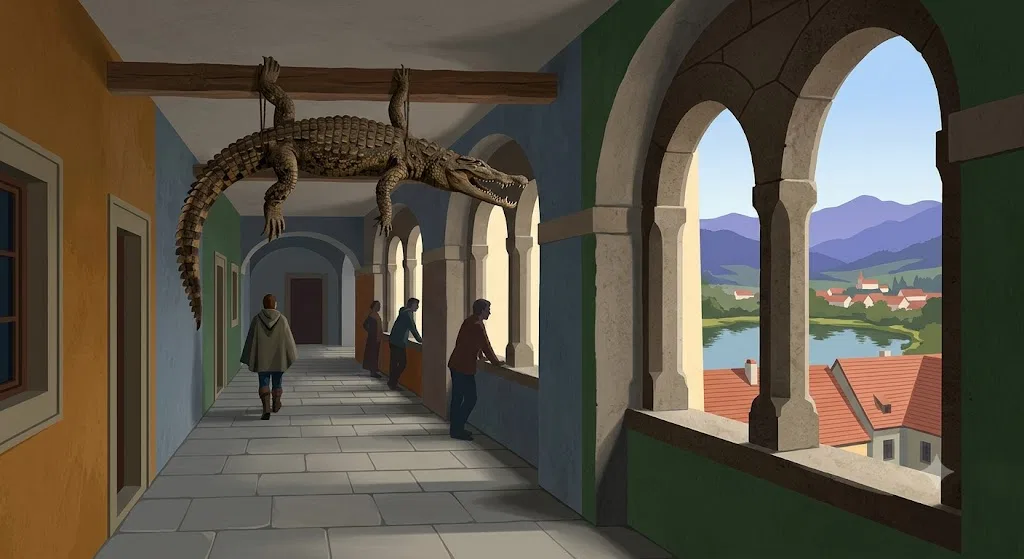
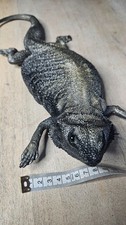
That distinction keeps the page honest. The Brno dragon is not evidence for a surviving dragon species; the official Brno tourism account identifies the object in the Old Town Hall passage as a female Nile crocodile, about five metres long and nearly 200 kilograms, with real skin reinforced by a metal structure and plaster cast. The story is still a monster tradition because generations of people treated an exotic animal body as a dragon, displayed it publicly, and built local identity around it.[Go To Brno]gotobrno.czGo To Brno The Brno dragon, wheel, and pinnacleGo To Brno The Brno dragon, wheel, and pinnacle
The same caution applies to Pérák. He is often described like a humanoid cryptid: a dark figure who leaps impossibly through Prague, sometimes with springs on his shoes, sometimes linked with blade-finger rumours. But the best reading is as a wartime urban legend and later pop-culture hero. Charles University’s publication record for folklorist Petr Janeček describes Spring Man as a Second World War Czech phantom, a nocturnal figure jumping across rooftops with steel springs, while Janeček’s wider work treats him as a belief legend moving between folklore and popular culture.[Explorer]explorer.cuni.czOpen source on cuni.cz.
Dragons with bodies, towers and town pride
Brno’s crocodile-dragon
Brno has one of the most tangible monster legends in Central Europe: a dragon you can actually go and see. It hangs in the passage of the Old Town Hall, although the “dragon” is a preserved Nile crocodile rather than a mythical reptile. The official city tourism site says the most frequently told origin story has Margrave Matthias, later Holy Roman Emperor, receiving a living specimen from the Turks and donating its corpse to Brno in 1608 after it died while passing through the city.[Go To Brno]gotobrno.czGo To Brno The Brno dragon, wheel, and pinnacleGo To Brno The Brno dragon, wheel, and pinnacle
That is exactly the kind of case where folklore and zoology overlap. A crocodile arriving in early modern Moravia would have seemed monstrous because it was out of place. It had scales, teeth, a long body and an alien shape, and it appeared in a society where few ordinary people would have seen a tropical reptile. The mistake, if it was a mistake, is understandable. The later legend did the rest: a rare animal became a civic beast.
For sceptical readers, the Brno dragon is not a mystery animal. The explanation is sitting in plain sight. But it is still a classic “monster report” mechanism: an unfamiliar real animal is reclassified through local imagination. That same process appears in many cryptid traditions worldwide, from misidentified marine animals to escaped exotic pets.
Trutnov’s dragon as a living civic ritual
Trutnov, in the foothills of the Giant Mountains, has a different kind of dragon tradition. The town’s tourist information centre says the dragon appears across Trutnov because a legend about the city’s beginnings and a dragon-slaying episode was already recorded in Simon Hüttel’s 16th-century chronicle; the dragon is also a main figure in the town emblem.[Trutnov]ictrutnov.czOpen source on ictrutnov.cz.
Unlike Brno’s crocodile, Trutnov’s dragon is not presented as a preserved animal body. It is a civic legend maintained through ritual. During the May festivities known as “They are carrying it already!”, a tin dragon is raised onto the tower of the Old City Hall in Krakonošovo Square; in September it is taken down during the “Removal of the Dragon” festivities.[mstary.trutnov.cz]mstary.trutnov.czOpen source on trutnov.cz.
That makes Trutnov useful for understanding Czech monster culture. The “evidence” is not tracks, bones or a captured creature. It is repetition: chronicle, emblem, festival, tower, public square. The dragon survives because the town keeps staging it.
The water goblin: Czech monster lore at pond level
The water goblin is one of the most important Czech creature traditions because it belongs to ordinary landscapes. Rivers, ponds, bridges, mills and laundry places are all natural settings for a being said to lure, drown or trap people. Dvořák’s official work page for The Water Goblin summarises the famous plot from Karel Jaromír Erben’s ballad: a girl approaches the lake despite her mother’s warning, the water rises, and the goblin pulls her below the surface.[https://www.antonin-dvorak.cz]antonin-dvorak.czOpen source on antonin-dvorak.cz.
This is not a lake-monster tradition in the modern cryptozoological sense. The water goblin is not usually a giant animal glimpsed from a boat. He is a moral, domestic and environmental figure: a person-like spirit of dangerous water. The story warns about drowning, disobedience, unsafe edges and the eerie pull of ponds and rivers. It also gives water a personality, which is exactly what many old monster traditions do when a place is beautiful but dangerous.
Dvořák’s musical afterlife matters because it helped carry this creature beyond local storytelling. His Czech-language work page notes that in 1896 he chose several ballads from Erben’s Kytice for symphonic poems, including The Water Goblin, The Noon Witch, The Golden Spinning Wheel and The Wild Dove. In other words, Czech monster folklore did not simply remain village belief; it entered national literature and classical music.[https://www.antonin-dvorak.cz]antonin-dvorak.czOpen source on antonin-dvorak.cz.
The water goblin also shows why “cryptid” can be a slightly awkward label here. Nobody needs to prove an unknown amphibious humanoid lives under Czech ponds for the tradition to be important. Its real evidence is cultural: recurring stories, literary treatment, music, and the way the figure explains danger in familiar places.
Prague’s monsters: clay, springs and wartime shadows
Prague’s creature lore is urban rather than wild. Its best-known monsters are not forest beasts or lake animals but figures shaped by streets, ghettos, rooftops, occupation and memory.
The Golem of Prague is the most famous. The Jewish Museum Berlin summarises the best-known version: Rabbi Loew brings a clay figure to life by placing a magic word in its mouth, and the Golem protects the Jewish ghetto. The museum’s framing also shows why the Golem travelled so well into modern culture: it is a monster, protector, servant and warning story all at once.[Jüdisches Museum Berlin]jmberlin.deOpen source on jmberlin.de.
Historically, however, the Prague Golem is not a straightforward medieval eyewitness tradition. The strongest scholarly caution is that the familiar Rabbi Loew version developed through later literary retellings rather than secure 16th-century evidence. That does not make the Golem unimportant; it makes it a powerful example of how a city can adopt a literary monster so completely that it becomes part of its global identity.[en.wikipedia.org]WikipediaOpen source on wikipedia.org.
Pérák, by contrast, belongs to the modern city. He is the jumping phantom of wartime Prague: part rumour, part resistance fantasy, part fright story. Research summaries describe him as a Czech version of the wider Spring-heeled Jack-type legend, adapted to local conditions during the Second World War and later reinvented in comics, animation, theatre and games.[ResearchGate]researchgate.netOpen source on researchgate.net.
The key difference is that Pérák feels like a sighting flap even when treated sceptically. His story depends on alleys, curfews, fear, whispers and exaggerated physical ability. The claim is not “there is an unknown species in Prague” but “something impossible is moving through the occupied city”. That makes him one of the Czech Republic’s strongest links between folklore and modern urban legend.
Mountain beings and real predators in the Czech wild
The Giant Mountains bring a different texture to Czech monster tradition. Krakonoš is described by Trutnov’s tourist information as the ruler, protector or mythical spirit of the Krkonoše mountains, a guardian who protects the region from poachers, treasure hunters and others who might harm it. The same source notes that the name Krakonoš was given in 1824 by V. K. Klicpera in a ballad.[Trutnov]ictrutnov.czOpen source on ictrutnov.cz.
Krakonoš is not a cryptid in the animal sense. He is closer to a mountain spirit, a guardian of landscape and morality. But he belongs in a country-level creature guide because he anchors a major Czech mountain region in personal form. If the water goblin is the danger of ponds, Krakonoš is the judgement of the mountains.
Modern wildlife makes these mountain stories more complicated. The Czech Republic now has real large carnivores again, and that can change how people interpret fleeting sightings, tracks and night-time movement. Conservation sources describe wolf, lynx and brown bear as native mammals that historically occurred across Czech territory before persecution and landscape change reduced or eliminated them from many areas.[zachranneprogramy.cz]zachranneprogramy.czOpen source on zachranneprogramy.cz.
The Eurasian lynx is especially relevant to mystery-beast interpretation. Carnivores.cz describes it as the most numerous Czech large carnivore, with roughly 50–70 animals in the Bohemian Forest after reintroduction in the 1980s and another 10–15 permanently inhabiting the Beskydy and Javorníky Mountains near the Slovak border. The same site notes that lynx occur only sporadically in other suitable mountain areas.[Carnivores]carnivores.czEurasian lynxEurasian lynx
This matters because a genuine lynx seen briefly can become a “big cat” story, especially in poor light or when the witness is not expecting one. At the same time, lynx do not explain everything: they are not black panthers, and their known range and markings matter. A good Czech cryptid reading treats returning wildlife as part of the explanation, not as a lazy answer to every strange report.

The North Bohemia big cat scare
The most cryptozoological modern Czech case is the 2019 North Bohemia big cat report near Jablonec nad Nisou. Expats.cz, reporting from Czech news agency CTK, said Jablonec Town Hall had issued a permit to catch or kill an unknown big cat after it had reportedly been seen roaming nearby forest for several weeks. The animal was described as an exotic beast of prey, not a known native species.[Expats.cz]expats.czAn unknown big cat is roaming North Bohemia, and CzechAn unknown big cat is roaming North Bohemia, and Czech
This case fits the wider European “phantom cat” pattern: a large feline is reported outside its normal range, sometimes described as a panther, puma or other exotic cat. The usual explanations are escaped private animals, misidentified domestic cats, lynx seen under odd conditions, hoaxes, or simple witness error. In the Czech case, the official response shows that authorities considered the report serious enough to issue a capture-or-kill permit, but the available public evidence does not establish a breeding population of exotic big cats.
It is also important to separate this from the confirmed return of smaller wild cats. In 2021, Mendel University reported that genetic analysis by the Institute of Vertebrate Biology of the Czech Academy of Sciences confirmed a dead animal found near Nový Knín in the Dobříš region was a male wildcat, the first documented presence there in about a hundred years. That is real wildlife recovery, not a phantom panther.[Lesnická a dřevařská fakulta]ldf.mendelu.czOpen source on mendelu.cz.
The best reading of the North Bohemia case is therefore cautious: an intriguing reported animal, a serious local response, but no public proof of a new Czech big-cat population. It is a useful reminder that mystery-beast claims often appear at the edge of known wildlife, exotic ownership and public anxiety.
Why Czech monster stories cluster where they do
Czech creature traditions are strongly tied to place. They are not randomly scattered; they follow the environments and social pressures that make a story memorable.
Water sites produce water beings. Ponds, rivers, bridges and mills are dangerous places, especially in older rural life. The water goblin gives drowning a face and turns ordinary caution into a story people remember.
Old towns produce civic monsters. Brno’s dragon and Trutnov’s dragon survive because they are attached to public buildings, coats of arms, festivals and tourism. A creature that belongs to a square or town hall is easier to preserve than a vague rumour from nowhere.[Go To Brno]gotobrno.czGo To Brno The Brno dragon, wheel, and pinnacleGo To Brno The Brno dragon, wheel, and pinnacle
Prague produces urban phantoms. The Golem and Pérák both belong to a dense city of streets, legends and political memory. One is tied to Jewish Prague and later literary myth; the other to occupation-era rumour and resistance imagination.[Jüdisches Museum Berlin]jmberlin.deOpen source on jmberlin.de.
Border mountains produce guardians and predator stories. The Krkonoše and Beskydy regions sit in a broader Central European landscape where folklore, tourism and wildlife recovery overlap. A mountain spirit such as Krakonoš and real animals such as lynx and wolves both express the same basic fact: Czech wild places are culturally alive.[Trutnov]ictrutnov.czOpen source on ictrutnov.cz.
The evidential limits around Czech Republic’s cryptid traditions
The evidence for Czech cryptids is strongest when read as folklore and cultural history, not zoological proof. There is good evidence that these traditions exist, are place-specific, and have changed over time. There is much weaker evidence for unknown animals.
The best-supported cases are tangible or well documented: Brno’s crocodile-dragon exists as a displayed specimen; Trutnov’s dragon is embedded in town ritual and tourism; Dvořák’s The Water Goblin preserves a major Czech water-being tradition in music; Pérák has been studied as a Czech belief legend and pop-culture figure; large carnivore recovery is tracked by conservation organisations and camera-trap monitoring.[gotobrno.cz]gotobrno.czGo To Brno The Brno dragon, wheel, and pinnacleGo To Brno The Brno dragon, wheel, and pinnacle
The weakest claims are those that require an unverified animal to be present now. The 2019 North Bohemia big cat scare is interesting because it involved local authorities, but a permit and sightings are not the same as a body, DNA, confirmed camera-trap images or a stable population. The more evidence-based comparison is with known Czech wildlife: lynx, wildcats, wolves and occasional bears are real, protected or monitored animals whose presence can shape public perception of “mystery beasts”.[expats.cz]expats.czAn unknown big cat is roaming North Bohemia, and CzechAn unknown big cat is roaming North Bohemia, and Czech
That does not make the stories dull. It makes them more revealing. Czech monster lore shows how a crocodile becomes a dragon, how a pond becomes a goblin’s kingdom, how a wartime rumour becomes a superhero, and how the return of real predators can make old forests feel mysterious again.
Czech Republic cryptids in one view
Creature or claimMain locationBest classificationWhat is actually supportedBrno DragonBrno Old Town HallMisidentified exotic animal turned civic monsterThe displayed “dragon” is a preserved Nile crocodile.[Go To Brno]gotobrno.czGo To Brno The Brno dragon, wheel, and pinnacleGo To Brno The Brno dragon, wheel, and pinnacle DragonTrutnov, Giant Mountains foothillsCivic dragon legendThe dragon is tied to a 16th-century chronicle tradition, town emblem and annual festivities.[Trutnov]ictrutnov.czOpen source on ictrutnov.cz. goblinCzech ponds, rivers and lakesFolklore water spiritA major Czech literary and musical monster tradition, especially through Erben and Dvořák.[https://www.antonin-dvorak.cz]antonin-dvorak.czOpen source on antonin-dvorak.cz. Golem of PraguePragueJewish legend and literary monsterA globally famous Prague protector figure, but the familiar Rabbi Loew version is best treated as later literary tradition rather than proven early history.[Jüdisches Museum Berlin]jmberlin.deOpen source on jmberlin.de. urban legendA Second World War jumping phantom later reshaped into Czech pop-culture hero.[Explorer]explorer.cuni.czOpen source on cuni.cz. mountainsMountain spiritA regional guardian figure associated with protecting the mountains.[Trutnov]ictrutnov.czOpen source on ictrutnov.cz. Bohemia big catJablonec nad Nisou areaModern mystery-animal reportReported sightings prompted an official capture-or-kill permit, but public evidence does not prove an exotic big-cat population.[Expats.cz]expats.czAn unknown big cat is roaming North Bohemia, and CzechAn unknown big cat is roaming North Bohemia, and Czech
The takeaway
The Czech Republic’s monster tradition is not dominated by one famous hidden animal. It is a mosaic of local beings: crocodile-dragons in town halls, a dragon hoisted over Trutnov, water goblins at ponds, a clay protector in Prague, a springing wartime phantom on rooftops, a mountain guardian in the Krkonoše, and occasional modern rumours of out-of-place cats.
The most reliable conclusion is that Czech cryptid history is strongest as place-based folklore plus occasional mystery-animal reporting. Its creatures are memorable because they attach themselves to real settings: a town-hall passage, a lake edge, a mountain range, a wartime city, a North Bohemian forest. The mystery is usually not whether a monster species is hiding in the Czech Republic, but how ordinary places became strange enough to need monsters.
Amazon book picks
Further Reading
Books and field guides related to Where Czech Monsters Become Local Legends. Use these as the next step if you want deeper reading beyond the article.
The Atlas of Monsters
Surveys monster traditions from around the world, fitting a national folklore overview.
The Golem and the Jinni
Connects directly to the Prague Golem tradition mentioned in Czech monster lore.
The Book of Imaginary Beings
Provides broad context for monster and folklore traditions like those discussed across Czech legends.
The Element Encyclopedia of Magical Creatures
Useful for readers exploring water spirits, guardians, monsters and legendary beings.
eBay marketplace picks
Marketplace Samples
Live-tested eBay searches with available results related to this page.
Endnotes
1.
Source: ictrutnov.cz
Link:https://www.ictrutnov.cz/en/dragon
2.
Source: antonin-dvorak.cz
Link:https://www.antonin-dvorak.cz/en/work/tha-water-goblin/
3.
Source: carnivores.cz
Link:https://www.carnivores.cz/conservation-of-large-carnivores/
4.
Source: researchgate.net
Link:https://www.researchgate.net/publication/347553642_The_Spring_Man_of_Prague_Czech_Versions_of_Spring-heeled_Jack_Narratives_between_Folklore_and_Popular_Culture
5.
Source: mstary.trutnov.cz
Link:https://mstary.trutnov.cz/tourist-info/the-legend-of-the-dragon-of-trutnov?lang=2
6.
Source: antonin-dvorak.cz
Link:https://www.antonin-dvorak.cz/dilo/vodnik/
7.
Source: Wikipedia
Link:https://en.wikipedia.org/wiki/Golem
8.
Source: Wikipedia
Title: Pérák, the Spring Man of Prague
Link:https://en.wikipedia.org/wiki/P%C3%A9r%C3%A1k%2C_the_Spring_Man_of_Prague
9.
Source: zachranneprogramy.cz
Link:https://www.zachranneprogramy.cz/en/wolf/
10.
Source: carnivores.cz
Title: Eurasian lynx
Link:https://www.carnivores.cz/lynx/
11.
Source: expats.cz
Title: An unknown big cat is roaming North Bohemia, and Czech
Link:https://www.expats.cz/czech-news/article/an-unknown-big-cat-is-roaming-north-bohemia-and-czech-authorities-want-it-captured
12.
Source: programme2014-20.interreg-central.eu
Link:https://programme2014-20.interreg-central.eu/Content.Node/Lynx-Monitoring-Report-%28BBA%29-LY18.pdf
13.
Source: Wikipedia
Title: Phantom cat
Link:https://en.wikipedia.org/wiki/Phantom_cat
14.
Source: Wikipedia
Link:https://en.wikipedia.org/wiki/Vodyanoy
15.
Source: Wikipedia
Title: List of cryptids
Link:https://en.wikipedia.org/wiki/List_of_cryptids
16.
Source: Wikipedia
Title: The Water Goblin
Link:https://en.wikipedia.org/wiki/The_Water_Goblin
17.
Source: Wikipedia
Link:https://en.wikipedia.org/wiki/Ultras
18.
Source: Wikipedia
Link:https://en.wikipedia.org/wiki/R%C3%BCbezahl
19.
Source: carnivores.cz
Link:https://www.carnivores.cz/threats-for-large-carnivores/
20.
Source: antonin-dvorak.cz
Link:https://www.antonin-dvorak.cz/en/work/tha-water-goblin-recordings/
21.
Source: prague.eu
Title: golem of prague
Link:https://prague.eu/en/golem-of-prague/
22.
Source: researchgate.net
Link:https://www.researchgate.net/profile/Imron_Harits/publication/310463694_The_5_th_ELTLT_CONFERENCE_PROCEEDINGS_THE_LEGEND_OF_VODNIK_WATER_GOBLIN_SLAVIC_TRADITION_AND_CULTURAL_ADAPTATION/links/582ec29c08ae004f74be1b93.pdf
23.
Source: researchgate.net
Link:https://www.researchgate.net/publication/226595325_Distribution_and_status_of_lynx_in_the_border_region_between_Czech_Republic_Germany_and_Austria
24.
Source: researchgate.net
Link:https://www.researchgate.net/publication/391086922_The_Spirit_of_the_Mountains_A_Geomythological_Perspective_on_the_Cultural_Evolution_of_Krakonos_Rubezahl
25.
Source: prague.fm
Link:https://www.prague.fm/298423/join-the-adventure-mark-international-lynx-day-by-exploring-the-habitats-of-this-majestic-big-cat/
26.
Source: wolf.org
Link:https://wolf.org/wow/europe/czech-republic/
27.
Source: carnivores.eu
Title: About project
Link:https://carnivores.eu/about-project
28.
Source: youtube.com
Title: The Underground Secrets of Brno That Tourists Never See
Link:https://www.youtube.com/watch?v=5eJb9bmPTTE
Source snippet
The Golem of Prague...
29.
Source: youtube.com
Title: The Golem of Prague
Link:https://www.youtube.com/watch?v=-Nq5fCnm3Yc
Source snippet
The Golem: Protector or Frankenstein's Cousin?...
30.
Source: gotobrno.cz
Title: Go To Brno The Brno dragon, wheel, and pinnacle
Link:https://www.gotobrno.cz/en/place/the-brno-dragon-wheel-and-pinnacle/
31.
Source: explorer.cuni.cz
Link:https://explorer.cuni.cz/publication/619315
32.
Source: jmberlin.de
Link:https://www.jmberlin.de/en/golem-from-mysticism-to-minecraft
33.
Source: ictrutnov.cz
Link:https://www.ictrutnov.cz/en/how-krakonos-appeared-krkonose-mountins-giant-mountains
34.
Source: ldf.mendelu.cz
Link:https://ldf.mendelu.cz/en/scientists-have-confirmed-the-occurrence-of-wild-cats-in-the-dobris-region/
35.
Source: atlasobscura.com
Title: brno dragon
Link:https://www.atlasobscura.com/places/brno-dragon
36.
Source: cryptidz.fandom.com
Link:https://cryptidz.fandom.com/wiki/P%C3%A9r%C3%A1k
37.
Source: monster.fandom.com
Link:https://monster.fandom.com/wiki/Vodnik
38.
Source: superheroes.fandom.com
Link:https://superheroes.fandom.com/wiki/P%C3%A9r%C3%A1k
39.
Source: ictrutnov.cz
Link:https://www.ictrutnov.cz/en/trutnov-dragon-defeat-legend
40.
Source: ictrutnov.cz
Title: 1000 years trutnov dragon brno
Link:https://www.ictrutnov.cz/en/1000-years-trutnov-dragon-brno
41.
Source: krkonose.eu
Title: Mountains | Krkonoše
Link:https://www.krkonose.eu/en
42.
Source: youtube.com
Link:https://www.youtube.com/watch?v=-z_e2idq3XA
43.
Source: from-my-pov.blogspot.com
Title: water goblin
Link:https://from-my-pov.blogspot.com/2012/02/water-goblin.html
44.
Source: jmberlin.de
Link:https://www.jmberlin.de/en/online-catalog-golem-chapter-4
45.
Source: brno.com.ua
Title: Old Town Hall
Link:https://brno.com.ua/old-town-hall/
Additional References
46.
Source: fluentwithellen.eu
Link:https://fluentwithellen.eu/czech-folklore/
47.
Source: pinterest.com
Link:https://www.pinterest.com/pin/a-belief-in-vodnk-the-water-goblin-was-quite-common-in-czech-republic-but-it-is-also-known-in-some-parts-of-germany–22588435625185902/
48.
Source: instagram.com
Link:https://www.instagram.com/reel/DU8sGz5k0ee/
49.
Source: facebook.com
Link:https://www.facebook.com/fieldsportsnews/videos/worcester-panther-shot/1034684002007080/
50.
Source: reddit.com
Link:https://www.reddit.com/r/czech/comments/1kmsfb4/are_there_any_mythical_creatures_or_folk_lore/
51.
Source: avcr.cz
Link:https://www.avcr.cz/en/news-archive/Be-careful-with-releasing-endangered-lynx-warn-Czech-scientists/
52.
Source: visitczechia.com
Link:https://www.visitczechia.com/en-us/things-to-do/places/nature/protected-areas-and-national-parks/a-krkonose-summer
53.
Source: facebook.com
Link:https://www.facebook.com/Antvmnos/posts/bestiary-or-museum-of-cryptozoology-a-great-place-for-anyone-interested-in-mytho/540376844294006/
54.
Source: mapy.com
Link:https://mapy.com/en/?id=1888405&source=base
55.
Source: umweltbundesamt.de
Link:https://www.umweltbundesamt.de/system/files/medien/1411/beratungshilfe/proceedings.pdf
Topic Tree
Follow this branch
Related pages 192
- Antigua Cryptids
- Maldives Monsters
- Malta Monsters
- Qatar Monsters
- Argentina Monsters
- +187 more in sidebar